Cooling Inflation in July Amid Sustained Consumer Spending
[Thursday’s] GDP report already showed that consumer spending was stronger in the second quarter than first reported; [Friday’s] personal income and spending report reveals July data and shows that the third quarter is off to a compelling start.
The report also offers affirmation that inflation is indeed on a cooling path with core PCE inflation at 2.6%. For policymakers at the Federal Reserve, maintaining restrictive policy is becoming difficult to justify with the three-month annualized rate now back below target at 1.7%.
At the start of this month, financial markets were cast into a tailspin when July employment data came in much softer than expected. It is difficult to square that jobs market weakness with not only sustained consumer spending, but income gains that feel more like the sort you would see in a stronger labor market.
Driven by a 0.3% increase in wages and salaries, overall compensation also rose 0.3%. Both measures are up 4.4% over the past 12-months. After accounting for inflation and taxes, real disposable personal income rose 0.1% in July and is up 1.1% over the past year. (…)
In order to sustain the increased outlays, households have pared back saving to 2.9%. That is just the second time in 16 years that the savings rate has had a 2-handle.
The retail sales report for July gave us a bit of a sneak preview of the spending action in today’s broader and more comprehensive personal income and savings report. The big takeaway from both indicators is that auto sales accounted for much of the surge. The 4.1% real increase in spending on autos was far-and-away the biggest gainer. Still, with only gasoline spending down (and only slightly) it is also fair to say that spending gains remained broadly based across other categories. (…)
But the composition of spending is not exactly reflective of the more cautious and choosy consumer so often discussed in corporate earning announcements. Discretionary spending is once-again outpacing non-discretionary outlays. (…)
Spending growth in July combined with upward revisions to second quarter sets us up for some pretty decent growth in Q3 despite not yet having data for two out of three months. Even if consumer spending sputtered out in August and September, Q3 spending is still on track to come in comfortably north of 2%.

The income side remains reasonably solid: nominal spending growth is keeping pace with labor income growth in the 5% range while inflation has steadied around 2.5%.

The rising angst stems from the gap developing between real disposable income and real expenditures, bringing the savings rate down to only 2.9%.

ING:
The obvious answer is that we are running down our savings and using debt. That is not sustainable so are we burning ourselves out? Well, the savings rate has dropped to just 2.9%. The only time we have ever been down here consistently is just ahead of the Great Financial Crisis. That suggests if unemployment does continue to climb there is less buffer to support consumer activity.
Actually, the buffer this time is real household wealth which keeps rising along with homes and equity prices while inflation growth recedes. Real household wealth is up 17% since 2019, well above trend, allowing Americans to spend merrily.
A lot of attention will now focus on employment growth to sustain spending, but the focus should also be on equity prices. Look at how the savings rate rises when household wealth drops below trend.

Ed Yardeni reminds us that “September has a history of being the worst month of the year for the stock market”, the only month with more down months (53) than up months (42) and the only month with a clearly negative average decline (-1.17%) since 1928. But he admits being currently “hard pressed to find what could possibly go wrong in September”.
What could go wrong is a Fed admitting (or, more likely, Mr. Market realizing) that its monetary policy actually did not slow demand as intended and mulling the idea that the recent inflation slowdown might only be transitory ( ), possibly delaying further declines in interest rates beyond September. Why?
- Real personal spending was up 2.0% YoY one year ago and early this year. It was up 2.8% on average in the last 3 months.
- Real expenditures on durable goods, the most interest sensitive category, are up 3.4% YoY in July vs +1.4% in April. They are up 16.9% annualized since April and +10.0% a.r. in the last 2 months. Booming, relentless demand! Remember when Mr. Powell said that goods consumption was about to slow from a lack of storage space?
- Fortunately, durable goods prices deflated at a 4.0% annualized rate since March and are down 2.5% YoY, the average YtD. However, nonfuel import prices (most goods Americans consume are imported), which declined 1.0% a.r. in the second half of 2023 are up 2.7% a.r. in the first 7 months of this year (+1.2% YoY in July). They were down 0.9% at this time one year ago. (See Lucky Fed)
- Meanwhile, real spending on services, the largest consumption category at 65%, keeps charging above 3.0% annualized in the last 6 months, far outpacing disposable income (+1.0%). In the 5 years to 2019, the average annual growth rate was 2.0%.
- So far, however, services prices have slowed to +2.5% a.r. in the last 3 months from 3.7% the previous 3 months. On a YoY basis, the slowdown was only from the 4.0% range to 3.7% in July. In the 5 years to 2019, the average annual growth rate was 1.9%.

BTW:
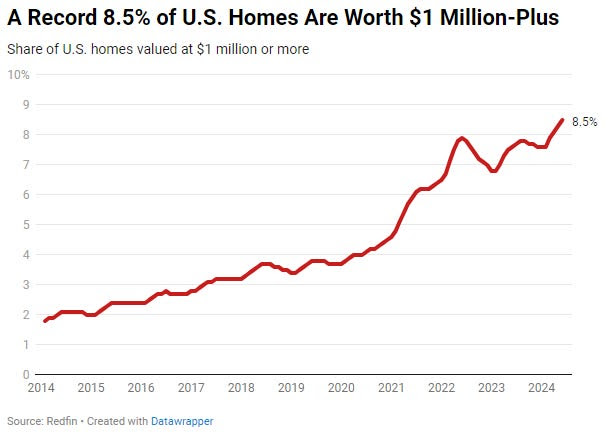
Americans Are Really, Really Bullish on Stocks The surging stock market has minted millionaires and helped send many Americans’ net worths sharply higher. Many are betting that the rally has more room to run.
As of the second quarter, the number of 401(k) retirement accounts at Fidelity Investments worth at least $1 million reached around 497,000, according to the firm. That is up 31% from a year ago and a record high.
U.S. households’ stock allocations have steadily inched up this year, according to JPMorgan estimates, and recently accounted for around 42% of their total financial assets. That is the most on record in data going back to 1952. (…)
“This melt up is exactly what any investor should be waiting for,” said William Bohrod, a 67-year-old dentist in Springfield, N.J. “The most conservative approach is ‘all in, all the time.’”
Bohrod says the big stock gains in recent years have helped him pay for a boat at his vacation house on the Jersey Shore. He is optimistic about the market and doesn’t plan to touch any of his holdings.
Professional investors have also embraced the rally. (…)
“We’re bullish, and to our clients we say now is an opportune time to invest,” said Thorne Perkin, president at Papamarkou Wellner Perkin, a multifamily office.

- “What Me Worry: My “Euphoriameter” indicator (which incorporates investor confidence signals from valuations, surveys, and risk pricing) not only shows no worries from the Aug-bust, but has actually gone on to new all-time highs. And why not? Investors got rewarded for buying the dip and the Fed is keen to keep the party going.” (Callum Thomas)
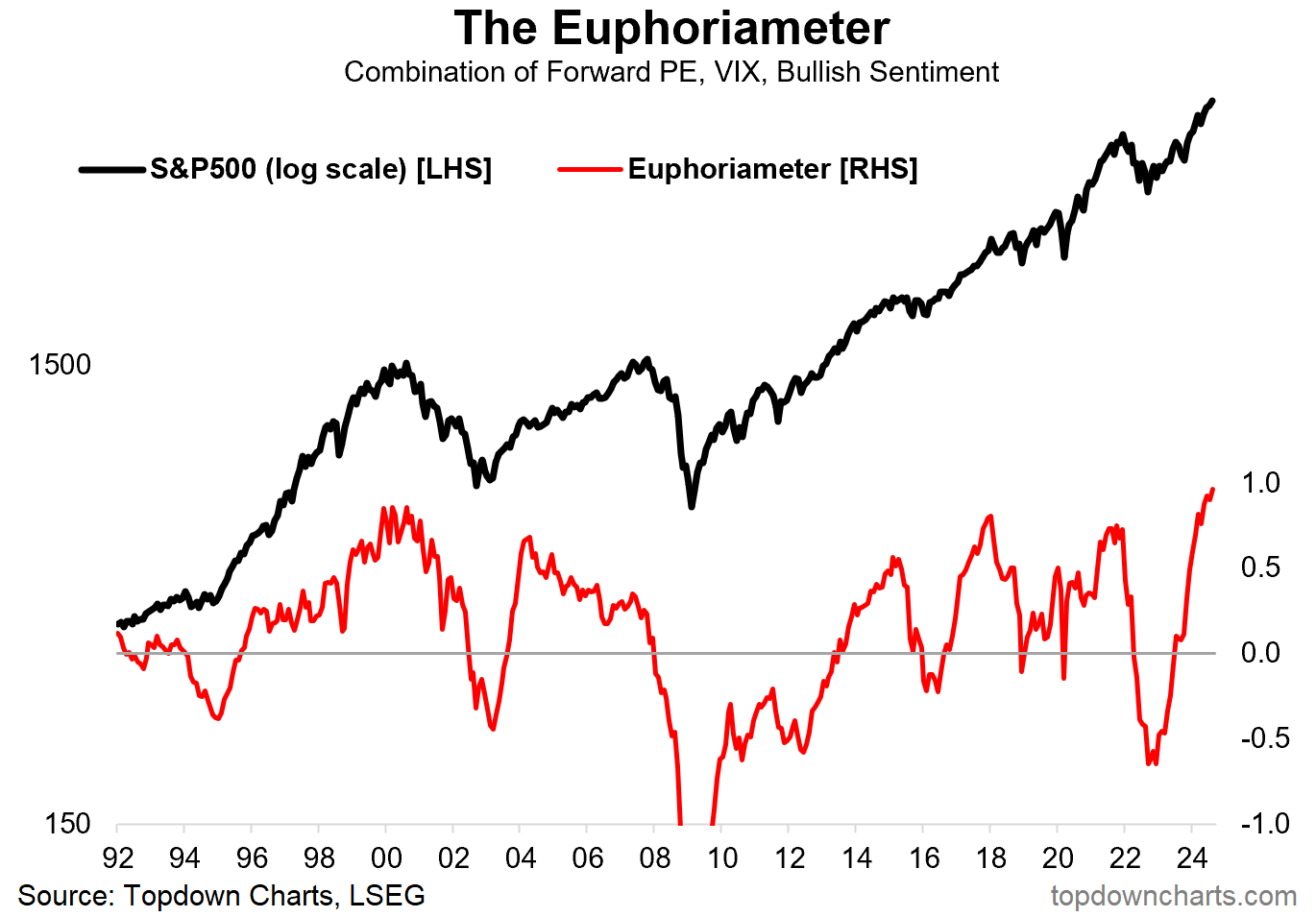
Source: Topdown Charts Professional
-
This has been one of the most anticipated Fed rate cut cycles. (The Daily Shot)
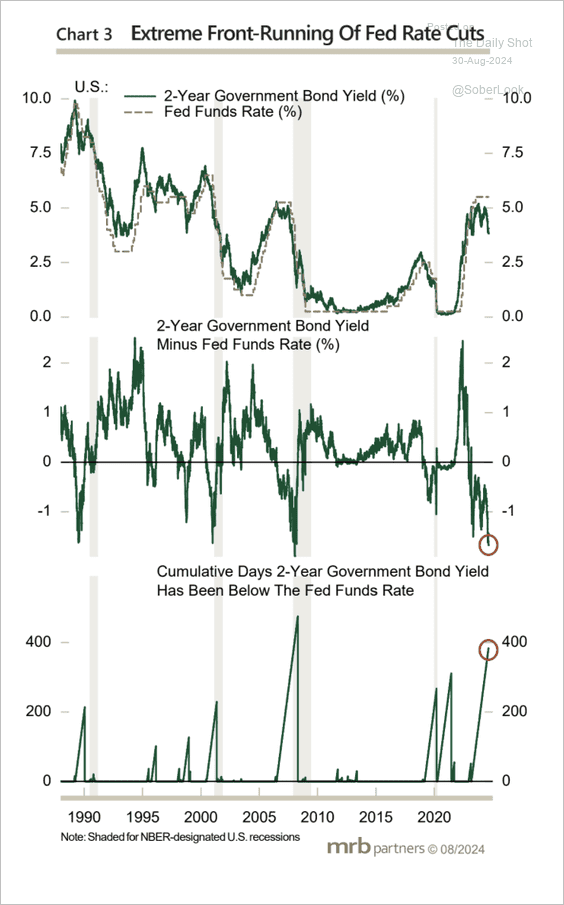
Source: MRB Partners
Threat of Strike This Fall Hangs Over U.S. Ports Officials at the dockworkers’ union will meet next week to discuss walkout plans at ports from Maine to Texas if demands for a 77% wage increase aren’t met
(…) Fears of a strike have prompted importers this year to pull forward orders for goods ahead of the fall retail shopping season, causing an earlier-than-usual flood of cargo, and pushing up shipping rates. “The prospect of an East Coast shutdown comes up in every client meeting,” said Nathan Strang, director of ocean freight at freight forwarder Flexport.
The early surge of cargo is exacerbating strains on ocean shipping networks caused by attacks by Yemen’s Houthi rebels on commercial vessels in the Red Sea. Diversions of containerships away from the Suez Canal that opens into the Red Sea are adding 10 days or more to sailing times from Asia to the U.S. and Europe, eating up cargo capacity as ships take longer routes around the Horn of Africa.
Almost 1.4 million containers, measured in 20-foot equivalent units, were shipped from Asia to North America in June, a record for that month, according to transportation data firm Xeneta. The average short-term contract rate to ship a 40-foot container from Asia to the U.S. East Coast at the end of August was $9,518, the firm said, more than double the cost in April.
Port tensions are mounting at a time when dockworkers from Germany to Australia have slowed and stopped operations in disputes over pay and working conditions. Last year, U.S. West Coast dockworkers sporadically disrupted cargo flows from Washington state to California during tense talks. (…)
MANUFACTURING PMIs
Eurozone: Eurozone manufacturing remains in contraction, weighed down by Germany and France
The HCOB Eurozone Manufacturing PMI, a measure of the overall health of eurozone factories compiled by S&P Global, registered 45.8 in August, as was also the case in both June and July, thereby signalling another solid deterioration in operating conditions across the euro area manufacturing sector. The headline index has registered in sub-50.0 territory on an ongoing basis since July 2022.

Of the nations covered by the PMI surveys, it was the euro area’s big-two economies – Germany and France – that provided the strongest drags on aggregate factory performance in August. In both instances, manufacturing conditions worsened. The only countries that registered growth were Greece, Spain and Ireland, although in the former two, rates of improvement slowed.
Factory performance was dented by a further steep contraction in new orders during August. The decline in total sales was the most pronounced in the year-to-date and broadly in line with that seen on average across the current 28-month period of shrinking demand. Weaker intakes of new export business were also recorded, with the rate of decline its steepest for eight months.
A sharper downturn in sales placed a greater onus on eurozone manufacturers’ backlogs as a means to support production. Indeed, outstanding business volumes fell at the fastest rate since February. The decline in output slowed slightly and was markedly softer than that for new orders.
Nevertheless, retrenchment and cost-cutting efforts were seen across the survey data in August. Purchasing quantities decreased at a pace that was not only substantial, but also the strongest since April. For a nineteenth month in a row, the volume of inputs held as stock contracted, while inventories of finished products likewise fell. Rates of decrease did slow in both cases, however.
Meanwhile, factory employment levels within the eurozone were reduced further midway through the third quarter, extending the current run of job cutting to 15 months. Lower staffing numbers coincided with another month in which business confidence weakened. Overall expectations for output growth in the year ahead were at their weakest since March and below the series long-run average.
For a third consecutive month, eurozone manufacturers reported an increase in their overall input costs. The rate of inflation slowed fractionally but held close to July’s 18-month high. Despite sharp and sustained contractions in new orders, eurozone goods producers lifted their prices charged for the first time since April 2023. The extent of the increase in selling prices was only modest, however.

China: Manufacturing sector conditions improve as new orders return to growth
The headline seasonally adjusted Purchasing Managers’ Index™ (PMI®) rose to 50.4 in August, up from 49.8 in July. Rising past the 50.0 neutral mark, the latest data signalled that conditions in the manufacturing sector improved following the brief deterioration in July. The rate of improvement was only marginal, however.

Manufacturing production expanded for a tenth successive month in August, led by firms in the consumer and intermediate goods sectors. Although modest, the rate of growth accelerated from July’s low as incoming new orders returned to expansion. Survey respondents revealed that better underlying demand conditions and promotional efforts underpinned the latest rise in new orders.
Export orders were subdued, however, falling marginally for the first time in the year-to-date amid reports of deteriorating external conditions. (…)
Some relief on price pressures was observed with average input costs falling fractionally for the first time in five months. Survey respondents often linked the decline to the lowering of raw material prices. In turn, Chinese manufacturers reduced their selling prices, with some firms indicating offering discounts to remain competitive. (…)


Japan: Manufacturing sector moves closer to stabilisation in August
The headline au Jibun Bank Japan Manufacturing Purchasing Managers’ Index™ (PMI) recorded 49.8 in August, up from 49.1 in July and indicative of a fractional contraction in the health of the Japanese manufacturing sector.
Latest data showed a renewed increase in output in August that was the second in the past three months. The rate of growth was modest, yet reached the highest since May 2022. Firms also signalled a softer preference for the use of existing inventories, with the rate of accumulation stagnating on the month. There were also reports of improving new order volumes, which declined again in August albeit at a softer rate than that seen in July. New export volumes meanwhile declined at a solid rate that was the most marked since March amid evidence of low demand from key export markets including Mainland China and South Korea.
(…) prices data showed that showed input price inflation picked up in August. Input prices rose to the steepest degree since April 2023. The weak yen and higher raw material prices were cited as key sources of inflation. Firms responded by raising their own charges, though at the softest rate since June 2021. (…)

Bank of Canada poised to cut rates again in widely anticipated move Economists and investors are nearly unanimous in predicting the central bank will lower its benchmark interest rate to 4.25 per cent
ABOUT SEASONALITY
From Callum Thomas:
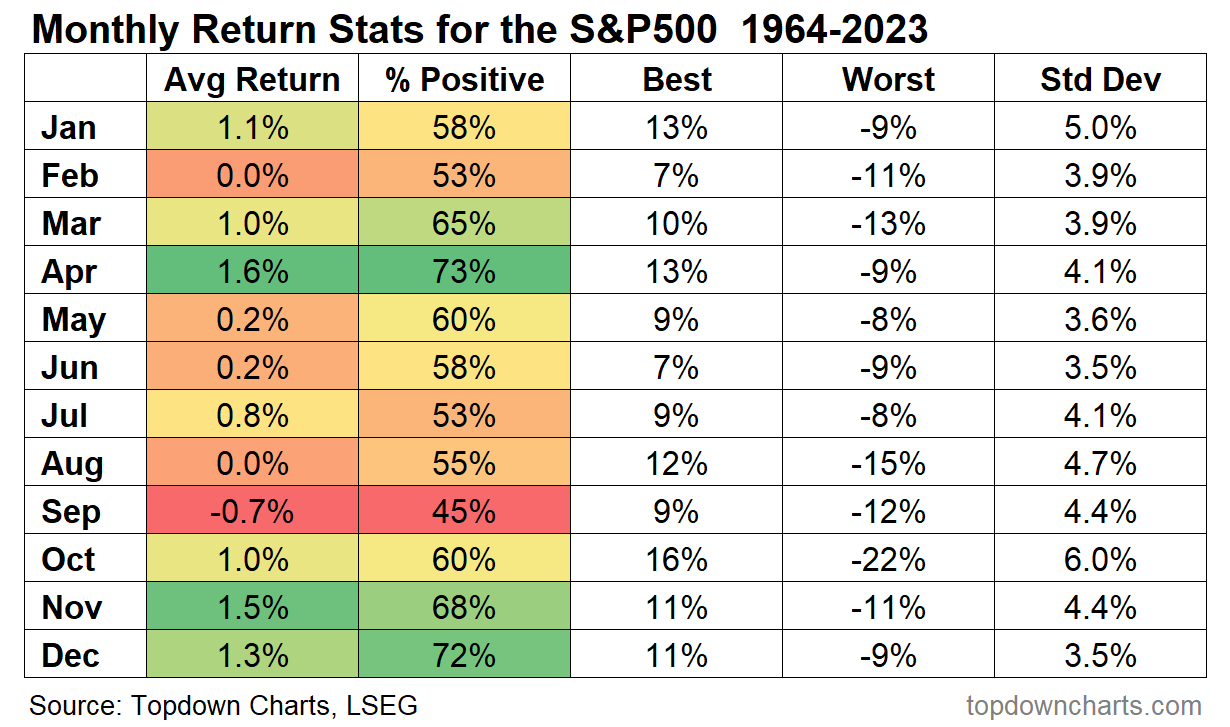
Seasonal Uptick in Seasonality Commentary: here’s a quick look at the monthly seasonality stats table, this one covering all years — September does boast the worst stats. It has the lowest (and negative) average returns, and the lowest probability of gains. But…
(…) a couple of caveats.
First, 45% is pretty darn close to 50/50 — i.e. you could state that there’s only a 55% chance the market drops in Sep based on historical probabilities. Further, note the best vs worst Septembers; in one year Sep saw 9% gains.
In other words, be mindful of seasonality, but note that it is just historical statistics — and when we look at historical averages we need to remember that there are distributions around the average, exceptions to the rule. Your mileage may vary.

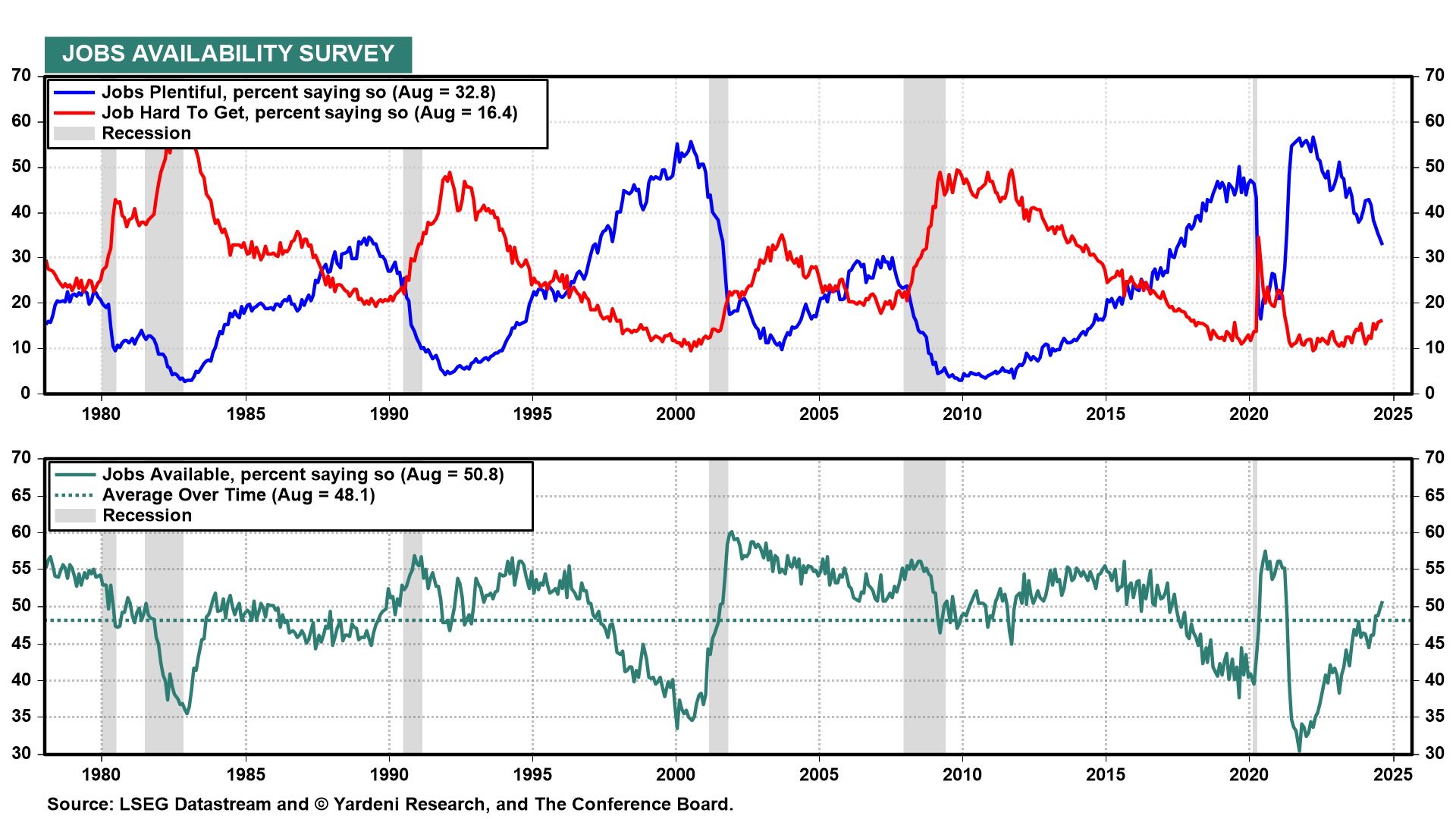

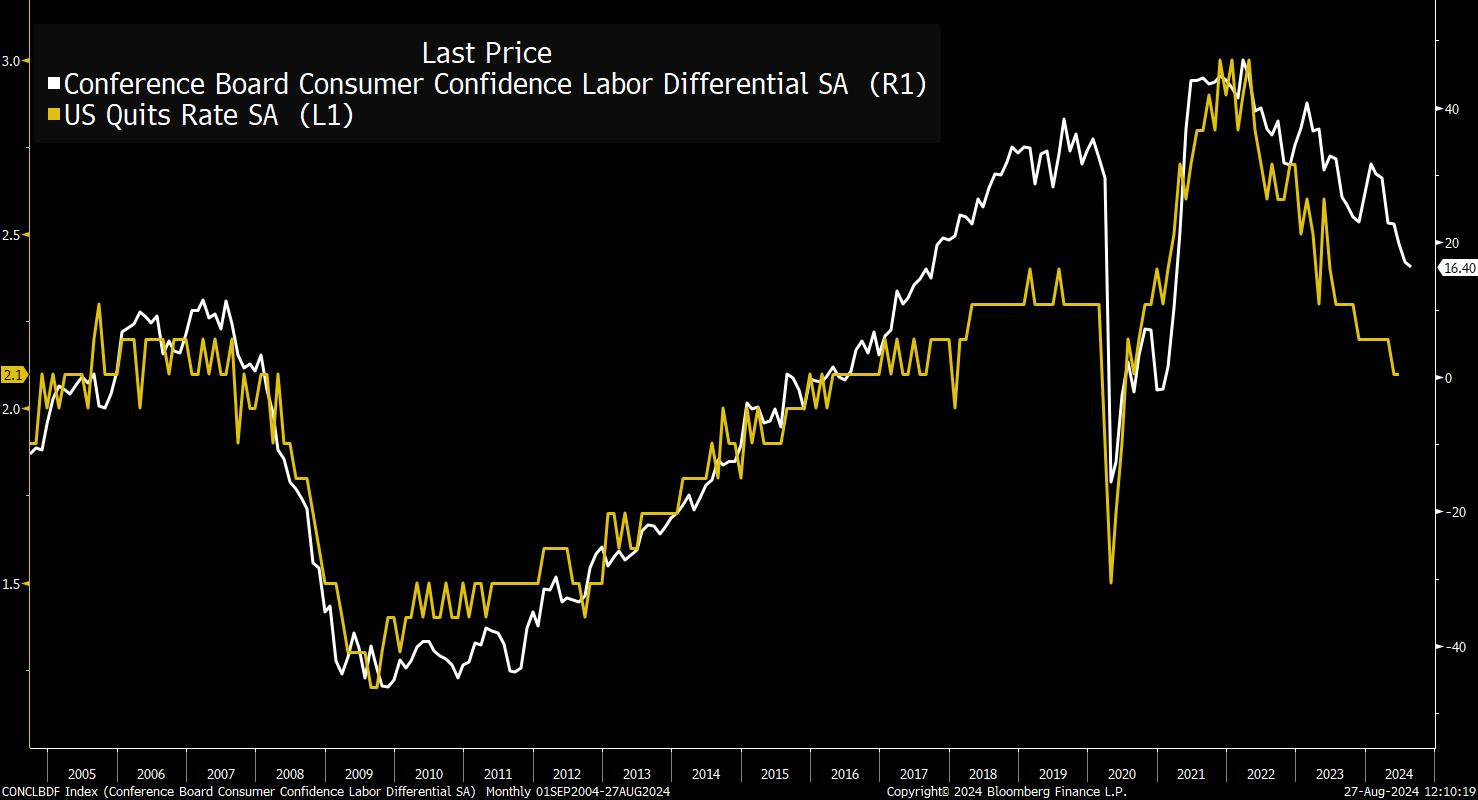


 Here’s a chart I have never seen. I wonder if the Fed has this chart in its playbook. Maybe “normalization” is not the appropriate word for the labor market. Transitory?
![image_thumb1[1]](https://i0.wp.com/www.edgeandodds.com/wp-content/uploads/2024/08/image_thumb11.png?ssl=1 "image_thumb1[1]")