Latest data signalled that operating conditions in China’s manufacturing sector deteriorated only marginally in May. Output contracted at a fractional pace, while new orders stabilised after a three-month sequence of decline. Subdued client demand was linked by panellists to relatively weak market conditions. In contrast, new export orders rose at the quickest pace in over four years, with a number of companies citing new client wins. Job shedding meanwhile persisted, with the latest reduction of workforce numbers the strongest in three months.
After adjusting for seasonal factors, the HSBC Purchasing Managers’ Index™ (PMI™) posted at 49.4 in May, down slightly from the earlier flash reading of 49.7, and up from 48.1 in April. The reading signalled only a marginal deterioration in business conditions. The health of the sector, however, has now deteriorated in each month of 2014 so far.

Manufacturers in China reported a fourth successive monthly fall in output during May. That said, the rate of contraction was only fractional. According to panellists,
uncertain economic conditions led some firms to lower production over the month. Total new business was unchanged in May, following a three-month sequence of
reduction. Data suggested that muted domestic demand hindered overall new work wins, as new export orders rose at the fastest rate since April 2010.Improving demand conditions led to an increased amount of purchasing activity in May, albeit only marginal. Nonetheless, it was the first time that input buying had increased in four months. Stocks of purchases were relatively unchanged in May, ending a three-month sequence of depletion. Inventories of finished goods fell for the first time in 2014 so far, though only slightly, as some companies increased their use of current stocks to meet new incoming orders.
Employment at manufacturing companies declined again in May, as has been the case since November 2013. The rate of reduction was marked overall, and partly driven by company down-sizing policies. Despite lower staffing levels, backlogs of work also declined. Average cost burdens fell again in May, though the rate of deflation was the weakest in the current five-month sequence. In contrast, output charges increased for the first time in 2014 so far, with some firms commenting that improved demand conditions boosted pricing power.
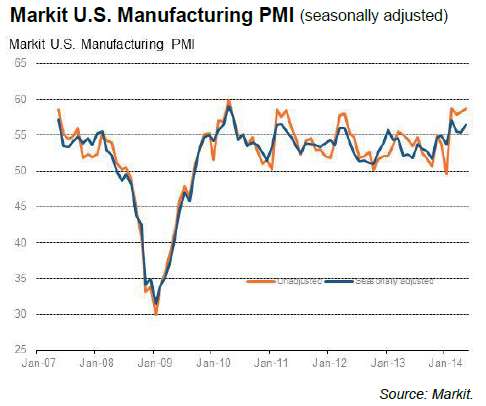
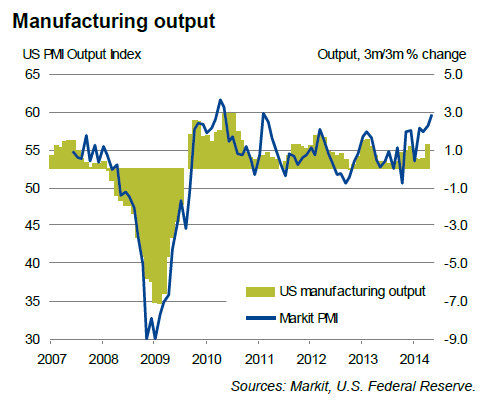
 Meanwhile, the latest survey signalled that input cost inflation picked up to its fastest since January. Despite a strong increase in input prices, May data indicated that factory gate price inflation was only marginal and the weakest for almost two years.