The enemy of knowledge is not ignorance, it’s the illusion of knowledge (Stephen Hawking)

It ain’t what you don’t know that gets you into trouble. It’s what you know for sure that just ain’t so (Mark Twain)

Invest with smart knowledge and objective odds

THE DAILY EDGE: 11 DECEMBER 2018

 U.S., China Kick Off a New Round of Trade Negotiations The U.S. and China started the latest round of trade talks with a phone call involving Treasury Secretary Steven Mnuchin, U.S. Trade Representative Robert Lighthizer and Chinese Vice Premier Liu He.

The three senior officials discussed Chinese purchases of agricultural products and changes to fundamental Chinese economic policies during the phone call, said people familiar with the conversation. They didn’t provide further details. (…)

China’s Commerce Ministry, in a brief statement, said the conversation—held Monday evening in the U.S., Tuesday morning in China—was meant to “push forward with next steps in a timetable and road map” for negotiations. Mr. Liu plans to travel to Washington after the new year, people familiar with the matter said. (…)

By holding the phone call, both sides are suggesting a willingness to keep the negotiations from getting derailed by Chinese anger at the arrest in Canada at the U.S. request of a senior executive at China’s Huawei Technologies Co.

(…) state media and social-media censors have been careful not to stir up anti-U.S. sentiment, in an apparent effort to separate the Huawei issue from the trade negotiations. President Xi has instructed his lieutenants to follow through on the agreement he reached with Mr. Trump, according to Chinese officials. (…)

Wu Handong, an adviser to China’s Supreme People’s Court, told The Wall Street Journal on Tuesday that China is speeding up approving a revised patent law in part to address U.S. concerns. Mr. Wu said the draft was submitted to China’s legislature earlier this month and is expected to be approved next year. Revisions, he said, would subject violators to greater administrative penalties and fines.

  • China Moves on U.S. Car Tariff Cut Trump Tweeted About

A proposal to reduce tariffs on cars made in the U.S. to 15 percent from the current 40 percent has been submitted to China’s Cabinet to be reviewed in the coming days, according to people familiar with the matter.

China Auto Sales Go Downhill for Fifth Month Running But yearly electric-vehicle sales passed the 1 million mark for the first time in November

Chinese vehicle sales fell 14% last month compared with November 2017 to 2.55 million, the government-backed China Association of Automobile Manufacturers said Tuesday. Sales in the first 11 months of 2018 were down 1.7% year-over-year. (…)

the government has shown no interest in helping the sector by cutting its auto-sales tax, a measure it has previously employed to help auto makers through lean spells.

It is unhealthy for the Chinese auto market to depend on official assistance every time sales dip, said Shi Jianhua, the association’s deputy secretary-general. In a truly competitive market, good companies will prosper and bad companies “will be forced to adjust and upgrade,” Mr. Shi said.

The government’s tax on light-vehicle sales only returned to its usual level of 10% at the start of 2018, after earlier being cut as a stimulus measure, likely making officials reluctant to intervene again so soon, said Ernan Cui, China consumer analyst at Gavekal Dragonomics. But more important, government policy has shifted decisively toward promoting EV sales and away from gasoline cars, Ms. Cui said, making any official moves to stimulate the market as a whole increasingly unlikely. (…)

U.S. JOLTS: Job Openings and Hires Rates Improve

(…) The level of job openings increased 1.7% in October (16.8% y/y) to 7.079 million following a 4.6% decline from the August record. Private-sector openings rose m/m and were up 17.7% y/y. Construction sector job availability surged by one-quarter y/y. Openings in leisure & hospitality strengthened by one-quarter y/y and they rose 15.1% y/y in education & health services. Trade, transportation & utilities job openings increased by one-quarter y/y as did factory sector openings. Job openings in professional business services gained an improved 13.2% y/y. Government sector job openings rose a lessened 8.5% y/y. (…)

Total hiring increased 3.4% (5.2% y/y) to a near-record 5.892 million, reversing the September decline. Hiring in the private sector increased 5.1% y/y with trade, transportation & utilities hiring strengthening 20.2% y/y. Factory-sector hiring rose a lessened 12.0% y/y. Educational & health services hiring increased 6.2% y/y and leisure & hospitality improved 2.7% y/y. Professional & business employment rose 3.8% y/y, down from the double-digit gains earlier in the year. Construction sector hiring fell 6.2% y/y.

image

OECD LEIs Point to Weakness

OECD LEIs point to weakness ahead for the OECD area as well as separately for the OECD seven largest economies, the euro area, and the United States. All LEI metrics declined in October as well as over three months, six months and 12 months. Japan is the ‘exception’ in the table, with sequential declines but with flat performance in its LEI in the two most recent months. (…)

large image

While the Fed in the U.S. would like to consider the U.S. an island and buffered from these effects overseas, the evidence does not support that. Fluctuating exchange rates do permit relatively more independent movement of national policies and more policy ‘insulation’ but it is clear that many of the same forces that are driving all these economies are forces that have been weakening. The OECD indicators signal slower than normal growth, but they do not give any clears reading on whether a recession is in prospect or not. (…)

What we see for these metrics are absolutely low LEI readings and erosion in LEI values that both point to slowing conditions ahead. We find signals with relative deep roots. We find this at a time that central banks are dismantling stimulus programs or planning to do so. In the EMU, Germany is running fiscal surplus and Italy is being hounded to run a less stimulative policy by the EU itself. In the U.S., the Fed balance sheet has been in the process of shrinking as rate hikes also have been in train since end-2015. And despite ongoing financial distress and a sharply flattening yield curve, there is no consensus that the Fed will shelve its rate hike planned for December. But the Fed is expected to more broadly back off its rate hike path. (…)

There is no way to sugar coat this news. It is not good and it likely stems from concerns over trade frictions explaining the global nature of the unraveling. Between global trade frictions and rising interest rates in the U.S. fading fiscal stimulus also in the U.S., there is a lot in the mix to explain financial markets concerns about growth. The U.S. interest sensitive sectors already have been hit despite slow interest rate increases made more modest by a voracious flattening of the yield curve. These are draining growth. Beware that the United States’ somewhat better recent U.S. economic performance is probably boosting the BRICS performance through their trade with the U.S. As U.S. growth suffers, the resilience of the BRICS that depend on the U.S. will be eroded as well.

  • Thai export boom fades on China slowdown
Global Recession Alarms Aren’t Ringing, Despite Market Mayhem Investors are growing anxious about the prospect of recession in developed countries, but many economic trends don’t fit with patterns that presaged previous downturns.

(…) “We find that on several dimensions, the behaviour of the data over the last four quarters in the U.S., Eurozone and Japan is completely incongruous with any of the recessions that took place since 1980,” write Pierre Lafourcade and Arend Kapteyn of UBS.

Mr. Kapteyn, in an interview, said the model is consistent with a “sharp slowdown” in global growth, but not the end of the business cycle. (…)

Economists at J.P. Morgan have drawn similar conclusions about the growth outlook. They built several alarm systems for impending recessions—one using only high frequency economic data and another including economic data and financial market behavior. The U.S. indicator using only economic data puts a 21% probability on a downturn in the next 12 months, up a bit in recent months but still below levels reached in 2016. The indicator that uses financial market behavior, such as stock price changes and changes in long-term Treasury bond yields, puts the probability at a much higher 36%. (…)

But Charles Schwab’s Jeffrey Kleintop finds that an inversion of the 10y-3m U.S. yield curve has preceded each global recessions by about one year since 1970 and should be used as a signal for non-U.S. stock markets:

US Treasury yield curve vs MSCI EAFE

(…) Why is the U.S. yield curve so much better at gauging global economic conditions? For one thing, the U.S. is the world’s largest economy and a major source of demand for global companies. In addition, the U.S. government bond market is the largest and most liquid in the world, which may mean it better reflects global conditions and is less susceptible to domestic influences than other countries’ bond markets. (…)

Macron Hands EU a New Headache in Fight Over Italian Budget

The promises Macron unveiled Monday night in a bid to defuse the Yellow Vest protests, from a 100-euro ($114) a month hike in the minimum wage to abolishing a tax on pensions, could play into the hands of Italian Deputy Premiers Matteo Salvini and Luigi Di Maio as they challenge EU budget rules to start delivering on election promises.

As the EU pressures Italy to retreat from a deficit of 2.4 percent of GDP next year, Macron’s plan could push France’s to 3.5 percent, according to initial estimates. (…)

SMALL BUSINESS OPTIMISM REMAINS HISTORICALLY HIGH IN NOVEMBER

Small business optimism slightly dipped in November. The Index declined 2.6 points to 104.8 with more than half the decline attributable to Expected Business Conditions and Expected Real Sales.

imageimageimageimageimage

(…) The ISM said labor and benefits costs are expected to rise 2.5% in the manufacturing sector and 3.2% in the nonmanufacturing sector in 2019, compared with year-ago forecasts of 2.1% and 2.6%, respectively. A large majority of survey respondents said they’ve had difficulty hiring workers to fill open positions, and a growing majority of companies also report raising wages to recruit new hires.

Purchasing and supply executives in the manufacturing sector said they expected the prices their businesses pay are expected to rise 3.3% in 2019 after a gain of 5.1% this year. In the nonmanufacturing sector, price increases are seen accelerating to 3.6% next year from 2% this year.

Compared with the ISM’s last economic survey, conducted in May, fewer companies now expect tariffs to raise the price of their goods to customers, or to cause delays and disruptions in their supply chains.

But 65% of executives at manufacturers said their companies are evaluating new sources of supply and other changes as a result of tariffs the Trump administration has either imposed or threatened on a wide range of imports.

THE DAILY EDGE: 10 DECEMBER 2018: Good Fundamentals, Bad Technicals, Ugly Politics

U.S. Hiring Slows, With Wage Gains, Jobless Rate Steady

(…) After robust growth in the middle of the year, the economy has been flashing mixed signals of late. Equity markets are well down from early October and yields on U.S. Treasury bonds have fallen, indications of diminished investor expectations for growth and inflation. Business investment data have softened, the trade deficit has widened and concerns over global growth are mounting.

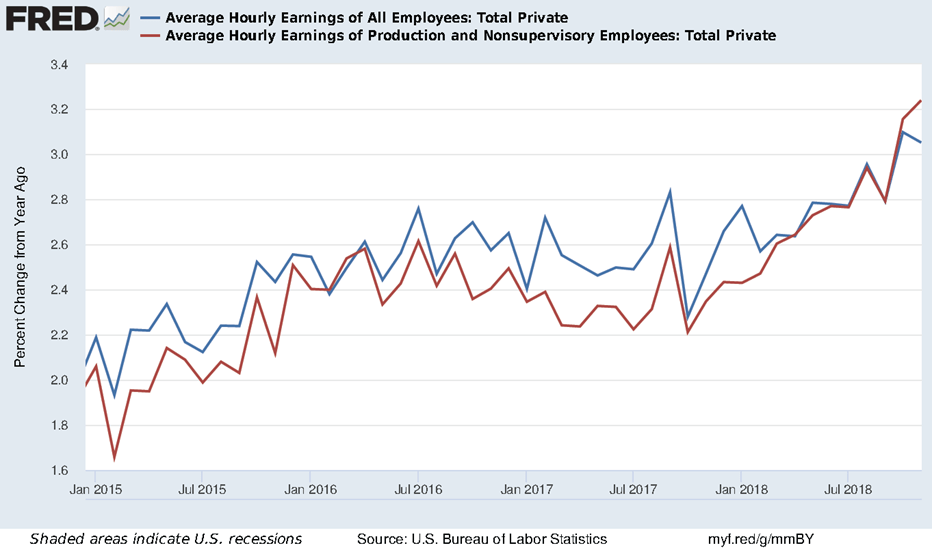
At the same time, however, the big driver of the U.S. economy—consumer spending—remains strong, supported in large part by improved wages and low unemployment. The unemployment rate held at 3.7% last month, matching the lowest rate since December 1969, and year-over-year wage growth matched the prior month’s 3.1% pace as the best rate since 2009. With oil prices falling and inflation softening recently, households are keeping more of what they earn. (…)

Unlike in 2007, aggregate weekly payrolls (hourly earnings x weekly hours, blue line) are not showing any signs of weakening. They are up 4.7% YoY in November, down from +5.2% on average since May but inflation is also slowing (last 3 months total PCE inflation +1.6% annualized, core +1.1%) keeping real purchasing power in the 2.5-3.0% growth range.

image

Given that the U.S. economy is 70% consumer spending, these facts are crucial in assessing probabilities of a major slowdown or a recession:

  • employment growth is steady around 1.7% YoY;
  • hours worked remain within the normal range;
  • wages are also firm above 3.0% YoY;
  • core inflation has slowed markedly in recent months;
  • oil prices have declined 30% since summer and are down 13% YoY;
  • consumers, overall, are not in bad shape financially.

Source: Capital Economics (via The Daily Shot)

In 2007, consumer spending cratered as inflation doubled led by oil prices jumping from $55 to $133 within 18 months, an unlikely scenario given the weakening economies throughout the world and overall supply conditions. Let’s also not forget that the Fed had been incessantly jacking Fed Funds rates up from 1.0% in 2004 to 5.25% in mid-2006 and kept them there until September 2007.

The main risk to inflation and the economy currently seems concentrated in the U.S.-China trade negotiations. An unfavorable outcome would likely hurt global demand and boost U.S. inflation, probably causing a recession. Per one study:

(…) Our analysis finds that if all trade actions are implemented, the cumulative impacts on the US would include:

    • Gross domestic product (GDP) would be reduced by a projected -1.78 percent in 2019 (or $365.1 billion in 2017 dollars) with a long run reduction of -1.25 percent in 2030 (or $331.8 billion in 2017 dollars).
    • GDP losses are projected to cumulate to a discounted value of $2.8 trillion between 2018 and 2030.
    • All countries, except the US and China, gain from US trade actions and responses and increase GDP.
    • In 2019, households suffer losses equivalent to $2,357 per household (or $915 per person) in 2017 dollars.
    • High economic growth in the US will initially protect workers from unemployment, however as more trade actions are initiated, and partners respond, increased unemployment could ensue.
    • In 2019, we find that 2.75 million workers are likely to become unemployed if all trade actions are implemented concurrently. With the implementation of each additional trade action, underlying wage growth in the economy is diminished, increasing the probability that workers will become unemployed. With such large negative impacts from the combined trade actions, it will be difficult for the US to maintain wage growth and full employment.
    • A high proportion of these job losses affect agricultural and low-skilled workers (e.g., workers in manufacturing where activity will slow due to higher costs for intermediate inputs into the supply chain caused by US trade actions and its partners’ responses).
    • In addition to those unemployed, we also project a further 665,000 workers will be displaced in 2019 and must find employment in new industries. By 2030, 1.07 million workers will be employed in a different sector, but for the trade actions.
    Oil Prices Soar After OPEC, Allies Announce Production Deal Deal calls for removing 1.2 million barrels of oil a day from global market

    (…) Ultimately, Friday’s deal may have to be adjusted to take into account any further U.S. decisions on energy output and whether or not the Trump administration extends waivers on Iranian oil sanctions.

    “There’ll be more of these supply adjustments in the future, because OPEC policy is something of a slave to U.S. policy on Iran and whenever there are waivers they have to cut,” said Norbert Rücker, head of macro and commodity research at Julius Baer. “When there are no longer waivers OPEC will have to supply again, and this volatility may persist over the coming months.”

    “Soar” sounds exaggerated considering that Brent is $61 this morning, from $59 last week.

    Eurozone Economy Grew More Slowly Than Previously Estimated

    The eurozone’s slowdown was broader than previously suspected in the three months through September, fresh figures show, affecting sectors as diverse as farming, construction and a range of services.

    That is likely to make policy makers at the European Central Bank, and the eurozone’s broader economic leadership, a little less hopeful going into 2019, because fragility was evident far away from the automobile factories of Wolfsburg and Turin.

    The European Union’s statistics agency lowered its estimate for eurozone third-quarter growth to 0.6% from 0.7% on Friday, leaving it further adrift of the U.S. economy, which grew at a 3.5% during the same period. It was the eurozone’s weakest quarter since early 2013, with gross domestic product having increased by 1.7% in the three months through June. (…)

    Eurostat’s new figures suggest automobile production will pick up gradually, rather than surge as 2018 comes to an end. The statistics agency recorded a large buildup in stocks during the third quarter, most likely the result of new vehicles piling up at factory parking lots. Running down those stocks may hit current and future production.

    The figures confirmed that two of the eurozone’s three largest economies—Germany and Italy—contracted during the quarter. Both have sizable automobile industries and between them account for 45% of the eurozone’s economy. (…)

    image
     Market-Shaking U.S. Case Against Huawei CFO Rolls Into Next Week

    (…) Meng was charged with conspiracy to defraud banks and should not be granted bail because she may flee, Crown attorney John Gibb-Carsley said during the court hearing in Vancouver earlier on Friday. Banks in the U.S. cleared money for Huawei, but unbeknownst to these financial firms, they were conducting business with Skycom in contravention of the sanctions, the lawyer said. (…)

    The hearing in Vancouver is the start of a long legal process in Canada that could end with Meng being sent to the U.S. to stand trial. Even though the North American neighbors have a longstanding treaty governing extradition, it can take months, even years, for a defendant to be handed over, if at all.

    Should a judge agree to extradite Meng, she would have multiple chances to appeal the decision.

    China’s leadership is trying to strike a delicate balance between outrage and necessity, as it seeks to maintain a recent thaw with the United States while lashing out at the arrest of a top Chinese tech executive. (…)

    But at a high-level conference on Sunday at Tsinghua University in Beijing that included four Nobel laureates in economics from the United States, a senior adviser to the Chinese leadership opened his remarks by praising the two countries’ broader economic relationship and avoiding any mention of the arrest.

    “The economies of China and the United States are integrated,” said the adviser, Ma Jianting, a vice president of the Development Research Council, the policy advisory unit of China’s cabinet. “There is no parting of the ways.”

    Mr. Ma’s remarks were the latest of many signs that the Chinese government was trying to compartmentalize the Huawei issue, while still taking an assertive enough stance to satisfy nationalistic anger in China. (…)

    On Thursday, hours after word of Ms. Meng’s arrest in Canada spread publicly in China, a Commerce Ministry spokesman, Gao Feng, said that Beijing was “full of confidence in reaching a deal in the 90 days.” He also confirmed for the first time a White House assertion that China would be buying American food, energy and cars following the truce, but declined to provide any details. (…)

    China’s leaders are coincidentally preparing to observe this month the 40th anniversary of the country’s post-Mao economic overhaul by calling for a series of moves to open up the economy to more trade and foreign investment, people familiar with Chinese policymaking said.

    The anniversary, heavily promoted in official propaganda and the subject of Sunday’s conference at Tsinghua University, offers Mr. Xi a chance to take market-opening measures sought by the United States without seeming to give in to American pressure.

    The final list of moves is still the subject of considerable discussion within the Chinese bureaucracy. But some options under serious consideration include further reducing tariffs on imports from all over the world and encouraging broader foreign investment in the slowing Chinese economy.

    China made some moves in these directions this year, however, and it is unclear how much further the Beijing leadership is willing to go. By Beijing’s calculation, China’s average tariffs have already fallen to 7.5 percent from 9.8 percent at the start of this year. By comparison, average tariffs in the United States are 3.5 percent, while the European Union’s are 5 percent. (…)

    Most likely, this particular case concerning Iran dealings will drag on for years and it would be very surprising if bail is not granted. More important, however, is that Huawei and its smaller Chinese competitor ZTE fit right in the current U.S.-China negotiations reaching well beyond tariffs. This is when it all started:

    In February 2011, Huawei Technologies Company, the leading Chinese telecommunications equipment manufacturer, published an open letter to the U.S. Government denying security concerns with the company or its equipment, and requesting a full investigation into its corporate operations. Huawei apparently believed – correctly – that without a full investigation into its corporate activities, the United States could not trust its equipment and services in U.S. telecommunications networks.

    The House Permanent Select Committee on Intelligence (herein referred to as “the Committee”) initiated this investigation in November 2011 to inquire into the counterintelligence and security threat posed by Chinese telecommunications companies doing business in the United States. (…)

    Despite hours of interviews, extensive and repeated document requests, a review of open-source information, and an open hearing with witnesses from both companies, the Committee remains unsatisfied with the level of cooperation and candor provided by each company. Neither company was willing to provide sufficient evidence to ameliorate the Committee’s concerns. Neither company was forthcoming with detailed information about its formal relationships or regulatory interaction with Chinese authorities. Neither company provided specific details about the precise role of each company’s Chinese Communist Party Committee. Furthermore, neither company provided detailed information about its operations in the United States.

    Huawei, in particular, failed to provide thorough information about its corporate structure, history, ownership, operations, financial arrangements, or management. Most importantly, neither company provided sufficient internal documentation or other evidence to support the limited answers they did provide to Committee investigators.

    During the investigation, the Committee received information from industry experts and current and former Huawei employees suggesting that Huawei, in particular, may be violating United States laws. These allegations describe a company that has not followed United States legal obligations or international standards of business behavior. (…)

    In sum, the Committee finds that the companies failed to provide evidence that would satisfy any fair and full investigation. Although this alone does not prove wrongdoing, it factors into the Committee’s conclusions below. Further, this report contains a classified annex, which also adds to the Committee’s concerns about the risk to the United States. The investigation concludes that the risks associated with Huawei’s and ZTE’s provision of equipment to U.S. critical infrastructure could undermine core U.S. national-security interests.

    At a minimum, Huawei’s global expansion plans seem seriously compromised. More ammo for Trump given how important Huawei is to China. Remember that he allowed ZTE to survive.

    (…) It’s becoming clear Mr. Trump’s prolonged tit-for-tat trade fight may represent American business’s best shot at addressing those long-standing grievances. “Calling the abuser an abuser to their face is the first step,” Basheer Junjua, chief executive of San Francisco software development firm Calculi, told me this past week at The Wall Street Journal’s CEO Council in Washington.

    (…) companies like China’s Huawei or ZTE Corp. “can’t make products without U.S. technology.”

    Can Western firms pull off 5G without Chinese partners? “The answer is yes, but it is going to cost a lot more.”

    (…) In Britain, which is also a member of the Five Eyes, BT Group announced on Wednesday that it is removing Huawei equipment from its core 4G networks and will not use its 5G technology, a move made two days after Alex Younger, chief of the Secret Intelligence Service, known as MI6, questioned whether Britain should use Chinese gear. Japanese media also reported on Friday that the country planned to ban government purchases of equipment from Huawei and rival Chinese telcom ZTE Corp. (…)

    EARNINGS WATCH

    The Q3 earnings season is over with all 500 companies in, a 77% beat rate and a +6.4% surprise factor that has been steady throughout the reporting period. Q3 earnings are up 28.4% (25.0% ex-Energy) on a revenue increase of 8.6% (7.4%).

    Trailing 12-month EPS are now $157.78, up 23.1% YoY, but pro forma the tax reform for the full 12 months, they really are around $160.50, up 25.2% YoY.

    Analysts have been revising large companies’ earnings primarily downward in recent weeks…

    imageimage

    …but Q4 estimates are still up 16.8%, down from 20.1% on Oct. 1. but only down from 17.3% in the last week. Corporate pre-announcements have not deteriorated even as we approach quarter end:image

    Full year 2018 EPS are seen reaching $162.70 up 23.3% for the year.

    Q1’19 estimates have been downgraded to +6.6% from +8.1% on Oct. 1 and +6.8% one week ago.

    The Rule of 20 P/E is 18.5, slightly above the 18.3 low of January 2016 when earnings were slipping and inflation was rising, unlike now.

    image

    S&P 600 earnings are up 21.6% in Q3 after 565 reports. The beat rate is 62% and the surprise factor +2.1%. However, earnings growth is very uneven among sectors

    image

    A big source of anxiety is that profit margins will erode along with rising wages. This chart is scaring many people:

    image

    But the reality is that U.S. wages are not accelerating much, if at all, when looked at on a monthly basis:

    image

    As seen earlier, weekly payrolls growth has been stable around 5.0% all year long but revenues have risen much faster at 8.6% for S&P 500 companies, 8.7% for S&P 400 companies and 6.8% for S&P 600 companies in Q3. In fact, from a corporate margins standpoint, the slowdown in November payrolls growth from 5.4% in October to 4.7% in November (slowest since April) is positive.

    Economy-wide profit margins continue to recover after the oil collapse-induced contraction in 2014-17. After-tax margins are back to their 2014 peak thanks to the tax reform but pre-tax operating margins are up nicely from their 12.7% trough in Q3’17 to 14.1% in Q3’18. Note how margins shrink well before recessions:

    image
    TECHNICALS WATCH
    Pointing up 13/34Week EMA Trend Chart:  Bearish Cyclical Trend Signal for Stocks

    From Steve Blumenthal:

    The process measures the intermediate-term trend in the S&P 500 Index.  A bullish trend is identified when the blue 13-week smoothed moving average (“MA”) trend line rises above the 34-week smoothed MA trend line.  A bearish trend is signaled when the blue line drops below the red line.  You can see that this trend process has done a pretty good job at identifying the major cyclical (short-term) bull and bear market trends (note small red and blue arrows).  In terms of risk management, a good stop-loss level may be at the point when the 13-week drops below the 34-week EMA with re-entry at the point the 13-week crosses above.

    Lowry’s Research is getting more cautious:

    The market pullback over the past few days has caused Selling Pressure to again assume the dominant position above Buying Power. (…) This (…) would suggest any new buying should be deferred until evidence a sustained market low has been established (…)

    NDR’s Volume Supply chart is also worrisome:

    Reasonably cheap market (which can get cheaper, panic downside is 2200 = 16 on the Rule of 20), good earnings, slowing inflation, potentially more dovish Fed but U.S.-China, Trump, Brexit, Italy…This chart does not provide too much comfort just yet, especially given the 13/34W EMA chart above:

    spy
    SENTIMENT WATCH

    (…) In consulting with advisers, he remained convinced that the volatility wasn’t his own doing, but rather, the product of the Federal Reserve’s plan to raise the benchmark interest rate.

    (…) several people close to the president say he places as much importance on the health of the Dow Jones Industrial Average for validation of his job performance as he does with his polling numbers. (…)

    Not sure the above makes anybody feeling any better…

    In the NYT:

    • “Every eye is going to be focused on every piece of commentary on this trade deal,” said Rick Rieder, chief investment officer of global fixed income at BlackRock, which manages over $6 trillion in assets. “Because the impact on growth is so significant.”
    • “The fact is that politics is driving the economy to an extent that is very atypical,” said Julian Emanuel, chief equity and derivatives strategist at BTIG, an institutional brokerage firm. “We would say probably to the greatest extent that we’ve seen in our investing lifetime.”

    And now this next chapter in the Mueller saga:

    A growing number of Republicans fear that a battery of new revelations in the far-reaching Russia investigation has dramatically heightened the legal and political danger to Donald Trump’s presidency — and threatens to consume the rest of the party, as well. (…)

    Stephen K. Bannon, the former Trump strategist who helped him navigate the most arduous phase of his 2016 campaign, predicted 2019 would be a year of “siege warfare” and cast the president’s inner circle as naively optimistic and unsophisticated.

    “The Democrats are going to weaponize the Mueller report and the president needs a team that can go to the mattresses,” Bannon said. “The president can’t trust the GOP to be there when it counts . . . They don’t feel any sense of duty or responsibility to stand with Trump.”

    (…) Mueller’s latest court filings offer new evidence of Russian efforts to forge a political alliance with Trump before he became president and detail the extent to which his former aides are cooperating with prosecutors.

    Some GOP senators were particularly shaken by this week’s revelation that former national security adviser Michael Flynn had met with Mueller’s team 19 separate times — a distressing signal to them that the probe may be more serious than they had been led to assume, according to senior Republican officials. (…)

        • Is Mueller Building an Expansive Obstruction Case? The sentencing memos suggest the possibility that Trump and perhaps others were involved in a series of lies from Paul Manafort and Michael Cohen.

        • Trump readies himself for Mueller’s final act Democrats say prosecutors have evidence of ‘impeachable offences’ by the president

        • Impeachment Is Getting More Likely There are still plenty of unknowns. But the president’s attempts to conceal his conduct are ominous.