Restaurants Sweeten Pay and Perks to Find Scarce Workers Restaurants are sweetening pay packages and adding perks like more scheduling flexibility to attract and retain workers in the tightest job market in decades.
(…) More than 7.5 million restaurant and hotel workers quit last year, the most since the Bureau of Labor Statistics began releasing that metric in 2001. Around 10.7 million food-service and hotel workers were hired last year, but there were an average of nearly 900,000 job openings in the restaurants and accommodation sector in each month of last year, a record, federal figures show. And quit rates this year are even higher. (…)
A recent Harri survey of restaurant employers found that 85% reported half their staff turning over annually on average, incurring thousands of dollars in costs.
Many restaurants are raising pay, of their own volition or by law. Nearly two dozen states and some big cities have raised minimum wages this year. U.S. hourly restaurant pay was $14.79 in May, the highest since that survey began in 2006, according to BLS figures that typically include tips. The National Restaurant Association predicts restaurant wages will rise 4.7% on average this year, outpacing total private-sector growth of 3.3%. (…)
Bundesbank Sees German Unemployment Rising on Economic Downturn
Total output probably contracted in the second quarter, the Frankfurt-based institution said in its monthly report. While domestic demand likely continued to support growth, softer momentum is starting to leave its mark on the labor market. (…) “A recovery in exports and industry isn’t yet in sight.”
 Trump: U.S. had ‘very good talk’ with China; in-person talks may follow U.S. President Donald Trump said on Friday that U.S. Treasury Secretary Steve Mnuchin had a very good talk with his Chinese counterpart, amid signals from China that officials could soon meet face-to-face in their bid to end a yearlong trade war.
(…) “We’re dealing with China. … They’re not doing very well. They had the worst year they’ve had in 27 years. We’re having the best year we ever had,” he said. “Let’s see what happens.” (…)
 Trade war is harming American economy more than China’s, claims official sent to US to defend Beijing’s position
China’s slower economic growth was due more to government efforts to cut manufacturing overcapacity and rebalance towards a service economy and less about the trade war, Bi Jiyao, vice-president of the Chinese Academy of Macroeconomic Research, told a group of former US diplomats and other China watchers in New York.
The trade war had caused American exporters to lose market share in China, he said, so US President Donald Trump was wrong to think China’s slower economic growth would force Beijing to make concessions.
After trying to whittle down excessive manufacturing capacity, “the economy is shifting from high-speed growth to a high-quality environment”, Bi said.
“The US has lost market share in China. Now you rank as the No 3 trading partner with China, overtaken by the Asean region.” (…)
- U.S. exports to China dropped 30% last month. China’s exports to the U.S. dropped too, but only by 8%, springing the U.S. trade deficit on goods to $30 billion. (Fortune)
- Stephen Roach: “I was in China last week. And the general sense was that the economy, while slowing in the manufacturing sector, the larger, more rapidly growing services sector was likely to provide a source of resilience.” ‘During his latest talks, he didn’t observe a heightened sense of anxiety over the ongoing trade war.’ According to Roach, the climate suggests China will resist moving aggressively to cut a trade deal out of economic slowdown fears.’ (CNBC)
- Mnuchin had “a very good talk” but said on CNBC that “there are just a lot of complicated issues.” One of which is next:
-
China-US talks could resume, but tariffs must go, state media say
And this other “complicated issue”
-
White House to host meeting with tech executives on Huawei ban: sources White House economic adviser Larry Kudlow will host a meeting with semiconductor and software executives on Monday to discuss the U.S. ban on sales to China’s Huawei Technologies Co Ltd, two sources briefed on the meeting said on Friday.
(…) A White House official confirmed the meeting would take place, noting that Google (GOOGL.O) and Micron (MU.O) would attend, but said it had been called to discuss economic matters.
The subject of Huawei was expected “to come up but that it is not the reason why they are convening the meeting,” said the official, who spoke on condition of anonymity. (…)
This is from KKR:
Simply stated, we think that a modern day ‘cold war’ of sorts has emerged between China and the United States. Consistent with this view, we think that we are at an inflection point for global supply chains, particularly those that rely on proprietary technology. Just consider that out of $70 billion Huawei spent buying components in 2018, some $11 billion in Huawei allocations went to U.S. firms including Qualcomm, Flextronics, and Broadcom. Without question, these relationships are now all in play in a world where it appears U.S. national security concerns have trumped more traditional trade priorities.

Japan-South Korea trade dispute implications
The ongoing trade dispute between Japan and South Korea could have serious consequences to the global semiconductor industry if a resolution cannot be identified in the near term. According to IHS Markit’s Technology division, SK Hynix and Samsung Electronics supplied 61% of memory components in 2018 that are used in a variety of electronics systems. Potentially many electronic devices and systems that employ DRAM and/or NAND flash could face supply allocation challenges if there is any protracted disruption of Japanese exports of key materials to the South Korean semiconductor industry.
South Korean exports of memory chips reached USD 127 billion in 2018, with China and the US being key markets. China imported USD 300 billion of semiconductors in 2018, with South Korea, Taiwan and the US being key suppliers. Since China is heavily reliant on imported semiconductors, its electronics supply chain is vulnerable to disruption of South Korean supplies of memory chips. The US imported USD 54 billion of semiconductors in 2018, with South Korea and Taiwan being key suppliers, even though the US is also a major global producer of chips.
If supply constraints arise in South Korean memory chip production, the price of memory components could significantly increase due to the inability of the other memory suppliers to meet global demand. End products, including servers, mobile handsets, PCs and a variety of consumer electronics would be impacted. Consequently, some US electronics firms, which have large production hubs in either the US and China, are vulnerable to supply shortages of South Korean memory chips, given the importance of South Korea as a supplier of chips to both China and the US.
The South Korean export sector has already seen a sharp contraction in exports during the first half of 2019 due to weak Chinese demand and the downturn in global electronics orders. Any protracted disruption of Japanese exports of the key materials to South Korea could disrupt the global electronics supply chain, since South Korea is a dominant global producer of memory components used in many electronics products. (…)
The use of trade sanctions as a negotiating lever in government-to-government negotiations has escalated over the past two years, with negative repercussions for world trade growth and new export orders. Exports are a key growth engine for many Asian economies, and the shockwaves from increased trade sanctions are having a negative impact on many exporting companies across the APAC region. A larger number of countries are also using trade policy countermeasures in retaliation for trade sanctions against their countries.
Trade disputes and trade sanctions are throwing sand into the wheels of world trade flows, eroding the progress made by decades of trade liberalization under the General Agreement on Tariffs and Trade (GATT) and WTO.
The Japanese trade measures taken against South Korea will add to global trade tensions at a time when Asia’s export sector is already facing strong headwinds from the US-China trade dispute as well as the slowdown in global electronics sector new orders.
With both Japan and South Korea suffering from contracting exports during the first half of 2019 due to the impact of the US-China trade war and the global electronics sector downturn, the additional impact of an escalating Japan-South Korea trade row is further bad news for the exporters of both nations.
With public sentiment in South Korea swinging towards some forms of retaliatory measures, such as boycotting the Tokyo Olympics, and some South Korean retail stores already having stopped selling Japanese products, there is a danger that the trade frictions could escalate into a protracted trade war unless some negotiated compromise can be found. An escalating bilateral trade dispute between Japan and South Korea will also endanger regional momentum for further trade liberalization. It is also likely to damage the further progress of negotiations between China, Japan and South Korea towards establishing a new trilateral free trade agreement.
With South Korea having significant vulnerability in its manufacturing supply chain to imports of manufactured parts and materials from Japan, the new export restrictions applied by Japan could create disruption in the South Korean manufacturing supply chain, notably for the electronics and chemicals sectors.
In the medium term, these Japanese government export controls on South Korea are likely to trigger trade diversion effects, as South Korean firms try to reconfigure their global supply chains to reduce their dependency on Japanese inputs and seek alternative supply sources for critical products. This could be damaging in the medium to long term to Japanese exporters, as South Korea may eventually substantially reduce its reliance on imports of Japanese parts and materials for its manufacturing supply chain.
But where is it safe to procure now that politics interfere so easily and significantly?
BTW, the United States is also at loggerheads with the Eurozone and India; while passage of the USMCA remains bogged down.
Fed Officials Signal Quarter-Point Rate Cut Is Likely in July Federal Reserve officials signaled they are ready to cut interest rates by a quarter-percentage point at their coming meeting, while indicating the potential for additional reductions.
(…) The market on Thursday was pricing in as high as a 71% chance of the Fed lowering its federal funds rate by 0.5 percentage point after its July 30-31 meeting, according to CME Group. That was the highest odds this year. The bet is raising the eyebrows of many investors, given the broad consensus that the U.S. economy is generally healthy and officials’ typical preference for moving deliberately in cutting rates. (…)
Those who believe the Fed will make a deeper rate cut say that, with interest rates already at low levels, the central bank has less room to move rates slowly to stave off an economic downturn. That is why Mr. Williams said Thursday that “it pays to act quickly to lower rates at the first sign of economic distress.” (…)
-
Trump blasts Fed’s ‘faulty thought process’ US president piles on pressure for big rate cut
-
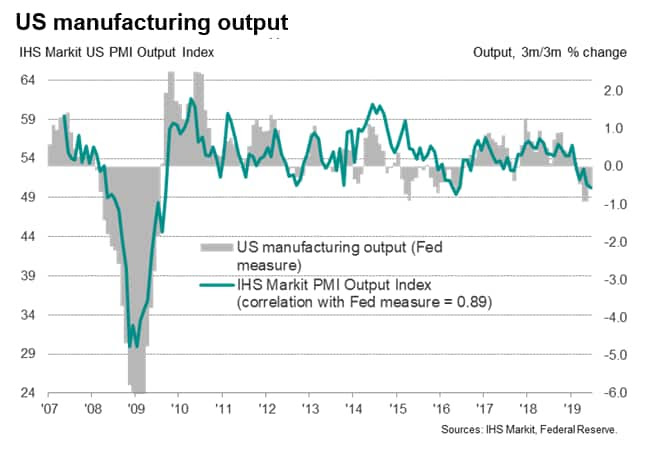
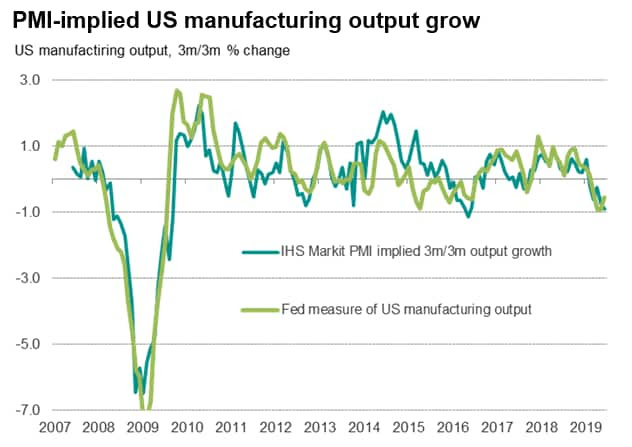
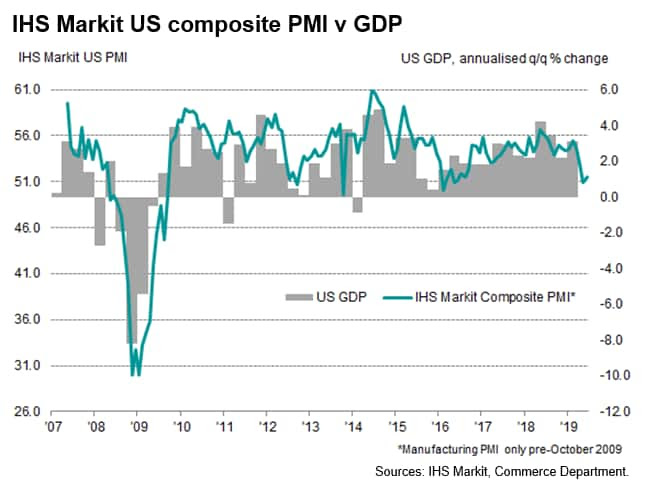
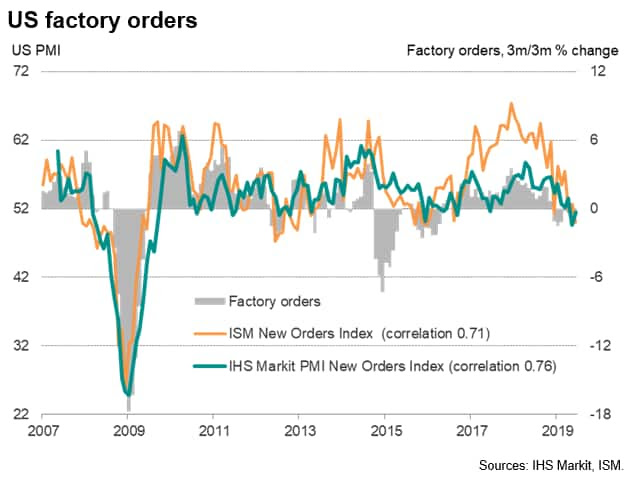
Manufacturing Is Not the Economy (GS)
(…) Directionally, Wall Street’s focus on manufacturing makes sense. After all, manufacturing activity is more volatile than the rest of the economy. And the slowly evolving economic statistics remain disproportionately geared to manufacturing despite the falls in its GDP and employment shares to 11% and 8%, respectively. The overrepresentation of manufacturing in the official statistics reflects its previous dominant role in the economy, combined with the tendency for statistical systems and methods to change only slowly. Additionally, the sector still accounts for 37% of the S&P 500 market cap.
However, we warn against putting excessive weight on manufacturing data because the sector now accounts for a relatively small share of the volatility in overall output and job growth.(…)
The upshot is that it is important not to get too obsessed with ups and downs in manufacturing data to assess the overall pace of economic growth. We are therefore not too worried about the Q2 slowing of manufacturing data, which likely reflects an inventory adjustment, weaker foreign growth, and 2018 dollar appreciation.
About the widely discussed “inventory adjustment” apparently needed after U.S. corporations front-loaded purchases to beat rising tariffs, the chart below confirms that inventories are on the high side but it seems to be the more result of weakening sales rather than front-loading.

So far, the 79 S&P 500 companies that have reported Q2 results have an aggregate revenue growth rate of 2.8%. At about the same time during the Q1 earnings season, the 82 companies that had released showed aggregate revenue growth of 3.0%. Analysts expect revenues to rise 3.4% for all of Q2, down from 5.7% in Q1.
The recent improvement in retail sales is supporting total GDP growth in Q2 and helping expectations for a rebound in manufacturing output as The Daily Shot shows:

But the Daily Shot also reveals that sales managers are not seeing the rebound just yet in Q3:
 Source: World Economics
EARNINGS WATCH
Through July 19, 79 companies in the S&P 500 Index have reported earnings for Q2 2019. Of these companies, 77.2% reported earnings above analyst expectations and 20.3% reported earnings below analyst expectations. In a typical quarter (since 1994), 65% of companies beat estimates and 20% miss estimates. Over the past four quarters, 76% of companies beat the estimates and 18% missed estimates.
In aggregate, companies are reporting earnings that are 5.3% above estimates, which compares to a long-term (since 1994) average surprise factor of 3.3% and the average surprise factor over the prior four quarters of 5.3%.
Of these companies, 64.6% reported revenues above analyst expectations and 35.4% reported revenues below analyst expectations. In a typical quarter (since 2002), 60% of companies beat estimates and 40% miss estimates. Over the past four quarters, 63% of companies beat the estimates and 37% missed estimates.
In aggregate, companies are reporting revenues that are 0.9% above estimates, which compares to a long-term (since 2002) average surprise factor of 1.5% and the average surprise factor over the prior four quarters of 1.0%.
The estimated earnings growth rate for the S&P 500 for 19Q2 is 1.0%. If the energy sector is excluded, the growth rate improves to 1.6%. The estimated revenue growth rate for the S&P 500 for 19Q2 is 3.4%. If the energy sector is excluded, the growth rate improves to 4.0%.
The estimated earnings growth rate for the S&P 500 for 19Q3 is -0.1%. If the energy sector is excluded, the growth rate improves to 1.0%. (Refinitiv)
Last week was a pretty good week for earnings overall. The 80 companies (as of this a.m.) that have reported have aggregate earnings growth of 8.4%, up from 6.2% at the same time during Q1 (82 companies). Upward revisions got a little stronger last week:


Maybe we have seen the worst on revisions which “are the most negative since the financial crisis of 2008-09 and are weak across all major countries, including the United States and Europe.” (Schwab)

Trailing EPS are currently $163.56, down from their May/June level and barely up since January ($162.25). This lull in EPS growth, combined inflation stabilized at the 2.0-2.2% level, has flattened the Rule of 20 Fair Value line (yellow), creating more headwind for equities and increasing the risk of greater volatility from non-financial events.

TECHNICALS WATCH
Lowry’s Research continues to see that “the weight of evidence heavily favors an ongoing, healthy bull market. (…) the forces of Supply and Demand provide little support for [a] bearish outlook. Major market tops, historically, take months to develop in a process that includes rising Supply, falling Demand and deteriorating breadth. Currently, none of these developments are present.”
Except for small caps:
Small Company Shares Fall Behind in Sign of Economic Worry While the most-closely watched U.S. stock market gauges have hit new records, shares in smaller U.S. companies have taken a beating.
(…) The Russell 2000 index, a gauge that tracks companies with smaller stock-market capitalizations, has lost 9% over the past year, while the S&P 500 index tracking the biggest American corporations has rallied about 6% on hopes of rate cuts from the U.S. Federal Reserve. A measure of the relative fortunes of small versus big company shares shows the level of the small-cap benchmark earlier this month at about 51.8% of the level of the bigger gauge, or the lowest level since March 2009. That figure stood above 60% around a year ago.
The divergence is raising flags for some investors. Small-cap stocks, which generate more of their revenues from domestic operations, typically rise ahead of a wider market rally and fall ahead of a broader capitulation.
“This is simply about fears of an economic slowdown,” said Benjamin Nahum, portfolio manager for the Neuberger Berman small and midcap intrinsic value strategy. “You don’t really want to own them if you suspect it’s late-cycle,” he added.
Around 82% of the revenue for Russell 2000 companies is generated within the U.S., compared with 50% for S&P 500 companies, according to Sally Pope Davis, a portfolio manager at Goldman Sachs Asset Management. (…)
The Russell 2000 trades for 21.6 times projected earnings over the next 12 months, down from 23.2 times a year ago, according to data from Refinitiv. The S&P 500’s multiple has widened in that period to 16.8 times, up from over 16 years ago. Smaller businesses typically trade at higher valuations because investors see the potential for an accelerated growth trajectory, while larger corporations are seen as more mature and stable. (…)
 Well, it’s not “simply fears of an economic slowdown”. As I explained in SMALL STILL NOT BEAUTIFUL on June 11, S&P 600 companies have an earnings problem. Small caps’ “potential for an accelerated growth trajectory” has not been realized for 15 years when considering dollar profits. Per share earnings plot much better thanks to humongous buybacks since 2000 but debt has also ballooned while margins have contracted. The end result is that 660 Russell 2000 companies are currently losing money (61 S&P 600 companies vs 3 S&P 500 companies). Beware of P/E multiples on small caps indices, they often only compute on profitable companies…
USA?
“United”? This is an amazing chart, showing the ‘current conditions’ indicator by political party affiliation. The divergence between Republicans and Democrats hit the highest level since the 2016 elections.

Source: @TheTerminal (via The Daily Shot)
This gap may well explain that gap:

Source: Pantheon Macroeconomics (via The Daily Shot)
Goldman Says Stocks Likely Won’t Go Up Much Higher
(…) “The S&P 500 index trades near fair value relative to interest rates,” the Goldman strategists wrote. It’s also appropriate relative to profitability and historical price-to-book valuations, they added.