The enemy of knowledge is not ignorance, it’s the illusion of knowledge (Stephen Hawking)

It ain’t what you don’t know that gets you into trouble. It’s what you know for sure that just ain’t so (Mark Twain)

Invest with smart knowledge and objective odds

THE DAILY EDGE: 8 JULY 2019: Relief?

U.S. Hiring Bounces Back, Easing Fears of a Jobs Slowdown
Strong Jobs Report Eases Fears of Damage From Trade War
Bounce in hiring soothes fears about economy amid trade war

That was a relief report, no doubt about it. Employment being a coincident indicator, June’s 224k new jobs after May’s 72k reduces the probability that the U.S. is already, and unknowingly, in recession like some economists claim. But it puts more pressure on FOMC members to figure out what’s really going on.

I am way down on Trump’s list for Fed candidates so I can look at trends with a rather detached eye. The Household Survey (HS-blue line) shows employment growth slowing much faster than the more widely followed Payroll Survey (PS). So is the growth in employment for the important 25-54-year main breadwinners. These lines will eventually meet again and let’s hope that the more volatile HS line (+0.7% YoY in Q2) is the one reaching out.

image

image

Employment for the 25-54-yr group has actually been negative 168k since December.

image

Some economists consider employment trends in Temporary Help Services companies a leading indicator. This recent lull is more suspect than the early 2016 episode which was mainly energy driven.

image

I focus on Americans’ buying power and the growth in the index of nominal aggregate weekly payrolls (employment x hours x wages) has dipped to a 3.2% annualized rate in Q2. Fortunately (!), inflation has also slowed recently, preserving real spending power, even while the Fed is desperately trying to push inflation up.

image

The bond market seems to have a clue. Treasury yields have plummeted from 3.2% last November 8 to below 2.0%, even following the Powell pivot. It looks like fixed income investors are focusing on trends discussed in my Friday post (No Economic Fireworks) and on these other trends detailed by Markit:

Falling business investment

(…) Production of machinery and equipment fell in June to an extent exceeded only once (last February) since detailed global sector PMI data were first available in late-2009. Output of this sector has fallen continually so far this year, representing the worst performance since the global financial crisis.

Production of tech equipment meanwhile dropped at the sharpest pace since November 2012, down for the third time over the past four months.
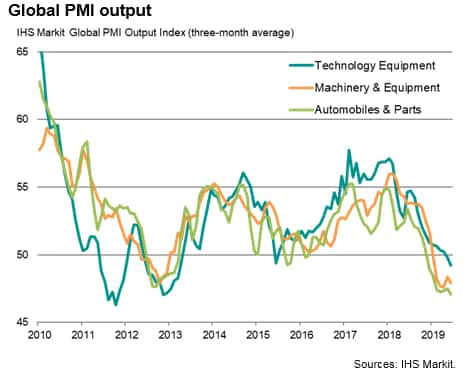
A broader PMI gauge of global investment goods production showed a similar weakness, with output down for a sixth month in June. Although some easing in the rate of decline was evident in the latest month, the average drop in output in the three months to June was the steepest calendar quarter decline since the final three months of 2012 (a downturn which was subsequently followed by a drop in official global fixed capital investment data). Official data have already shown annual global business investment growth cooling sharply up to the first quarter of the year, running at less than half the pace seen a year earlier, closely following the trend in the PMI data. The survey data therefore point to a further moderation in the second quarter.
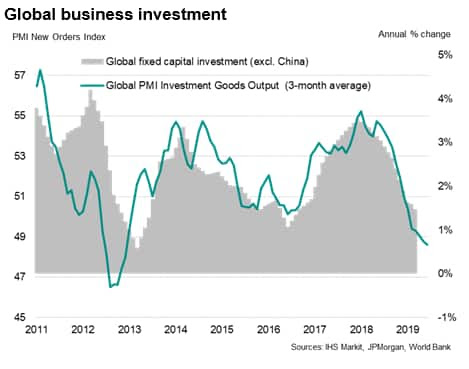
The downturn in capex spend signalled by the global PMI data highlights the extent to which rising geopolitical uncertainty has led to a broad pull-back in business spending which is likely to subdue economic growth. However, with business investment being a major determinant of future productivity and profitability, the drop in capex spend signalled is a particular red flag for future corporate earnings.

Another sector of concern is automobiles, which sat at the foot of the global sector PMI rankings in June as output fell at the second-steepest rate since 2009.

The survey data indicate that car sector output has now fallen continually since last September. However, whereas declines late last year were in part caused by temporary disruptions such as new emissions regulations in Europe (which many therefore saw as being temporary), the ongoing weakness in 2019 paints a more worrying picture of weakening demand for autos.

Other indicators added to the auto sector gloom: the sector’s PMI new orders index signalled a further steep decline in business inflows, leading to a sharp drop in car industry order book backlogs.

Such a weakening of orders books often leads to cuts in employment, so it was little surprise to see employment falling in the autos sector in June, with jobs being lost globally at the sharpest rate for over two years.
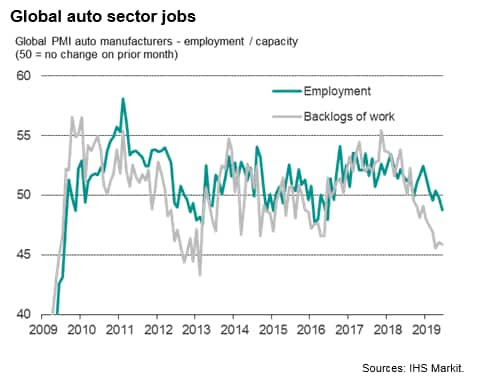
With the June survey also seeing a record drop in input buying by auto makers, a further cut in production is indicated for July. (…)

So the June 17k spike in manufacturing employment will be scrutinized in the next 2 months. Revisions in the last 3 months were downward, as were revisions for total payroll employment, generally not a positive sign for the economy in general.

From Markit’s June PMI Manufacturing Survey, polling real business people in the thick of it:

June data signalled a further near-stagnation of operating conditions across the U.S manufacturing sector. The rate of overall growth held close to May’s near-decade low. On a positive note, the rate of output growth quickened slightly amid a renewed rise in new orders. (…) Uncertainty surrounding future output growth weighed on hiring decisions among goods producers, with the rate of job creation softening to the least marked since August 2016. Expectations of production growth over the coming year remained solemn and among the weakest in the survey history in June. Manufacturing firms often raised concerns surrounding tariffs and the softer trend in new orders.

Here’s a chart of manufacturing employment per the latest PS. Notice the difference with August 2016 at the far left, just to keep your spirits tempered:

image

David Rosenberg is among the most vocal economists claiming that the U.S. is already in recession (Gary Shilling is another one). He has serious doubts about these payroll numbers:

In fact, since February, nearly every single job that has been added to nonfarm payrolls has come via the birth-death model – employment growth from the actual sample of firms in the survey has completely stalled out.

His point finds support from the Household Survey which shows flat employment year-to-date (second chart above). Even more so given that June was up 247k, including a low 31k in the private sector following –172k in the previous 3 months. Per the HS, the private sector has cut 141k jobs in the last 4 months.

To preach to non-subscribers, Rosie uses the Twitter megaphone:

I’ll share a well kept secret. The aggregate-hours worked index for all of Q2 slowed to a mere 0.6% SAAR from 1.8% in Q1. This is the weakest quarter since…Q4 of 2009! Just to reiterate. The term ‘head fake’ was coined precisely for the sort of employment report we received today. You’ll soon be scurrying to buy those bonds you sold today. (‏@EconguyRosie)

Here’s the chart:

image

But even more worrying is the quarterly decline in production workers’ hours. Naturally, employers tend to shrink hours before giving the pink slip, especially in such a tight labor market where skill is a precious commodity.

image

Let’s drill down the employment well a bit further. This was released July 3rd:

U.S.-based employers announced plans to cut 140,577 jobs from their payrolls in the second quarter of this year, down 26% from the 190,410 cuts announced in the first quarter. Despite the drop, Q2 cuts are 34% higher than the 104,800 cuts announced in the same quarter last year, according to the latest report on job cuts released Wednesday from global outplacement and business and executive coaching firm Challenger, Gray & Christmas, Inc.

Last quarter’s total is the highest for the second quarter since 2015, when 147,458 cuts were recorded. So far this year, employers have announced plans to cut 330,987 jobs, a 35% increase from the 245,179 cuts announced through the first half of last year. This year marks the highest first-half total since 2009, when 896,675 job cuts were announced.

“The second quarter is historically the slowest period for job cut plans. Companies typically have not determined staffing decisions by this point, either because they are in the middle of or are only approaching their fiscal year’s end by June,” said Andrew Challenger, Vice President of Challenger, Gray & Christmas, Inc.

Employers announced 41,977 cuts in June, down 28% from the 58,577 cuts announced in May. Despite the monthly drop, June’s cuts are 13% higher than the 37,202 cuts announced in June of last year. This is the eleventh consecutive month job cuts are higher than the corresponding month the year prior.

“Job cuts are trending higher overall. In addition to Retail, we’ve seen significant cuts in the Industrial Manufacturing and Automotive sectors in recent months,” said Challenger. (…)

Companies in the Industrial Goods sector have announced 47,651 cuts, 562% higher than the 7,194 announced through June of 2018. Meanwhile, Automotive makers and suppliers announced plans to cut 32,350 jobs through June, a 190% increase over the 11,165 cuts announced in the first six months of 2018. (…)

Companies in the Technology sector announced 21,777 job cuts through June, up 266% from the 5,942 cuts announced in the same period last year. (…)

Layoff announcements from the Automotive, Industrial, Technology and Aerospace/Defense sectors aggregate YtD 106k through June, 3.8x last year’s number, and account for 33% of all announced layoffs this year, up significantly from 11% last year. It looks like employers are now resigned to part with skilled employees.

These are layoff announcements, which should eventually show up in weekly initial unemployment claims before impacting actual monthly employment numbers. Not visible as of the end of June:

image

I will ask President Trump to take my name off the list for Fed nominee…

He’s probably right on that!

But as far as his July 2nd tweet goes…

…the Association Of American Railroad would probably question that:

 image image

Of the 20 categories that the AAR monitors, 16 are in the red for both the first 6 months and the month of June. Virtually every good produced and sold in the U.S. must be transported by rail and/or truck. Intermodal traffic is currently weaker than in 2017 while truck freight is nose diving.

 image image

In all, it seems safer to side with the bond market, not unlike most investors do as Refinitiv shows:

image

Relief coming?

Missing Spending Stimulus Weighs On U.S. Growth The economy was supposed to get a lift this year from higher government spending enacted in 2018, but so far much of that stimulus hasn’t shown up, puzzling economists.

(…) The level of the federal component of GDP in the first quarter of 2019 was $78 billion, or 0.4%, lower than what forecasters expected it would be following the February 2018 budget deal, Ernie Tedeschi, an economist at Evercore ISI, estimated.

The government is spending much less on disaster relief than it did in fiscal 2017, and a partial shutdown temporarily stalled outlays in January. Those factors explain about one-third of the missing stimulus, Mr. Tedeschi said. The rest appears to be slower spending by the federal government than previously estimated. (…)

Commerce Department data suggests the drop-off actually began at the end of 2018, almost entirely because of weaker nonmilitary spending. (…)

Part of the spending miss can be explained by a CBO forecasting quirk: The agency assumed the government would keep spending the same amount on emergencies as it did in fiscal 2017, when several major hurricanes prompted a large increase in disaster aid. That spending slowed in 2018 and 2019. (…)

Other factors could be at play. The budget deal, which affected fiscal years 2018 and 2019, didn’t come together until almost six months into the fiscal year, which may have complicated agencies’ ability to plan for the increase and spend the money. That means spending could show up later this year. (…)

CANADA: HOW DO YOU SPELL RELIEF

The Canadian economy has surprised on the upside so far in 2019 and a new source of impetus is about to hit in the coming months via falling interest rates. The best rate available for a five-year mortgage (fixed term) has dropped a whopping 70 basis points since the start of the year and now stands at a two-year low of 2.6%. Recall that mortgages set to renew in 2019 carried an effective rate of 3%. This means that current homeowners renewing in H2 2019 should enjoy a LOWER mortgage rate. Looking at the affordability perspective, a 40 basis point decline would represent a relief of $100 per month for a $500,000 mortgage. If the global economy doesn’t slow too much, Canada should do well in the coming months. (NBF)

image
EARNINGS WATCH

From Refinitiv/IBES:

Through July 5, 21 companies in the S&P 500 Index have reported earnings for Q2 2019. Of these companies, 85.7% reported earnings above analyst expectations and 14.3% reported earnings below analyst expectations. In a typical quarter (since 1994), 65% of companies beat estimates and 20% miss estimates. Over the past four quarters, 76% of companies beat the estimates and 18% missed estimates.

In aggregate, companies are reporting earnings that are 6.6% above estimates, which compares to a long-term (since 1994) average surprise factor of 3.3% and the average surprise factor over the prior four quarters of 5.3%.

The estimated earnings growth rate for the S&P 500 for 19Q2 is 0.0%. If the energy sector is excluded, the growth rate improves to 0.2%. The estimated revenue growth rate for the S&P 500 for 19Q2 is 3.4%. If the energy sector is excluded, the growth rate improves to 3.9%.

If you are relieved by the strong beat rate and surprise factor, please also consider that the 21 companies that have already released Q2 numbers have seen their profits collapse 11.2% YoY, worse than the –4.6% drop in Q1 and a total reversal from the +19.6% recorded in Q4’18.

Analyst estimates keep being ratcheted down, small and large caps alike:

imageimage

Equity investors are again flirting with overvaluation per the Rule of 20, generally prompted by the China/USA trade ping-pong game and the hope of Fed easing. At some point, people might get tired of this back and forth between hope and despair and decide to get back to fundamentals. There are not that many things that can boost P/Es at this point, are there?. Q2 earnings and guidance should be the focus for the next 4 weeks and we are not off to a strong start…

image

TECHNICALS WATCH

Lowry’s Research says that “despite the deceleration of the rally in the 2nd quarter, the forces of Supply and Demand continued to suggest that the market’s primary trend is still up” and that “there was little evidence during the 2nd quarter of the rising Supply that typically occurs in the last stages of a bull market. (…) In recent days, the positive spread
between Buying Power and Selling Pressure has widened to its best levels in nearly 2 months.”

SENTIMENT WATCH
Morgan Stanley Turns Bearish on Global Stocks as Challenges Grow Morgan Stanley cut its global equities allocation to the lowest in five years.

(…) Profit forecasts remain too optimistic, as measures of manufacturing health around the world keep deteriorating, strategists including Andrew Sheets wrote in a note Sunday. Expectations for looser central bank policy are high, leaving little to boost already elevated equity prices, they said.

“We see a market too sanguine about what lower bond yields may be suggesting – a worsening growth outlook,” they wrote. “Continued deterioration in global PMIs suggests a macro environment with plenty of downside risks.” (…)

relates to Morgan Stanley Turns Bearish on Global Stocks as Challenges Grow

Winking smile CHAIN OF EVENTS?

At the G20 in 2018:

Trump turns around to the Turkish president, Recep Erdogan, and says, ‘Except for Erdogan over here. He does things the right way,’ and then actually fist-bumps the Turkish president.” (CBS)

At the recent G20:

The US President was photographed standing between Erdoğan and Crown Prince Mohammad Bin Salman during the G20 summit Friday. Trump has a breakfast with the Saudi crown prince before a sit down with the Turkish leader.

During his meeting with Trump, Erdogan said “our strategic partnership requires solidarity in many fields.” (CNN)

Last Saturday:

Turkey’s Erdogan fires central bank chief as policy rifts deepen

Yesterday:

Trump Jawbones Fed Yet Again, May Be Grooming Powell Successor

(…) If the Fed “knew what it was doing” it would cut rates, Trump told reporters before he boarded Air Force One in Morristown, New Jersey, to return to Washington after a weekend at his nearby golf club. Fed policy is putting the U.S. at a disadvantage versus Europe and suppressing gains in the stock market, Trump said.

Sunday’s comments came after Trump said on Friday that the central bank “doesn’t have a clue” and was “our most difficult problem.” (…)

Speaking of friends:

Boeing Loses MAX Deal to Airbus Saudi airline says it will buy up to 50 Airbus jets, worth more than $5.5 billion

THE DAILY EDGE: 5 JULY 2019: No Economic Fireworks

Payroll employment increases by 224,000 in June; unemployment rate changes little at 3.7%

Total nonfarm payroll employment increased by 224,000 in June. Employment growth has averaged 172,000 per month thus far this year, compared with an average monthly gain of 223,000 in 2018. After revisions, job gains have averaged 171,000 per month over the last 3 months.

The change in total nonfarm payroll employment for April was revised down from +224,000 to +216,000, and the change for May was revised down from +75,000 to +72,000. With these revisions, employment gains in April and May combined were 11,000 less than previously reported.

The average workweek for all employees on private nonfarm payrolls was unchanged at 34.4 hours in June. In manufacturing, the average workweek edged up 0.1 hour to 40.7 hours, while overtime was unchanged at 3.4 hours. The average workweek for production and nonsupervisory employees on private nonfarm payrolls held at 33.6 hours.

In June, average hourly earnings for all employees on private nonfarm payrolls rose by 6 cents to $27.90, following a 9-cent gain in May. Over the past 12 months, average hourly earnings have increased by 3.1 percent. Average hourly earnings of private-sector production and nonsupervisory employees increased by 4 cents to $23.43 in June [+3.4%].

image

Weak Factory Orders and Shipments Data

Manufacturers’ orders declined a greater-than-expected 0.7% (-1.2% year-on-year) in May following a slightly downwardly-revised 1.2% drop in April (was -0.8%). The Action Economics Forecast survey looked for a 0.5% decrease. Factory shipments edged up 0.1% (1.4% y/y) after contracting 0.6% in April (revised from -0.5%). Shipments of nondefense capital goods excluding aircraft, also known as core durable goods, which is one of the key inputs into nonresidential equipment investment in GDP, rose 0.6% in May (+4.0% y/y) and is currently growing at 1.5% annual rate for the quarter.

Orders in the volatile durable goods sector fell 1.3% (-2.8% y/y) after dropping 2.8% in April. This decline was driven by a 4.6% collapse in orders for transportation equipment (-8.4% y/y) as civilian aircraft orders plummeted 28.2% in May. While notoriously volatile on a monthly basis, these orders have fallen 56% over two months and 66% from a year ago. Total factory orders excluding transportation edged up 0.1% (0.4% y/y). (…)

 image image

Strangely, after pointing out the growth in the important non-def cap goods ex-air series, Haver omits to signal the poor trend in new orders in same series, up only 1.4% YoY in May from +9.1% in July 2018, and up a puny 0.3% annualized in the last 4 months (down 0.8% annualized in the last 3).

image

Weakening new orders in the less volatile part of manufacturing is confirmed by the PMIs and Haver illustrates how this eventually feeds in economic growth:

image

Purchasing managers worldwide are extremely gloomy based on what they see in their daily activities managing inputs vs outputs:

June’s soft manufacturing surveys drove Goldman Sachs’ CAI to 0.7%:

image

High five Surprised smile Wait, wait! Morgan Stanley will not be outdone by GS as Zero Hedge revealed last week:

Morgan Stanley’s Business Conditions Index, which captures turning points in the economy, fell by 32 points in June, to a level of 13 from a level of 45 in May. This drop is the largest one-month decline on record and the lowest level since December 2008 during the financial crisis, according to the firm.

(…) the MSBCI suggests the Mfg PMI New Orders component will fall to 40 over the next few months, which would be down approximately 25% on a y/y basis. Another way of putting it – if Morgan Stanley’s indicator is right, the world is already in a recession.

German Factory Orders Plunge Across Industries

(…) The 2.2% overall drop on the month was far worse than the 0.2% fall predicted by economists in a Bloomberg survey. The year-on-year decline of 8.6% was the biggest in almost a decade. (…) JPMorgan now predicts that Germany may have contracted in the second quarter. If that happens, it would be the third time in a year that Europe’s largest economy posted no growth at all.

Germany’s troubles, some of which are linked to the car industry, have weighed on the euro region. Governing Council member Olli Rehn summed up the mood on Thursday, saying saying that growth has “slowed significantly” and it’s no longer possible to consider the downturn as temporary. (…)

ING adds:

(…) In particular, foreign orders dropped sharply: -5.7% MoM from non-Eurozone countries and -1.7% MoM from Eurozone countries, reflecting continued global uncertainties. After four disappointing months, domestic orders increased by 0.7% MoM. Still, domestic orders have been an even bigger disappointment than foreign orders this year, having dropped by an average of 1.5% MoM since the beginning of the year. (…)

The last two times order books shrank with a similar magnitude was in 2011/12 and 2008/9. While the former fall ended mildly with a decent rebound, the latter continued and we all know how it ended. Back to the current situation, a strong inventory build-up in the automotive industry also does not bode well for the coming months and brings back the not so distant memories of last Fall. Combined with the weakest June performance of the labour market since 2002 and disappointing retail sales, today’s new orders wrap up a week to forget for the German economy. The fear factor is back.

From Markit’s June German PMI:

(…) Overall employment in Germany is now in a lower growth phase, with the service sector providing the bulk of new jobs. In a similar vein, the PMI data have shown the strongest quarterly growth performance from the service sector for almost five years, but thanks to falling manufacturing production, overall economic output looks to be expanding at only a moderate pace. (…)

Rising inflows of new work continued to form the basis for growth across the services economy. June saw new business increase at a solid rate that was quicker than that recorded in May, albeit slightly slower than April’s seven-month high. Continuing the theme of recent months, the main driver of the increase in new business was stronger demand from domestic sources. New work from abroad fell for the eleventh time in the past 12 months and at the quickest rate since January 2015. Surveyed firms partly attributed this to delayed decision-making among European clients. (…)

But the survey’s forward-looking indicator – the only one based on sentiment – raises question marks over how long the service sector can continue growing at such a pace and keep compensating for the weakness in manufacturing. Slowdown fears have weighed on service sector optimism, which is now the lowest since October 2015.

And the subsequent German Construction PMI:

(…) The latest figures show that the construction sector has lost all of its growth momentum, with the PMI slipping for the third month in a row in June to register in line with the 50 ‘no change’ mark. Only commercial activity increased, with the previously strong housing activity component having its first setback in eight months. (…)

image

Germany is but a microcosm of the Eurozone’s cyclical industries as Markit shows:

image

Markit’s Eurozone Nowcaster is pointing down:

China Reiterates Demand That U.S. Must Lift All Tariffs

On Friday, an influential blog connected to state media said the talks will “go backward again” without that step, echoing the line from Ministry of Commerce’s weekly briefing on Thursday. (…) “If the two sides are to reach a deal, all imposed tariffs must be removed,” Ministry of Commerce Spokesman Gao Feng said on Thursday. “China’s attitude on that is clear and consistent.” (…)

China laid out three red lines for a trade deal when the talks collapsed in May. As well as the removal of all the tariffs, any purchases must be in line with the country’s real demand and the deal must be based on equality and mutual respect.

Chinese purchases of U.S. agricultural products is the country’s “special chip” in the negotiation, and any imports will depend on whether the talks will be equal and mutually respectful, according to the Taoran Notes commentary.

China is apparently considering buying some agricultural goods from the U.S. as a gesture of goodwill, but so far, there has been no sign of the “tremendous” purchases that President Donald Trump said China had promised to make.

Crunch Time Looms for Trump’s New Nafta

(…) Next Tuesday is the first day Trump can send the USMCA implementing legislation to Congress, starting the clock for lawmakers to take it up. (…)

U.S. Trade Gap Widened in May Despite Tariff Moves Trade deficit in goods and services jumped 8.4% in May from a month earlier

(…) The gap widened because of the biggest monthly rise in imports in more than four years along with moderate growth in exports amid a cooling global economy.

The monthly trade figures provide a window into how U.S. trade is affecting the economy. Sarah House, a senior economist at Wells Fargo , said that a bigger trade deficit appears likely to shave around half a percentage point off economic growth in the second quarter after adding almost twice that much in the first.

Regarding U.S. trade with China, the bilateral goods deficit widened in May by 12% from the prior month to $30.2 billion, as both imports and exports rose sharply. (…)

Capital Economics said it expects gross domestic product growth in the second quarter to come in around 1.5% in annual terms, down from 3.1% in the first quarter. (…)

How the trade balance performs going forward, she said, will in part depend on whenBoeing Co. is able to resume exports of its best-selling 737 MAX aircraft, which has been grounded since March due to safety questions. Civilian-aircraft exports rose in May from April but were down 12% in the first five months of 2019 compared with a year earlier. Many economists expect aircraft shipments to decline further in the months ahead.

Imports rose 3.3% in May from April, the fastest monthly growth since March 2015, to $266.16 billion, the Commerce Department said Wednesday. The increase was led by a 7.5% rise in automotive imports, to a record $33.23 billion, as well as an 11% jump in crude-oil imports, to $13.02 billion.

Exports, meanwhile, increased 2% to $210.64 billion, the biggest monthly increase in a year. Outbound shipments were boosted by a 41% jump in exports of soybeans, which have been volatile in the past year after being targeted by China for retaliatory tariffs. (…)

Many suggest that beat-the-tariffs imports played a big role in May’s trade numbers. Perhaps, but Canada’s exports to the U.S. jumped 8.1% YoY in May without any tariff issues.

Canada Posts Unexpected Trade Surplus on Record Exports to U.S.

(…) The country ran a rare trade surplus of C$762 million ($582 million) in May, from a deficit of C$1.1 billion previously. It’s only the fourth surplus for the country since oil prices began declining in 2014, driven by a 4.6% increase in exports. (…)

Exports to the U.S. increased 3.7% [MoM] to a record C$39.3 billion, widening Canada’s trade surplus with its biggest trading partner to C$5.9 billion — the largest since October 2008.

May’s export jump comes on the heels of other strong gains, bringing the increase in merchandise shipments to 15% since December. That’s the biggest five-month gain in Canadian exports in more than a decade.

Export volumes — the variable that goes into calculations of real growth — were up 4% in May, the most since August 2016. (…) Nine of 11 sectors tracked by Statistics Canada recorded an increase in exports in May, led by a 12.4% jump in motor vehicle shipments. Non-energy exports are up 6.3% since December. (…)

Some economists now anticipate annualized growth could come in closer to 3% in the second quarter, well above Bank of Canada expectations for 1.3%.

Canada non-energy export volumes strengthen

The Peterson Institute takes a global view of trade:

Trump Has Gotten China to Lower Its Tariffs. Just Toward Everyone Else.

China increased its retaliatory tariffs hitting US exports on June 1 in response to President Donald Trump’s latest escalation of his trade war. Yet, this action is only half of the bad news for US exporters. The other half is that China has begun rolling out the red carpet for the rest of the world. Everyone else is enjoying much improved access to China’s 1.4 billion consumers, a fact that has been little noticed or reported in accounts of the US-China economic confrontation. (…)

Figure 1: China’s average tariff rate is climbing on US goods and falling for the rest of the worldAs China’s economic growth has slowed during the trade war, its imports from both the United States and the rest of the world have also fallen (figure 4). China’s tariff reductions toward the rest of the world are likely to have helped stem the decline in imports from those countries. Nevertheless, the drop in US exports to China—due to slowing domestic demand, the retaliatory tariffs, as well as the incentive to switch to other foreign sources—is much more severe. (…)Figure 4: China’s imports from the United States have declined much more rapidly than imports from elsewhere during the trade war

This is not good news for US exporters. China’s retaliatory tariffs put them at a disadvantage relative to local firms, which obviously don’t have to pay any border taxes. But reducing tariffs on imports from other countries means US exporters also face an increasing disadvantage relative to competitors in Canada, Japan, Europe, and elsewhere. (…)

THERE WILL BE BLOOD
Farmers Built a Soybean Export Empire Around China. Now They’re Fighting to Save It. Trade tensions have hammered sales of soybeans to the Chinese, a major export market it took U.S. agriculture decades to create. Growers are traveling to Beijing and Washington to plead their case. “Farmers can’t say, I’ll just grow broccoli this year.”

The customer is China and the export is soybeans, of which the U.S. shipped $21 billion abroad in 2017, far more than anything else farmers grow. That marked a tripling in two decades, the fruit of a sweeping effort, by nearly every arm of U.S. agriculture, to build a once-obscure crop into a blockbuster.

Then last year, sunk by a bitter trade dispute, American soybean exports to China plunged 74% by volume. Brazil raced to fill the gap, while prices paid to U.S. farmers recently slid to a seven-year low. (…)

Last year, U.S. farmers planted soybeans on more than 89 million acres, an area roughly the size of Montana. That was more than the land planted to corn, long Midwestern farmers’ crop of choice.

Seed companies, grain traders, railroads and other businesses have all been part of the soybean-industry buildup—investing heavily, rolling out new varieties and adding rail capacity to ferry crops to market. (…)

Joe Steinkamp, an Indiana farmer and a director of the American Soybean Association, brought such a message to a recent meeting with Gregg Doud, chief agricultural negotiator for the Office of the U.S. Trade Representative. Mr. Steinkamp said he expressed concern about destroying export markets for younger farmers who are struggling with debt loads or access to credit.

“We don’t want the next generation to be scared away from agriculture,” Mr. Steinkamp said, on what was his third trip to Washington since Chinese tariffs took effect. “Markets don’t just come back.” (…)

The U.S. share of world soybean exports is expected to drop to 31% this season, the lowest on record, while Brazil’s portion is forecast to swell to 52%, which would be its largest ever.

At an agricultural forum in Beijing last fall, according to Mr. Schickler, China’s deputy agriculture minister said China would not easily forget the current standoff, and China is building alternatives for soybean imports so it will never again be so dependent on a single source.

(…) Brazil’s ambassador to China told the group his country was working to become China’s most reliable supplier.

According to Mr. Sutter, the CEO of the Soybean Export Council, Chinese companies are working to develop soybean production in Russia, where soybeans haven’t yet become a major crop.

American farmers have few easy options if Chinese demand for U.S. soybeans remains depressed. Robust world grain supplies suggest there is little need for additional U.S. corn or wheat production. Switching to a new crop would require huge investments in equipment and infrastructure, to say nothing of finding viable markets. (…)

For that reason, the U.S. soybean industry is also working intensely to woo buyers in other international markets. The largest single-country export customer after China is Mexico. (…)

Restoring trade with China remains a critical goal for the export council. “We need to be looking for a way to get out of the mess we’re in” with China, said Mr. Adams, the former American Soybean Association president. In the trade fight, in his view, “We’re going to have to blink.”

(…) “If the US flip-flops again in the negotiations, the promises to buy American agriculture products will also be overturned,” Taoran Notes said. (…) The commentary was published ahead of next week’s revival of trade talks, when American negotiators will visit Beijing.

A lot will ride on how the US government handles the supply ban on Chinese telecom giant Huawei Technologies, sources have told the South China Morning Post. (…)

Beijing remained coy on whether China would immediately resume buying American soybeans, an American source briefed about the situation told the South China Morning Post.

He said Beijing wanted first to see how – and if – the Trump administration would ease the supply ban on Huawei, as promised by Trump.

He said the White House probably would make an announcement “in the next couple of days” on the conditions under which American companies would be allowed to resume supplying the Chinese tech giant.

The Chinese would then commit to buying American agricultural products. (…)

GM’s China sales decline for fourth straight quarter amid economy woes

(…) U.S. car companies’ share of China’s passenger vehicles market has fallen to 9.6% in the first five months of this year from 10.9% in the year-ago period, according to CAAM. Over the same period, German car makers’ share has risen to 23.3% from 20.9% and Japanese auto makers’ to 21.3% from 17.3%. (…)

Samsung Electronics Expects Quarterly Operating Profit to Fall More Than 50% sluggish demand for memory chips was exacerbated by the nagging U.S.-China trade dispute.

Samsung said it expects operating profit to fall to 6.5 trillion South Korean won ($5.56 billion) from 14.87 trillion won a year earlier. Revenue is expected to fall 4.2% to 56 trillion won. The company will report final results later this month.

The Suwon, South Korea-based company’s preliminary results exceeded market expectations. Analysts expected an operating profit of 6.01 trillion won and revenue of 54.6 trillion won for the quarter, according to S&P Global Market Intelligence.

Analysts say the company benefited in the quarter from a weaker-than-expected domestic currency and what the company described as a “one-time gain related to the display business.” (…)

The South Korean tech giant could experience further geopolitical headwinds in the coming months. Earlier this week, Japan effectively placed export restrictions on South Korea for three materials used to produce semiconductors and displays. The move could affect Samsung’s production yields for chips and displays since the materials can’t be easily replaced in the production process.

Dow Industrials Close at Record High The Dow Jones Industrial Average closed at a record, its first new high in nine months and fourth straight session of gains. The Dow was the last of the three major indexes to notch a record this year.
TECHNICALS WATCH

CMG Wealth’s Trade Signals and Lowry’s Research’s analysis all suggest a positive technical picture:

  • 13/34–Week EMA Trend Chart

  • Volume Demand vs. Volume Supply

  • S&P 500 Index 200-day Moving Average Trend

  • S&P 500 Index 50-day vs. 200-day Moving Average Cross

However, the gap to the slightly rising 200dma is wide:

image

image

Mutually Assured Disruption in Silicon Valley With venture-capital funds flowing freely, everyone wants to be a disrupter; few actually disrupt

(…) The heightened competition is reflective of an era where big investors, desperate to generate returns when interest rates are low, are plowing money into startups like never before. By The Wall Street Journal’s count, as of April there were 88 still-private U.S. startups valued at $1 billion or more, up from 43 just five years earlier. (…)

Squeezed by U.S. Sanctions, Iran Shifts From Patience to Confrontation Tighter new U.S. sanctions have proven more punishing than Iran’s leaders expected, driving Tehran to hit back militarily and breach limits it had agreed to put on its nuclear program.

Well, with all the above, I hope we all have a nice weekend!