- 88. The U.S. hit a grim milestone this week when it surpassed 100,000 confirmed coronavirus deaths. I realize “time†is a squishy concept, but it’s important to note the U.S. went from zero to 100,000 in just about 88 days, calculates Fortune‘s Lance Lambert. Few countries have managed the outbreak well. Most days it seems like we’re looking at a game of whack-a-mole where hotspots smolder and cool off, only for new hotspots to emerge. According to the New York Times, the number of infections and deaths are rising in more than a dozen states. The stock markets may be soaring, but this public health crisis is far from over. (Fortune)
PANDENOMICS
Easing Unemployment Claims Show Slower Pace of Coronavirus-Related Layoffs
Initial claims for unemployment benefits declined to a seasonally adjusted 2.1 million last week from 2.4 million the prior week, the Labor Department said. The level of claims is still 10 times prepandemic levels but has fallen for eight straight weeks.
Meanwhile, the number of workers receiving jobless payments for the week ended May 16 was 21.1 million, down 3.9 million from the prior week. The level remains well above the record before this year—6.5 million in 2009—and underscores that tens of millions remain jobless. (…)
Employees reported for 17% more shifts for the seven days ended May 24 than they did six weeks earlier, when job activity bottomed out, according to Kronos, a Massachusetts workforce management software company.
And some firms have begun hiring. Job search site Indeed.com said job postings have increased during the past three weeks, though the total is still down 35% from a year earlier.
Companies are also bringing back workers to qualify for government loan forgiveness, though some have warned they may need to lay off employees again when that support runs out. (…)
Many economists say it will take many months, if not years, to replace all the jobs lost this spring. Forecasters at the University of Michigan project the pandemic-related shock will result in about 30 million total jobs lost, with about a third of those returning this summer. (…) (WSJ)
U.S. GDP Decline in Q1’20 is Deepened; Corporate Profits Plunge
U.S. GDP declined 5.0% (SAAR) last quarter, revised from -4.8%, following a 2.1% Q4’19 rise. An unrevised 4.8% fall had been expected in the Action Economics Forecast Survey. (…)
After-tax corporate profits without IVA & CCA declined 16.0% (-11.1% y/y) with the decline in business activity. Profits with IVA & CCA fell 13.9% (-8.5% y/y). Nonfinancial sector profits were off 11.9% (-5.2% y/y) while financial profits declined moderately. Foreign sector profits fell 10.8% (-3.2% y/y).
Domestic final sales was shaved to 4.8% last quarter from -5.4%. The decline was lessened as the consumer spending fell 6.8% (+0.6% y/y), revised from -7.6%. (…)


- Goldman Sachs US Economics forecasts the unemployment rate will spike to 25% before ending the year at 12%.
- U.S. Pending Home Sales Plunge to Record Low Pending home sales fell 21.8% in April.
- STR: US hotel results for week ending 23 May
STR data ending with 23 May showed another small rise from previous weeks in U.S. hotel performance. Year-over-year declines remained significant although not as severe as the levels recorded in April. (…) “What was also noticeable in the week’s data was the higher occupancy levels across all classes of hotels. Economy properties continued to lead, but we also saw the higher-priced end of the market up over 20%. Regardless, Upper Upscale occupancy continues to lag the broader industry as meeting demand is still not returning.†(…) (Chart from CalculatedRisk)

Americans Have Stopped Thinking the Economy Is Getting Worse
This is from recent survey data that Democracy Fund/UCLA Nationscape shared with Bloomberg Businessweek. The survey asks more than 6,000 people each week whether the economy is better, worse, or about the same as a year ago:
But it only stopped getting worse, at a very low level. Gallup:

Banks report uptick in credit card spending, loan activity as consumers loosen pandemic purse-strings
(…) Consumer spending and loan origination has rebounded to varying degrees over the past two months. Bank of Nova Scotia saw total consumer spending fall by 35 per cent in mid-March, then steadily improve since the beginning of April. Spending is now just 4 per cent below prepandemic levels, according to Daniel Moore, chief risk officer at Scotiabank.
National Bank, meanwhile, saw weekly mortgage originations drop by 50 per cent, year-over-year, in early April, and auto lending plummet 80 per cent. Both segments have rebounded in recent weeks, and are now 5 per cent and 35 per cent below last year, respectively.
Over the course of the pandemic, spending patterns have varied by sector, said Neil McLaughlin, Royal Bank of Canada’s head of personal and commercial banking. RBC clients spent about 50 per cent less at restaurants in the quarter, which ended on April 30, but spent about 20 per cent more at grocery stores and pharmacies, he said.
“Net for the quarter, we were down about 12 per cent or 13 per cent in terms of spending. … There’s about $5-billion of purchase volume that we had anticipated that did not materialize because of the COVID measures,†Mr. McLaughlin said on a Wednesday conference call.
Across all of the big banks, credit card balances have come down. Likewise, lines of credit, which were drawn down heavily in March, are starting to be repaid. (…)
Taken together, the Big Six banks have deferred payments on more than $200-billion worth of mortgages, personal loans and credit cards. The payment holidays range from one to six months. What will happen at the end of this deferral period remains the biggest outstanding question for bankers and policy makers alike.
- Europe inflation dropped further to 0.1% as the decline in the oil price continued to work its way through to petrol prices in May. The decline in energy prices was -12% YoY, which far outweighs the somewhat higher unprocessed food inflation of the lockdown. Core inflation has remained surprisingly stable at 0.9%, which might have been influenced by the difficulty in gathering data gathering during the lockdown period. (ING)
- The aviation industry’s recovery from the coronavirus outbreak will be long and slow, with passenger numbers likely to stay below pre-pandemic levels through 2023, according to S&P Global Ratings, which warned of more rating downgrades for airports over the next few months. Global air passenger numbers will drop as much as 55% this year, a far steeper slump than previously estimated, analysts including Tania Tsoneva and Julyana Yokota wrote in a report dated May 28.
- CN lays off 5,800 as rail traffic, economic demand fall
- Renault SA plans to eliminate about 14,600 jobs worldwide and lower production capacity by almost a fifth as part of cost reductions aimed at outlasting the downturn that has rocked the global auto industry. The plan includes cutting almost 4,600 positions in France, or about 10% of the carmaker’s total in its home country, through voluntary retirement and retraining, according to a statement Friday. More than 10,000 further jobs will be scrapped in the rest of the world, trimming a global workforce of about 180,000 people.
- Volkswagen Pours More Than $2 Billion Into China’s Electric-Car Industry Volkswagen is raising its share in a Chinese electric-vehicle joint venture and buying 26% stake in a local battery producer.
Our Exploding National Debt – How Will It Be Managed Post-Covid?
This is from Haver Analytics’ Paul Kasriel:
(…) Before the COVID-19 pandemic hit, the US was facing a federal fiscal environment that, according to the CBO, was on a course to push the ratio of federal debt to GDP above the 1946 high. (…) The forecast shows that in 2037 federal debt as a percent of nominal GDP is forecast to surpass the previous high of 106% set in 1946 and continue higher through the end of the forecast period. (…)
Given that we will soon be at or above WWII levels of national debt relative to GDP, it might be instructive to review how the debt-to-GDP ratio was brought down after the war. (…) For starters, the federal government ran small budget deficits relative to nominal GDP. Chart 4 shows that the 20-year moving average of the federal budget deficit as a percent of nominal GDP reached a post-WWII minimum of 0.1% in fiscal year 1966. How did the Treasury accomplish this narrowing in its budget deficit relative to nominal GDP?
For starters, personal federal income-tax rates were raised in 1942 after the breakout of WWII and stayed above their pre-war levels until 1964 (see Chart 5). So, income-tax rates remained high in order to generate revenues to help narrow the Treasury budget deficit. In addition to keeping marginal income-tax rates high, Congress showed restraint in federal spending. As shown in Chart 6, the annualized growth in federal outlays slowed to a post-WWII low rate of 1.2% in the 20 years ended 1965.

When WWII broke out, the Fed entered into an agreement with the Treasury to peg the yields on Treasury bills and bonds. The Fed pledged to keep the interest rate on 3-month Treasury bills from rising above 3/8% and the yield on Treasury bonds from rising above 2-1/2%. Around midyear 1947, the Fed stopped pegging the rate on Treasury bills. In March 1951, the Fed reached an “accord” with the Treasury to stop pegging the yield on Treasury bonds.
Pegging the yields of Treasury securities at low levels helped restrain the cost of servicing the massive amount of debt outstanding. But it also required the Fed to purchase large amounts of securities in order to enforce the interest-rate pegs. This manifested itself in rapid growth in the money supply. All of this is shown in Chart 7. The rapid growth in the money supply during WWII under normal circumstances would have resulted in high inflation. But from early 1942 through the spring of 1946, the federal government imposed controls on prices. But, as shown in Chart 8, after the lifting of price controls in the spring of 1946, the prior rapid growth in the money supply resulted in a sharp increase in consumer-price inflation in 1947.

Speaking of inflation, that is another method to bring down the federal debt-to- nominal GDP ratio. It sure worked wonders during the 1970s and early 1980s in bringing down the federal debt-to-nominal GDP ratio, as shown in Chart 9. If the central bank creates higher inflation, this boosts nominal GDP. Thus, for a given amount of federal debt outstanding, the ratio of debt to GDP falls. But won’t higher inflation increase interest rates because of the expected-inflation premium? And won’t that result in an increase in debt issuance due to the higher debt-servicing costs?
Higher inflation will raise those interest rates on maturities of securities the central bank is not pegging. For example, if the central bank is pegging interest rates on short-maturity securities, then interest rates on longer-maturity interest rates will rise in reaction to the higher inflation. The government need not incur higher debt-servicing costs if it refunds maturing debt and issues new debt in the short-maturity range. Alternatively, the central bank could peg interest rates at the long end of the maturity spectrum. Then the government would finance maturing and issue new debt at the long end of the maturity curve.

I don’t know how the Treasury is going try to prevent the national debt-to-GDP ratio from exploding ever upward once the COVID-19 epidemic is over and the economy is in a strong recovery phase. Perhaps there the body politic will accept some tax increases. But there was no appetite for that before COVID-19. Certainly the COVID-induced safety-net spending will be cut. But the primary drivers of post-COVID spending will be Social Security and Medicare. Do you think we Baby Boomers will vote for that? Perhaps COVID will take enough of us Baby Boomers out so there will be a reduced supply of Social Security and Medicare beneficiaries, but don’t bet on it.
That leaves us with inflation, the silent tax, coming on the heels of the silent COVID-19 “enemy”. In the past 20 years, the median percent change in the annual average CPI (all items) has been 2.2%. My bet is it will be higher than 2.2% over the next 20 years? My bet also is that the level of interest rates, other than the maturity sector the Fed pegs, will be higher than what we have become accustomed to in recent years. Equities might have some competition.


Mr. Williams said the Fed’s support actions, which have boosted its balance sheet to just over $7 trillion from $4.2 trillion in early March, are aimed at bridging the economy over the crisis and aren’t a form of outright stimulus. (…)
Mr. Williams also pushed back at any notion the Fed was looking to use negative interest rates as a stimulus tool during the current troubles, saying such a policy wasn’t right to address the challenges facing the nation.
For now, the governments’ and central banks’ bridges are preventing a depression. But much buying power and demand will have been destroyed for good. The output gap will remain large for a while.

DEALING WITH UNCERTAINTY
Goldman’s David Kostin sees five key drivers that powered the rally:
(1) A series of critical monetary policy initiatives by the Fed; (2) massive fiscal stimulus by Congress; (3) a bending of the viral curve in the US; (4) a narrow group of large-cap stocks that lifted the cap-weighted index while the typical stock lagged; and (5) optimism about the restart of the economy. (…)
Items 1,2,3 and 5 removed the extreme fear that peaked March 23rd. Item 4 provided some fundamentals to buy certain stocks/sectors and created general momentum. Just in the past two weeks, the Nasdaq tech-heavy index rose nearly 5%, pushing it into positive territory for 2020 (4.4% higher YTD). Essentially more of the same since 2013. Per Ed Yardeni’s numbers:
Since 2013:
- S&P 500 Index: +192% (+9.1% annually); earnings +125% (+3.0%)
- FANG stocks: +734% (+30.4%); earnings: +653% (+28.4%)
- S&P 500 ex-FANGs: +173% (+7.6%)
Kostin continues:
Our baseline 2021 EPS forecast of $170 represents a best-case scenario — achievable, but definitely optimistic. Current valuation based on our macro model implies business steadily normalizes. If these developments transpire, at year-end 2020 the S&P 500 will be trading at 18x our 2021 EPS estimate and 20x buy-side expectations. The risk of an economic, earnings, trade, or political hiccup to normalization means near-term returns are skewed to the downside, or neutral at best. (…) Monetary and fiscal policy support limit likely downside to roughly 10% (2750).
Q2 earnings are seen falling $18 YoY which would take trailing EPS down to $140 at the end of August. If inflation is stable at 1.4%, the Rule of 20 P/E would be 21.1 at 2750. It troughed at 15.9 in March.
One can also wonder how long item 4 above will continue its momentum. Still using Ed Yardeni’s data and charts:
Forward P/Es:
- S&P 500 Index: 13.0 in 2013, 21.2 on May 21
- S&P 500 ex-FANGs: 12.5 in 2013, 19.4 on May 21

FANG stocks were selling at 60x forward earnings in 2013, now 62.5. Since 2016, they have not sold at more than 60x and since 2019 rarely more than 50x.

However the pandemic helps their respective businesses going forward, these 4 companies are now very large, challenging their capability to keep growing at the same lightspeed rates (next charts via Morningstar/CMPS):

And its not like if their EPS have been keeping pace with sales:

Their net margins are generally in a downtrend:

All this to say that the FANGs’ current high momentum and expectations (valuations) are not without fundamental risks.
Rosenberg: This is when the stock market rally is likely to unravel – and it’s not going to be pretty
(…) We know what the market has priced in and what it is willing to ignore. If there is no vaccine success by the end of the summer, risk assets will have a very tough time with that, and what I now call the “benefit of the doubt†rally will peter out and roll over.
We have to tack on the added complication of a U.S. election in November. Donald Trump is trailing badly in the polls, even in some of the key battleground states, and I see in the betting markets that the Senate is now a toss-up. The market is not looking that far out, but I can tell you that a Democratic sweep would not be good news for capitalism or the stock market, and while top marginal personal, corporate and capital-gains tax rates won’t go up immediately, they will be going up at some point. All the portfolio managers who are bullish today because they don’t see the current situation as impairing the long-run normalized earnings curve will undoubtedly have to start making some permanent downward adjustments to that curve on an after-tax basis. (…)
Speaking of polls:
- Prediction markets currently assign a 78% probability the Democrats control the House of Representatives, a 51% likelihood of occupying the White House, and a 48% probability of controlling the Senate.
- President Donald Trump’s prospects of winning a second term in office will be closely tied to the level of his job approval rating. Historically, all incumbents with an approval rating of 50% or higher have won reelection, and presidents with approval ratings much lower than 50% have lost.
- Trump, like his two immediate predecessors, has approval ratings in the mid-to-upper 40% range, which indicates his reelection is uncertain. Thus, even a modest increase or decrease in his approval ratings significantly alter his odds of winning a second term.
To sum up, we need to acknowledge that, at this particular moment, more than most other moments, we know nothing about the immediate and intermediate future: Covid-19, economy, finance, revenues, margins, profits, elections, etc., etc…
Oaktree’s Howard Marks wrote about uncertainty a few weeks ago and again yesterday:
Since we know nothing about the future, we have no choice but to rely on extrapolations of past patterns. By “past patternsâ€, we mean what has normally happened in the past and with what severity. (…) How can we prepare for something if we can’t predict it? Turned around, if the greatest extremes and most influential exogenous events are unpredictable, how can we prepare for them? We can do so by recognizing that they inevitably will occur, and by making our portfolios more cautious when economic developments and investor behavior render markets more vulnerable to damage from untoward events.
This is where the Rule of 20 helps most. We know more about the present than about the future. At least, we know where valuations currently stand and we know how they fluctuate, almost inevitably:

- We know valuations are on the high side.
- We know that earnings will keep falling throughout 2020, making current valuations on trailing EPS even more expensive on future EPS.
- We know a full-V-shape recovery carries very low odds.
- We know about the enormous debt overhang building up.
What we don’t know:
- timing for medicine/vaccine availability on a large scale.
- inflation/deflation?
- elections?
We know this is not “buy-low†time and that risk management is paramount. We know we can prepare.
13/34–Week EMA Trend: (CMG Wealth)

WHO FEARS ZOMBIES!
From STA Wealth Management:
The chart below from Arbor Data Science illustrates strong stock market returns during the recent rebound for companies that have had a low EBIT/Interest expense ratio over the last three years.

Ned Davis Research calculated that 36% of Russell 2000 companies were unprofitable in 2019. Q2 EPS for the Russell 2000 Index are expected to be down 95% and Credit Suisse says that
35% of Small Caps are expected to lose money in 2Q, versus just 15% for Large. EPS growth is
expected to lag Large Caps across all major groups with the greatest differences in Health Care
(51% vs. 12% losing money) and TECH+ (36% vs. 7%).
So small caps’ earnings are cratering at twice the rate of large caps’. Yet:


 BAR NONE?
Barry Ritholtz recently interviewed Jon Taffer (Bar Rescue):
So by effect, the regulations to open a restaurant has closed the bar. Now you can order a drink at your table, but the bar itself is closed for walk-up or sit-down customers. (…) So the bar industry is far more challenged than the restaurant industry is. And I’m very concerned we’re going to lose about 40 percent of them.
JP Morgan agrees
High-traffic, destination oriented, bar-focused businesses without
drive-throughs or meaningful delivery (below 10% of sales) will
likely have the most difficulty recovering previous peak customer
counts.
But, well, don’t count American solidarity out just yet:
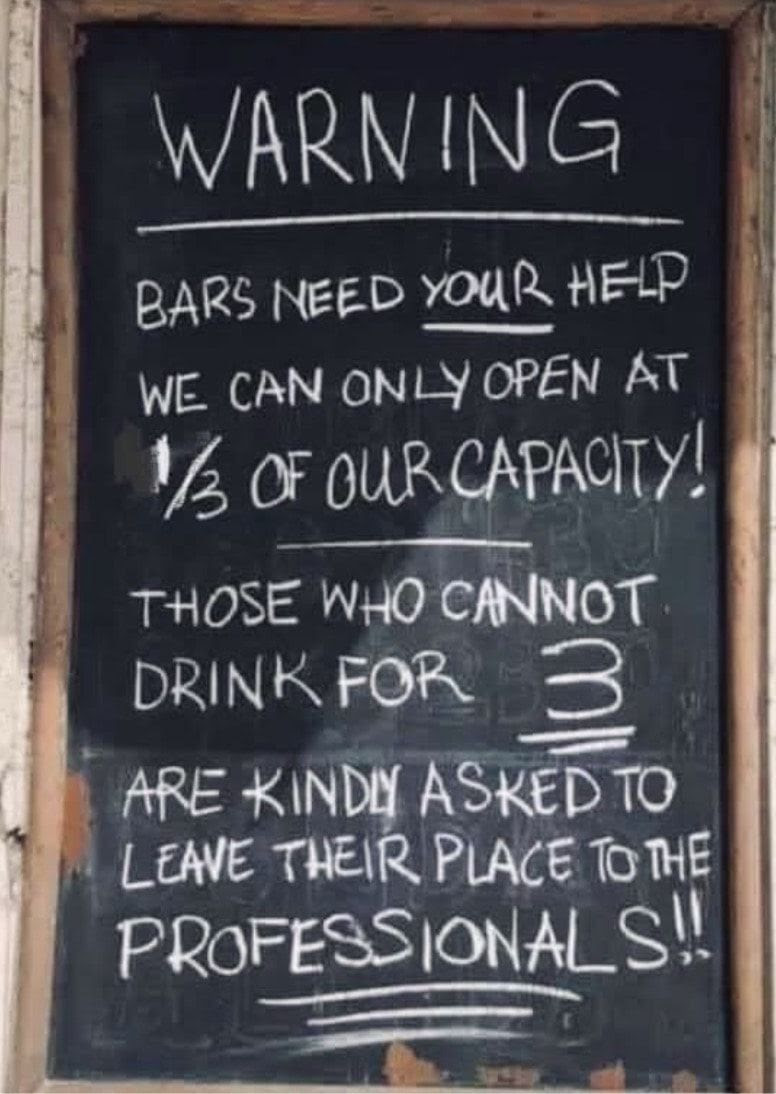
Cheers!


 Another is that even if we didn’t have big imbalances before, the slump may be creating them now. Think of business closures, which will require time to reverse.

 Moscow says Putin and Saudi Arabia’s Mohammed bin Salman agreed to ‘close coordination’ on oil output