The enemy of knowledge is not ignorance, it’s the illusion of knowledge (Stephen Hawking)

It ain’t what you don’t know that gets you into trouble. It’s what you know for sure that just ain’t so (Mark Twain)

Invest with smart knowledge and objective odds

THE DAILY EDGE: 24 SEPTEMBER 2020

Europe, Shunning New Lockdowns, Fights Resurgent Coronavirus With Local Restrictions Governments want to avoid returning to the full-blown lockdowns of early 2020, including widespread business closures and stay-at-home orders, which broke the pandemic’s first wave but also froze European economies.

(…) From Madrid to Marseille to the English Midlands, local interventions range from restrictions on bars to limits on social gatherings and travel. But, so far at least, infections are still rising rapidly in the worst-affected areas.

“These measures are not very effective,” said French epidemiologist Catherine Hill. “We are headed straight for disaster.” She said France’s government should focus instead on building up mass testing and quickly isolating infected people. (…)

Madrid is a major reason why Spain is now recording around 11,000 new coronavirus infections on an average day. In the Madrid region, one in four hospital patients is a Covid-19 case, and 23% of coronavirus tests are coming back positive, a sign that contagion is far from under control. (…)

coronavirus-data-explorer (25)

coronavirus-data-explorer (26)

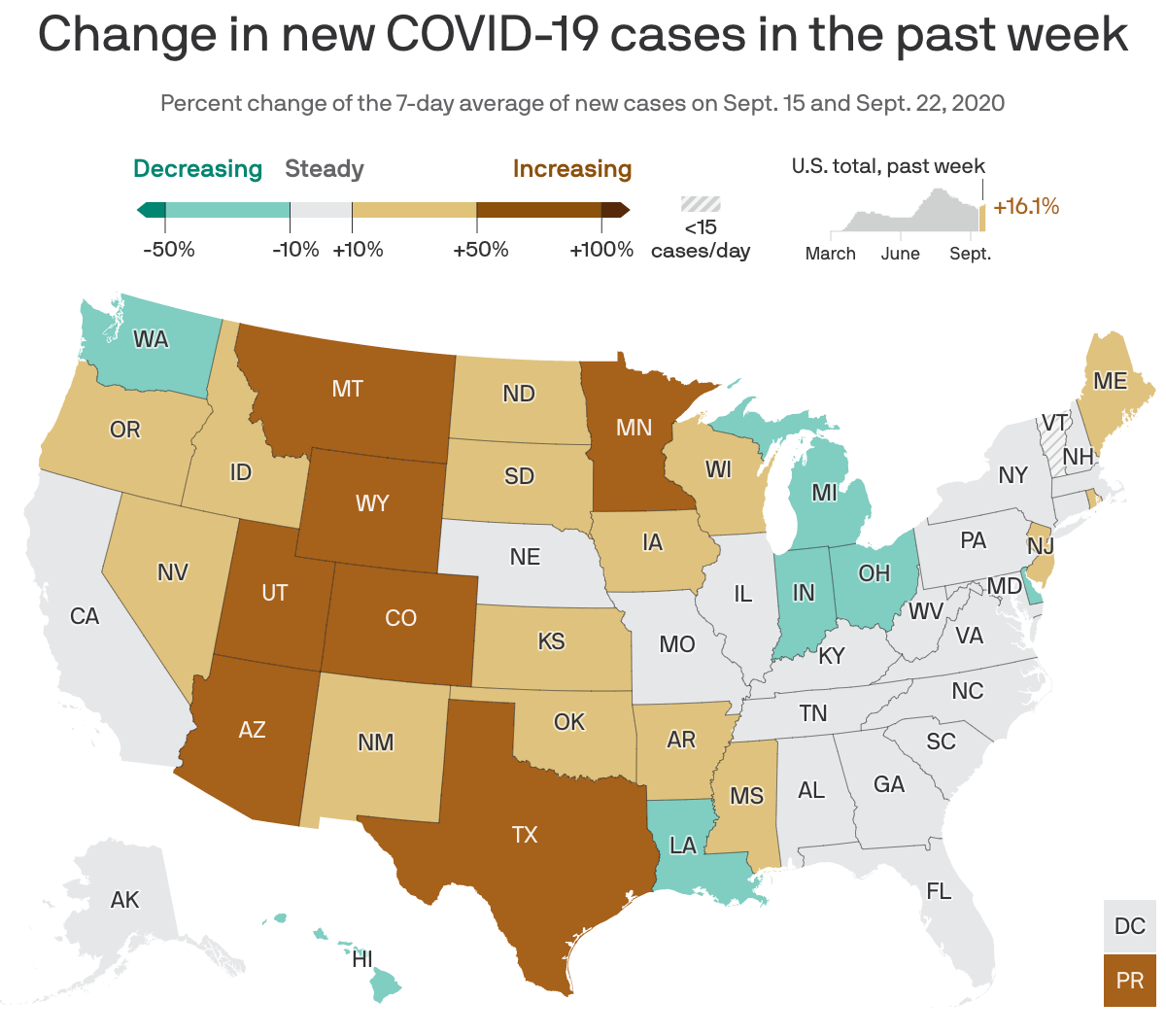
  • The coronavirus is surging once again across the U.S., with cases rising in 22 states over the past week, Axios’ Sam Baker and Andrew Witherspoon write.
  • Moscow registered 1,050 new cases in the last day, the first time that the Russian capital diagnosed over a thousand infections since June.
  • New daily cases in Moscow have grown by two-thirds since Sept. 1, when schools opened nationwide. The number of infections is rising throughout Russia, with 6,595 new cases in the last day.
  • The Israeli government sharply tightened lockdown restrictions for the next two weeks in an effort to rein in a coronavirus outbreak that’s spun out of control.
  • CDC director Robert Redfield said he expects “the entire American public completely vaccinated” against coronavirus by July and anticipates around 700 million doses of a vaccine to be available by late March or April. (Reuters)
  • Sinovac Biotech will seek approval globally for its coronavirus vaccine by the end of the year after a successful completion of a trial in Brazil, said Chief Executive Officer Yin Weidong. So far, the shot has shown a very good safety profile with very few low-fever cases and offers cross-protection against different strains.
  • President Donald Trump said that the White House could veto any tightening of Food and Drug Administration rules for authorizing the emergency use of a coronavirus vaccine. (…) The FDA is expected to issue final rules in coming days for issuing an emergency-use authorization for a coronavirus vaccine. “That has to be approved by the White House,” Trump said at a news conference on Wednesday. “We may or may not approve it.”
  • Some Covid-19 Patients Show Signs of Heart Damage Months Later
Concern Over Outbreak Among Gen Zers Takes Sharp Dive

In the latest update [the latest survey was conducted Sept. 18-20, 2020] to our Coronavirus trend tracker, concern over the outbreak has taken a significant drop among Gen Zers. Compared to a week ago, the share of Gen Z adults who said they were very concerned about the coronavirus outbreak dropped 13 percentage points to 38 percent, from 51. (Morning Consult)

unnamed (73)

Confused smile What have these 15-21 year-olds just learned we haven’t learned yet?

Business Roundtable CEO Economic Outlook Index Up in Q3

(…) Forty percent said they expect business conditions to recover in 2021, and 36 percent said they expect business conditions to recover in 2022 or later. (…)

Other components of the Index were as follows:

  • CEO plans for hiring increased by 20.3 points to 46.6, 11.9 points [20%] below the sub-index’s historical average of 58.5.
  • CEO plans for capital investment increased by 33.8 points to 58.8, 16.8 points [22%] below the sub-index’s historical average of 75.6.
  • CEO expectations for sales increased by 35 points to 86.5, 24.7 points [22%] below the sub-index’s historical average of 111.2.

unnamed (72)

Data: Business Roundtable; Chart: Naema Ahmed/Axios

Trudeau Vows ‘Whatever It Takes’ to Get Canada Through Covid

(…) Immediate steps include extending the emergency wage subsidy program until next summer and expanding credit facilities for companies, as well as more targeted support for the hardest hit industries.

These measures would be part of a campaign to create 1 million jobs in Canada, returning employment to pre-pandemic levels, according to Trudeau’s address. (…)’

The government’s promise to extend the wage subsidy could cost around C$40 billion ($30 billion), while the drug and daycare plans could add another C$20 billion annually, Young said. (…)

The government already projects a budget deficit equal to 16% of gross domestic product this year, the widest since World War II. (…)

Housing Agency Stands by Forecast for Sharp Price Drop in Canada

Canada’s federal housing agency is sticking to its pessimistic forecast for the future of the country’s housing market, citing “tremendous” risks from the Covid-19 pandemic.

Canada Mortgage and Housing Corp. forecast in May that average prices would fall between 9% and 18% from pre-pandemic levels before beginning to recover in the first half of 2021. Chief Economist Bob Dugan reiterated that forecast, though he cautioned that it’s difficult to predict the “peaks and troughs” and there are many moving parts. (…)

“When I look at the housing market there are a tremendous number of risks.”

Canada’s housing market has not only defied expectations of a slowdown, it’s booming, even as the economy suffers from the deepest downturn since the Great Depression. Demand for homes combined with tight inventory levels and historically low interest rates are driving gains. (…)

“I’m not convinced that we have a sustainable basis for housing demand in the economic disturbance that’s going on related to Covid-19,” he said. “That’s why I say I stand by the forecasts.”

Pent-up demand has been formidable, driving the country’s housing market to new heights. Nationally, sales jumped 6.2% in August, the fourth straight month of strong gains after the market froze at the height of the Covid-19 pandemic, CREA said last week. Sales are now 33.5% above year-earlier levels. Benchmark prices rose 1.7% in August and are now 9.4% higher than in August 2019. (…)

California to Ban Sales of New Gas-Powered Cars in 2035 Gov. Gavin Newsom signed an order that aims to end the sale of new gasoline and diesel-powered passenger cars in the state by 2035.
WeWork Sells Majority Stake in China Business, Cutting Costs The real-estate operator is selling control of its business in China, the latest sign it is abandoning its former rapid-growth approach and looking to reduce risk.
Goldman Sachs downgrades Q4 growth expectations
  • We think it is now clear that Congress will not attach additional fiscal stimulus to the continuing resolution. This implies that after a final round of extra unemployment benefits that is currently being disbursed, any further fiscal support will likely have to wait until 2021.

  • We estimate that the withdrawal of fiscal support will reduce disposable income in Q4 to roughly the pre-pandemic level. This will weigh on consumer spending, but probably by less than initially feared. Seven weeks after unemployment benefits lapsed, timely spending measures have trended higher, reflecting an offset from ongoing adaptation and reopening in the service sector. This process can likely continue to at least some extent in coming months, and we therefore expect softer but still modestly positive consumption growth in Q4.

  • We are lowering our Q4 GDP growth forecast from 6% to 3% on a quarterly annualized basis. This leaves more room for catch-up later [!!!], and we have therefore raised our 2021Q2-Q4 growth forecasts as a partial offset. Our new forecasts imply full-year growth of -3.5% in 2020 and +5.8% in 2021 (or -2.5% in 2020 and +5.5% in 2021 on a Q4/Q4 basis).

This Bout of Stock Market Angst Looks Much Darker We’ve gone from correcting excess to questioning the basic assumptions of a pandemic recovery that underpinned the rally.

(…) The latest sell-off was about rethinking the basic assumption that the U.S. and world economies can continue to recover, buoyed by continuing Fed largesse. This wasn’t so much “we took things too far” as “we might have taken things in completely the wrong direction.” (…)

TECHNICALS WATCH

The 13/34–Week EMA Trend maybe flattening…

“Selling was across the board” says Lowry’s. Last 4 sessions, Buying Power declined 8 points while Selling Pressure rose 10 points. BP remains above SP but only barely. Next test: the 100dma at 3193, then the 200dma at 3100.

Buybacks are not there to boost BP this year:

Buybacks in 2020 - Announced Share Repurchases for S&P 500 Companies

Speaking of power, Axios highlights SPI yesterday, vaulting from a buck to $46 before closing below $14.

spi

Dunno SPI?

The company has about 15 million shares outstanding, and a float of about 7.4 million, according to Bloomberg’s data. Tiny float but …

… trading volume hit nearly 350 million shares yesterday, more than 700 times its usual activity. Why>

SPI announced it was launching a unit to design and develop electric vehicles and charging solutions called EdisonFuture — a nod to electric vehicle companies Nikola and Tesla, which are both named after Nikola Tesla, a rival of Thomas Edison.

Another concept stock for Robinhooders!

Companies Adjust Earnings for Covid-19 Costs, but Are They Still a One-Time Expense? CFOs navigate accounting rules as some coronavirus-related expenses may be here to stay

(…) Some investors and accounting professionals suggest that after two quarters of reporting Covid-19-related costs, companies should consider treating these items as regular costs of doing business as they close the books for the third quarter and not adjust their non-GAAP earnings. (…)

In the second quarter, 94% of companies in the S&P 500 used at least one non-GAAP measure, according to data provider Audit Analytics. (…)

The Center for Audit Quality, which represents public-company auditors, reviewed a sample of second-quarter earnings releases and found an increase in the dollar amounts of non-GAAP adjustments compared with before the pandemic. Among the more common were adjustments for hazard pay or Covid-19 bonuses, PPE charges, and incremental sanitation and cleaning costs, said Dennis McGowan, senior director of professional practice at the CAQ. (…)

Ebitda adjustments for virus-related costs also have become a point of contention between companies and lenders. Businesses that have term loans or revolving credit facilities have to meet certain financial targets, or covenants. Adding back certain costs or charges can boost a company’s adjusted Ebitda, therefore making it easier to comply with those requirements, said Janet Vance, a partner at Gibson, Dunn & Crutcher LLP, a law firm.

“We have seen some lenders who are sensitive to these add-backs,” Ms. Vance said.

image

Devil JPMorgan will pay a record $1 billion to settle charges of metals and Treasury manipulation after prosecutors charged that its desk acted as an illicit enterprise within the bank for almost a decade. (Bloomberg)

PANDEMONIUM
Trump Won’t Commit to Peaceful Transfer of Power After Election

President Trump wouldn’t commit to a peaceful transfer of power after the November election and predicted the outcome would be decided by the Supreme Court, a reason he wants to quickly fill the vacancy left by the death of Justice Ruth Bader Ginsburg.

“I think this will end up in the Supreme Court. And I think it’s very important that we have nine justices,” Mr. Trump said Wednesday.

During an event on social-media companies Wednesday, Mr. Trump amplified his long-running claim of widespread ballot fraud—which studies show is rare—and asserted without providing evidence the idea that Democrats plan to use mail-in voting to tilt the election in their favor.

Later, during a news conference, Mr. Trump was asked if he would commit to a peaceful transfer whether he won or lost in November.

“Well, we’re going to have to see what happens,” he responded. “I’ve been complaining very strongly about the ballots.…The ballots are out of control.”

Pressed on the question, the president said, “Get rid of the ballots and…we’ll have a very peaceful. There won’t be a transfer. Frankly, there’ll be a continuation.”

Lawmakers from both parties called Mr. Trump’s comments unacceptable. (…)

Five states—Colorado, Hawaii, Oregon, Washington and Utah—routinely conduct elections primarily by mail. In response to the pandemic, at least four additional states—California, Nevada, New Jersey and Vermont—and the District of Columbia have pledged to mail out ballots [which is how the president casts his vote in Florida] to all properly registered voters for the November election.

Many other states allow voters to request a mail-in ballot without providing a specific reason, such as being away on Election Day. Some states restrict who can vote absentee. (…)

Academic studies and election scholars say there is no evidence of widespread fraud linked to mailed ballots, though there have been isolated cases.

Research isn’t definitive on whether voting by mail benefits one party more than another. Past elections held primarily through mail-in voting have shown mixed party outcomes. (…)

In December 2000, the Supreme Court in a 5-4 decision decided the presidential race in favor of George W. Bush after it stopped a recount that was under way in Florida, where only 537 votes separated Mr. Bush and Democrat Al Gore. Florida’s 25 electoral votes put Mr. Bush over the top.

  • “Well, we’re going to have to see what happens. You know that. I’ve been complaining very strongly about the [mail-in] ballots. And the ballots are a disaster.”

Axios attempts to explains why “ballots are a disaster”:

unnamed (71)

Graphic: Third Way

THE DAILY EDGE: 23 SEPTEMBER 2020: Flash PMIs

FLASH PMIs
USA: Solid rise in private sector business activity in September

U.S. companies signalled a further solid rise in business activity during September, albeit one that was slightly weaker than seen in August, rounding off a solid third quarter. Manufacturers and service providers alike noted strong expansions in output, with goods producers registering a faster rise in production.

Adjusted for seasonal factors, the IHS Markit Flash U.S. Composite PMI Output Index posted 54.4 at the end of the third quarter, down slightly on 54.6 seen in August. The index’s quarterly average was the highest since the opening three months of 2019.

image

Although the pace of expansion slipped slightly from that seen in August, the solid upturn in private sector output was a marked improvement following the substantial drops in activity during the second quarter, with the downturn having peaked in April at the depths of the pandemic.

Meanwhile, new orders increased for the second successive month, growing at the fastest rate since February 2019. The strong expansion was largely linked to an acceleration in the pace of new business growth at service providers. Companies continued to report a recovery in foreign client demand, notably for services, although the overall pace of new export order growth eased following a slowdown in manufacturers’ foreign sales.

Although pressure on operating capacity persisted in September, the rate of backlog accumulation slowed slightly, largely due to recent hiring. Manufacturers and service providers both recorded slower increases in outstanding business, which reflected further growth of payroll numbers.

Private sector firms remained optimistic regarding the outlook for output over the coming 12 months at the end of the third quarter, but the overall degree of confidence dropped to a four-month low. Election uncertainty and the ongoing pandemic reportedly weighed on sentiment.

Companies meanwhile raised their average selling prices at the fastest pace since October 2018 in September, amid a further sharp increase in cost burdens. Both good producers and service providers recorded quicker increases in selling prices.

The seasonally adjusted IHS Markit Flash U.S. Services PMI™ Business Activity Index registered 54.6 in September, down slightly from 55.0 in August. Nonetheless, the rate of expansion was the second-fastest since March 2019 and solid overall. Firms noted that increased business activity stemmed from the resumption of client operations following lockdowns.

The rate of new business growth quickened in September, and was the strongest for 18 months. The pick-up in sales was commonly linked to firmer demand conditions. New business from abroad also rose at a strong pace, with growth slowing only slightly from August’s record high.

Meanwhile, employment continued to increase solidly, albeit at a softer pace than in August following a slower upturn in backlogs of work. Business expectations also moderated amid election and coronavirus disease 2019 (COVID-19) uncertainty.

On the prices front, service providers increased their selling prices steeply in September alongside a sharp rise in cost burdens. Firms reportedly sought to pass on higher input prices to clients, especially the costs of PPE.

Manufacturers indicated the fastest improvement in operating conditions since January 2019 in September, as highlighted by the IHS Markit Flash U.S. Manufacturing Purchasing Managers’ Index™ (PMI™) posting 53.5, up from 53.1 in August. The expansion was solid overall, signalling a further recovery from April’s nadir.

The overall upturn was supported by a faster rise in production at manufacturers, with a further increase in new orders and the resumption of operations at clients helping drive growth. New business rose at a solid pace that was broadly similar to August’s 19-month high.

The expansion in new export orders slowed, however, and was only marginal overall.

At the same time, output charges rose at the fastest rate since January 2019, as firms partially passed higher costs on to clients following sustained growth in demand.

Goods producers registered a slower increase in backlogs of work in September as pressure on capacity eased. As such, firms expanded their workforce numbers at a slightly softer pace.

In line with their service sector counterparts, manufacturers were less confident of an increase in output over the coming 12 months in September. Firms often linked the moderation in optimism to operational difficulties and the ongoing COVID-19 pandemic.

Eurozone business activity stagnates in September as rebound falters

Business activity stalled across the eurozone in September, albeit with increasingly divergent trends by sector and country. Faster growth of manufacturing, led by Germany, was offset by a renewed downturn in the service sector, which was often linked to resurgent coronavirus disease 2019 (COVID-19) infection rates.

A net loss of jobs continued to be reported, though the rate of payroll reduction eased, notably in manufacturing, thanks in part to improved future expectations. Price pressures meanwhile moderated during the month.

The flash IHS Markit Eurozone Composite PMI® fell for a second successive month in September, dropping from 51.9 in August to 50.1, indicating only a very marginal increase in business activity. Having rebounded sharply in July and, to a lesser extent, August from COVID-19 lockdowns during the second quarter, the PMI has since indicated a near stalling of the economy at the end of the third quarter as rising infection rates and ongoing social distancing measures curbed demand, notably for consumer-facing services.

image

Manufacturing output growth accelerated in September to the fastest since February 2018, fueled by the largest rise in new orders seen over this period. But the service sector, having already almost stalled back in August, recorded the largest contraction of output since May, albeit with the rate of decline running far weaker than seen during the height of the pandemic.

Germany continued to lead the recovery, though even here a strong surge in manufacturing output, which grew at the fastest rate since January 2018, was countered by a decline in services activity for the first time since June to cause the rate of expansion to slow for a second month running.

France meanwhile saw business activity deteriorate for the first time in four months as falling service sector output more than offset a modest rise in factory production.

Elsewhere, business activity fell for a second successive month after July’s brief return to growth, with the pace of decline accelerating as an increased rate of contraction in services was accompanied by slower manufacturing output growth.

Employment was meanwhile cut for a seventh successive month. Although the rate of job losses moderated further from April’s record peak, the pace remained higher than at any time since June 2013 prior to the pandemic. An easing in manufacturing job cutting to the lowest since February contrasted with a slight increase in the rate of job losses in services, reflecting the divergent business activity trends between the two sectors. Reduced staff cuts in Germany and France were partly countered by greater job losses in the rest of the region.

image

Backlogs of work fell at a slightly reduced rate, showing encouragingly robust growth in manufacturing but falling at an increased rate in services due to the latter’s drop in inflows of new business. While the build-up of uncompleted work in manufacturing hints at growing capacity pressures in the factory sector, the service sector data point to the development of excess capacity.

Average prices charged for goods and services meanwhile fell at the steepest rate since June, down on average for a seventh month running as firms increasingly reported the need to offer discounts to stimulate sales.

The drop in charges occurred despite costs rising again. Average input prices increased for a fourth consecutive month in September, albeit only modestly and at a slightly reduced rate compared to August. Falling manufacturing input prices, often linked to the appreciation of the euro, were offset by a further rise in services costs, in turn often blamed on higher virus protection costs.

The combination of falling selling prices and rising costs indicated the greatest squeeze on companies’ margins since December 2018.

Looking ahead, business expectations about the coming 12 months hit the highest since February, improving in both manufacturing and services and across Germany, France and the rest of the euro area as a whole. Optimism stemmed mainly from the belief that disruptions from COVID-19 will ease over the course of the coming year.

JAPAN: Private sector downturn extends into September

Flash Composite Output Index, Sep: 45.5 (Aug Final: 45.2)

Flash Services Business Activity Index, Sep: 45.6 (Aug Final: 45.0)

Flash Manufacturing Output Index, Sep: 45.2 (Aug Final: 45.8)

imageFlash PMI survey data indicated a further decline in Japanese private sector output during September, setting the scene for further economic weakness in the third quarter. Other survey indicators pointed to a challenging recovery in the coming months. New order inflows continued to fall in September, reflecting subdued demand. This contributed to further evidence of spare operating capacity.

That said, the picture of the economy remained much improved when compared to the height of the pandemic during the second quarter. The survey also revealed some positive signs. Firstly, employment moved closer to stabilisation, with only a marginal drop in workforce numbers that was the weakest in the current sequence of job shedding. Secondly, business sentiment improved to the strongest since the start of the year, with manufacturing firms particularly optimistic about the year-ahead outlook.

image

U.S. Existing Home Sales & Prices Strengthen in August

The housing  market remains on a firm footing. The National Association of Realtors (NAR) reported that sales of existing homes increased 2.4% (10.5% y/y) during August to 6.000 million units (AR). It was the highest level of sales in fourteen years. The rise came after a 24.7% strengthening in July to 5.860 million and 20.2% to 4.700 million in June. The Action Economics Forecast Survey expected August sales of 6.06 million. Existing home sales data are compiled when sales close.

Sales of existing single-family homes improved 1.7% (11.0% y/y) to 5.370 million units following two months of strong gain. Sales of condos and co-ops rose 8.6% (6.8% y/y) to 630,000 units. It was the third straight month of strong increase and left sales at the highest level since January 2018.

The median price of an existing home increased 1.7% (11.4% y/y) to a record $310,600 after a 3.7% July rise. The mean sales price improved 1.3% last month (8.8% y/y) to $342,500. (…)

Sales in all four regions of the country strengthened last month. In the Northeast, sales surged 13.8% (5.7% y/y) to 740,000 after rising by one-third in July. Sales in the Midwest rose 1.4% (9.3% y/y) to 1.410 million units, the highest level since December 2006. In the West, sales edged 0.8% higher (9.6% y/y) to 1.250 million after two months of strong increase. Sales in the South improved 0.8% during August (13.0% y/y) to 2.600 million units after two months of strong improvement.

The number of homes on the market declined 18.6% y/y. The months’ supply of homes on the market fell to 3.0, matching the record low.

image

  • The number of homes for sale when sales were last this high, in 2006, was more than double the current supply. (Axios)

High five But availability and affordability are increasing problems:

U.S. lumber prices rose 170% from April to an all-time high in August and moderated only slightly in September, driving the cost of the average new home up $16,148 since April 17, according to the National Association of Home Builders, a Washington, D.C.-based trade organization. (…)

The home market is hot, but it is driven by millennials and first-time homebuyers who want mid-priced homes that are under $400,000. For every $1,000 price increase, some 150,000 potential buyers are priced out of a home purchase, according to the NAHB.

“That [the price of lumber] is really starting to have an impact on the builders’ ability A, to get lumber, and B, to build affordably with it,” said Howard. That “is really really what has me worried about the first-time homebuyer market and therefore potentially the overall markets.” (Yahoo Finance)

(Bespoke)

The high-wage jobs aren’t coming back
  • Postings for the highest-paying jobs on the site Indeed are down 24% year over year, even though most of the work in this wage bracket can be done from home.

  • Compare that with low-wage jobs (down just 12%) and middle-wage jobs (down 18%). (Axios)

unnamed (70)

This from the World Economics’ Sales Managers Survey:

The Staffing Index remains deep in negative territory, with few respondents appearing to have need of more staff, and most making do with fewer employees than a year ago.

In general panelists report an economy slowly re-opening and ready to produce, but still waiting for the resurgence of consumer demand that makes up a sizeable proportion of overall economic activity in the USA. Conditions as yet do not appear to be getting better in the sense of showing real and significant sales increases, but at least the dive into recession is moderating, and confidence clearly improving.

image

Only 29% of Canada’s Small Businesses Are Back to Full Sales Only one in three, or 29%, of small- and medium-sized companies surveyed by the Canadian Federation of Independent Business said they’re back to “normal or better” sales as of Sept. 16. That number is largely unchanged since mid-July.

I don't know smile Jerome Powell to the House Financial Services Committee on Tuesday: “We still have 11 million people out there without jobs. There is a lot of work to do there.”

I am sure Mr. Powell has a lot of numbers in his head which can get confusing for a lawyer. But the facts are:

  • August unemployment level was 13.55 million per the BLS;
  • Continued unemployment claims were 12.63 million during the week ended Sep. 5 per the U.S. Employment and Training Administration;
  • Continuing Pandemic Unemployment Assistance claims totalled 14.47 million on Sep. 5;
  • Pandemic Emergency Unemployment Compensation claims were 2.1 million at the end of August.
  • In total, 28.3 million Americans were actually jobless last month.
China’s uninspiring consumer environment

After months of contraction, Chinese retail sales grew slightly for the first time since February, up 0.5% in the twelve months to August. This is a positive development for the Chinese economy, which up to now had only seen signs of recovery in the stimulus-fuelled producer economy. However, compared to the pre-COVID economy, this retail sales growth is disproportionately dependent on the growth in online retail sales, which grew by 9.5% annually in August. Despite reported new COVID cases in China hovering around zero, and an apparent return to ‘normality’, consumers still seem to be avoiding bricks and mortar stores. Furthermore, countries such as the US and the UK have experienced a much more pronounced rebound in retail sales, despite still being in the midst of the COVID-19 pandemic. This could suggest that, relative to other global powerhouses, there are fundamental weaknesses in China’s consumer environment.

This is in stark contrast to measures of the producer economy, which have been in positive growth territory for many months. With goods being manufactured and domestic demand in the doldrums, this excess capacity may well be sold to international markets, and perhaps at a discount, just as China has done in the past. Raw monthly data from China are already suggesting that this is translating into an increase in China’s trade surplus with the US, which would be a significant blow to President Trump. (…) In terms of the Phase one deal, there are many signs that suggest this will soon be a Phase none deal.

VIRUS UPDATE

These trends are not friendly. 19 of the 26 countries listed by NBF are uptrending:

image

China’s state media denounce TikTok deal as ‘dirty and unfair’ Editorials signal Beijing may not approve parent ByteDance’s agreement with Oracle and Walmart
GUARANTEE!!

Lev Parnas and David Correia, former associates of Rudy Giuliani, were charged with defrauding investors through a company that ironically purported to insure investors against corporate fraud.

According to an indictment filed in the Southern District of New York, the two conspired to defraud multiple victims over the course of seven years by inducing them to invest in a corporate fraud protection firm called “Fraud Guarantee.”

The indictment alleges that Parnas and Correia pitched Fraud Guarantee to potential investors as a company that would provide services to protect investors from fraud. They said Fraud Guarantee would offer an insurance product that would allow policyholders to recoup their losses if they lost money as a result of fraudulent activity.  For example, if an investor invested in a company that purchased a Fraud Guarantee policy, he or she would be able to recoup any losses caused by criminal fraud at the company. (…) (Chief Investment Officer)