AstraZeneca, Oxford Vaccine Up to 90% Effective in Trials The Covid-19 vaccine being developed by the University of Oxford and AstraZeneca was found to be as much as 90% effective in preventing infections without serious side effects in a large clinical trial.
Astra-Oxford Vaccine Prevents Average of 70% of Covid Cases The vaccine stopped an average of 70% of participants from falling ill, an early analysis of the data show. That’s below the high bar set by Pfizer Inc. and Moderna Inc., but effectiveness rose to 90% for one of two dosing regimes, using half a dose followed by a full one later.
U.K. Sees Astra, Pfizer Vaccine Rollout Starting Next Month The vaccine will be far cheaper than the others previously announced and can be stored in an ordinary fridge.
The U.S. aims to start immunizations in less than three weeks. Also from Bloomberg:


FLASH PMIs
Eurozone: Flash PMI signals steep downturn in November amid COVID-19 lockdowns
Eurozone business activity fell sharply in November as countries introduced more aggressive measures to counter rising coronavirus disease 2019 (COVID-19) infection rates. The flash IHS Markit Eurozone Composite PMI® slumped from 50.0 in October to 45.1 in November, its lowest since May. (…)
The deteriorating performance was broad-based, albeit with the service sector hardest hit from virus containment measures. While manufacturing output growth merely slowed in November to the lowest since the start of the sector’s recovery back in July, attributable to a marked slowing in order book growth, service sector output fell for a third month running, with the rate of decline accelerating sharply to the fastest since May.
Inflows of new orders rose in manufacturing at the slowest rate recorded over the past five months, while new business placed at service providers collapsed to an extent not seen since May. Hospitality, travel and consumer-facing companies reported especially weak demand due to additional measures implemented by various governments across the region amid second waves of virus infections.
Divergent trends were also seen across the region, with Germany again bucking the wider downturn. At 39.9, the flash composite PMI for France fell from 47.5 to indicate a third successive monthly decline in business activity and the steepest drop since May, acting as a major drag on the region as a whole. A third, and accelerating, month of services decline was accompanied by a downturn in factory output for the first time since May.
Germany, in contrast, continued to expand, albeit with the flash composite PMI dropping from 55.0 to 52.0 to register the weakest expansion since the recovery began in July. Although manufacturing output growth eased, it remained among the highest seen over the survey’s history. However, service sector activity fell for a second month running, contracting at the sharpest rate since May.
Elsewhere, business activity fell for a fourth month in succession, with the pace of decline running at the fastest since May 2009 barring the recent collapse seen between March and June. A near-stalling of manufacturing output growth was exacerbated by an increasingly severe drop in services activity, pushing the flash composite PMI down from 47.2 to 42.4.
Employment meanwhile fell across the eurozone as a whole for a ninth consecutive month, with the rate of job losses holding steady on the post-pandemic low seen in October. Job losses were seen across both manufacturing and services, though the former saw the rate of losses ease while services headcounts fell at an increased rate.
By country, employment rose in Germany for the first time since February, and France saw the lowest number of job losses since the pandemic struck. Job cuts deepened in the rest of the region as a whole, however, to the steepest since June.
The ongoing need to cut employment was again often blamed on the development of spare capacity, as reflected in a steep downturn in backlogs of uncompleted work. In the absence of new work inflows, existing orders were depleted to an extent not seen since June, albeit with growing backlogs in manufacturing (led by a steep rise in uncompleted orders in Germany) countered by an increased rate of depletion in services.
With demand having weakened, companies increasingly sought to boost sales via discounts, causing average selling prices for services to fall at an increased rate in November, though goods prices rose modestly, registering the largest increase since May 2019 due to higher input costs. Manufacturers reported the steepest rise in average input prices since January 2019, often linked to rising demand and widespread shortages for many key raw materials. Delivery times lengthened to the greatest extent since May.
Looking ahead, business expectations about the coming 12 months recovered most of the slump seen in October to run at the second highest since February. Manufacturers were especially upbeat, with confidence rising to the strongest since March 2018, though service providers also grew more optimistic about the year ahead, commonly attributed to encouraging news of vaccine developments in recent weeks. (…)


Japan: Downturn extends into middle of fourth quarter
The Japanese private sector economy continued its struggle to gain recovery momentum midway through the fourth quarter, with flash PMI survey data indicating a further decline in business activity during November. Demand conditions continued to weaken, with inflows of new business falling for a tenth month in a row, weighed down by a further drop in export orders.
The headline au Jibun Bank Japan Manufacturing Purchasing Managers’ Index™ (PMI)® slipped to 48.3 in November, down from 48.7 in October, and signalled a deterioration in the health of the manufacturing sector for the nineteenth straight month. Production and new orders fell at faster rates. Employment consequently fell further, albeit marginally. While positive, business expectations about the year-ahead outlook slipped to a three-month low.
The au Jibun Bank Flash Japan Services Business Activity Index dropped from 47.7 in October to 46.7 in November, indicating a sharp decline in output across the service sector. New business inflows shrank at a marked rate, contributing to a noticeably faster decline in backlogs of work. Consequently, employment fell in November after being unchanged in the previous month, though the rate of decline was marginal. Business sentiment remained positive, but the degree of confidence was less upbeat when compared to October.
Other survey indicators also showed worrying signs. Operating capacity remained in excess amid weak sales, leading to a faster rate of decline in employment in November. Input and output prices fell while business expectations about output in the year-ahead slipped to the lowest for three months.
Looking ahead, the path to recovery remains fraught with challenges as a renewed rise in the number of COVID-19 cases worldwide could dampen global economic activity and trade, thereby putting Japanese exporters in a tough situation.


EARNINGS WATCH
From Refinitiv/IBES:
Through Nov. 20, 474 companies in the S&P 500 Index have reported earnings for Q3 2020. Of these companies, 84.6% reported earnings above analyst expectations and 12.4% reported earnings below analyst expectations. In a typical quarter (since 1994), 65% of companies beat estimates and 20% miss estimates. Over the past four quarters, 73% of companies beat the estimates and 21% missed estimates.
In aggregate, companies are reporting earnings that are 19.4% above estimates, which compares to a long-term (since 1994) average surprise factor of 3.5% and the average surprise factor over the prior four quarters of 8.7%.
Of these companies, 78.3% reported revenue above analyst expectations and 21.7% reported revenue below analyst expectations. In a typical quarter (since 2002), 60% of companies beat estimates and 39% miss estimates. Over the past four quarters, 61% of companies beat the estimates and 39% missed estimates.
In aggregate, companies are reporting revenue that are 3.6% above estimates, which compares to a long-term (since 2002) average surprise factor of 1.5% and the average surprise factor over the prior four quarters of 1.1%.
The estimated earnings growth rate for the S&P 500 for 20Q3 is -6.7%. If the energy sector is excluded, the growth rate improves to -2.5%.
The estimated revenue growth rate for the S&P 500 for 20Q3 is -1.1%. If the energy sector is excluded, the growth rate improves to 2.2%.
The estimated earnings growth rate for the S&P 500 for 20Q4 is -11.0%. If the energy sector is excluded, the growth rate improves to -7.9%.


From Steve Blumenthal’s On My Radar
I love the following chart from Ned David Research. It plots each month-end median price-to-earnings (P/E) values back to 1980. If there are 500 stocks in the S&P 500 Index, the median is the P/E ratio of the one in the middle. The orange line in the center section of the chart tracks median P/E. Take a look at the far right. At the end of last month, the number was 34.40. A three standard deviation move above “fair value.”
Normally, overvalued would be a one SD move above the dotted green line. For us to get back to “overvalued,” the S&P 500 will need to decline 26.7%. To get back to “fair value,” a decline of 41.4% is required.

Investors Look Past the Chaos and Throw $53 Billion at Stocks
In what is shaping up as a historic month for equities, exchange-traded funds focused on U.S. stocks were just hit with one of the biggest deluges of cash ever recorded, attracting nearly $53 billion in November. A similar enthusiasm can be seen in flows to long-term mutual funds, following a stretch in which the buy-and-hold set pulled money for 26 of 29 weeks.
The cascade of money explains any number of market trends, not just the strength of gains — November could easily be the fourth-best month for the S&P 500 in two decades — but the much-discussed rotation into beaten-down areas. The small-cap Russell 2000 beat the tech-heavy Nasdaq 100 for a second week, even as hospitalizations climb and the future of Federal Reserve lending programs remains unclear. (…)
That’s likely to continue given that mountains of cash are still parked in money market funds, Santos said. Nearly $1 trillion flooded into the funds from February to late May as the pandemic gripped markets, ballooning U.S. money-fund assets to a record $4.8 trillion. That pile has since shrunk to roughly $4.3 trillion — still well above pre-virus levels.

(…) “Another week of negative headlines, and people will get more defensive going into year-end, especially now that states are continuing to shut down,” said Michael O’Rourke, chief market strategist at JonesTrading. “If we don’t see hospitalizations start to decline, come the first week of December, investors who rushed in on the vaccine news may revisit their thinking.” (…)

Earnings Brief: U.S. vs. ROW (Credit Suisse) U.S. Outpacing EAFE on Revenues and Earnings
- 3Q EAFE estimates are for revenue, earnings and EPS growth of -9.2%, -20.9% and -20.9%. By comparison, U.S. expectations are -2.2%, -7.4% and -7.8%.
- U.S. earnings are topping EAFE by +13.5%. More than a third of this difference is due to sector weights, mostly around TECH+ and Health Care. At a sector level, U.S. earnings are topping EAFE in 8 of 11 groups, with the widest spread in Materials, Staples, and Health Care. EAFE results are superseding the U.S. in Energy, REITs and Comm Svcs.
- Within EAFE, European top- and bottom-lines are projected to decline -9.6% and -18.5%.
- Similarly, Japanese revenues and earnings are forecasted to contract -9.0% and -28.9%.
- EAFE revenues and EPS are beating estimates by +0.1% and +18.1%. By comparison, U.S. companies are surpassing top- and bottom-lines by +2.4% and +18.7%.
- Regionally Europe is exceeding EPS expectations by +19.1% while Japanese companies are beating forecasts by +18.7%.
McKinsey:
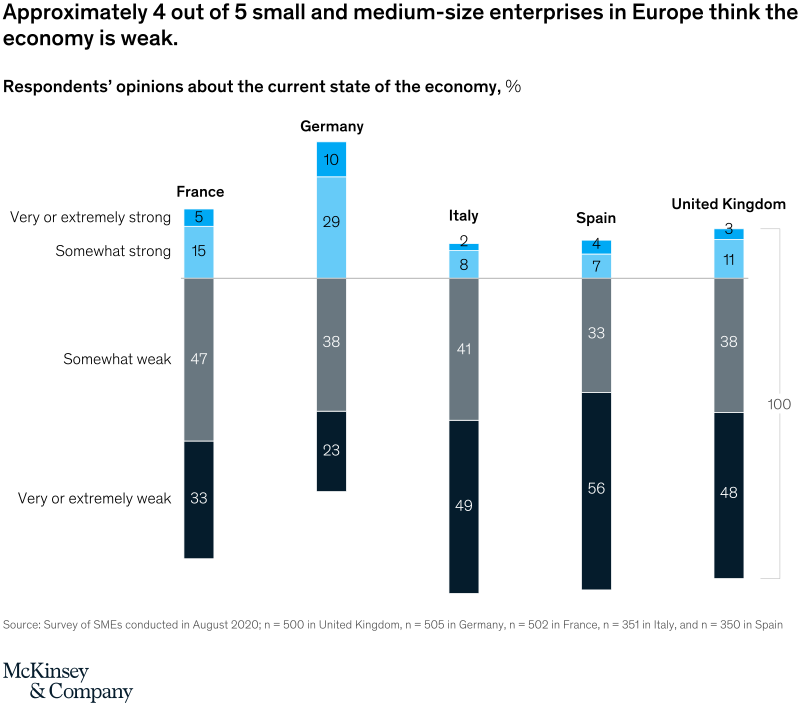
Overall, 80 percent of small and medium-size businesses surveyed in Europe view the economy as somewhat to extremely weak. But sentiment varies among countries, with the most optimistic businesses in Germany and the least optimistic in Italy and Spain.
JPMorgan Sees Possible $300 Billion Rebalancing Flow From Stocks Large multi-asset investors may need to rotate money into bonds from stocks.
Large multi-asset investors may need to rotate money into bonds from stocks after strong equity performance so far this month, strategists led by Nikolaos Panigirtzoglou wrote in a note Friday. They include balanced mutual funds, like 60/40 portfolios, U.S. defined-benefit pension plans and some big investors like Norges Bank, which manages Norway’s sovereign wealth fund, and the Japanese government pension plan GPIF, the strategists said.
“We see some vulnerability in equity markets in the near term from balanced mutual funds, a $7 trillion universe, having to sell around $160 billion of equities globally to revert to their target 60:40 allocation either by the end of November or by the end of December at the latest,” the strategists wrote.
If the stock market rallies into December, there could be an additional $150 billion of equity selling into the end of the month pension funds that tend to rebalance on a quarterly basis, they added.


