 Happy and Healthy New Year
When It Comes to Inflation, I’m Still on Team Transitory Fed Chair Powell may have retired the term, but bottlenecks and shortages should be over soon.
By Alan S. Blinder, a professor of economics and public affairs at Princeton, served as vice chairman of the Federal Reserve, 1994-96.
(…) The old aphorism that inflation arises from “too much money chasing too few goods” is close, but “too much demand chasing too little supply” is spot on. (…)
There won’t be large fiscal expansion in March 2022, regardless of what happens to President Biden’s Build Back Better plan. And the Fed is now taking its foot off the monetary accelerator. (…)
In short, there is an inflationary price to pay when you catapult rapidly out of a pandemic-induced recession, and we are paying that price now. But it still looks transitory to me—though that doesn’t mean it will be over in a month or two. It won’t, which is presumably why Federal Reserve Chairman Jerome Powell recently stopped using the word.
Several factors point to lower inflation rates ahead.
- First, the price of crude oil, which more than doubled between November 2020 and October 2021, has begun to fall.
- Second, normal consumption patterns will re-emerge as pandemic fears subside. Consumers will start buying more restaurant meals, hotel rooms and movie tickets—and fewer things that are shipped in boxes. Omicron may delay the return to normalcy, but it will happen.
- Third, capitalism is on our side. Shortages raise prices, but high prices create opportunities for profit, which attract capitalists to alleviate the shortages. They don’t do this out of altruism, but out of self-interest.
(…) Bottleneck inflation may be gone in a few months, or it may take another year or so. You can call another year of high inflation “transitory” or “terrible.” But it isn’t likely to be permanent, which is why I’m still on Team Transitory. (…)
Mr. Blinder’s first argument in favor of an eventual decline in inflation is that “the price of crude oil has begun to fall”. Period! Let’s all hope he is right but let’s admit that this is a rather concise analysis on what constitutes his first argument.
My first counter argument is that “the fall” is not all that obvious, so far:
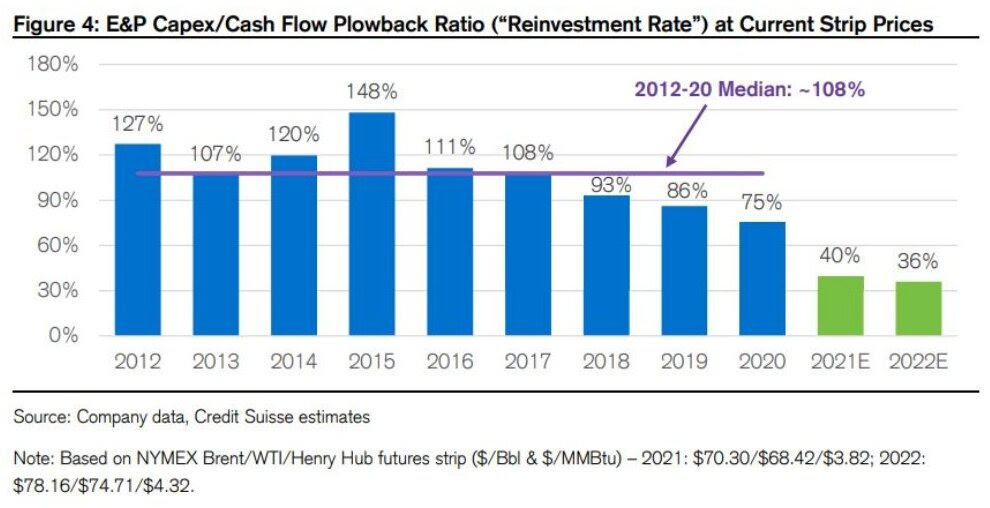
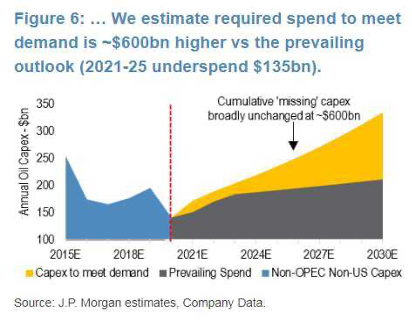
My second counter uses his own “spot on” reason for the recent jump in inflation: “too much demand chasing too little supply”. Oil supply needs continued investment in production which has been materially slowing since 2017:
His second argument simply says that demand will shift away from goods towards services which will ease pressures on goods prices. But inflation on services is already between 4% and 5% annualized and the official measure of inflation on the heavy-weight shelter is still relatively subdued at 3.8% YoY in November but is dangerously accelerating (+6.2% a.r. in the last 2 months). Real world data suggest actual rent inflation is much higher. Inflation on services is far more important, sticky and damaging than inflation on goods.
Yet, Mr. Blinder spends precious little time discussing the basic factors impacting services prices, particularly wages.

Finally, the notion that capitalism will save us all is ________ (fill yourself). He is right that “They don’t do this out of altruism, but out of self-interest”. Look what profit margins did during the pandemic:

BTW:
- IKEA to Raise Prices as Global Supply Costs Keep Rising The Swedish furniture giant said the largest cost increases relate to transportation and purchasing prices, and are particularly affecting North America and Europe.
Ingka Holding BV, the biggest owner and operator of IKEA stores, said it planned to raise prices across the group by around 9% on average, with variations depending on country and range, amid a global squeeze on supply chains and higher associated costs.
“IKEA continues to face significant transport and raw-material constraints driving up costs, with no anticipated break in the foreseeable future,” Ingka said Thursday, adding that it expected disruptions to continue well into 2022.
The Swedish company said the largest cost increases relate to transportation and purchasing prices, and are particularly affecting North America and Europe.
“For the first time since higher costs have begun to affect the global economy, we have to pass parts of those increased costs onto our customers,” said Tolga Öncü, retail operations manager at Ingka’s core IKEA Retail division. He said the company needed to take the pricing action now to safeguard its competitiveness and resilience. (…)
- Raises From Coast to Coast in 2022 56 Cities, Counties, and States Will Raise Minimum Wage Rates on January 1—Many Reaching or Exceeding $15— With Another 26 Jurisdictions to Lift Pay Later in 2022
- Oil Posts Longest Streak of Consecutive Gains Since February
David Rosenberg yesterday:
The inflation hawks seem to be ignorant of history and how inflation tends to spike in the context of a pandemic supply-shock of this magnitude — go back and see how inflation soared in 1918, 1919 and 1920, to only then plunge in the next decade. Three years up and then ten years down certainly does fit the bill as being “transitory” — the real problem today is the radical shortening in investor time horizons where “long-term” today is basically “lunch tomorrow.” The real bull market is in impatience and tempestuousness and, generally speaking, an economic and strategist community that seems bereft of any historical perspective (I mean, come on — all they ever drum up is the 1970s when we had a dozen oil price shocks spread out over an entire decade).
David included charts showing how inflation did actually transit down as he explains. But he never pointed out that there were recessions in 1920-21, 1923-24, 1926-27, 1929-33 etc..
US prepared to respond ‘decisively’ if Russia invades Ukraine, Biden warns Putin Presidents speak for almost an hour in latest diplomatic effort to defuse tensions
 Here come the antivirals
By Katelyn Jetliners, epidemiologist
As epidemiologists, “primary prevention” is our main goal—reduce morbidity and mortality by preventing large populations from getting disease altogether. Vaccines are our best (but not only) tool to prevent severe disease from SARS-CoV-2. But even if someone gets the vaccine, there is still a small chance they could end up in the hospital. (This is especially true for those over 65 years or with comorbidities). Some immunocompromised vaccinated people are also not protected. And of course millions are not vaccinated. So, if someone gets severe disease, how can we help them?
One viable option is antiviral drugs. This is a class of prescription medications that can fight a virus once someone is infected. There are many mechanisms through which antivirals can potentially help. As depicted in the figure below, once the virus enters the human body, it searches for a host cell. Then the virus’s life cycle begins: 1) entry into our cells; 2) replication within our cells; 3) assembly; and 4) escape to go infect other cells. Scientists try to create antivirals to disrupt any one of these steps.
Jones et al. Viral and host heterogeneity and their effects on the viral life cycle. Nat Rev Microbiol 19, 272–282 (2021)
For example, oseltamivir (Tamiflu), the antiviral for the influenza, disrupts the last stage: it stops the virus from dissolving its way out so it can’t go infect others. This helps people recover from the flu 1 or 2 days earlier. But, antivirals are really difficult for scientists to make for a myriad of reasons (see my previous post here). This is why it’s taken so long to get an evidence-based antiviral, compared to, for example, vaccines, of which we now have 19 authorized and 9 approved worldwide.
Thankfully, the science for SARS-CoV-2 antivirals is finally coming through. In the past week, the FDA has authorized two for use in the United States. And this is a big deal.
Here’s what they are, what they do specifically, and pros/cons of each.
PaxlovidThis antiviral was created by Pfizer and is the most promising option so far. This treatment combines three pills that must be taken twice a day for five days. Two of the three pills are Paxlovid and the other pill is Ritonavir—a low dose HIV drug that will help the Paxlovid drug remain active in the body longer.
Paxlovid’s main mechanism is to slow down viral replication. (Stage 2 in the figure above). It does this by inhibiting one of the virus’s tools—called an enzyme—that it uses to replicate itself.
After Pfizer developed this drug, it went through randomized control trials just like vaccines do. Pfizer’s Phase III randomized clinical trial (called EPIC-HR) had 2,246 participants with a confirmed COVID19 infection that were randomized to get a five-day course of Paxlovid or a five-day course of a placebo. For this trial, all participants had to be “high risk:” unvaccinated with at least one high risk characteristic, like over the age of 65 or a comorbidity. The participants were followed for 28 days after entering the trial to see if they were hospitalized or died from COVID19. What did scientists find?
There was an 88% reduction in hospitalization and death among the Paxlovid group compared to placebo. Which is really high! Specifically,
Importantly, efficacy was similar whether the treatment was given within three or five days of symptom onset: 89% efficacy in the first three days and 88% efficacy in the first five days.
This was a huge win, because antivirals only work if given early. In the “real world,” this is difficult because it means the patient needs to realize their symptoms (which takes a few days), get tested (which is really hard right now), go to the doctor to get a prescription, and then start treatment. All of this needs to happen within a small window. The bigger that window, the better.
After receiving the full results, the FDA quickly authorized Paxlovid. They did this without convening their external scientific committee board for a review of the evidence. To me, this is a sign that the results were solid and/or an indication of the dire need for a highly effective antiviral in the wake of Omicron.
It was also very reassuring to see an independent study (i.e. science not conducted by Pfizer) come out this week confirming Pfizer’s results. The scientific group also found that this drug works against Omicron. We hypothesized that it would, because Omicron’s mutations don’t target the process mentioned above, but this is great news nonetheless. The figure below shows the effectiveness of the pill series (called Nirmatrelvir; orange lines) did not change in light of various variants of concern.
Pfizer also has two other concurrent studies using this drug:
EPIC-SR: This clinical trial evaluates the efficacy of Paxlovid among 662 people that were not considered high risk. Preliminary data showed that 2 of 333 (0.6%) patients who received Paxlovid were hospitalized compared to 8 of 329 (2.4%) who received the placebo. Unfortunately, the 0.6% isn’t statistically different than 2.4%, which means the drug isn’t too much help for non-high risk groups. But only 45% of the data is in thus far; we will see if the scale tips as more data comes in.
Concurrently, Pfizer is evaluating if, and by how much, Paxlovid blocks transmission in households. We should expect results in the first half of 2022.
And while this is all great news, the big concern is supply. Pfizer only manufactured enough pills for 65,000 people this month. When divided by 50 states, the availability gets smaller and smaller. For example, in DC—the place hardest hit with Omicron right now—there is only enough supply for 120 people. Antivirals are difficult to manufacture, so supply will ramp up slowly. Pfizer said they will have enough for 300,000 Americans by the end of February and, eventually, 120 million courses in 2022. The antiviral’s promise is also dependent on affordability and the assumption that individuals can get it in a timely manner (symptoms, test, doctor’s appointment, prescription), which is becoming more and more difficult across the country right now. There’s no doubt this antiviral will help down the road, but the promise for right now is limited.
MolnupiravirThe second antiviral drug that was authorized this week was created by Merck and and Ridgeback Biotherapeutics. It, too, is a pill series: four capsules twice a day for five days early in infection.
Molnupiravir works differently from Paxlovid, in that it does not directly slow down the replication or copying process. Instead, the drug interferes and inserts numerous mutations when the virus is replicating. As a result, the copied virus is weaker and the immune system is able to clear it much more quickly.
(FDA Molnupiravir Background Package Here)
Merck’s clinical trial (called the MOVe-OUT study) had 1,433 participants with confirmed COVID19 infection that were randomized to receive a drug or placebo series between May and October 2021. After the placebo or series, the participants were followed for 29 days to see if they were hospitalized or died. This cohort of participants will also continue to be followed until their late-follow up visit at 7 months. What did Merck find? Well, this data story is fascinating:
When Merck originally submitted their FDA application they announced promising interim results: 50% reduction in hospitalization and death.
Molnupiravir group: 7.3% (28 out of 385 people) were hospitalized. No deaths were reported.
Placebo group: 14.1% (53 out of 377 people) were either hospitalized or died. Eight deaths were reported.
Importantly this analysis was only among 762 participants from May to July 2021. Once Merck analyzed data from the second half of the study in August and early October (646 additional people), they only found only a 3% reduction in hospitalization and death. This was a shocking difference. (I’m giving them the benefit of the doubt that this was truly a weird data phenomenon, rather than purposeful and deceitful).
So, pooled together (50% efficacy from first half and 3% efficacy from second half), Molnupiravir had an overall 30% reduction in hospitalization and death compared to the placebo. Results are shown below, from Merck’s presentation to the FDA.
Merck Presentation at FDA Here
On November 30, 2021, the FDA’s external scientific advisory board met to discuss Merck’s authorization application. There were two streams of significant reservations during the discussion:
Modest efficacy: There was disappointment voiced around Molnupiravir’s modest effectiveness. The advisory board also had a lot of questions for Merck about the drastic effectiveness difference (50% to 3%). Merck didn’t have an answer for them.
Possible dangers: There was also a lot of interesting discussion about theoretical dangers. The drug works by causing of a lot of mutations in the virus (making it weaker and allowing the immune system to clear it). However, there is a risk that the virus mutates a lot but isn’t cleared. Thus, there is the theoretical danger that the drug could drive viral evolution. There is also the opportunity for the drug to change a person’s DNA. While no data has supported this, data has found this happens with pregnant rats. Some voting members voiced theoretical concerns that the drug could lead to cancer-causing mutations down the road.
This interesting discussion resulted in the external scientific committee narrowly voting to authorize this medication in a 13-10 vote. It took the FDA an abnormally long time to then take the advisory board’s vote to authorization. I was actually very surprised that the FDA ended up authorizing; I didn’t think this would happen.
Bottom line:While it may take a few months for supply, an antiviral like Paxlovid will be a game changer. I’m incredibly excited to see the science’s progression, as we can use all the help we can get in this pandemic.



 I am no Didi expert but I note that
 HAPPY NEW YEAR!