The enemy of knowledge is not ignorance, it’s the illusion of knowledge (Stephen Hawking)

It ain’t what you don’t know that gets you into trouble. It’s what you know for sure that just ain’t so (Mark Twain)

Invest with smart knowledge and objective odds

THE DAILY EDGE: 4 MARCH 2021

U.S. SERVICES PMI: Steepest expansion in business activity since July 2014, but costs rise at record rate

February PMI data indicated the fastest expansion of business activity across the U.S. service sector since July 2014. The upturn in output was supported by a marked rise in new orders following stronger client demand. However, despite further pressure on capacity, service providers registered only a fractional rise in employment. Meanwhile, concerns regarding the longevity of the pandemic led to a moderation in business confidence.

At the same time, cost pressures remained elevated, with the rate of input cost inflation accelerating to the fastest on record (since October 2009). In response, firms raised their selling prices at the second-quickest rate since data collection began over 11 years ago.

The seasonally adjusted final IHS Markit US Services PMI Business Activity Index registered 59.8 in February, up from 58.3 in January and above the earlier ‘flash’ figure of 58.9. The expansion in output was the sharpest in over six-and-a-­half years. The upturn was reportedly linked to stronger client demand and a further rise in new business.

image

The increase in new sales also accelerated in February. New order inflows expanded at the steepest pace since April 2018. Anecdotal evidence suggested the sharp upturn was due to stronger client demand and greater customer confidence following the start of the vaccine roll-out.

In contrast, service providers registered a renewed contraction in new export orders, albeit only fractional overall. Firms stated that ongoing COVID-19 restrictions and limits on travel in key export markets weighed on foreign client demand.

Input costs rose further in February, amid hikes in supplier charges and wage bills. Some service providers also noted that higher PPE prices pushed up cost burdens. The rate of cost inflation quickened to the fastest since data collection began in October 2009.

In response, service sector firms sought to pass on higher cost burdens to clients. The rate of charge inflation was the second-fastest on record.

At the same time, employment continued to rise in February, albeit only fractionally. The rate of job creation eased to the slowest in the current eight-month sequence of growth

Due to little-changed staffing levels, backlogs of work were accumulated at the sharpest pace for five months. Greater levels of outstanding business were often linked to a further rise in new orders and pressure on capacity.

Service providers signalled upbeat expectations regarding the outlook for output over the coming year in February. Optimism was commonly attributed to hopes of a successful vaccine roll-out and stronger client demand. That said, the degree of confidence moderated from that seen in January, amid concerns regarding the duration of the pandemic.

The IHS Markit Composite PMI Output Index posted 59.5 in February, up from 58.7 in January, to signal a substantial upturn in private sector business activity. A further robust expansion in manufacturing production and a faster increase in service sector activity helped boost total output.

image

Contributing to the overall rise in activity was a stronger rise in new business. Private sector new order growth was the fastest since April 2018. Despite a renewed contraction in service sector foreign client demand, an expansion in manufacturing export orders led to another modest upturn in overall new business from abroad.

Cost pressures remained marked in February, with the rate of input price inflation accelerating to the fastest since data collection began in October 2009.

Firms were able to pass on higher costs through a robust rise in output charges. The pace of increase was the second-steepest on record, behind November 2020.

Reflecting stronger pressure on capacity, private sector firms took on more workers in February. That said, service providers reined in job creation, with employment only rising fractionally. Manufacturers, however, registered a sharp rise in staffing levels.

Finally, business confidence moderated from that seen in January due to service sector concerns regarding the longevity of the pandemic and success of the vaccine roll-out.

image

U.S. Businesses Optimistic About Economy Due to Vaccines and Hiring, Fed Beige Book Says Federal Reserve’s compilation of anecdotes from business contacts shows economic activity expanded modestly at the start of the year

(…) “Economic activity expanded modestly from January to mid-February,” the report said, adding that “most businesses remain optimistic regarding the next 6-12 months.”

The Fed said the economy expanded in eight of the Fed’s 12 regions, with areas including the Northeast reporting mixed or stagnant results. The New York area economy declined modestly and the Boston area saw mixed results, the report said.

Overall manufacturing activity increased moderately despite supply-chain challenges, the report said, and nearly every region reported manufacturing growth. In Philadelphia, manufacturers told the Fed they have noticed longer delivery times, growing backlogs and increased demand from customers around the globe. (…)

While the report said business contacts expect hiring to pick up, it also said many businesses are having trouble finding workers, particularly in low-skill occupations and skilled trade positions. (…)

Business costs such as materials rose moderately from January through mid-February, the Fed said, widely attributed in many regions of the country to supply-chain disruptions and high demand in areas such as housing. (…)

Just kidding The Beige Book’s assessment is pretty beige compared with Markit’s PMIs on both activity and costs pressures.

The Inflation Regime Change Is Already Upon Us Epochal shifts can be difficult to spot in real time, but the signs are there.

(…) Inflation psychology is difficult to change. But last year might do the job. The monetary and fiscal response was of a different order of magnitude from the crises that preceded it. (…) “Volcker said he was going to tame inflation, unemployment be damned,” says Alex Lennard of Ruffer LLP. “Now it’s the other way around. I don’t think people have quite realized that you’ve had this huge change in the mandate of policymakers.” (…)

Yesterday I listened to an exchange between David Rosenberg and Schwab’s Liz Ann Sonders, both essentially agreeing that inflation would rise in spring-summer but be transitory and mainly the result of the low-base effect. They both recognize the humongous savings in consumers’ bank accounts but don’t expect a gusher. One of Rosenberg’s main argument is that, following the 2020 splurge on goods, there is no pent-up demand, actually there is “spent-up demand”.

This chart shows real expenditures on durable goods, annually in blue and semi-annually in red. The splurge in the second half is obvious but considering the drop in the first half, the full year consumption of durable goods remained on the long-term trendline. There actually was no splurge, substantially weakening the spent-up scenario.

image

Where stimmies went:

image
U.S. Light Vehicle Sales Weaken in February

Light vehicle sales faltered last month. The Autodata Corporation reported that sales of light vehicles declined 5.6% during February (-6.7% y/y) to 15.88 million units (SAAR), the lowest level in six months.

Auto sales declined 8.2% (-20.9% y/y) last month to 3.56 million units, the lowest level since last July. (…) Sales of light trucks were off 4.9% (-1.6% y/y) during February to 12.32 million units versus record sales of 12.95 million in January. (…)

Imports’ share of the U.S. vehicle market held steady last month at 23.9%, up from 22.2% in January 2020 and a low of 19.9% during all of 2015. Imports’ share of the passenger car market strengthened to 34.0% in February, the highest level since November 2010. Imports’ share of the light truck market eased m/m to 20.9%, down from a high of 23.0% in November.

CalculatedRisk comments that “Sales in February were probably negatively impacted by the poor weather in many parts of the country.”

Canadian auto sales in February were down nearly 10 per cent compared with February 2020, the last full month before the lockdowns began due to the COVID-19 pandemic. (…)

Despite some lifting of pandemic restrictions, much of the country was still in various degrees of lockdown in February, DesRosiers said on Wednesday. These, combined with microchip supply chain disruptions, led to a drop in light vehicle sales, the firm said. (…)

Eurozone retail sales plunged in January

The European Union’s statistics agency said Thursday that the volume of retail sales fell 5.9% in January on month, a larger decline than the 1.7% drop economists polled by The Wall Street Journal expected.

Compared with January 2020, sales fell 6.4% in calendar-adjusted terms in the eurozone.

Eurostat also revised its figures for the previous months. Following the revision, eurozone retail sales rose 1.8% in December on month and 0.9% on year, instead of growing by 2.0% on month and 0.6% on year, as previously reported.

Compared with December 2020, retail sales in January decreased by 12.0% for non-food products and by 1.1% for automotive fuels, while sales increased by 1.1% for food, drinks and tobacco, Eurostat said.

Saudis, Russia Discuss Joint Oil Output Raise Ahead of OPEC Meeting Saudi Arabia and Russia are discussing a proposal to bring back a combined one million barrels a day of oil to global markets, people familiar with the matter said.
Cathie Wood’s ARK Investment Faces Reckoning as Tech Trade Stalls The firm’s exchange-traded funds are underperforming badly as investor sentiment shifts toward cyclical shares tied to an economic upswing.

(…) The ETFs suffered double-digit percentage decreases last week, their biggest routs since the stock market’s plunge last March, according to FactSet. Further declines among growth stocks on Tuesday and Wednesday drove even deeper drops among ARK’s funds, bringing the declines for its flagship ARK Innovation ETF to 14% over the past month.

The cascade of red has proved hard for many investors to stomach. ARK’s funds collectively lost more than $1.8 billion between Feb. 24 and Monday, their biggest stretch of outflows ever, according to FactSet. Together, they managed roughly $51 billion at the end of February, making ARK the ninth-largest ETF operator. That’s after attracting $36.5 billion in assets over the past year, more than Invesco Ltd. , Charles Schwab Corp. and First Trust—the fourth, fifth and sixth biggest ETF issuers in the U.S., according to Morningstar Direct. (…)

With tech stocks continuing to fall, ETF analysts and traders worry that a combination of broad market declines and additional outflows could create a snowball effect across ARK’s portfolio. That could potentially cause some of its more illiquid, small-cap holdings to trade sharply lower. (…)

Flows into ARK’s innovation fund turned positive Tuesday, pulling in $464.3 million, according to FactSet. (…)

ARKK

ndx

TECHNICALS WATCH

None of the main indicators I watch is flashing red. However, the S&P 500 is sitting on its (still rising) 50-day m.a. and so is the MSCI World-ex-US Index. The Nasdaq 100 is now on its second support (100dma) and its 50dma bended down yesterday. That said, most of the short-term trends are weak.

spy

  • S&P 500 Index vs. 50-Day & 200-Day Moving Average Cross

  • 13/34–Week EMA Trend

  • Volume Demand vs. Volume Supply

The above chart is from NDR (via CMG Wealth like many others). Another service I use is showing a more meaningful uptrend in selling measures in recent days.

BTW, gold’s 13-week EMA vs. 34-week EMA is now signaling a bear market just when the USD technicals are turning up.

A ‘Mind-Boggling’ Individual Investor Boom Stirs Up Markets in Asia Stock trading has surged across Asia, as markets have recovered from the shock of the Covid-19 pandemic, with many younger individual investors piling into shares for the first time.

(…) Activity on the region’s two busiest stock markets, in Shanghai and Shenzhen, has risen toward levels last registered in China’s 2014 and 2015 boom. Trading on exchanges in Seoul and Hong Kong has broken records. Shares are also changing hands in huge numbers in Taiwan, India and some smaller markets like Indonesia and Vietnam. (…)

“We’ve seen armies of Asia retail investors appear and invest in sizes that are mind-boggling, both in terms of trading volumes and the value of shares traded,” said Herald van der Linde, head of Asia-Pacific equity strategy at HSBC.

In South Korea, individual investors have been net buyers of stocks in record quantities. On Wednesday, individuals made up 49% percent of all stock trading by value on the country’s main board, the Kospi, up from 40.4% a year earlier, according to figures from the exchange. (…)

Like in the U.S., investing apps have attracted individual traders with time on their hands thanks to the pandemic. Social media is also fueling interest: in South Korea, for example, influencers on YouTube and Instagram have helped inspire a new wave of day traders. (…)

Auto Morgan Stanley Warns Tesla Is Losing Market Share To Ford Mustang Mach-E

Remember my January 11 post (THE DAILY EDGE: 11 JANUARY 2021: Tesla Now Has Company)

tsla

THE DAILY EDGE: 3 MARCH 2021: Perfect “Storm”!

Senate Democrats Iron Out Details on Covid-19 Aid Package Senate Democrats sought to bridge differences over jobless benefits, aid for state and local governments and $1,400 direct payments as they aim to complete a $1.9 trillion coronavirus relief package and pass it through their chamber in the coming days

(…) Lawmakers are also looking at changing who is eligible to receive the direct payments and reducing a proposed $400 weekly federal supplement to jobless aid to $300. (…) Democrats are expected to approve the legislation—which also expands the child tax credit and funds vaccine distribution, among other measures—in the Senate without Republican support. (…)

“Despite the optimism, without new resources, our entire effort will be set back,” [Biden] said. “The bottom line is we need the American Rescue Plan now, now.”

  • Senate Majority Leader Chuck Schumer said Democrats have the votes and plan to pass Biden’s favored $1.9 trillion stimulus bill next week. (CNBC)

BTW 1:unnamed - 2021-03-03T071832.534

BTW #1a:

unnamed - 2021-03-03T080535.343

Data: Hamilton Place Strategies, CivicScience; Chart: Axios Visuals

BTW #2: Vaccines Promised for All U.S. Adults By the End of May The president said enough vaccines would be available two months earlier than he had previously indicated, after Merck agreed to help Johnson & Johnson produce shots.

BTW #3: image

Texas Governor Lifts Mask Mandate, Business Restrictions Texas businesses will be able to operate at full capacity and state residents will no longer be required to wear masks to visit them beginning March 10, Gov. Greg Abbott said.

Asia’s Champions of Covid-19 Control Fall Behind on Road to Recovery Asian countries led the world in crushing Covid last year, but now they are lagging behind on vaccinations and can’t afford to reopen borders, suggesting their economies may take longer to fully rebound.

(…) Most countries in Asia have only vaccinated a small percentage of their populations, and most Asian economies won’t reach herd immunity until 2022, Goldman Sachs estimates. (…)

That could leave some Asian countries in a holding pattern, forced to keep their borders sealed since their populations have developed little natural immunity to the disease, even as swaths of the world reopen businesses and international travel. (…)

Consumer demand is rebounding faster in the U.S. and Europe than in Asia, a trend that is likely to continue as Asian vaccination rates lag and households remain wary, S&P Global Ratings wrote in a January report. (…)

Nordea’s take:

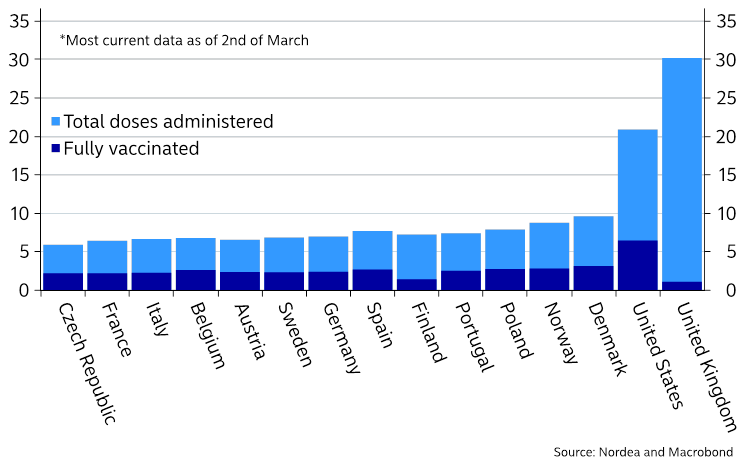
When will economies be allowed to reopen? When are we without restrictions? We take a look at the Israeli case and conclude that 35-37% of the population needs to be vaccinated before a major breakthrough is seen. The UK will soon hit this benchmark, while the US and efficient EU countries (such as Denmark and other Nordic countries)will reach this benchmark in early April. We will be without (most) restrictions sooner than you think. The UK will likely soon move towards a swift reopening, US will follow around Easter, while continental Europe will follow in early May. (…)

Swifter approvals of vaccines, smarter wordings of contracts with suppliers and more funding given to the R&D phase, leaves the UK and US clearly ahead of the EU on the supply front. The UK has also opted for a wide vaccination programme, ensuring a broad immunization before a full immunization of each individual. This has so far proven to be a winning strategy and e.g. Finland now follows roughly the same strategy. (…)

Current pace of vaccinations

One of the key ingredients to a larger progression in the EU will be the addition of JnJ to the supply. EU holds a 300m dose contract with the firm and remember that JnJ provides “full protection” at only one dose. This significantly increases the vaccination progress. (…)

These re-opening dates are still BETTER than consensus expectations, as e.g. the global investor survey hints of a peak positive macro effect from reopening economies towards the end of the summer. It is also clearly a more upbeat scenario than most administrations hold across the globe, and we argue that most virologists are clearly too pessimistic by now. We see a “catch-up” effect in growth coming already in early Q2, which is before broad consensus expectations. (…)

Earlier than expected reopening coupled with a huge Biden package would boost growth forecasts and interest rates. How about inflation? Read Goldman Sachs:

We forecast core PCE inflation to peak at 2.4% in April—bolstered by the year-on-year comparison to the April 2020 lockdowns—and end the year at 2.0%. But how high could core inflation go if mass vaccination unleashes surging demand in virus-sensitive categories?

In our baseline, a partial rebound in four particularly sensitive categories—air and ground transportation, hotels, and recreation admissions—will contribute nearly +0.5pp to the swing in core inflation this year. But if these price levels fully converge to the pre-crisis trend, core inflation would end the year at 2.1-2.2%, other things equal.

In a scenario where consumer demand for travel and recreation overshoots enough to recoup the coronacrisis shortfall over the next three years, we estimate core inflation would average 2.25% in the second half of 2021 with a peak of 2.5% in November, though the impact would then fade in the first half of 2022. (…)

How would the Fed view such a sudden and sharp inflation pickup? Several months of mid-2% core PCE inflation in late 2021—at a time when unemployment is back around 4.5% on our estimates—would increase the odds of tapering asset purchases in late 2021, a bit earlier than we expect. Beyond that, however, Fed officials have already indicated that they would likely downplay the transient effects of a post-pandemic demand surge. In the January press conference, for example, Chair Powell said “Base effects… will pass. There’s also the possibility [of] a burst of spending that could also create some upward pressure on inflation. We would see that as something likely to be transient and not to be very large… The way we would react is, we’re going to be patient.”

We shall see. ING is not as optimistic:

The prospect of a re-opening economy experiencing very strong demand when there will be inevitable supply constraints – thousands of bars, restaurants and entertainment venues have closed, airlines have laid off staff and mothballed aircraft, leisure and hospitality staff need to be hired and trained – mean there is scope for more meaningful price rises. We see inflation moving above 3.5% YoY before moving slowly lower in 2H21. However, there is the risk it proves to be somewhat sticky, which to us means the Federal Reserve will be forced into an earlier first rate hike than the early 2024 date they are currently indicating. (…)

US household balance sheets are in a healthy position with cash, checking and savings deposits having increased by $2tn between 4Q19 and 3Q20 while outstanding credit card balances have fallen to a four-year low. The equity market rally has provided a further boost to household wealth. (…)

The Fed is awake:

John Authers:

(…) The single most important data point for the market is that a Federal Reserve governor has commented publicly on the sharp rise in bond yields. Moreover, it’s Lael Brainard, who was widely canvassed as a potential treasury secretary and is also considered a potential next chairwoman of the Fed. She used language that closely echoed the words of Christine Lagarde, president of the European Central Bank, last week:

“I am paying close attention to market developments — some of those moves last week and the speed of those moves caught my eye. I would be concerned if I saw disorderly conditions or persistent tightening in financial conditions that could slow progress toward our goal.”

Parsing this, we get the message that the Fed cares about what is happening in the bond market, and dislikes the speed with which yields tightened. But arguably the operative word is “if.” She is saying that “disorderly” conditions and “persistent” tightening would be concerning if they happened. So this doesn’t portend immediate action, though it does suggest that the Fed will act in the event of another leg upward. At the margin, this would embolden those who believe that some version of yield curve control or financial repression is inevitable, and that bond yields will stay unnaturally low for a while. This would strengthen the case for stocks, despite their valuations. What it would do to the economy in the longer term is a profoundly different and much more difficult discussion.

  • Tuesday’s remarks from Brainard were echoed by San Francisco Fed president Mary Daly who told reporters after a speech that the Fed could change the maturity of its bond purchases if the yield curve steepens in a problematic way. (Axios)
COMPOSITE PMIs

Eurozone: Strong manufacturing growth fails to offset services contraction

The eurozone’s private sector economy experienced a further modest drop in output during February, although a rise in the seasonally adjusted IHS Markit Eurozone PMI® Composite Output Index pointed to a slower rate of contraction. The index posted 48.8 in February, up from January’s 47.8 and also higher than the earlier flash reading.

image

The latest data again indicated a broadly two-speed economy. On the one hand, manufacturing registered its strongest expansion of output in four months, fuelled by strengthened demand from both domestic and international sources. In stark contrast, the service sector – especially those areas impacted the most by social-contact restrictions – recorded another marked contraction of activity.

imageItaly joined Germany as the only nations to record modest growth of output during February as strong manufacturing performances more than offset ongoing weakness in services industries.

Overall declines were recorded elsewhere, with Ireland again recording the sharpest contraction, followed by Spain and then France.

Returning to the eurozone overall, the modest fall in activity was again closely linked to a decline in new orders. Latest data showed that new business fell for a fifth successive month, though February’s rate of contraction was marginal. This partly reflected the strongest increase in new export business for nearly three years.

On the employment front, there was some positive news as a net increase (albeit marginal) was recorded for the first time in 12 months. Jobs growth was seen across the region, with the exception of Spain, where another drop in staffing levels was seen. Of the remaining four nations for which data are available, France experienced the strongest rise in staffing levels.

Growth in employment was however limited by ongoing spare capacity, as evidenced by a fall in levels of work outstanding in February. Although marginal, the latest cut in backlogs extended the current period of continuous decline to two years.

Led by rapidly rising in costs in manufacturing – in turn reflective of acute input delivery delays amid an upturn in global demand and transportation challenges – overall private sector operating expenses rose sharply in February. According to the latest data, input cost inflation was recorded for the ninth successive month and to the sharpest degree recorded by the survey since November 2018.

In response to increased costs, output charges edged higher for the first time since last February, although the rate of inflation was marginal.

Finally, hopes of a successful rollout of vaccines and a noticeable dialing back of restrictions related to COVID-19 prevention helped to drive business confidence up to its highest level for three years.

The IHS Markit Eurozone PMI® Services Business Activity Index remained mired below the 50.0 no-change mark to signal a sixth successive monthly reduction in service sector activity. The index was little changed since January’s 45.4, recording 45.7 in February.

Once again, all five nations recorded a drop in activity, led by Ireland and Spain. France and Germany recorded similarly marked falls in activity, with the latter experiencing its worst performance since last May.

Driving the reduction in regional activity was again a fall in levels of incoming new work, which were down for a seventh month in a row. Export sales were also lower, albeit at the slowest rate in the past year.

Due to modest gains in both Germany and France, a net increase in eurozone service sector staffing levels was recorded during February. Though slight, it was the first time that growth has been recorded in 12 months and reflected in part more positive projections for activity in the coming year. Indeed, service sector business expectations improved in February to their highest level since April 2018.

Meanwhile, input cost inflation was unchanged on January’s five-month high in February amid reports of higher prices for a range of goods and services. The challenging business environment however meant that output charges were cut for a twelfth successive month, with all nations covered by the survey recording a reduction in prices since January.

China: Modest increase in business activity during February

Business activity across China’s service sector rose only modestly in February, with the rate of growth dipping to a ten-month low. The slowdown coincided with a softer increase in total new business, which was partly driven by a fresh decline in new export work. Panel members often mentioned that the coronavirus disease 2019 (COVID-19) pandemic, and a recent rise in cases globally, had dampened customer demand. At the same time, firms trimmed their staff numbers for the first time in seven months amid a further steep rise in operating costs. Companies expressed robust optimism towards the year ahead, however, with businesses widely anticipating customer demand to pick up once the pandemic ends.

The headline seasonally adjusted Business Activity Index edged down from 52.0 in January to 51.5 in February, to indicate a mild increase in services activity across China. Moreover, the rate of expansion was the softest recorded in the current ten-month period of rising output.

image

Service providers indicated that business activity rose in line with new work. Total new orders increased modestly overall, with the rate of growth likewise easing to a ten-month low. While a number of firms commented on firmer client demand, there were reports that the recent resurgence of COVID-19 cases globally had dampened sales growth.Notably, new export orders fell for the first time since last October, albeit modestly.

imageService providers took a more cautious approach to workforce numbers in February and reduced their headcounts. Though only mild, it was the first time that employment had fallen since last July. Companies that noted lower staffing levels often linked this to cost-cutting initiatives and the non-replacement of voluntary leavers.

Although employment fell, there seemed little pressure on operating capacities in February. This was signalled by a further reduction in outstanding business, though the rate of depletion remained marginal. Anecdotal evidence suggested that greater efficiency and subdued sales had enabled firms to work through backlogs.

Chinese services companies registered a further steep increase in operating costs during February. Although not as sharp as that seen at the start of the year, the upturn was among the quickest seen over the past decade. Greater purchasing and staffing costs were cited as key drivers of inflation. However, efforts to remain competitive meant that firms only partially passed on higher input costs to clients, as prices charged rose modestly.

Looking ahead, service providers in China were strongly optimistic that business activity will rise over the next year. Moreover, the degree of positive sentiment strengthened since January and was among the highest seen over the past eight years. Hopes that the COVID-19pandemic will come to an end were central to upbeat forecasts, while there were also mentions of planned company expansions and new product releases.

At 51.7 in February, the Composite Output Index fell from 52.2 in January to signal a moderate increase in total business activity across China. That said, the rate of expansion was the slowest recorded in the current ten-month sequence of growth. Softer increases in output were recorded across both the manufacturing and service sectors.

image

Composite new orders also rose at a slower pace, with growth easing to a ten-month low. Sales rose only slightly at manufacturers, while services companies noted a mild upturn. Employment at the aggregate level, meanwhile, fell for the first time since last July,albeit modestly, driven by reductions at both manufacturing and services companies.

Composite input costs continued to increase sharply, despite the rate of inflation easing to a three-month low. Prices charged also rose at a slightly softer pace.

Note that

The Goldman Sachs Analyst Index (GSAI) rose 9.4pt to an all-time high of 76.0 in February. The composition of the survey was strong, as the orders, shipments, and employment components all increased.

Other major business activity surveys were strong on net in February.

A majority of our sector analysts report that business activity in their industry is at or above normal levels. Most also indicated that last week’s winter storm in the South and Midwest did not significantly affect their industry.

1. GSAI Surges in February. Data available on request.We construct the headline GSAI using the following weights: 30% for new orders, 25% for sales/shipments, 20% for employment, 15% for materials prices, and 10% for inventories.

Toronto, Vancouver home sales soar in February as condo market rebounds, low rates drive up prices

(…) In the Toronto region, home resales hit a record for February, 52.5 per cent higher year over year, with condos leading the way up, according to the Toronto Regional Real Estate Board. Condo resales in the city were 27 per cent higher than in January. (…)

The average selling price for condos in the city was still 6 per cent lower than in February of last year, but 8 per cent higher than in January.

Over all, the home price index, which is adjusted for expensive transactions, rose 15 per cent year over year to $969,600 across the Toronto region, with the biggest price increases outside the city. In Simcoe County, north of the city, the index was up 35 per cent, and to the east in Durham region, the index was up 29 per cent.

The total number of properties for sale in the Toronto region was flat compared with the previous year. Although condo listings in the city were 50 per cent above February, 2020, the number was not as high as in the fall, when more condo owners were putting their units up for sale. Condo listings have decreased since the peak in October.

In Vancouver, home sales were 73 per cent higher than in February of last year, and 56 per cent above January, with increases for detached houses as well as condos.

The total number of properties for sale was 20 per cent below the 10-year average.

The home price index reached $1,084,000 last month, 7 per cent above February of last year and 3 per cent higher over January. (…)

OPEC+ considering rolling over oil supply cuts into April, sources say
EARNINGS WATCH

One closely watched revision comes from Goldman Sachs, which now forecasts S&P 500 EPS will grow by 21% this year (up from a 13% decline a year ago) to $181. That would be a solid 10% higher than the 2019 pre-pandemic level of $165. Earnings growth will be in the 9% range next year, before settling to a more normalized 6% gain in in 2023 and 5% gain in 2024. Here’s the chart they provide:

SENTIMENT WATCH

Comment volume for Rocket, a highly shorted home loan provider, surged to nearly 19% on WallStreetBets today, according to SwaggyStocks. And the company was the fifth-most-mentioned company on Stocktwits. Shares surged 71%, giving it a market cap of about $82.6 billion. (Bloomberg)

Dumb money has never been so smart

The “dumb money” has been pretty smart lately. To a record degree, actually.

Dumb Money Confidence is a model that incorporates more than a dozen indicators that have a track record of cycling to extremes, and equating with ebbs and flows in sentiment among broad categories of investors. (…)

Dumb Money Confidence

For the most part, these indicators reflect retail, mom-and-pop types of traders, but certainly not exclusively. Sophisticated institutional investors have just as much propensity to suffer from group-think as everyone else, so determining “smart” and “dumb” is not necessarily straightforward.

The term “dumb” itself needs to be clarified. A more accurate description would simply be “trend-following.” Most trend-followers are not dumb – they’re positioned correctly during the meats of most major trends. That sounds pretty smart.

Where this term gets its meaning is that because trend-followers use different methodologies, some waiting until trends are well-established, by the time most trend-followers hop on a trend, and most aggressively, is about the time the trend is becoming exhausted. So these traders tend to be the most net long near peaks and least net long (or most net short) near bottoms. Because most investors follow trends to some degree, these indicators tend to capture the behavior of most of the money flowing into and out of markets.

At the same time that these traders are showing aggressively optimistic behavior, Smart Money Confidence in a rally has plunged. It has been a struggle for stocks to sustain large gains when we see a Smart Money / Dumb Money spread like this.

Smart Money Confidence

Jack Ma’s Ant forced into arms of banks he once dubbed ‘pawnshops’ Fintech will have to rely on state-owned behemoths under online lending reforms

Ninja Microsoft hack. The company urged customers to download software patches after Chinese hackers broke into some customers’ copies of its software for email, contacts and calendar. The attackers used previously undiscovered flaws as a way in.