U.S. Housing Starts Fall Sharply in February
Housing starts declined 10.3% (-9.3% y/y) during February to 1.421 million (SAAR) from 1.584 million in January, revised from 1.580 million. December starts were revised to 1.670 million from 1.680 million. The Action Economics Forecast Survey expected 1.548 million starts in February.
Ice & snow storms caused starts of single-family homes to fall 8.5% (+0.6% y/y) to 1.040 million from 1.136 million in January, revised from 1.162 million. Adding to this decline was a 15.0% decrease (-28.5% y/y) in multi-family starts to 381,000 from 448,000 in January, revised from 418,000.
A 10.8% February decline (+17.0% y/y) in building permits to 1.682 million reversed all of the prior month’s increase. The February level of permits was the lowest in three months. Permits to build single-family homes declined 10.0% (+15.0% y/y) to 1.143 million following a 3.8% January gain. Permits to build multi-family homes weakened 12.5% (+21.4% y/y) to 539,000 from 616,000 in January.
By region, housing starts in the Northeast fell just over one-third (-2.5% y/y) to 118,000 after rising 43.4% in January. In the Midwest, starts also fell by roughly one-third (-29.9% y/y) to 138,000 following January’s 13.8% decline. Housing starts in the South weakened 9.7% (-16.6% y/y) to 725,000 following January’s 4.4% decline. In the West, building activity wasn’t dampened by the weather and starts increased 17.6% (15.8% y/y) to 440,000 after falling 16.5% during January.

Supply Chain Woes Slam Global Manufacturing The extreme weather in Texas and backlogs at California ports have compounded problems during the pandemic by slowing production and supplies for a range of businesses.
(…) Last month’s freeze in Texas was the latest plank on the pile. The state is home to the world’s largest petrochemical complex, which turns oil and gas and its byproducts into plastics. The February freeze triggered mass blackouts that shuttered plants, many of which remain offline. (…)
Several of Dow’s petrochemical plants in Texas were forced to shut down during the freeze, and Mr. Ungerleider said they would be running at 80% capacity by the end of March.
He said plastic prices in Asia and Europe had already begun increasing due to supply shortfalls in the U.S. He estimated it would take more than six months to correct the supply-and-demand imbalances caused by the February storm. (…)
Samsung, one of the world’s largest chip makers, was forced to idle two chip factories in Austin, Texas, last month. The facilities represent about 28% of Samsung’s total output, according to Citi analysts, and remained shut as of Wednesday.
Toyota cited a petrochemicals shortage for curtailments at its factory in Kentucky, where it builds the Camry and Avalon sedans and the hybrid version of its RAV4 sport-utility vehicle. The shortage would also lead to cuts in production of its Tacoma pickup truck built in Mexico. (…)
- Texas Freeze Triggers Plastics Shortage Numerous chemical plants were shut down as state lost power last month, disrupting a global supply chain for consumer goods
(…) Prices for polyethylene, polypropylene and other chemical compounds used to make auto parts, computers and a vast array of plastic products have reached their highest levels in years in the U.S. as supplies tighten. For example, prices for polyvinyl chloride, or PVC, have more than doubled since last summer, according to S&P Global Platts.
That is expected to result in cost increases and delays for auto makers, home builders and countless other businesses, with impacts ultimately felt by consumers, according to companies and analysts. (…)
Jason Keiswetter, president of Petoskey Plastics, which makes car-seat covers, protective gowns for healthcare workers and numerous other products, said his raw-material costs are up nearly 150% from last summer, as suppliers that had already announced price increases before the Texas freeze have issued more in its aftermath. (…)
John Schiegg, vice president of supply-chain services for David Weekley Homes, a Houston-based home builder, said he was being told by suppliers to expect shortages of everything from siding to adhesives to insulation. That will mean delays for home starts and further increases in costs for home buyers, which have been climbing in the midst of a housing shortage, he said. (…)
An active hurricane season along the U.S. Gulf Coast last year further disrupted markets. Chemical feedstock prices were already at years long highs before the freeze hit. Some companies said the result is the most severe shortage of these raw materials they have seen in decades.
“It’s a total disaster,” said Josh Lee, financial chief for chemical distributor CJ Chemicals, who estimated that about 70% of the products his company sells have been affected. “We were already having shortages before the ice storm.” (…)
He estimated that prices may not ease until the fourth quarter, resulting in higher prices for consumers. (…)
More than two dozen plants remain offline, according to the most recent count by S&P Global Platts. (…)
BTW:
- Petrochemicals account for more than a third of the raw material costs in the average vehicle, according to ICIS. The car industry is also struggling due to a shortage of semiconductors.
- the freeze alone will reduce U.S. production of polyethylene, the most common plastic compound, by about 12% this year.
- Polypropylene prices are at record levels and more than double the 2019-2020 average, according to ICIS, But that’s just the tip of the iceberg: PVC is also trading at record highs while high density polyethylene, used for shampoo bottles and grocery bags, is at the highest since 2008.
- Housing was the first place where it [inflation] came about but now we’re seeing it more broadly.” (Bloomberg)
Treasury Says It Has Issued 90 Million Stimulus Payments Worth $242 billion, more than half of the estimated total relief authorized under the latest Covid-19 relief package
Passenger Car Registrations Continue to Sag in Europe
Passenger car registrations in Europe rose by 6.3% m/m in February but only after falling by 28.2% in January. Registration rose in the month in four of the five countries in the table, with France being the exception. This month’s gain does not shift the trend.
Over three months, however, registrations in Europe fell at a 48.6% annualized rate. Registration growth rates fell in extreme double-digit terms in Spain (-68.7%), Germany (-61.4%) and Italy (-22.7%). Registrations fell at only a 7.2% annualized rate in the United Kingdom while sales rose over three months in France.
Sequentially European sales fell over 12 months and fell faster over six months then fell faster still over three months. (…)

The U.S. trend during the same period. Note the different scales.

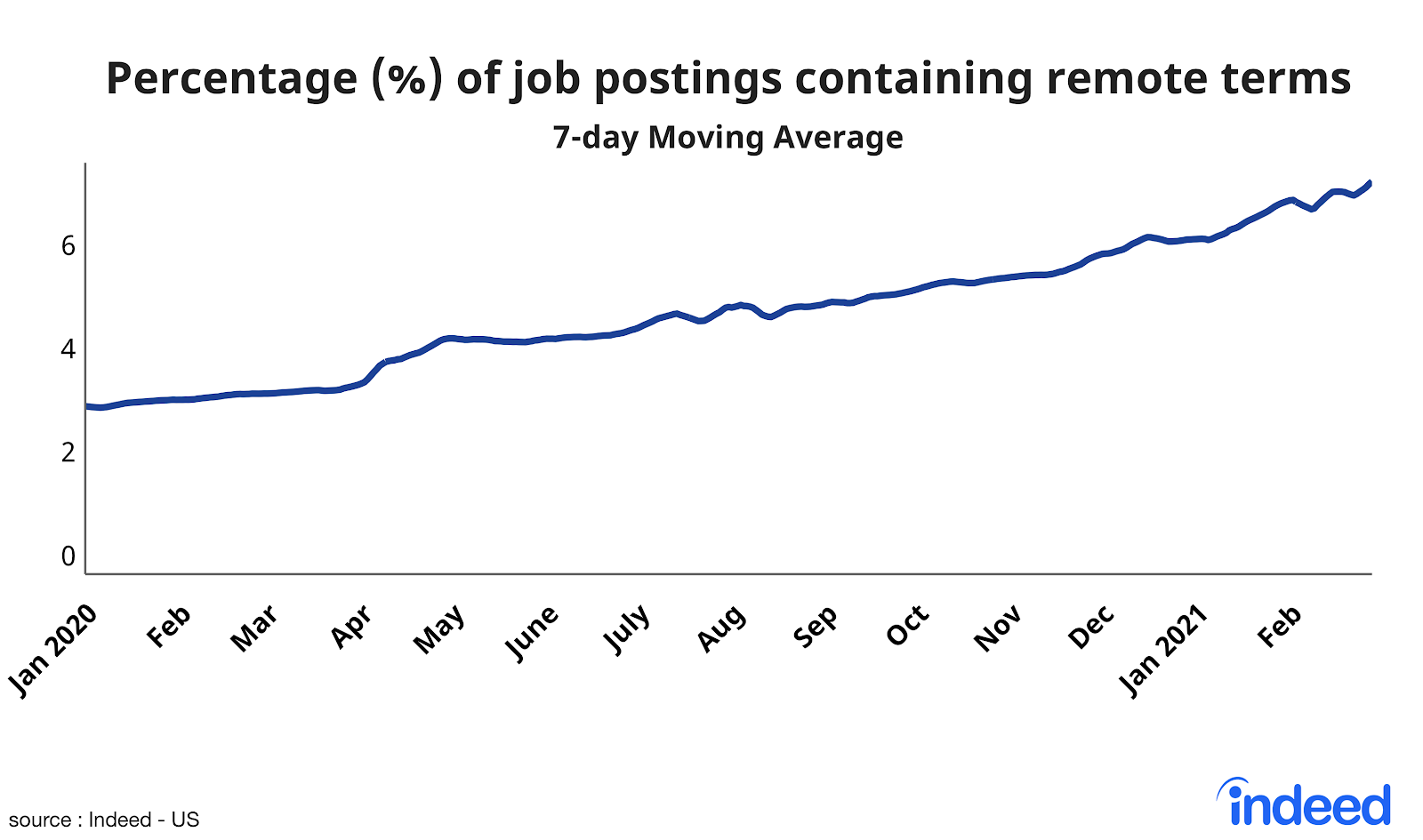
Remote Job Postings Double During Coronavirus and Keep Rising Indeed job postings in the US are twice as likely to mention remote work now than before the pandemic, though opportunities during the crisis have leaned toward positions that can’t be done remotely.
(…) Last spring, at the worst of the pandemic, it looked like nearly everyone who could work from home was doing so. A full 35% of employed people were working from home because of coronavirus in May, very close to an academic estimate that 37% of jobs were in occupations that could be performed remotely. In February 2021, the share working remotely fell to 23% as some people returned to workplaces.
One sign that remote work will outlive the pandemic is that job postings on Indeed increasingly include “remote work,” “working from home,” and similar terms. Postings are more than twice as likely to mention remote work now as before the pandemic. While remote work remains unfeasible in many areas, like food service and beauty & wellness, it has increased dramatically in sectors where it had been rare, like therapy, finance, and law. (…)
In February 2021, 6.9% of Indeed US job postings were remote versus 2.9% in January 2020. (…)
Most striking is that the remote job postings share has continued to rise even as many workers have returned to the office. At-home work fell moderately to 23% of employed workers in February 2021 from 35% in May 2020, when the US Current Population Survey first asked about remote work. But the share of Indeed job postings indicating remote work has climbed steadily. In fact, the increase in remote work accelerated in early 2021 even after accounting for the April 2020 change in our job posting form. (…)
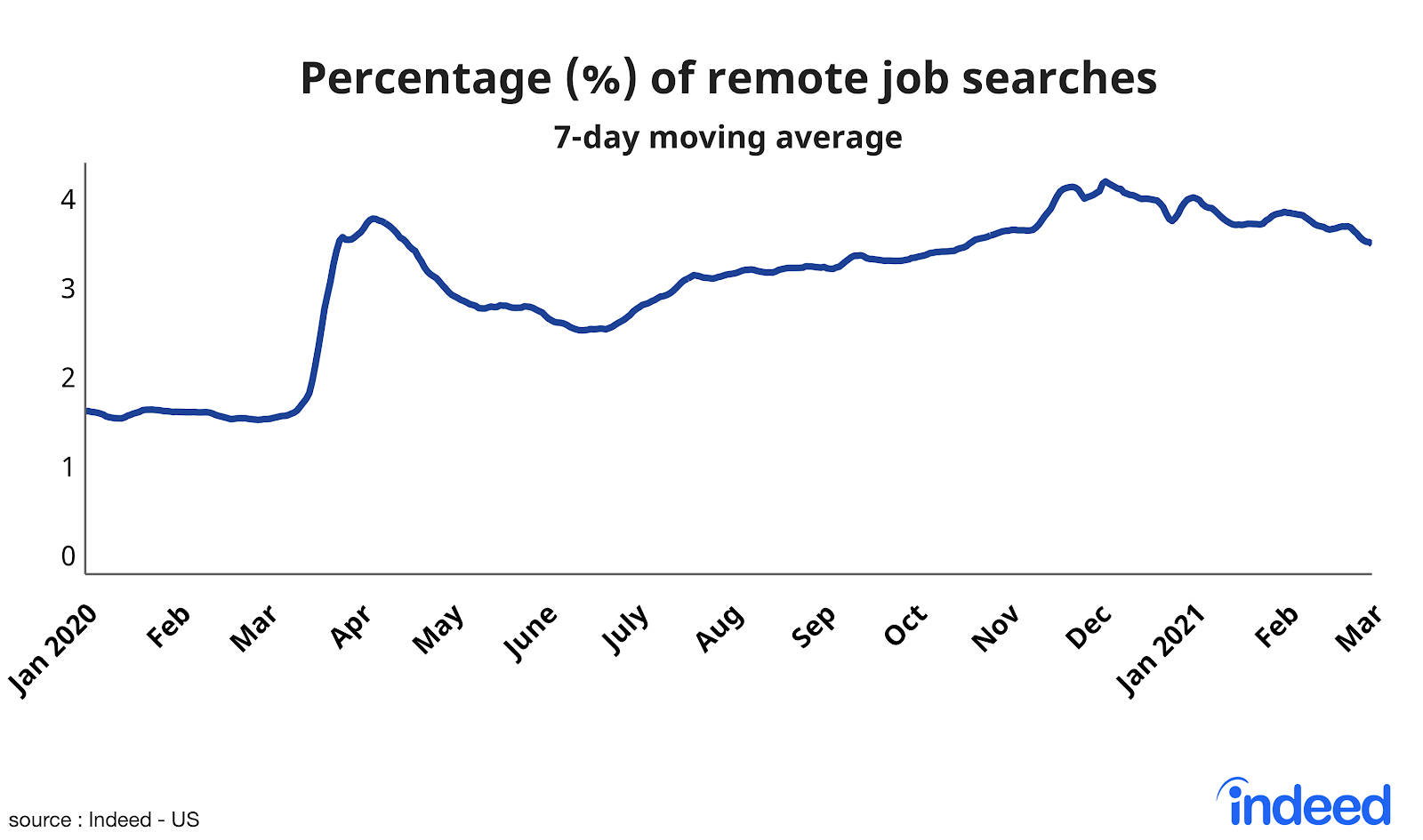
The share of job searches for remote work remained elevated in February 2021, but below its peak in November 2020 and below the spring 2020 spike. (…)
Fed Faces Challenge of Sticking to Its Plan
(…) Fed officials expect the economy to recover more quickly than they did a few months ago, according to new projections released Wednesday. They sharply raised their forecasts for economic growth and inflation, anticipating that the Covid-19 vaccination campaign and trillions of dollars of fiscal stimulus will propel the U.S. economy to its fastest expansion since the early 1980s. (…)
Officials haven’t said exactly how long they would allow inflation to run above 2%, or how high they would allow it to rise. But their median forecast now shows annual inflation accelerating to 2.4% in the fourth quarter of this year, up from their December projection of 1.8%, and remaining at or slightly above 2% through 2023.
Fed policy makers’ projections for the fourth quarter now show that they expect gross domestic product will be up by 6.5% from a year earlier, compared with their December forecast of 4.2%; that the unemployment rate will slip to 4.5%, instead of 5%; and that their preferred measure of inflation will be above 2% before moderating. Robust growth will continue in 2022 at 3.3% while unemployment falls to 3.9%. (…)
Mr. Powell said Wednesday that any pickup in prices this year will likely be temporary. He added that a transitory increase wouldn’t meet the Fed’s bar for raising rates. (…)
Mr. Powell said it will take “actual progress, not forecast progress,” to convince the Fed to change tack. (…)
Pre-emptivity no more! Here comes reactivity, but don’t worry, when the Fed thinks it needs to adjust, “we’ll say so, and we’ll say so well in advance of any actual taper.”
But the Fed’s dot plot allows mind reading:
The dots, Mr. Powell explained, show “how we think about the future,” they don’t “pin down a time when we might or might not lift off.”
Some Fed officials clearly see the case for earlier liftoff: four of 18 see rates rising by the end of 2022, and three more by the end of 2023. Asked about that at Wednesday’s press conference, Fed Chairman Jerome Powell responded by noting that the majority of officials still don’t see liftoff until 2024 or later: “Part of that is wanting to see actual data rather than just a forecast at this point.”
The unusually high level of uncertainty is weighing on officials, he noted: “We haven’t come out of the pandemic before. We haven’t had this kind of fiscal support before.”
The WSJ editorial board:
(…) In other words, the Fed is forecasting that the economy will boom, reaching nearly full employment with inflation at or above its 2% target, but it still won’t tighten monetary policy. If this all turns out to be true, Milton Friedman will rise from the dead and rewrite his monetary history. (…)
(…) Powell made a mistake by admitting to having to quantify what a moderately overshooting inflation rate means as soon as inflation actually overshoots target. This clearly raises the stakes markedly ahead of Q2. The risk of a taper tantrum 2.0 remains high in April/May. (…)
Powell said that “..we have resisted the temptation to try and quantify what that means, but when we are above target… we can do that”. This will leave stakes SUPER high ahead of inflation figures from April when the big inflationary effects start to kick in. After all, it is much easier to say that you will allow inflation to overshoot as long as you actually don’t overshoot, but once the overshooting kicks in, it will be much more difficult to sound as dovish. (…)
Treasury Yields Breach More Key Levels as Inflation Bets Surge
Yields on the benchmark 10-year bond climbed as much as 10 basis points to 1.74% — the highest since January 2020 — in London trading Thursday. They also breached 2.5% for the 30-year debt, a level that hasn’t been seen since August 2019. (…)
Fed Chair Jerome Powell again indicated that he wasn’t concerned over the recent surge in long-term yields, with his focus still on whether financial conditions remained accommodative. (…)
But some are concerned:
U.S. Recovery, Higher Fuel Prices Force Brazil’s Hand in Rate Rise Brazil became the first major economy to raise interest rates this year, a harbinger for other developing countries that could be forced to raise borrowing costs and endanger their fragile economies.
(…) The central bank’s decision to lift its benchmark lending rate to 2.75% from its record low of 2% comes as inflation hit a four-year high in Latin America’s biggest economy amid a weakening currency and sharply rising fuel prices. On top of that, Brazil is logging nearly a third of all the world’s daily Covid-19 deaths.
Economists say the tightening monetary policy in Brazil underscores risks for emerging markets, many of which have dire outlooks in comparison with developed countries. A strong U.S. recovery is prompting a rise in long-term bond yields, which attracts more investors to buy dollars at the expense of emerging-market currencies. That could lead other developing nations to raise their interest rates to stem the capital outflow, stifling the economic rebound those countries are counting on.
The Brazilian currency has depreciated about 10% against the dollar in the last three months as investors pull their money out of riskier markets that racked up debt during the pandemic, pushing consumer prices higher as imports become more expensive. Rising oil prices, buoyed by a strong recovery in Asian demand, also has increased Brazil’s fuel costs, which helped raise inflation to 5.2% in February, near the top of the central bank’s target range. (…)
Ukraine’s central bank surprised economists this month when it tightened its monetary policy to combat higher inflation. Turkey sharply raised its benchmark interest rate in November and is expected to boost rates again Thursday as inflation surges.
The sharp rise in U.S. bond yields in recent weeks has awakened memories of the 2013 “taper tantrum,” when yields on U.S. government bonds rose sharply after the Federal Reserve said it was considering tapering its bond-buying, sending shock waves around the world.
The result was a widespread decline in emerging-market equity and bond prices, and a weakening of emerging-market currencies. Some central banks raised their key interest rates in response, fearing that a sharp fall in their currencies would make it difficult for businesses to repay U.S. dollar debts, weaken their financial systems and push inflation higher.
This year, the Institute of International Finance, which represents banks, warned a repeat of the taper tantrum was possible if U.S. bond yields rose too quickly as emerging markets see an outflow of capital. (…)
After a tough year, CFOs express increased optimism and expectations for economic growth
- CFOs reveal a brighter view of the North American and Chinese economies 12 months out, with 73% believing that North America’s economy will be better or much better and 64% saying the same for China;meanwhile, 36% of CFOs expect Europe’s economy to be better or much better a year out.
Own-company financial prospects: CFOs show greater optimism for their organizations’ financial prospects, with 67% reporting they are somewhat or significantly more optimistic compared to three months ago.
Risk-taking and risk concerns: Nearly two–thirds of CFOs have an increased appetite to take greater risk (66% compared to 49% in the 4Q20 survey), perhaps in the search for growth in a post-pandemic environment. CFOs cite concerns for their talent’s well-being, the ongoing pandemic, the economy’s health, and regulatory developments.
Return to work on-site: Plans for finance staff to return to work on-site post-pandemic will not necessarily be the traditional five days per week in the office. More than half (58%) of CFOs expect their finance staff to work two to three days on-site, with 31% expecting four or more days a week on-site.
Travel expenditures: Nearly three-quarters (73%) of CFOs expect travel expenses post-pandemic to be 50% to 80% of pre-pandemic levels.


Bring it on!
M&A is consistent tailwind for SMid-Caps. As we can see in the charts below, more than 94% of all M&A deals involve a SMid-Cap being bought with the average premium paid as of late being close to 40%. (The Market Ear)

COVID-19
Europe is going the wrong way…

…in more than one way as John Authers explains:
This isn’t good, as the EU is particularly dependent on AstraZeneca’s vaccine. (…)
Pfizer and Moderna were important for the U.S., which made fewer orders of the AstraZeneca vaccine. Indeed, the British drugmaker hasn’t even applied yet for regulatory clearance in the U.S. But the EU is for now mostly reliant on AstraZeneca (as is the U.K., where the vaccine continues to be rolled out). Continental Europe can ill-afford to do without it. (…)
Ethically, this makes the decision to stop the vaccinations look odd to say the least. Covid can kill and “long Covid” can debilitate, and these problems are on the rise. More avoidable human suffering appears to be in prospect. And for markets, continued lockdowns and interruptions to “business as usual” look inevitable. Whatever date you had penciled in for Europe to return to normal, you probably need to move it a few months later.
For countries like Greece and Spain that are particularly dependent on the tourist trade, another wave would be a disaster. Highly contentious “vaccine passports” are now on the EU agenda, in a bid to make it possible for these countries to welcome some tourists this summer. But this won’t happen without a big political fight first.
(…) it doesn’t look as though the market has yet woken to a very alarming situation.
- U.K. Faces Significant Cut in Vaccine Supply for Four Weeks
- Has the EU lost its mind? To fail a test as big as Covid has existential implications for Europe