The enemy of knowledge is not ignorance, it’s the illusion of knowledge (Stephen Hawking)

It ain’t what you don’t know that gets you into trouble. It’s what you know for sure that just ain’t so (Mark Twain)

Invest with smart knowledge and objective odds

THE DAILY EDGE: 10 MARCH 2021: Noflation Just Yet!

CPI for all items rises 0.4% in February as gasoline index continues to rise

The Consumer Price Index for All Urban Consumers (CPI-U) increased 0.4 percent in February on a seasonally adjusted basis after rising 0.3 percent in January, the U.S. Bureau of Labor Statistics reported today. Over the last 12 months, the all items index increased 1.7 percent before seasonal adjustment.

The index for all items less food and energy rose 0.1 percent in February. The indexes for shelter, recreation, medical care, and motor vehicle insurance all increased over the month. The indexes for airline fares, used cars and trucks, and apparel all declined in February.

The all items index rose 1.7 percent for the 12 months ending February, a larger increase than the 1.4-percent reported for the period ending in January. The index for all items less food and energy rose 1.3 percent over the last 12 months, a smaller increase than the 1.4-percent rise for the 12 months ending January. The food index rose 3.6 percent over the last 12 months, while the energy index increased 2.4 percent over that period.

image

Core CPI is up only 0.1, or 0.4% annualized in the last 3 months. Core Goods is -0.2% in February, zero in the last 3 and 5 months!

America’s $5 trillion bet

From Axios’ Felix Salmon:

Once President Biden signs the latest relief bill into law, Washington will have spent more than $5 trillion in less than a year — far more than it has in past crises.

In a letter to colleagues Tuesday night, Senate Majority Leader Chuck Schumer wrote that the poorest 20% of Americans are estimated to see about a 20% boost in income from Biden’s bill, citing an analysis from the Tax Policy Center.

  • 85% of households will get $1,400 in stimulus checks; the unemployed will receive an additional $300 per week through the fall; and families with children under 17 will get $3,000 per child.
  • That’s in addition to increased rental assistance, food aid and health insurance subsidies. A recent Washington Post analysis found that 54% of Biden’s package provides direct aid to individuals, compared with 40% or less in previous packages.

This bill and the series of other COVID-19 packages passed in the last year work out to just over $43,000 per U.S. household — the type of spending that would have been unthinkable as recently as 2009, when Biden was last in office. (…)

Economists predict the economy will grow at a pace of well over 6% in both the second and third quarters of 2021 as Biden’s stimulus plan kicks in, according to FactSet.

  • This time last year, the Wall Street consensus was that a coronavirus-addled economy would grow by only 2% in 2021.
  • Congressional aides say that the expected economic boon, in conjunction with scientists promising a light at the end of the pandemic tunnel, mean this $2 trillion bill is likely the last mammoth COVID-related package we’ll see.
Small Business Optimism Improves Slightly in February
  • Outlook at cyclical lows:image
  • Sales and earnings not recovering yet:image

image

  • Rising prices and hoping for even more:

image

  • “Forty percent of owners reported job openings that could not be filled, an increase of seven points from January.” But keeping compensation low:

image

  • Job openings rising but planned employed declining…

image

  • While large companies’ confidence is at cycle highs:

image

THE INFLATION DEBATE

Double Line’s Jeff Gundlach expects headline inflation to be over 3% for a few months this summer. Contrary to David Rosenberg (discussed here An Inflated Post on Inflation), he finds a good correlation between ISM Prices aid and the CPI and says that one could plausibly see headline inflation exceeding 4%. “That would really spook the bond market.”

Andrew Cates (for Have Analytics) sees inflation as only transitory as stronger demand will be offset by improving supply:

(…) An intriguing chart that puts recent moves into context is shown in figure 3 below. It compares the yield on 10 year US Treasuries with an index that’s designed to measure the pace of global economic activity in commodity markets. The latter is calculated by the Dallas Fed and derived from a panel of dollar-denominated global bulk dry cargo shipping rates. It may be viewed therefore as a proxy for the volume of shipping in industrial commodity markets.

Figure 3: Global economic activity in commodity markets versus US 10 year Treasury yields

image

As an aside, check how the pandemic has impacted shipping rates (from DoubleLine):

Freight Container Rates (HK to LA)image

The chart is intriguing because the correlation between the two variables – until recently – has been impressive (around 75% from 2007 to 2020). It’s intriguing though as well because some of the recent concerns about inflation stem in part from firmer commodity prices. It’s admittedly still difficult to draw strong conclusions from this because in theory there are many moving parts to gyrations in bond yields.

The chart nevertheless suggests that yields still appear to be quite low relative to the measured pace of activity in industrial commodities in recent weeks. Indeed the recent climb in yields looks entirely warranted relative to the rebound in activity and that a further increase ought to not necessarily come as a big surprise. That said ultra-loose monetary policy – and Central Banks’ bond buying programmes in particular – are a key factor that are suppressing long rates relative to the underlying pace of economic growth. Absent any major shift in these policies – which seems unlikely based on recent rhetoric – and a further sharp upward shift in long term rates seems unlikely.

The still unanswered element to this though is the degree to which firmer activity in these commodity markets heralds higher inflation in the period ahead. To some extent that seems inevitable given the strong links between higher oil prices and the energy components of headline consumer prices. There are some base effects from the plunge in activity – and some prices – that took place last year that will equally put upward pressure on CPI inflation in the coming months.

As we discussed in our last commentary (see Inflation Fears Are Probably Over-stated) what really matters now is how second round effects on wages and inflation expectations now play out. And that will largely hinge on issues such as spare capacity.

On that score though there was further evidence in the detail of the recent raft of purchasing managers’ surveys that suggest inflation fears may be over-stated. For example much of the recent sharp climb in the output price component of these surveys coincided with supply chain disruption and delivery delays as well as rising cost inflation. Indeed average supplier lead times lengthened to the second greatest extent in the global manufacturing survey’s history with almost all of the nations covered reporting an increase (see figure 4 below).

This supply chain pressure though has not – judging by other components of this index – been a manifestation of soaring demand. Instead it seems much more likely to have been a consequence of the pandemic and the tighter restrictions that have been placed on the movement of factors of production (including labour).

Figure 4: Global manufacturing PMI: Output prices and supplier delivery times

image

If that’s right it implies that as vaccines take effect, as fear unwinds, and as government lockdown restrictions ease these supply chain pressures also ought to ease. Indeed just as the onset of the pandemic triggered both a negative demand and a negative supply shock so the easing of the pandemic ought to trigger a positive demand and a positive supply response. And the latter ought to mitigate some of the inflationary consequences that could stem from the former.

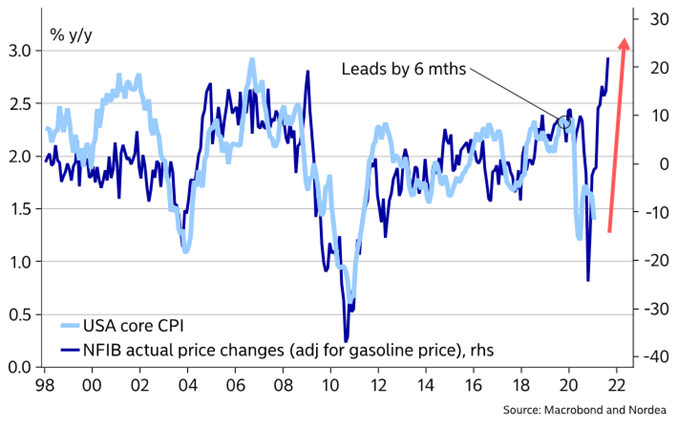
With yesterday’s release of February’s NFIB, Nordea updated this chart and commented:

Our, slightly manicured NFIB price survey, hints of 2.75-3% core inflation already over the next six months. Inflation will accordingly likely print markedly above the Fed target, also in core terms, already before summer. The Fed is only partially aware of it, and it will be tricky for Jay Powell and his lieutenants to handle the rhetoric around the average inflation target regime once inflation starts overshooting markedly. It is so much easier to defend AIT when inflation runs below target.

Brace yourself. Core inflation is coming
Flood of New Debt Tests Weakening Bond Market Supply is seen as one factor driving Treasury yields higher as investors anticipate an economic resurgence fueled by vaccinations and government stimulus.

Treasury Bond Sentimentimage

Source: Bloomberg, Rosenberg Research

Who’s Buying Treasuries?image

Source: DoubleLine

7-year Treasury Auction:Foreigners Retreated Sharply Last Week

image

Source: Bloomberg, DoubleLine. UST -U.S. Treasury.

Meanwhile:

unnamed - 2021-03-10T080437.266

Data: Investing.com; Chart: Axios Visuals

Royal Bank CEO Dave McKay expects faster recovery to pressure central banks to raise rates as early as next year

(…) With rising input prices for labour and commodities, it could create a challenge for central bankers, Mr. McKay said in a webcast speech at the RBC Capital Markets Financial Institutions Conference.

“We see inflationary pressure building earlier than later on those goods and services,” Mr. McKay said.

“We do see a challenge to the policy and, therefore, central banks having to respond to this in 2022, the latter half of 2022, with rate increases. Versus where you might have thought – late 2023, even 2024 – six months ago.” (…)

For U.S. Farmers, China Is Back and Bigger than Ever Record exports follow a painful trade war, but concerns remain: ‘We can’t just be reliant on one partner’

(…) U.S. agricultural exports to China in 2020 rose to 55.5 million tons and comprised one-quarter of all farm shipments, according to U.S. Agriculture Department data. China is now buying more farm goods than it did before the trade war, and U.S. agricultural officials expect Chinese demand to grow further. (…)

China’s race to fatten its hogs helped drive a 53% jump in U.S. soybean exports to the country last year compared with 2019, representing the second-highest volume on record and more than half of all soybean shipments, according to USDA. Corn exports soared more than 20-fold to a new high. (…)

In the first eight weeks of this year, Chinese buyers have purchased nearly triple the amount of U.S. soybeans compared with the same period a year earlier. Prices for the oilseeds are up 64% from year-ago levels. In response, U.S. farmers are expected to plant a record 182 million acres of corn and soybeans this spring, boosting soybean acreage by seven million from 2020, according to a USDA forecast.

Grain-trading giants that are pumping out feed ingredients for Chinese hog farmers say they expect the strong demand to continue. Chinese purchases are helping draw down U.S. corn and soybean stockpiles, prompting domestic processors to rush to lock in supplies and boosting some food prices for consumers. (…)

States Expected the Pandemic to Bring Widespread Tax Shortfalls. It Didn’t Happen. Despite the pandemic’s crushing toll on the economy, total state-tax revenues were roughly flat in 2020 from the year before, aided by stimulus checks and the stock-market recovery.

(…) Net new supply of two- to 30-year Treasurys is expected to reach $2.8 trillion this year, according to BofA Global Research, up from $1.7 trillion last year and around $990 billion in 2019. The Fed, meanwhile, is expected to purchase $960 billion of Treasurys, down from more than $2 trillion last year. (…)

One piece of good news for investors is that the Treasury Department may not need to increase the amount of notes and bonds it issues to fund the $1.9 trillion coronavirus relief package that President Biden is expected to sign shortly, analysts said, given its cash on hand and the size of current auctions. (…)

In recent weeks, congressional Democrats and the Biden administration have signaled interest in another multitrillion-dollar spending package to update the country’s infrastructure. (…)

The Treasury sold another $58 billion of three-year notes on Tuesday and is scheduled to issue $38 billion of 10-year notes Wednesday and $24 billion of 30-year bonds on Thursday. A year ago, auctions of the same bonds totaled $38 billion, $24 billion and $16 billion respectively. (…)

THE DAILY EDGE: 9 MARCH 2021

When Are Stimulus Checks Coming?

A House vote is expected Tuesday, to be followed shortly afterward by Mr. Biden’s signature. Here are the details on this third round of direct stimulus payments to households, which at more than $400 billion total is the largest set yet. (…)

Last year, when former President Donald Trump signed the first big relief bill in March, the bulk of direct deposits arrived within about two weeks. The second round of payments, approved in December, hit bank accounts within a few days after Mr. Trump signed them into law.

The latest payments are $1,400 per household member, including adults, children and adult dependents such as college students and elderly relatives. Adult dependents were ineligible for prior rounds of payments.

The $1,400 comes on top of the $600 approved in December, so people will be receiving a total of $2,000 between the two rounds of payments, fulfilling a Democratic promise.

A married couple with two children will receive up to $5,600. That is more than the $3,400 maximum payment in last year’s first round for that household and the $2,400 maximum from the second round. (…)

Individuals with adjusted gross income up to $75,000, heads of household with AGI up to $112,500 and married couples with AGI up to $150,000 will get the full payments. Above that, the payments phase out. (…)

Also coming shortly:

Tax Forgiveness for Student Loan Forgiveness Democrats grease the budget wheels for writing off debt by Biden decree.

(…) A Senate revision to the original House bill exempts student loans discharged through 2025 from federal income taxes. The IRS treats most cancelled debt as taxable income that must be reported in the year the discharge occurs, and this is a major obstacle to the left’s plans to issue blanket loan forgiveness by executive decree.

President Biden last year promised to cancel $10,000 per borrower. Senate Democrats are urging him to forgive $50,000 apiece, and some progressives want to cancel all $1.6 trillion in outstanding federal student debt. (…)

Biden stimulus will boost global recovery from Covid, says OECD US spending package forecast to add 1 percentage point to world’s economic growth this year

unnamed - 2021-03-09T072246.232

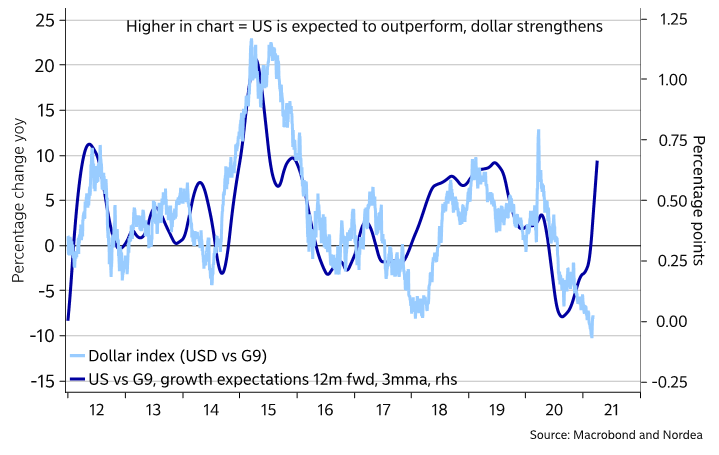
The USD is gaining momentum against most peers and we see more USD strength coming. (Nordea)

(…) And no, we do not think the liquidity trsunami unleashed by Jay and Jay-net will be enough to prevent the dollar from gaining further. For instance, the liquidity tsunami could trigger sales of US Treasuries, which would boost yields and probably be dollar-positive – even more so if higher yields crash equity markets and pop the bubble.

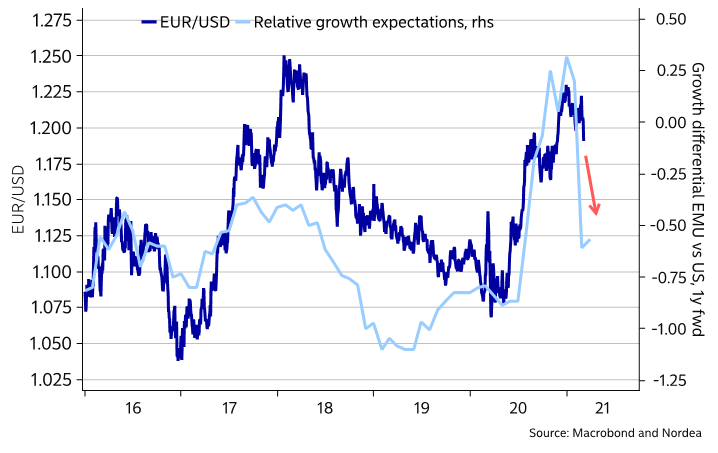
US growth expectations moving strongly to the USD’s advantage

EUR/USD vs relative growth expectations – 1.13 more fair than 1.19?

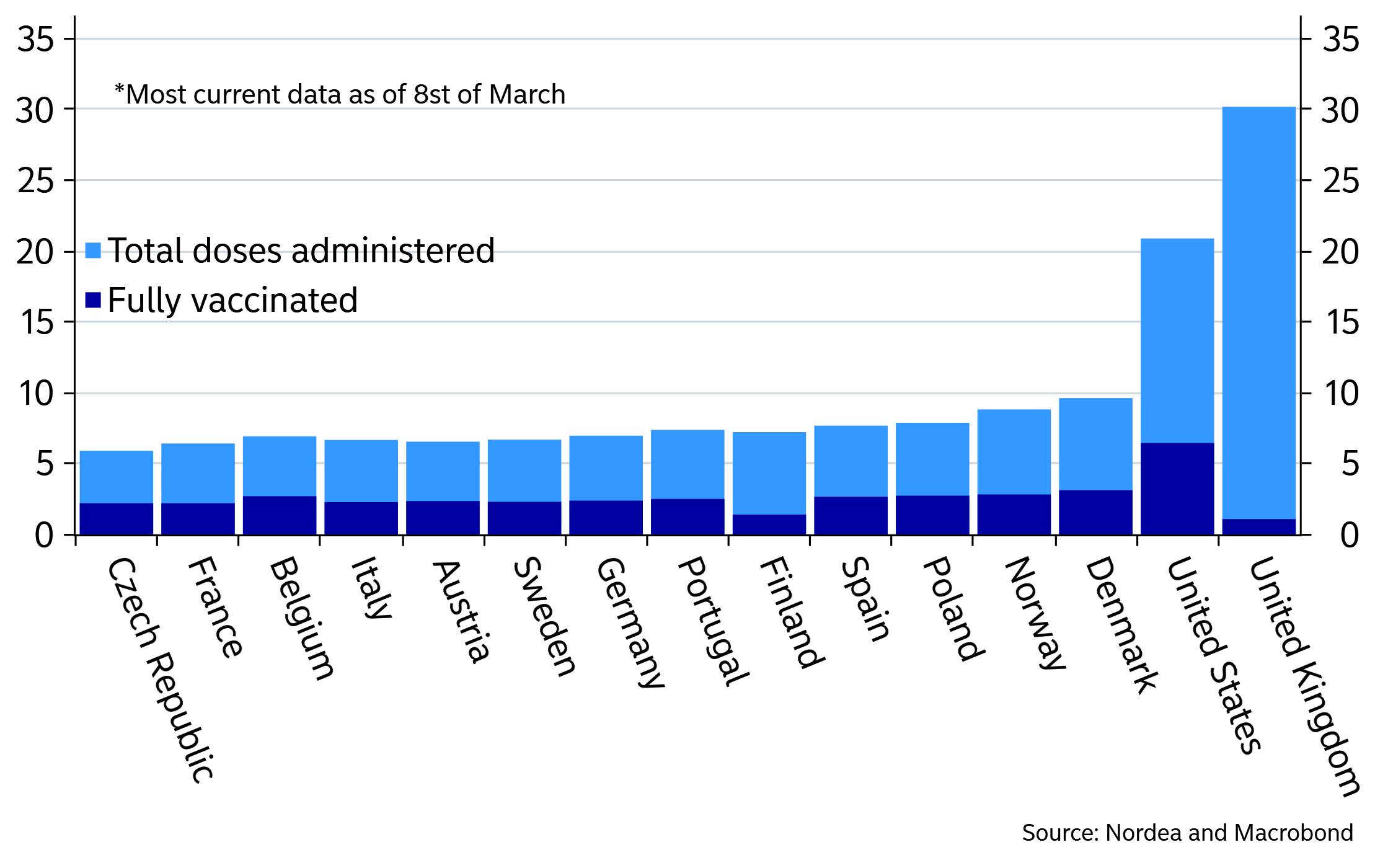
Doses administered and fully vaccinated people as percent of population

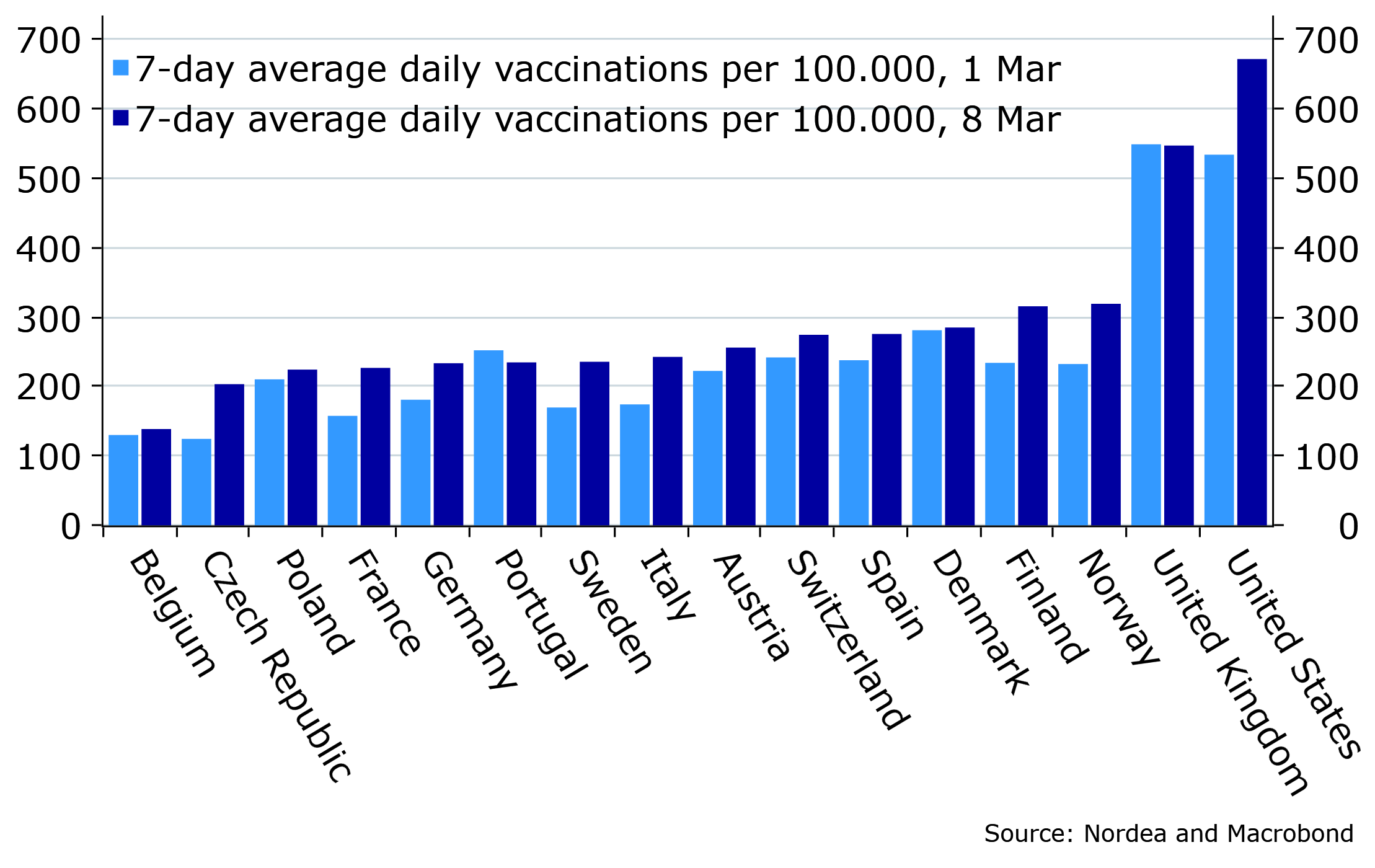
Vaccination pace

unnamed - 2021-03-09T070106.110

Data: CDC, Census Bureau. Chart: Andrew Witherspoon/Axios

  • It looks like Pfizer and BioNTech’s Covid shot stands up to those pesky new variants. It showed a high ability to neutralize strains first detected in Brazil, the U.K. and South Africa. While the lab study needs to be validated with real-world data, it offers reason for optimism that vaccines are generally performing well against variations. (Bloomberg)
China’s Car Sales More Than Quadrupled in February Sales plunged in early 2020 when the country was in the grip of the Covid-19 pandemic.

(…) Sales plummeted 79% in February 2020 as many cities were locked down and factories and dealerships were shut.

In February, 97,000 electric cars were sold, CPCA said. That is a more-than-sevenfold increase from a year earlier, but represents a 38% decline on month. Tesla Inc. sold 18,318 Shanghai-made Model 3s and Model Ys last month, the group’s data showed.

CONSUMER WATCH

Consumers Anticipate Higher Price Growth for Rent and Gas

The February 2021 [NY Fed] Survey of Consumer Expectations shows sharp increases in the outlook for growth in the cost of rent and gas, with both series reaching new highs. The median expectation regarding changes in the cost of rent increased to 9.0 percent in February from 6.4 percent in January. Similarly, the median year-ahead expected change in gas prices jumped to 9.6 percent from 6.2 percent over the month. The short-term inflation expectation edged up to 3.1 percent, its highest level since July 2014.

Yet, spending growth expectations at 4.6% are the highest since December 2014, even though income growth is only expected at +2.4%.

image

MARKETS

Investors fear new Treasury auctions will set off repeat bout of selling Painful sale of 7-year debt last month sent quake through US debt market

There are $38 billion of 10-year bonds slated for sale tomorrow and $24 billion of the 30-year instrument on Thursday.

Morgan Stanley: “the Fed did expand its balance sheet by US$180 billion in February, 50% greater than its target. Yet, rates surged higher. Markets lead the Fed, not the other way around, and we are now at that moment of recognition.”

Copper/gold ratio has surged and continues to hold “up here”. One of Gundlach’s “top indicators” sees yields moving even higher.

Refinitiv (via The Market Ear)

This is a smart indicator: copper as a growth proxy, gold as an inflation proxy against LT yields:

fredgraph - 2021-03-09T071812.324

  • Not a slam dunk however:
unnamed - 2021-03-09T072832.582
Nasdaq Enters Correction Territory The Nasdaq dropped 310.99 points, or 2.4%, to 12609.16, extending the declines from its Feb. 12 record to more than 10%.

(…) The S&P 500 fell 20.59 points, or 0.5%, to 3821.35, pulled lower by losses in the tech, communication services and healthcare groups. In the bond market, the yield on benchmark 10-year U.S. Treasurys ticked up for the fourth consecutive session to 1.594%, its highest since February 2020, from 1.551% Friday. (…)

The firm’s five exchange-traded funds all have declined more than 23% since early February, stung by a sharp rise in government-bond yields. The flagship ARK Innovation ETF has suffered the steepest declines, falling 31% from its Feb. 16 high. In comparison, the Nasdaq Composite Index has dropped more than 10% over the same period. (…)

Among the factors compounding the pain for ARK are a series of highly concentrated positions, including small companies in which Ms. Wood’s firm owns a significant chunk of the stock. Bearish investors also are taking short positions to bet that ARK’s funds and some of its holdings will decline further. (…)

When investors short an ETF, shares are created by specialized investment firms known as authorized participants solely for the purpose of lending. That process involves authorized participants shorting the fund’s underlying stocks, which could be adding to the short interest in some of ARK’s holdings, Mr. Kartholl said. That can lead to increased volatility of the individual shares, he added. (…)

Bloomberg says that

Data show that Wood’s main fund recorded a small inflow on both Thursday and Friday, even as it retreated and other funds like the Ark Next Generation Internet ETF (ARKW) and the Ark Genomic Revolution ETF (ARKG) posted outflows.

Tech’s (relative) earnings problem

Tech has strongly outperformed, supported by the collapse in bond yields, as well as the relative earnings tailwind from COVID-19. A large gap has opened up between Tech price and EPS relative; with the sector’s relative performance likely to stall. Chart shows US Tech +ve to -ve EPS revisions and performance

JPM Equity strategy (via The Market Ear)

A split market, with a difference

Thanks to a big split between winning and losing securities, the HiLo Logic indexes on both the NYSE and Nasdaq have spiked to worrying degrees.

A quick correction: The Nasdaq Composite closed more than 10% from its all-time high on Monday. It took only 15 days for the index to cycle from all-time high to a correction, the 9th-fastest cycle in its history, dating to 1971. (…) the Nasdaq’s forward returns after it first fell into a correction following an all-time high was pretty mixed over the next 2-3 months.

A few times last week, we looked at the “split” in the market between winners and losers. To one of the greatest degrees in history, we’re seeing a large number of securities at 52-week highs and a large number at 52-week lows at the same time.

There is no doubt this is being heavily influenced by the sudden drop in SPACs, which have been distorting the breadth numbers for months. Whenever there is a split like this, there’s always an excuse. In prior years, the split was “only” because of bank stocks, or energy stocks, or rate-sensitive issues. The vast majority of the time, that doesn’t matter. It is what it is.

Does the influence of SPACs this time mean we should ignore the warnings? I dunno. Maybe? Trying to outsmart the indicators and guess when they matter and when they don’t has never been consistently successful.

Last week, Jay noted that this kind of split is what makes the HiLo Logic Index spike higher. The indicator is simply the lesser of 52-week highs and 52-week lows. Bull markets are typically preceded by very low readings, when everything is in gear one way or the other. Bear markets, or at least tough market conditions, tend to be preceded by times when markets are split between winners and losers. Like now.

Over the past 5 days, the HiLo Logic Indexes on both the NYSE and Nasdaq have averaged a very high reading. In recent years, this has had a mixed record, roughly preceding 3 rallies and 4 declines. Generally, if it was going to matter, then it mattered right away.

Over a long time frame, the Backtest Engine shows that anytime the NYSE figure averaged more than 2.5 over a week, forward returns were very poor. The test includes only those times when the S&P 500 was above a rising 200-day moving average at the time. The same can be said for the Nasdaq.

One of the saving graces this time is that leading up to the last week, the HiLo Logic has been extremely low. That’s because 52-week highs had overwhelmed 52-week lows, once again thanks in large part to the roaring performance of SPACs. Other times the HiLo index was very low and then spiked higher, the declines tended to be more muted.

We rate these splits as a negative, with the modest caveats that it’s being heavily influenced by one particular corner of the market, and it was preceded by very healthy internal conditions.

Chinese Stocks Slide, With a Major Index in Correction Territory China’s main stock benchmarks tumbled, erasing all of this year’s gains, as investors grappled with signs that policy makers in Beijing will take more action to rein in debt and prevent asset bubbles from forming.

(…) Top Chinese financial regulators recently warned about the risk of asset bubbles forming in domestic real-estate prices and global financial markets. Last week, Chinese leaders also indicated they could renew their focus on curbing debt levels now that the economy is on firmer footing. (…)

The CSI 300 Index closed about 2.2% lower despite evidence that state-backed funds had intervened to shore up the market in morning trading. The news earlier helped the gauge erase losses of as much as 3.2%, before declines resumed in the afternoon. (…)

The funds, known as China’s “national team,” had stepped in order to ensure stability during the National People’s Congress in Beijing, according to people familiar with the matter. A Hong Kong-based trader, who declined to be identified discussing client business, said entities linked to mainland funds were actively buying shares through stock links with Hong Kong Tuesday morning.

The CSI 300 has now plunged more than 14% from its Feb. 10 high in the biggest loss among global benchmarks tracked by Bloomberg. Declines have been led by the champions of the recent rally such as Moutai, which has fallen 26%. (…)

mchi

Japan Risks Resuming Global Economic Irrelevance After its most promising economic expansion since the early 1990s, Japan no longer seems to have a strategy to beat stagnation.

(…) Reducing interest rates any further into negative territory is pretty much a no-go, because of the deleterious effect on the profits of banks, and regional banks in particular. Having reached the end of its rope with conventional monetary policy by the time of the global financial crisis, the BOJ seems to have reached the limits of its own comfort with unconventional policy too. (…)

The missing component was fiscal support, rather than further monetary expansion. Contrary to perceptions, Japan’s budget deficit declined almost continually as a proportion of GDP through former Prime Minister Shinzo Abe’s time in office. Two poorly considered sales-tax increases worked directly against reflation efforts.

Most of the responsibility for preventing Japan from returning to the morass of nominal stagnation therefore belongs to politicians. But Japan’s central bankers need to admit that, rather than saying yet again that they believe they have the tools they need themselves. Options such as helicopter money—giving cash directly to citizens, rather than simply swapping assets with them—are of uncertain legality and would require clear cooperation from the government.

The best element of Abenomics, despite its flaws, was a degree of consensus between the Bank of Japan and the prime minister’s office on economic ambition. Without similar coordination and an honest acceptance of the limits to what the BOJ can do alone, Japan’s stagnation is likely to resume.

Lost decades you say?

spy vs japan

This chart plots real GDP growth rates, Japan minus USA:

fredgraph - 2021-03-09T074035.536

The growth of Japan’s economy, the globe’s third largest as measured by nominal GDP, is limited by demographic headwinds, namely a projected 30% decline in the working-age population over the 2020–2030 period. This decline can be offset to some extent by increasing labor force participation. Increased immigration would also help but is not favored thus far. Chronically weak demand, worsened by pandemic restrictions, has also been a limiting factor. (Cumberland Advisors)

From Ed Yardeni:

image

image