The enemy of knowledge is not ignorance, it’s the illusion of knowledge (Stephen Hawking)

It ain’t what you don’t know that gets you into trouble. It’s what you know for sure that just ain’t so (Mark Twain)

Invest with smart knowledge and objective odds

THE DAILY EDGE: 16 JULY 2021

ADVANCE MONTHLY SALES FOR RETAIL AND FOOD SERVICES, JUNE 2021

Advance estimates of U.S. retail and food services sales for June 2021, adjusted for seasonal variation and holiday and trading-day differences, but not for price changes, were $621.3 billion, an increase of 0.6 percent (±0.5 percent) from the previous month, and 18.0 percent (±0.7 percent) above June 2020. Total sales for the April 2021 through June 2021 period were up 31.5 percent (±0.5 percent) from the same period a year ago. The April 2021 to May 2021 percent change was revised from down 1.3 percent (±0.5 percent) to down 1.7 percent (±0.3 percent).

Fed’s Powell Concedes Anxiety About Inflation but Resists Policy Shift Federal Reserve Chairman Jerome Powell said recent inflation was uncomfortably above the levels the central bank seeks, concluding two days of testimony in which he sounded somewhat less confident about the economic outlook—and the Fed’s policy path—than earlier this year.

(…) “This is a shock going through the system associated with reopening of the economy, and it has driven inflation well above 2%. And of course we’re not comfortable with that,” Mr. Powell told the Senate Banking Committee on Thursday.

Mr. Powell said pandemic-related bottlenecks and other supply constraints for a small group of goods and services have led to rapid price increases. He said it would be an error to overreact to inflation that results from one-time increases in the prices of certain services, like air travel and hotel rates, or goods, like new and used cars, that have surged due to the reopening of the economy.

Earlier this year, Mr. Powell said he expected inflation would prove transitory because those one-time increases wouldn’t continue. But Mr. Powell said Thursday that even though the central bank still expects surging prices related to bottlenecks to reverse, the Fed was watching to see if other goods and services, where price growth has been flat or modest, might accelerate as the economy heats up.

“We’ve identified a half dozen things” that “look very much like temporary factors that will abate over time. What we don’t know is are there other things coming along to replace them?” said Mr. Powell. “We won’t have to wait a tremendously long time, I don’t think, to know whether our basic understanding of this is right.” (…) “We are humble about what we understand.” (…)

Mr. Powell indicated the Fed was in no hurry to adjust its policies right now, but that it would have a better understanding of how the reopening was proceeding by year’s end. (…)

If “there’s less labor supply, then you’ll hit full employment earlier,” Mr. Powell said. Mr. Powell said he expected and hoped to see a significant increase in the number of people looking for jobs in the coming months. (…)

“The challenge we’re confronting is how to react to this inflation, which is larger than we had expected—or that anybody had expected,” Mr. Powell said. “And to the extent it is temporary, it wouldn’t be appropriate to react to it. But to the extent it gets longer and longer, we’ll have to re-evaluate the risks.” (…)

So, the facts are that labor supply is not coming back as expected and inflation is larger than expected. But we won’t react to these facts just yet, maybe by year’s end.

Initial claims for unemployment insurance fell to 360,000 in the week ended July 10 from an upwardly revised 386,000 (initially 373,000) in the previous week rose. The Action Economics Forecast Survey expected 362,000 initial claims. The four-week moving average fell to 382,500 from 397,000 in the prior week. Both readings are the lowest in the pandemic period.

Initial claims for the federal Pandemic Unemployment Assistance (PUA) program fell to 96,362 from a slightly upwardly revised 100,590 (initially 99,001) in the previous week. The PUA program provides benefits to individuals who are not eligible for regular state unemployment insurance benefits, such as the self-employed. Given the brief history of this program, these and other COVID-related series are not seasonally adjusted.

Continuing claims for regular state unemployment insurance in the week ended July 3 fell to 3.241 million from 3.367 million in the prior week. The insured rate of unemployment held at 2.4%, a post-pandemic low. The rate reached a high of 15.9% in the week of May 9, 2020.

Continued claims for PUA fell to 5.687 million in the week ended June 26, the lowest since the week ended April 25, 2020, from 5.825 million in the prior week. Continued PEUC claims again fell sharply to 4.710 million in the week ended June 26 from 4.908 million in the previous week. The Pandemic Emergency Unemployment Compensation (PEUC) program covers people who have exhausted their state unemployment insurance benefits.

The total number of all state, federal, PUA and PEUC continuing claims declined to 13.837 million, the lowest level since the first week of April 2020 and a decrease of 372,279 from the previous week. The level is down from the high of 33.228 million in the third week of June 2020. These figures are not seasonally adjusted.

(Bespoke)

U.S. Import and Export Prices Continued to Soar

Import and export prices continued to soar in June. Export prices rose 1.2% m/m (16.8% y/y) in June after an unrevised 2.2% m/m jump in May. Import prices rose 1.0% m/m (11.2% y/y) in June versus an upwardly revised 1.4% m/m gain in May (initially 1.1%). The 16.8% y/y gain in export prices was the second largest in the series history, dating back to 1983, exceeded only by the 17.5% y/y surge in May. The Action Economics Forecast survey had looked for import prices to rise 1.2% m/m and for export prices to increase 1.3% m/m.

(…) Nonfuel import prices rose 0.7% m/m (6.5% y/y) in June, after advances of 0.9% in May, 0.8% in April, and 0.9% in March. In June, higher prices for nonfuel industrial supplies and materials (1.9% m/m); foods, feeds, and beverages (1.9% m/m); consumer goods ex autos (0.4% m/m); and capital goods (0.2% m/m) all contributed to the increase in nonfuel import prices.

The 1.2% m/m rise in export prices in June was the seventh consecutive month in which export prices have increased more than 1.0%. Higher prices for nonagricultural and agricultural exports both contributed to the overall advance in June. Prices for agricultural exports advanced 1.5% m/m (33.5% y/y) in June following a 6.1% jump in the previous month. (…)

image

Nonfuels import prices are up 10.0% annualized in the last 3 months.

Meanwhile:

image

How Is the Economy Doing? Here’s What Banks Say Quarterly earnings from JPMorgan, Goldman and other big banks show an economy going strong. The question is, for how long?

Consumer spending is returning to pre-pandemic levels, and borrowing appears poised to rise. Markets are cooling, but deal making is as hot as ever. Still, the recovery remains vulnerable, bank executives said. Covid-19 variants are driving up case counts, raising the specter of new lockdowns. Government-aid programs that kept many Americans afloat are about to expire. (…)

Americans are spending again, even more than they were pre-pandemic—booking trips and paying for restaurant meals with their credit cards. Flush with cash from government stimulus programs, they are paying down their card debt faster than they are spending. (…)

The housing market remained red hot, with buyers bidding up the prices of second homes and suburban mansions. Wells Fargo & Co. and JPMorgan extended more mortgages than in the first quarter, which was already a blockbuster stretch for home lending. (…)

Goldman Sachs Group Inc. , for example, said its backlog of investment-banking transactions ended the quarter at a record level. (…)

Auto Loans Are Getting Off the Beaten Track Lenders are cushioning the impact of high sticker prices on cars with longer, cheaper loans

(…) Used cars and trucks were 45.2% more expensive in June than they were a year earlier, while new cars were 5.3% pricier, according to the Labor Department. Monthly payments don’t look all that different to consumers, though, thanks to lower rates, longer terms, or putting up more cash. For new cars, average monthly loan payments increased just $7 in the first quarter of 2021 compared with a year earlier, according to consumer-credit reporting company Experian. Monthly loan payments for used cars rose $19, or 5%, in the same period. (…)

The average length of an auto loan was 70 months for new cars and 68.9 months for used cars in the second quarter, according to data from Edmunds; 10 years ago, they averaged 64 months and 62 months, respectively. (…)

The average age of cars and light trucks in operation in the U.S. rose to 12.1 years this year, according to IHS Markit, from 9.6 years in 2002. (…)

The U.S. Housing Market Is Losing Some of Its ‘Frenzy,’ As More Homes List for Sale An uptick in inventory, especially at the high end, is bringing a crazy seller’s market back to earth

(…) More houses are coming on the market, real-estate experts said. For high-end properties in particular, inventory is increasing as owners who delayed selling during the worst of the pandemic list their homes. Owners who weren’t planning to sell have changed their minds after watching prices climb ever higher. Meanwhile, some deals made at the height of the frenzy have fallen through, while overpriced homes sit rather than getting snapped up immediately. The market is still hot, with strong demand buoyed by low interest rates, agents said, but buyers now have more options as a sense of normalcy returns. (…)

In June, the number of new listings hitting the market nationwide grew 11% from May and 5.5% compared with the same month of last year, according to the Realtor.com Monthly Housing Report. And while total active inventory is down 43% from the same period of last year, that is an improvement from a 60% difference in May, said Realtor.com Senior Economist George Ratiu. (…)

Price growth has slowed with more listings hitting the market across the country, Mr. Ratiu said. In June, the median listing price increased 12.7% year-over-year, compared with a jump of 17.2% in April. He said he expects growth to continue slowing over the next year. (…)

The number of new listings over $1 million jumped 17.5% year-over-year in the week ended June 19, according to Realtor.com, while new listings priced under $350,000 were down 7.4%. The total inventory of homes for sale above $1 million was still down from last year by 23%, but the number of listings below $350,000 fell 49%.

High-end listings are more abundant in part because the investors who have been scooping up single-family houses tend to purchase inexpensive homes to maximize returns, Mr. Ratiu said. (…)

Seasonally-adjusted home sales fell 1.2% from May to June, the largest drop at this time of year on record through at least 2012, suggesting that the housing market frenzy may have peaked for the year. Homes sold for their highest prices and at their fastest pace on record, but measures for market speed and competition seem to be at or near peak levels for this year. (…)

“In June we entered a new phase of the housing market,” said Redfin Chief Economist Daryl Fairweather. “Home sales are starting to stall because prices have increased beyond what many buyers can afford. This summer I expect home prices to stabilize as more homeowners list their homes, realizing they likely won’t fetch a higher price by waiting longer to sell. But as rents rise, homeownership will become appealing to more people, and home sales will rev back up by 2022.” (…)

Seasonally adjusted new listings of homes for sale were up 8% in June from a year earlier. (…) In June, 56% of homes sold above list price, the largest share on record. (…)

Seasonally Adjusted New Listings Up 8% Year Over Year

The number of homes that changed hands dropped 8.4% in June from the month before, the third consecutive decline after hitting an all-time record in March, according to data released Thursday from the Canadian Real Estate Association. Still, benchmark prices managed to rise 0.9% as activity remained elevated by historical standards. (…)

Inventory on the market, meanwhile, continued to climb to about 2.3 months worth of housing stock, up from the record low 1.8 months in March, according to the real estate board’s report. (…)

OUT OF BREADTH!

Almost Daily Grant’s writes that

Yesterday’s seemingly routine 40 basis point decline in the S&P 500 included an historic footnote:  A whopping 429 members of that index finished lower on the day, marking the smallest decline with that many red components since at least 1996, Callie Cox, senior investment strategist at Ally Invest, relays to Bloomberg.

Since May 7, the S&P 500 is up 3.0% but its equal-weighted version is down 0.8%. The NDX is up 7.8% and the NYFANG 9.5%. At the other end of the cap spectrum, the S&P 600 is down 4.2% and the Russell 2000 down 3.4%.

Measures of demand and supply show weakening demand and rising supply with the latter threatening to become dominant.

The truth is that there is growing uncertainty on the course of the economy, inflation and interest rates. Even the Fed is admittedly less certain about its own convictions. Interested buyers don’t know why they should be buying or what they should buy. The bigger risk is that more investors lose faith in the Fed.

image

COVID-19

The Reassuring Data on the Delta Variant There’s no sign of a surge in hospitalization or severe illness, and the vaccines remain extremely effective.

(…) A new study from the U.K. found that vaccines are still incredibly effective at preventing serious illness with the Delta variant circulating. The Pfizer vaccine was 96% effective after two doses at preventing hospitalization, meaning the average unvaccinated person in the study was more than 25 times as likely to be hospitalized with Covid as the average vaccinated one. (This almost certainly understates the protectiveness of the vaccine, as the vaccinated cohort was older and had a higher incidence of pre-existing conditions than the unvaccinated one.) The Johnson & Johnson vaccine produces strong neutralizing antibodies and cellular responses against the Delta variant, still present eight months after administration.

Studies from Canada and the U.K. show 79% to 87% effectiveness against symptomatic infection with the Delta variant. On July 8 the Centers for Disease Control and Prevention and the Food and Drug Administration asserted their confidence in the vaccines. They jointly announced that no boosters are necessary at this time.

This is all excellent news, as is the finding that 99% of hospitalizations for Covid-19 are among unvaccinated people. The vaccines are as good as first heralded, even against new variants. (…)

When we look at current hospitalization data across the country, the most striking predictive pattern is that a high vaccination rate in a region accurately predicts a lower hospitalization rate. (…)

So far, as we march through the variant alphabet, none of the predicted doomsday scenarios in virulence or vaccine resistance have come to pass. (…)

We have to work harder to get people vaccinated, given that almost every American death from Covid-19 is tragically preventable, that world-wide vaccination is paramount to tamp down transmission and stop future variants, and that saving lives everywhere is the right thing to do.

These charts are courtesy of NBF Economics and Strategy:

image

 image image

 image image

 image image

 image image

image

U.K. Warns Covid Curbs May Return If Cases Get Out of Control

Merkel presses Biden over lifting Covid-related Europe travel ban US president says he will have an answer soon as German chancellor makes final visit to Washington

Canada Eyes Reopening Border to U.S. Tourists in Mid-August The lifting of restrictions would be conditional on Canada continuing a robust pace of Covid-19 vaccinations, according to Prime Minister Justin Trudeau.

(CalculatedRisk)

China snubs senior US official in worsening diplomatic stand-off Beijing refuses to allow Biden’s deputy secretary of state to meet counterpart in planned visit

THE DAILY EDGE: 15 JULY 2021

THE INFLATION DEBATE

U.S. Producer Prices Jump More Than Expected in June

The Producer Price Index for final demand strengthened 1.0% (7.3% y/y) in June following a 0.8% May rise. The year-to-year increase is the largest in the series history, dating back to 2009. The index has risen at a 12.4% annual rate so far this year. A 0.6% rise for last month had been expected by the Action Economics Forecast Survey. The PPI excluding food and energy prices also rose 1.0% (5.6% y/y) in June after two months of 0.7% increase. The index has risen at a 10.0% annual rate during the last six months. A 0.5% June increase had been expected. The PPI less prices of food, energy and trade services rose 0.5% m/m (5.5% y/y), also following two months of 0.7% gain.

Prices for final demand goods increased 1.2% (11.7% y/y) in June after rising 1.5% in May. Final demand goods less foods and energy rose 1.0% (6.9% y/y) in June, after 1.1% and 1.0% increases in the prior two months. Core finished consumer goods prices rose 0.6% (3.7% y/y) about the same as in the prior three months. Durable goods prices surged 1.1% (4.9% y/y) following two straight 0.8% increases and the cost of core nondurable goods rose 0.3% (2.9% y/y) for a second month. Capital equipment prices gained 0.8% (3.6% y/y) for the second consecutive month.

Energy prices for final demand surged 2.1% (35.2% y/y following a 2.2% May rise. Gasoline prices strengthened 2.8% (81.1% y/y) after gaining 2.2% and the cost of home heating oil rose 5.6% (95.6% y/y following a 6.9% jump. (…)

Final demand services prices increased 0.8% (5.2% y/y) in June following two months 0.6% gain. Trade services prices surged 2.1% (5.8% y/y) after a 0.7% increase. Prices for final demand transportation and warehousing services rose 0.9% (8.2% y/y) after spiking 1.9% in May. Prices for services less trade, transportation, and warehousing rose 0.3% (4.7% y/y) after a 0.2% rise.

Construction costs increased 0.7% (3.5% y/y) in June after rising 0.6% and 1.1% in the prior two months.

Intermediate goods prices jumped 1.9% (22.6% y/y) in June after a 2.8% May surge.

image

That sure looks like a full pipeline. PPI measures are up 4-6% from February 2020 but the recent broad acceleration is significant:

fredgraph - 2021-07-15T063411.490

From the WSJ Editorial Board:

How do you define transitory? Three months? A year? Or is it two? Inquiring minds want to know after Tuesday’s report that the consumer price index rose 0.9% in June. Consumer prices are now up 5.4% from a year earlier, so what the Federal Reserve means when it dismisses these price increases as “transitory” takes on growing economic and political significance.

The June increase was nearly twice what economic forecasters predicted, which isn’t reassuring. The inflation optimists are dismissing the June increase as the result of “special” factors that are likely to ease. Used car and truck prices rose 10.5% in the month, accounting for about half the increase in core CPI. No doubt vehicle prices won’t keep rising at that rate, but then that’s also what we were told when they rose 10% in April. This won’t reassure the non-affluent Americans who buy used cars.

Price increases were widespread across the economy, which suggests factors that may not be transitory. Food prices rose 0.8%, and energy prices 1.5% in the month. The Fed likes to strip out food and energy prices, which are volatile, to examine core inflation. But the core increase was also 0.9% in June.

Year-over-year core prices are up 4.5%, which is less than for all consumer prices, but is still well above the Fed’s target of 2% a year. The last time core prices rose 4.5% in a 12-month period was 1991 and the Fed’s benchmark short-term interest rate was above 5%. Today it’s near zero. (…)

One risk for the Fed is that more months of these price increases will become what consumers and businesses come to expect. To use the Fed jargon, prices would no longer be “well-anchored.” That may be happening. The NFIB’s small business survey for June, released Tuesday, found the share of owners raising average selling prices rose seven points to 47%, the highest reading since January 1981.

unnamed (59)Source: Macrobond, ING

Owners are under pressure to raise prices because their costs are rising, especially for labor. Some 46% of small-business owners reported job openings that couldn’t be filled in the month. This is one result of the market distortion caused by excessive federal jobless benefits that exceed what people can make by working.

The political implications of this inflation spike could be potent. The price increases mean that real average hourly earnings fell 0.5% in June. They are down 1.7% in the last year. This is despite healthy wage increases and hiring bonuses from employers desperate to find and keep scarce workers. If real wages continue to fall, workers will demand higher pay untied to productivity increases, which will further increase inflationary pressure. It will also take the shine off the post-pandemic boom that President Biden wants to take credit for.

The price increases put Mr. Powell in a monetary and political bind of his own making. Some at the Fed may feel obliged to tighten money sooner than Mr. Powell would like. But if he does, that would raise the cost of financing the trillions of dollars in new spending that Democrats in Congress have passed, or soon will.

Watch for Democrats to keep the pressure on Mr. Powell this week by coaxing him to endorse more spending. They know Mr. Powell’s term expires next year, and they want to leverage his desire for reappointment into a fiscal endorsement.

All of which makes us wonder why Republicans would want to put their fingerprints on any of this Democratic spending. Democrats and the Fed own this inflation spike. If Republicans help pass a $1 trillion infrastructure bill, Democrats will make them co-owners.

  • Powell Says Fed Still Expects Inflation to Ease Federal Reserve Chairman Jerome Powell said the central bank wouldn’t hesitate to raise interest rates to keep inflation under control but repeatedly emphasized he still expects price pressures to ease later this year.

Inflation “has been higher than we’ve expected and a little bit more persistent,” Mr. Powell said in a semiannual report Wednesday to House lawmakers. (…) Higher inflation readings “should partially reverse as the effects of the bottlenecks unwind.” (…) “We’re anxious, like everybody else, to see that inflation pass through,” he said. (…)

Mr. Powell said it would be a blunder to raise interest rates to address one-time increases in the prices of certain services, like air travel and hotel rates, or goods, like new and used cars, that have surged due to the reopening of the economy.

“Honestly, it would be a mistake to do it at a time when virtually all forecasters believe that these things will come down on their own accord,” Mr. Powell said. “It would be a mistake to act prematurely.”

There could come a point when “the risks may flip,” he said.

If inflation stayed too high or began to seep into consumers’ and businesses’ expectations of future inflation, which can be self-fulfilling, then the Fed would raise rates. “People need to have faith in the central bank that we will do that,” Mr. Powell added. (…)

“Inflation is not moderately above 2%. It’s well above 2%. It’s nothing like ‘moderately,’” Mr. Powell said. The question facing the Fed is “where does this leave us in six months or so when inflation, as we expect, does move down?” (…)

(…) “While some contacts felt that pricing pressures were transitory, the majority expected further increases in input costs and selling prices in the coming months,” the report said.

It said supply-chain disruptions became more widespread for both labor and materials, and that businesses reported low inventories and delivery delays.

The Fed also said the economy overall grew at a brisk pace over the past two months. “The U.S. economy strengthened further from late May to early July, displaying moderate to robust growth,” the Fed said. The report said the improvement came as consumers spent more on tourism, travel and other services that were restricted earlier in the pandemic. (…)

Wages increased at a moderate pace and demand for low-skilled workers rose, suggesting workers have increased leverage in a tight labor market.

Still, businesses told the Fed they were experiencing a widespread worker shortage, coupled with workers quitting or leaving jobs at an above-average pace. (…)

Retail businesses in the Northeast told the Fed that they had a hard time finding workers, even after raising wages by $1 to $2 an hour. (…)

Year-Ahead Inflation Expectations

Current Profit Margins

Year-over-Year Unit Costs

Future Influence of Labor Costs on Prices

Future Influence of Productivity on Prices

Future Influence of Non-Labor Costs on Prices

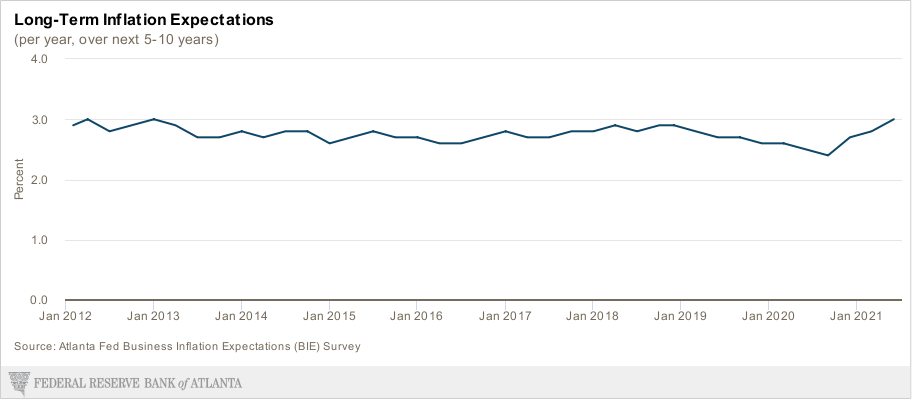
Long-Term Inflation Expectations

  • Some corporate comments via Axios:
    • “The inflation could be worse than people think,” JPMorgan Chase CEO Jamie Dimon said on an earnings call Tuesday. “I think it’ll be a little bit worse than what the Fed thinks. I don’t think it’s only temporary.”
    • “[Policymakers] are saying jobs are more important than consumerism,” BlackRock CEO Larry Fink told CNBC on Wednesday. “That is going to probably lead to systematically more inflation.
    • “Is there somewhat more inflation out there? There is,” PepsiCo CFO Hugh Johnston said on an earnings call Tuesday. “Are we going to be pricing to deal with it? We certainly are.”
    • “Will Conagra take list pricing increases? The short answer is, yes,” Conagra CEO Sean Connolly said. “And we have more pricing coming.”
    • “[We’ve] done at least one large [price] increase earlier in the second quarter, and that was received fairly well,” Fastenal CFO Holden Lewis said on an earnings call Tuesday. “But based on what cost is doing, we’ll have to go to the market with some additional ones.”
  • John Authers: Bonds Are Predicting Another Hawkish Fed Mistake The conundrum of falling longer-term yields implies traders think policy makers will tighten too early, whatever Jerome Powell says.

(…) Now, inflation may or may not prove to be transitory, but it is the highest in decades. Month after month, the official numbers have turned out higher than expected. With higher inflation, investors should in theory demand a higher yield from bonds to compensate for the erosion of buying power. And any suggestion that interest rates are going to go up should, as Greenspan implied, lead to higher long-term yields. Yet they are falling. (…)

I think this point from Andrew Brigden, of Fathom Financial Consulting in London, is well made:

It is becoming increasingly apparent that the pick-up taking place in inflation, particularly in the US, is cyclical. It is not just a consequence of base effects. Traditionally, any cyclical pick-up in inflation has required a monetary policy response. But that is not the intention of policymakers at present. The FOMC continues to believe that the pick-up will be transitory. We have our doubts. Inflation overshoots driven by a spike in the oil price, by a change in tax rates, or by a depreciation of the currency, tend ultimately to subtract from household real incomes. In that sense, they can be self-limiting, and deflationary in the long run, and it is often appropriate for policymakers to look through them. But that is not what we are seeing here. Only in the unlikely event that higher product prices do not feed through at all to higher wages, which would require a very strong degree of faith in policymakers’ ability to rapidly bring inflation back to target, would a cyclical pick-up in inflation be self limiting.

(…)

(…) Policy makers led by Governor Tiff Macklem said Wednesday that they would reduce their weekly purchases of government debt by one-third to C$2 billion ($1.6 billion). Officials held the benchmark overnight interest rate at 0.25%, while indicating they don’t expect any hikes before at least the second half of next year — in line with previous guidance.

The decision to taper advances the central bank’s gradual return to more normal policy, which has put Macklem on the vanguard of unwinding stimulus among his peers. It’s the third time officials have downsized the asset purchase program, and it reinforces expectations the Bank of Canada will be among the first central banks in advanced economies to hike rates. (…)

Swaps trading suggests investors are fully pricing in a hike over the next 12 months, and a total of four over the next two years, which would leave Canada with one of the highest policy rates among advanced economies. (…)

In the U.S., investors aren’t pricing in any rate hike over the next year, and only two over the next two years. (…)

In its latest Monetary Policy Report, the Bank of Canada revised higher its profile for output and inflation amid growing optimism that households will start spending hoards of cash they’ve accumulated over the past year.

The bank now sees households spending 20% of the excess savings accumulated during the pandemic, something it hadn’t predict in its April report. (…)

While conceding that inflation will remain above 3% for much of the rest of this year, the central bank said the uptick reflects factors like gasoline prices, base effects from last year’s lockdowns and supply chain constraints that should fade. They see consumer price gains falling back down to near their 2% target later in 2022 because of lingering excess supply.

The economy will be in a period of excess demand by 2023, the Bank of Canada projected.

China’s Economic Growth Slows in the Second Quarter Despite the slower rate, China’s economic rebound continued to show unusual resilience more than a year after the country largely got control of the coronavirus within its borders.

(…) China’s government said Thursday that gross domestic product grew by 7.9% in the second quarter from a year earlier, in line with economists’ expectations. (…)

Beneath the headline GDP figure, stronger-than-expected readings on factory output, retail sales and fixed-asset investment data in June are likely to quiet rising speculation that Beijing will intervene more forcefully to keep its growth momentum going in the latter half of the year. (…)

With the 12.7% first-half growth figure, policy makers now appear to have lots of cushion to hit their full-year growth target of at least 6%—even if the economy slows considerably in the second half. (…) Many forecasters expect China to easily post 8% growth or more this year, given the low base of comparison from 2020. (…)

Industrial output rose 8.9% in the second quarter and 8.3% in June compared with a year earlier, according to data released by the National Bureau of Statistics Thursday, beating expectations.

Retail sales, a key measure for China’s consumer spending, increased 13.9% in the second quarter and 12.1% in June from a year earlier, also topping forecasts.

Fixed-asset investment grew 12.6% in the first six months of the year, again beating expectations.

China’s urban surveyed unemployment rate, its headline measure of joblessness, stood steady at 5.0% in June, the same as in May, the statistics bureau said. (…)

OPEC Reaches Compromise With U.A.E. Over Oil Production OPEC agreed to raise the amount of crude the cartel member can eventually pump, but it is subject to approval by a wider group of producers that includes Russia.

(…) The U.A.E. had asked for its so-called baseline—or the maximum amount of oil the group would recognize the country as being capable of producing—to be raised to 3.8 million barrels a day from 3.2 million barrels a day. In the compromise reached Wednesday with Saudi Arabia, the U.A.E. can increase that to 3.65 million barrels a day starting in April, according to people familiar with the matter. (…)

Other OPEC members could use concessions made to the U.A.E. to argue for increases in their own output inside the group, delegates said.

Goldman Sachs’ take:

(…) such an OPEC+ agreement would be bullish relative to our base-case (…). As a result, a deal as described above would imply downside risk to our OPEC+ production forecast of 0.4 to 0.6 mb/d on average for 3Q21-1Q22 (depending on whether the lack of August production hike is compensated for in September).

All else equal, this would represent $2 to $4/bbl upside risk to our $80/bbl summer and $75/bbl 2022 Brent price forecasts. While the lack of definitive OPEC+ production agreement (and the potential modest downside demand risk from the Delta COVID variant) leave our forecasts unchanged, we see such an OPEC+ agreement as the first of likely four potential bullish supply catalysts over the coming month that would more than offset higher recent realized North American production.

No Market Breadth, No Problem as Faangs Lift S&P 500 Higher

(…) Tech was among the top-performing sectors Wednesday. And while 429 stocks in the S&P 500 fell on Tuesday, tech was the only sector to close in the green — cushioning the index’s 0.4% drop. That’s the S&P 500’s largest number of decliners for a drop that small since at least 1996, according to Callie Cox, senior investment strategist at Ally Invest. (…)

Just eight stocks — the Faamg group of Facebook Inc., Apple, Amazon.com Inc., Microsoft Corp. and Google parent Alphabet, alongside Netflix, Nvidia Corp. and Tesla Inc. — accounted for more than half the S&P 500’s 7.6% gain since May 12, according to data from Bespoke Investment Group. And their weighting in the index rose to more than 27%. (…)

The S&P 500 has hit a record just about every three days this year, but few of its components are trading above their 50-day moving averages, Jason Goepfert, president and founder at Sundial Capital Research, wrote in a note. (…)

The Russell 2000 lost 1.6% yesterday while large caps indices were about flat. The 50 and 100dmas are now declining with the still rising 200dma 6% below.

iwm

TWO GOOD PODCASTS

Cornerstone Macro’s Nancy Lazar, firmly in the lowflation camp, and Weiss President & CIO Jordi Visser, a convinced inflationist, go back and forth arguing the variables and trends impacting inflation over the next several years. A nearly one hour podcast but its nice to listen to well articulated, “one-armed” economist/investor.

One of Jordi Visser’s argument is the wealth effect partly created by younger people being strongly invested in cryptos. This next podcast would not support this view, far from it…Also time well spent, even if you don’t care about cryptos; but you should care, even if you don’t invest in cryptos…

My recent foray into the world of the stablecoin tether and the companies and personalities surrounding it has been utterly fascinating.

I’ve seen many curious things during my career but the seemingly blatant nature of what certainly seems, at face value, like a gigantic fraud, has astonished me. In the recent June edition of Things That Make You Go Hmmm…, I dove into Tether (the company), Bitfinex and tether (the coin) and what I found blew my mind.

Much of my research was built upon the work of a group of tether skeptics, one of whom, Bennett Tomlin, agreed to join me for this discussion to hopefully bring the story to wider attention. It’s worth pointing out that Bennett is not a crypto-skeptic, but what he’s uncovered is a complex web of deceit and obfuscation that will, I suspect, take your breath away like it did mine. Joining Bennett and myself is George Noble, a hugely experienced hedge fund manager with an extraordinary track record. Like Bennett, George is not anti-crypto, but his own work on Tether has led him to similar conclusions.

Hopefully, this discussion between a stalwart of the financial industry and a man who has immersed himself deep in the crypto world can help both sides understand each other better and you to gain a perspective on what could well become the biggest story in crypto in the coming weeks and months…