The enemy of knowledge is not ignorance, it’s the illusion of knowledge (Stephen Hawking)

It ain’t what you don’t know that gets you into trouble. It’s what you know for sure that just ain’t so (Mark Twain)

Invest with smart knowledge and objective odds

THE DAILY EDGE: 8 OCTOBER 2021: Jobs Miss

Payroll employment rises by 194,000 in September; unemployment rate declines to 4.8%

Thus far this year, monthly job growth has averaged 561,000.

The change in total nonfarm payroll employment for July was revised up by 38,000, from +1,053,000 to +1,091,000, and the change for August was revised up by 131,000, from +235,000 to +366,000. With these revisions, employment in July and August combined is 169,000 higher than previously reported. (…)

U.S. Initial Unemployment Insurance Claims Drop Sharply

The labor market continues to strengthen. Initial claims for unemployment insurance fell to 326,000 (-58.3% y/y) during the week ended October 2 from 364,000 in the prior week, revised from 362,000. The Action Economics Forecast Survey expected 348,000 initial claims in the latest week. The four-week moving average of initial claims rose to 344,000.

Initial claims for the federal Pandemic Unemployment Assistance (PUA) program in the week ended October 2 were 23,453 (-93.8% y/y) versus 17,687 in the previous week. The latest number was the highest in four weeks, but remained near the lowest level since the program began on April 4, 2020 at the start of the pandemic. By comparison, these claims averaged 107,756 per week during August. The PUA program provided benefits to individuals who are not eligible for regular state unemployment insurance benefits, such as the self-employed. This program expired on September 6, explaining the smaller number of new claims during the latest several of weeks. Given the brief history of this program, these and other COVID-related series are not seasonally adjusted.

Continued weekly claims for regular state unemployment insurance fell during the week of September 25 to 2.714 million (-74.1% y/y) from 2.811 million in the prior week, revised from 2.802 million. The insured rate of unemployment slipped to 2.0% from 2.1%.

Continued weekly claims in the Pandemic Assistance Program (PUA) program dove to 647,690 from 1.059 million in the September 18 week (-94.0% y/y) as the program wound down. Continued weekly claims for Pandemic Emergency Unemployment Compensation (PEUC) fell sharply to 630,814 in the week of September 18, down from 991,813 in the prior week and 3.645 million in the week before that. This program covered people who had exhausted their state unemployment insurance benefits.

In the week ended September 18, the total number of all state, federal, PUA and PEUC continued claims fell sharply w/w to 4.173 million from 11.250 million two weeks earlier. These total claims averaged 8.139 million over the four weeks ended September 18. These figures are not seasonally adjusted.

(Bespoke)

Bank of Canada Sees ‘Good Rebound’ Despite Rising Inflation Risk

Bank of Canada Governor Tiff Macklem said the economic recovery is on track despite disappointing output growth, but warned there’s a risk high inflation could prove more persistent than expected. (…)

Macklem said supply disruptions and price pressures are “proving more complicated, they are continuing, so there is some risk that there’s a bit more persistence than we previously thought.” However, he added there are still “good reasons” to believe high inflation will be temporary. (…)

Manheim Market Report (MMR) values saw accelerating weekly increases throughout September. Over the full four weeks in the month, the Three-Year-Old Index increased a net 4.6%. (…)

unnamed - 2021-10-08T075240.425

Data: Manheim Used Vehicle Value Index; Chart: Axios Visuals

Using a rolling seven-day estimate of used retail days’ supply based on vAuto data, we see that used retail supply peaked at 114 days on April 8, 2020. Normal used retail supply is about 44 days’ supply. It ended September at 37 days, which is below normal levels. We estimate that wholesale supply peaked at 149 days on April 9, 2020, when normal supply is 23. It ended September at 18 days. (…)

  • High demand even at higher prices

Levi Strauss uses 2 pounds of cotton in every pair of pants, CFO Harmit Singh said on Wednesday’s earnings call.To help cover its skyrocketing costs for the material, the company has raised its average selling prices by more than 10% over 2019 levels. Despite higher costs, lean inventories and shoppers’ willingness to pay up are helping big companies continue to grow. Levi’s gross margins were a record 57.5%. (Axios)

unnamed - 2021-10-08T072429.196

Dude, Where’s My Stuff?

By Michael Cembalest, Chairman of Market and Investment Strategy for J.P. Morgan Asset & Wealth Management

The global supply chain mess will require increased global vaccination and acquired immunity, semiconductor capacity expansion and the end of extraordinary housing/labor supports to resolve. We expect all three to occur over the next few months, leading to a global growth bounce in 2022.

The containership industry is a good illustration of the supply chain mess: more than 70 containerships are stacked up outside Los Angeles/Long Beach ports waiting to unload. Idle containerships are back to just 3% of the total fleet, shipping costs are surging, manufacturing delivery times are extended and rail shipments are declining sharply from their summer peak, illustrating the far reaching impact of the delays. (…)

Note that global supply chain problems are not getting better as growth momentum slows, since production growth is declining as fast as new order growth. For all the clients that have asked me about the political and economic problems associated with the rise of autonomous vehicles and more unemployed truckers, I keep telling them they’ve got it backwards: the US has had a trucker shortage for the last few years, and it’s projected to get worse. In other words, COVID has worsened some existing vulnerabilities in the US supply chain, just as global trade is surging. As for the August US inflation report in which CPI came in lower than expectations, that was mostly a function of COVID related declines in airfare, lodging and rental cars. These categories will probably bounce back when the Delta wave fades, and the other categories are still rising sharply.

First, the world is going to need more containers, which carry more than 90% of the world’s traded goods. Chinese companies affiliated with its government make 95% of the world’s containers and have ramped up production. The number of containerships in service is rising as well, albeit more slowly; again, China stands to benefit as the world’s largest shipbuilder (37% of the shipbuilding market in 2019 by deadweight, and 45% of all new shipbuilding orders). (…)

But more containers and containerships won’t solve problems in the West unless other supply chain issues are resolved as well. That will probably require (a) an end to extraordinary housing and income support measures, and (b) less community spread and concern about COVID. (…)

imageHousing and income policy may have to normalize before labor supplies do. G7 manufacturing wages are rising at a very high rate given the prevailing level of unemployment, another sign of labor markets whose supply-demand equilibrium has shifted. By the way, I find it interesting that some people arguing for continued extension of COVID benefits also argue for the largest amount of new Congressional spending ($3.5 trillion), without explaining what that might do to current labor shortages, where all these new workers are supposed to come from and how all that spending might impact inflation and Fed policy. In August, 50% of small business owners said they had job openings they already couldn’t fill, the highest level on record. (…)

Vaccination rates have hit 70% in Malaysia; while they are still less than 50% in Indonesia, Thailand, Philippines and Vietnam, acquired immunity appears to be playing a role now as well.  Furthermore, mRNA vaccines should make greater inroads in the entire region in 2022, displacing Chinese vaccines with lower observed efficacy. (…)

Michael Cembalest, a banker, is talking of a resolution “over the next few months”.

Hapag-Lloyd CEO Rolf Habben Jansen, a shipper, does not see much light before February/March:

“The worst numbers we have seen so far were in the month of August, where the time that it takes us to get a container back is up about 20%, which also means that we need 20% more containers than we normally need to transport the same amount of volume.

“The same goes for voyage delays,” Habben Jansen said. “We also have seen these delays go up, and if we look at the situation today, we are probably in the peak of the problems. … The already congested supply chain is getting congested even further.” (…)

In many ports at the moment, capacity remains strained. This is the case in Asia, where we have significant delays when we look at Korea, we have significant delays when we look at China, also Singapore [is] not as smooth as it normally runs. If you go to Europe, especially in the north, [there are] definitely a number of ports where we have very significant waiting times,” he said.

“If we look at the United States, that’s probably where we still have most of the difficulties, not only in LA/Long Beach but also in other ports on the West Coast, but also increasingly at ports on the East Coast, where places like Savannah and New York are heavily congested.” (…)

“Let’s not forget that these difficulties are in many cases not limited to the ports only, but we also have bottlenecks on inland transportation. The most obvious bottlenecks, they’re definitely in the U.S., but also in places like the U.K., and in some places in Europe we also see that shortage of available inland capacity [is] prominent.” (…)

“If we look at the operational challenges that we have, they are currently still very, very significant, and we do not expect to see any normalization until Chinese New Year ’22,” he said. “I would seriously hope that after that, we will see a gradual normalization — until we go into the next peak season of 2022.” (H/T ZeroHedge)

China’s Energy Crisis Is Hitting Everything From iPhones to Milk The hit from China’s energy crunch is starting to ripple throughout the globe, hurting everyone from Toyota Motor Corp. to Australian sheep farmers and makers of cardboard boxes.

The extreme electricity shortage caused by soaring prices of coal in the world’s largest exporter is set to hurt China’s own growth, and the knock-on impact to supply chains could crimp a global economy struggling to emerge from the pandemic. (…)

At Citigroup, a vulnerability index indicates that exporters of inputs to China’s manufacturing sector as well as commodities are particularly at risk to a weakening Chinese economy. Neighbors like Taiwan and Korea are sensitive, as are metal exporters such as Australia and Chile, and key trading partners such as Germany are also somewhat exposed.

As for global consumers, the question is whether manufacturers and retailers will absorb higher costs or will pass them along.

“This is looking like another stagflationary shock for manufacturing, not just for China but for the world,” said Craig Botham, chief China economist at Pantheon Macroeconomics. “The price increases by now are pretty broad-based — a consequence of China’s deep involvement in global supply chains.”

(…) power use curbs on the most energy-intensive industries such as steel, aluminum and cement will persist for months and China will continue to aggressively target imports of natural gas, adding to global price pressures, they said.

Some industries are already under pressure, and the damage they’re seeing could fan out to other sectors. (…)

Investors pile into cash and TIPS in week to Wednesday – BofA

Investors ploughed $14.9 billion into cash in the week to Wednesday and snapped up $1.8 billion of inflation protected U.S. Treasuries as markets suffered a major sell off, a round-up by BofA on flow number based on EPFR data showed on Friday.

Fixed income markets attracted the smallest weekly inflow since March at $3.9 billion with investment grade securities attracting just $2.1 billion and both high-yield and emerging market bonds suffering outflow, the BofA report noted.

Equities sucked in $13 billion with Japan stocks enjoying the best inflows since April 2019 at $4.3 billion and U.S. stocks gaining $71 million, while their European peers suffered a 1.3 billion outflow.

“Late-60s/70s “stagflation” winners were real assets, real estate, commodities, volatility, cash, EM, all of which held their own vs inflation; losers were bonds, credit, equities, tech, all of which ultimately struggled,” strategist Michael Hartnett said in the note to clients.

  • More than 4,000 stories mentioned the word “#stagflation” in September, 2X as many as in August, itself a record high going back to 2012
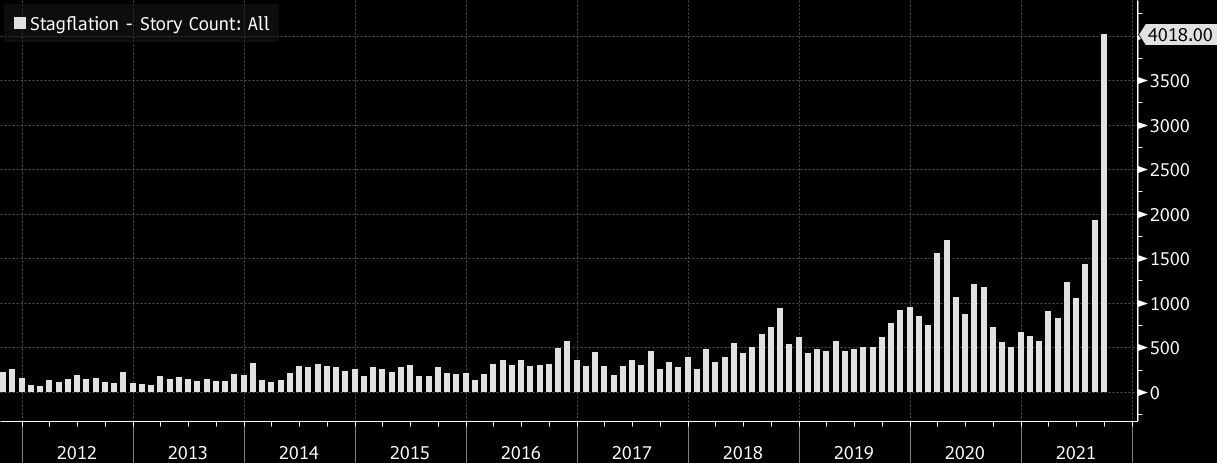
@Schuldensuehner

THE DAILY EDGE: 7 OCTOBER 2021: Beware The Comet!

Chinese Property Bonds Hammered by Default Worries, Weak Sales Shrinking apartment sales and a surprise default have stoked investor concerns about China’s property developers, causing a selloff in U.S. dollar bonds from many of the sector’s debt-laden companies.

(…) Some developers’ sales figures for September have also showed a significant drop in home-buyer demand, after embattled property giant China Evergrande Group ran short of cash and was forced to halt construction at some of its unfinished residential projects. (…)

An ICE BofA index of high-yield dollar bonds from Chinese companies showed a yield of more than 18% on Wednesday, its highest in nearly 10 years. Property bonds make up a large part of the gauge. (…)

“It is now a full-blown risk aversion to this sector,” he said.

(…) about half of China’s high-yield property bonds were now trading at yields of above 20%—implying a high default risk for those companies and making it hard for them to refinance coming debts.

(…) average contracted sales for key developers dropped 28% compared with September of last year. (…)

(…) The value of nationwide land sales abruptly fell 17.5% on year in August, according to Reuters calculations of finance ministry data, the biggest slide since February 2020.

Further falls could force regional governments, who on average depend on land sales for a fifth of their revenue, to cut spending and investment. (…)

In an ongoing round of auctions in June-October, about 40% of the plots on offer were withdrawn or had no bidders as of Sept. 30, a Reuters analysis of over 1,000 public notices showed. That compared with 5% of untaken offers in the first round. (…)

Moody’s predicts land sales growth will be in the low single-digits in 2021 before declining in 2022. (…)

The value of winning bids by state firms have been triple that of private developers in the June-October auctions so far, marking a departure from past trends. But, as of Sept. 30, their overall bids were down 45% to 277.2 billion yuan from the March-June auctions. (…)

INFLATION, GROWTH WATCH
Natural Gas Prices Take Wild Ride After Putin Comments Russian president said the country’s gas supplies to Europe are set to reach a record this year

Russian President Vladimir Putin said Moscow was ready to work on stabilizing the global energy market, causing a sudden reversal in natural gas prices, which had earlier soared to their highest level on record.

The Russian leader appeared to be flexing his geopolitical muscles by signaling that he could help tamp down a growing crisis in Europe caused by a shortage of natural gas, a key energy source for producing electricity and heating homes. High prices in Europe have spilled over to the U.S. as well, with natural gas trading at its highest in over a decade. (…)

Higher prices are being interpreted in European capitals as an attempt to pressure officials and regulators into approving Nord Stream 2, a controversial pipeline linking Russia and Germany that is close to launching. The Kremlin has repeatedly said that Russia is fulfilling its contractual obligations. (…)

Gas futures skidded more than €50 after Mr. Putin’s comments to trade 9.5% lower on the day at €105.00 a megawatt-hour. Even after the retreat, European gas prices remained more than twice as high as they were a month ago and had risen more than fivefold this year. (…)

A large share of Russian gas exports to Europe transits through Ukraine, but that is expected to change after the Nord Stream 2 pipeline comes on stream, possibly in the next few months if the pipeline receives approval from European authorities. An adviser to the European Court of Justice helped clear the way to opening Wednesday, saying that Nord Stream 2 AG, the unit of Gazprom that built the pipe, is able to challenge rules stipulating that producers cannot control gas pipelines that deliver their fuel. (…)

The U.S. fears Russia will use Nord Stream 2 to wield influence over Europe and punish pro-Western Ukraine. But the Biden administration waived sanctions on the project in May as it sought improved ties with Germany. Russia and Germany say Nord Stream 2 is a commercial project, providing a shorter and cheaper route for gas supplies.

“And we can say with confidence that we will exceed our contractual obligations for gas supplies through the territory of Ukraine,” Mr. Putin said, though suggested that increases would be limited. “Increasing volume is economically unprofitable for Gazprom, because it is more expensive.” (…)

Nordea:

To understand why we are currently stuck in an energy crunch, we need to turn time at least ten years back to the launch of the German Energiewende in 2010, which was further accelerated by the Fukushima-disaster in 2011. Germany decided to end the nuclear capacity as soon as possible with a potential end-date during 2022. Capacity in nuclear production has since gone from >10% of German energy consumption to levels below 5% currently, with wind energy and natural gas as the replacements.

We have seen similar developments in countries such as Sweden and France, which has left the European electricity grid vulnerable should the wind not blow. Windfarms have produced 30-40% less electricity Y-T-D compared to a normal year, which paired with a structurally distressed supply chain has chased energy input prices up into the stratosphere with continued bizarre daily price increases in both natural gas, coal and oil at the moment.

Even if we see ourselves as a cross-asset strategy team, we don’t have a strong view on whether the wind will blow more or less than usual over winter, why we prefer to take a look at the energy situation should weather patterns behave as normal over the next 4-5 months. Inventories are scarily low ahead of the heating season.

German inventories of natural gas are scarily low ahead of the winter. We have taken a deep look at Gazproms major storage sites in Germany (Katharina, Jemgum, Redhen and Etzel), and were almost shocked by the severity of the issue. Current inventories will run frighteningly close to zero by Mid-March 2022, if usual seasonal patterns unfold over winter. (…)

Remember that natural gas make up around 25% of the total energy consumption in Europe still. We are counting on you Vladimir! (…)

The situation is about as bad in China, (…) as coal makes up around 60% of the energy consumption in China. Per anecdotal evidence China has now re-allowed Australian coal shipments to reach Chinese land-territory despite the ongoing geopolitical dispute between the two countries. (…)

OECD oil stocks remain below averages, but not in a dramatic way. US oil inventories are even above usual mean levels still, which makes the situation less uncomfortable for the Yankees. (…)

The bottom-line is that the Euro area is likely to be the most sensitive and we should expect at least 1.5-2%-points to be shaved off 2022 growth prospects (on a stand-alone basis) within the G3+ countries (Japan, Euro area and US) just due to the recent price moves in energy. (…)

Let’s hope that the wind starts blowing!

  • Fallout from China’s energy crisis (Axios)

Supply chain disruptions are a huge part of what’s holding back the world’s economic growth as it recovers from the pandemic lockdown era. Electricity blackouts in China spawned by a power shortage could make that worse.

Key suppliers to tech giants like Apple, Tesla, Microsoft, HP and Dell have been forced to cease or reduce operations, the FT reports.

  • Suppliers to U.S.-based makers of consumer products like water bottles and backpacks also face caps on their power usage, the WSJ writes.
  • Food costs will probably rise, too. Agricultural processing plants have had to go dark, according to Bloomberg.

Global markets may be in for a further supply shock, which could add to inflation, Nomura chief China economist Ting Lu wrote in a research note, according to the WSJ report.

Kolanovic on the Canary in the Coal Mine for Higher Energy Prices

Now with power and gas prices in Europe and China soaring to multi-year highs, the JPMorgan Chase & Co. strategist seems on the verge of once again living up to his ‘Wizard of Wall Street’ moniker as pandemic-plagued supply chains and years of persistent underinvestment in dirtier forms of energy such as oil combine. “While this scenario has not fully materialized as of now, circa eight months after our forecast, several signs of it are appearing,” he writes in research published alongside his quant colleague Bram Kaplan on Thursday.

At issue is the transition to clean energy, which has deprived traditional energy producers of capital needed to fund exploration, energy and efficiency improvements. As Odd Lots has noted before, there’s a risk that the costs of moving to cleaner fuel plus the stranding of more polluting alternatives could increase the cost of energy at the same time that food and other essential prices have been rising.

Kolanovic suggests following coal prices as a gauge of both supply and demand for energy, as well as the cost of capital and broader “energy transitioning issues for all fossil fuels.” The concern, as Kolanovic writes, is that coal ends up being the proverbial canary in the coal mine for higher oil prices, which would be a much bigger deal for the global economy and overall levels of inflation.

Or as he puts it:

We believe that the evolution of coal prices might reflect supply, demand, cost of capital and energy transitioning issues for all fossil fuels, and it would certainly be possible that oil prices will follow the same pattern (inflation adjusted for oil, that would be in a $150-200/bbl range). So the risk is that coal is a proverbial “canary in a coal mine” for the much more important commodity oil (figure below). Laws of physics (law of conservation of energy) would indicate that various forms of energy are interchangeable, as we are seeing currently with some oil for gas substitution, or firing up of coal plants above certain thresholds of electricity prices, private power generation, etc. The linkage between various sources of energy has been true in financial markets as well, and historically energy assets have been correlated (averaging about 20-30% correlation of price returns). For this reason, investors should consider hedging for higher oil prices, which can be expressed in asset class (long commodities, short bonds), sector (long energy), style (long value, short growth) or thematic form. The most likely outcome of the current energy crisis is increased production at significantly higher energy prices, which would stabilize the global economy and energy infrastructure, but also temporarily slow down the energy transition.

Prices for other types of energy may follow coal

The good news for bulls is that Kolanovic doesn’t think oil as high as $150 per barrel will be a massive problem for risk assets. The bad news — for anyone who cares about climate change and humanity’s long-term future — is that the clean energy transition risks being delayed or interrupted if inflationary pressures prove too much.

World food prices hit 10-year peak -FAO

(…) FAO’s food price index, which tracks international prices of the most globally traded food commodities, averaged 130.0 points last month, the highest reading since September 2011, according to the agency’s data.

The figure compared with a revised 128.5 for August. On a year-on-year basis, prices were up 32.8% in September. (…)

World vegetable oil prices were up 1.7% on the month and showing a year-on-year rise of about 60%, as palm oil prices climbed on robust import demand and concerns over labour shortages in Malaysia, FAO said. (…)

  • Food prices fuel stagflation scenario (NBF)

The risks of a stagflation scenario are increasing. Global supply chain constraints are currently being exacerbated by an energy shortage and the soaring coasts of carbon emission permits in many OECD countries. And this at a time when China is recalibrating its industrial policies. This confluence of factors is looking more and more like a supply shock reminiscent of the early 1970s, when soaring production costs idled industrial capacity and lowered potential GDP for many quarters.

As if this were not already bad news for inflation, we now have to contend with soaring food costs. (…) The FPI adjusted for inflation is currently at its highest level since the early 1970s. This is a particularly troubling development for emerging markets where food accounts for a large share of the consumption basket. Remember than EMs now account for about 60% of global GDP. Clouds are forming over global economic growth forecast for 2022.

image

  • Canada completed its smallest canola harvest in 13 years, raising prices on world markets for the oilseed. (Globe and Mail)
  • The digital ad price surge

The cost to advertise on Facebook is 33% higher than it was in Q3 2019 (before the pandemic), as measured by CPM, or cost per thousand impressions. Instagram CPM is up 23% over the same period, and Google’s cost per click (CPC) is also up 23%, according to proprietary data provided by performance marketing firm Tinuiti.

“For most advertisers, pricing is the highest it’s ever been.” One VP of e-commerce at a direct-to-consumer beauty brand tells Axios that the company’s digital ads are now at least 50% more costly than they were in January, on a per-click or per-impression basis. (…)

“For a startup, this is a really tough time. A lot of them have historically depended quite a bit on the social platforms to track their business. They usually have lean marketing budgets, and you need returns on those investments,” the e-commerce exec says.

unnamed - 2021-10-07T075125.797

  • The FT informs us that semiconductor maker Infineon Technologies says auto makers have ordered enough chips to make 120 million cars. Annual world production was 92 million in 2019.

Workers strike back (Axios)

  • Production has been halted at Kellogg cereal plants across America after 1,400 workers walked off the job in a bid for better benefits (and worries about job outsourcing).
  • The last time a cereal workers strike hit the company was nearly 50 years ago.

unnamed - 2021-10-07T070055.932

Almost Daily Grant adds:

Reading the tea leaves, Bank of America announced today that minimum wages will increase to $21 per hour from $20.  That’s only the beginning: BofA targets a $25 hourly floor by 2025, up 120% from 2010 and 47% from 2019. That comes a day after Target upped its hourly ante by $2 for peak days this holiday season in stores and service centers. The big-box retailer bumped its minimum wage to $15 per hour from $13 last July, six months earlier than previously projected.  Those incentives may help Target get the jump on its peers, as all but 2% of respondents to a September survey of 176 retailers by consulting firm Korn Ferry reported that securing sufficient staff was a problem. (…)

Similar dynamics are at play across the Atlantic.  The U.K.’s Low-Pay Commission is reportedly set to recommend bumping the hourly minimum by 5.7% to £9.42 ($12.81) next year, following a 2.2% hike to £8.91 per hour in April, with Prime Minister Boris Johnson stating yesterday that he will accept the committee’s suggestion.  (…)

The implications of an unhappy labor force may soon be felt on the European continent. Some 900,000 German construction workers threatened a nationwide strike today if their demands for a 5.3% wage hike, along with enhanced travel compensation, are not met. “Without the employers really giving in, there will be no agreement with us this time,” Robert Feiger, head of the IG Bau labor union, told Sueddeutsche Zietung newspaper today. “And believe me: We know how to strike.”  That comes two days before negotiations are set to commence between Germany’s 15 federal states and public employee unions representing 2.3 million workers, who are asking for a 5% hike in their earnings.

German wage inflation footed to 5.5% on an annual basis in the second quarter, according to data from the Federal Statistics Office, while headline CPI jumped 4.1% year-over-year in September for its hottest reading since shortly after the Berlin Wall came down.

“Definitely for the time being we cling to the hope that the current inflation spike will be transitory,” ECB Governing Council member Robert Holzmann illuminatingly stated today.  Indeed, the bedrock of near-zero interest rates and accompanying edifice of sky-scraping asset prices arguably depends on just that.

Quite a statement from the ECB member: “ Definitely” …”for the time being”…

Tether’s $69 Billion Mystery

(…) There are now 69 billion Tethers in circulation, which means the company that issues them should hold a corresponding $69 billion of assets to back them [48 billion of them issued this year], enough to make it one of the top 50 banks in the U.S.—that is, if it were a U.S. bank and not an unregulated offshore company. But for years, despite the company’s assurances that the money is safe, exactly what’s behind Tether has been a mystery. Here are five takeaways from Bloomberg Businessweek’s cover story “The $69 Billion Crypto Mystery.”

  • Tether has invested some of its reserves in Chinese commercial paper. Businessweek obtained a document showing a detailed account of Tether Holdings Ltd.’s reserves. It said they include billions of dollars of short-term loans to large Chinese companies—something money-market funds have avoided. (…)
  • Tether has made billions of dollars of crypto-backed loans. Some of those loans have Bitcoin as collateral. (…)
  • A banker says Tether’s top executive put reserves at risk. John Betts, former chief executive officer of Noble Bank International LLC in Puerto Rico, which Tether used, says Tether Chief Financial Officer Giancarlo Devasini, who effectively controls the company, had put its reserves at risk by investing them to earn potentially hundreds of millions of dollars of profit for himself. “It’s not a stablecoin, it’s a high-risk offshore hedge fund,” he says.
  • Tether no longer keeps all of its assets at a bank in the Bahamas. (…)
  • Tether executives are the subjects of a U.S. criminal investigation. (…)

Check out the full story to learn how Tether was dreamed up by a former Mighty Ducks child actor, run by an Italian ex-plastic surgeon, and banked with the co-creator of Inspector Gadget.

More from the same authors: Anyone Seen Tether’s Billions?

As far as the regulators are concerned, the size of Tether’s supposed dollar holdings is so big that it would be dangerous even assuming the dollars are real. If enough traders asked for their dollars back at once, the company could have to liquidate its assets at a loss, setting off a run on the not-bank. The losses could cascade into the regulated financial system by crashing credit markets. If the trolls are right, and Tether is a Ponzi scheme, it would be larger than Bernie Madoff’s.

‘It’s Like There’s No Covid’: Booster Shots Bring Tel Aviv Back to Life

The mass distribution of third shots in Israel has driven down new cases and hospital admissions, allowing restaurants and shops to fill up with customers. New variants of the disease could change the pandemic’s trajectory again, but for now, the boosters are working, Mayor Ron Huldai said in an interview with Bloomberg News. (…)

The country began administering booster shots in August and inoculated 2.8 million people with third doses. Israel has administered enough vaccine doses to cover 85% of its population, compared with 62% in the U.S., according to the Bloomberg Vaccine Tracker. (…)

Axios:

  • The U.S. is now averaging 102,000 new cases per day — a 22% drop over the past two weeks.
  • Deaths are also falling, by a nationwide average of about 13%. The virus is now killing roughly 1,800 Americans per day.

NBF charts:

 image image
image

Heart damage from Covid-19 extends well beyond the disease’s initial stages, according to a study that found even people who were never sick enough to need hospitalization are in danger of developing heart failure and deadly blood clots a year later.

Heart disease and stroke are already the leading causes of death worldwide. The increased likelihood of lethal heart complications in Covid survivors — who number in the hundreds of millions globally — will add to its devastation, according to the study, which is under consideration for publication by a Nature journal. (…)

They found non-hospitalized Covid patients had a 39% increased risk of developing heart failure and a 2.2-fold increased risk of a potentially deadly blood clot, known as a pulmonary embolism, in the following year, compared with someone who didn’t develop the disease. That works out to an extra 5.8 cases of heart-failure and 2.8 cases of pulmonary embolism for every 1,000 Covid patients who were never hospitalized.

Being hospitalized for Covid is associated with a 5.8-fold increased risk of cardiac arrest and almost a 14-fold greater chance of myocarditis, or inflammation of the heart muscle, the study found. Covid patients who needed intensive care are at significantly greater risk, with almost one in seven suffering a major adverse cardiac event that they wouldn’t have otherwise had within a year. (…)

Having read through here, you might tend to read this next headline figuratively: One of the largest comets ever seen is headed our way

It apparently should be read literally…

Here’s something positive: The World Health Organization approved the first-ever malaria vaccine — which is also the first-ever vaccine against a parasitic disease.