Note: I will be in California for the next 3 weeks. Time zone, family matters and limited equipment could have an impact on the frequency, quantity and, perhaps, quality of my blogging.
Two Fed Officials Weigh Prospect of Speeding Bond-Buying Taper Fed Vice Chairman Richard Clarida and Fed governor Christopher Waller in separate appearances remarked on the possibility that the central bank could move more swiftly to end its asset-buying stimulus effort.
“The economy is in a very strong position” and “there is upside risk to inflation,” Federal Reserve vice chairman Richard Clarida said in a virtual appearance. When it comes to the possibility of speeding up the drawdown in the Fed’s bond-buying stimulus effort, “I’ll be looking closely at the data that we get between now and the December meeting, and it may well be appropriate at that meeting to have a discussion about increasing the pace” of the pullback in asset buying at the coming Federal Open Market Committee meeting, he said. (…)
“For my part the rapid improvement in the labor market and the deteriorating inflation data have pushed me towards favoring a faster pace of tapering and a more rapid removal of accommodation in 2022,” Mr. Waller said in a speech in New York. “The next few months will be critical…in determining how the tapering process plays out,” he added.
Mr. Waller said that ending the bond buying that expands the Fed’s balance sheet should happen before raising rates, and doing that swiftly gives the Fed options for when it can raise its now near zero short-term rate target. He said he would like to see the taper process done by the end of the first quarter.
“You could have a rate hike as early as the second quarter” if the taper was complete and the Fed decided that was the right choice for interest rate policy, Mr. Waller said. (…)
Mr. Waller was upbeat about the economy and said that given changes in the labor force, the nation is likely only two million jobs short of where it would have been had the pandemic not struck. If current job gain trends continue the jobless rate could soon fall below 4% which means “the labor market is rapidly approaching maximum employment.”
Meanwhile, inflation is rising due not just to supply-chain issues related to the pandemic, but also to high levels of demand, Mr. Waller said.
“Inflation pressures are becoming more widespread and may last longer into 2022 than I thought they would,” the official said, adding he is also concerned about rising inflation expectations held by the public. (…)
Discussions will heat up at the next FOMC meeting. On November 3rd, Powell said “The inflation that we’re seeing is really not due to a tight labor market” while acknowledging that it is “also demand related”.
But we can see the Fed’s narrative changing in real time. Waller is subscribing to the idea that the actual labor slack is not what the official numbers suggest, after Powell raised that possibility on November 3rd: “maximum employment can be measured in several ways. We look at a range of things. By many measures we are already at a very tight labor market, but the issue is how persistent is that”.
Some clues:
John Deere, Inflation Bellwether The company’s union workers win automatic cost-of-living increases, which should raise alarms at the Federal Reserve.
By the WSJ Editorial Board
Credit Deere & Co. employees for reading the moment. After a month or so on strike, they won a contract this week that their union negotiators might not have dreamed of a year ago. The episode reveals how inflation is seeping into business decisions and worker demands.
Some 10,000 union workers for the farm-equipment giant approved a labor contract Wednesday, ending a strike that began Oct. 14. The contract includes an $8,500 restart bonus, an immediate 10% raise, two 5% raises and two large bonuses through 2026. Total retirement benefits for an average worker will rise by $270,000. Most important as an economic signal, wages will be adjusted each quarter based on inflation.
Deere workers rejected two earlier agreements that their United Auto Workers reps brought for a vote. The original deal offered 5% and 3% raises, which were dwarfed by the 6.2% rise in consumer prices since October 2020. When the negotiation started, the Biden Administration and Federal Reserve said inflation was “transitory.” But manufacturing workers read the price signals better than the politicians.
Deere is on pace to have its most profitable year in 2021, despite the drag from supply-chain issues. But the labor agreement will take a big chunk of future earnings, costing north of $3.5 billion. To address workers’ fears about long-term living costs, Deere had to offer raises with a looser connection to each worker’s expected productivity.
Congrats to the Deere workers, but the alarm bell for the Fed should be the automatic cost-of-living adjustments. Those were a feature of the 1970s economy but faded as inflation was brought under control. The longer inflation stays high today, the more workers will demand COLAs, putting employers on the hook for long-term costs they can’t control. Once COLAs are embedded into labor contracts, they become hard to wring out. This is how you get a wage-price spiral and durable inflation.
From today’s WSJ:
(…) Labor accounts for about 15% of Deere’s overall cost of goods sold, analysts said. The 10% pay raise and $8,500 bonus that each UAW member will receive and raises awarded to nonunion employees as well are expected to cost Deere about $235 million in the first year of the six-year contract, said Stephen Volkmann, an analyst for Jefferies Research Services LLC. He estimated that the higher cost will shave nearly 1 percentage point off Deere’s operating margin.
Those profits, Mr. Volkmann said, could easily be recovered by higher prices or greater output at Deere factories. Deere increased prices on large farm equipment by about 8% during its just-concluded fiscal year, the company said.
In a push to hire 160 more workers, a North Whitehall distribution and fulfillment center is offering wages up to $28 an hour plus what the company is tooting as a “competitive benefits package.”
United Natural Foods, Inc. (UNFI), one of the nation’s largest grocery store distributors, is offering warehouse and driver positions.
Pay for those positions ranges $17.50 to $28. A full benefits package, including medical, dental and vision plans; a 401(k) plan with company match; an “early access” to paychecks program; and entry at the Lifestyle Distribution Center are included.
A company spokeswoman said the Lifestyle Distribution Center soon will include a wellness center, company store, café, video game room and an outdoor pavilion on-site. (…)
Uline in October held a hiring event looking to employ 90 workers for its Upper Macungie Township distribution and fulfillment center. The Wisconsin-based employer was offering wages up to $27 hourly and a $2,000 sign on bonus. (…)
- High shipping costs could lift global inflation by 1.5% in 2023, a UN report said. (Dow Jones Newswires via the WSJ)

This OECD chart (via The Market Ear) shows how stimulus checks boosted Americans’ goods splurge
REAL GOODS CONSUMPTION

This extraordinary demand, 10% above trend, is pulling goods inflation up, worldwide.

When will the bond market care?

As to equity markets, the Rule of 20 P/E (actual P/E minus core inflation) is at its cyclical or secular peak and the Rule of 20 Fair Value (yellow, R20 P/E * EPS) is about to turn lower as inflation begins to rise faster than earnings:

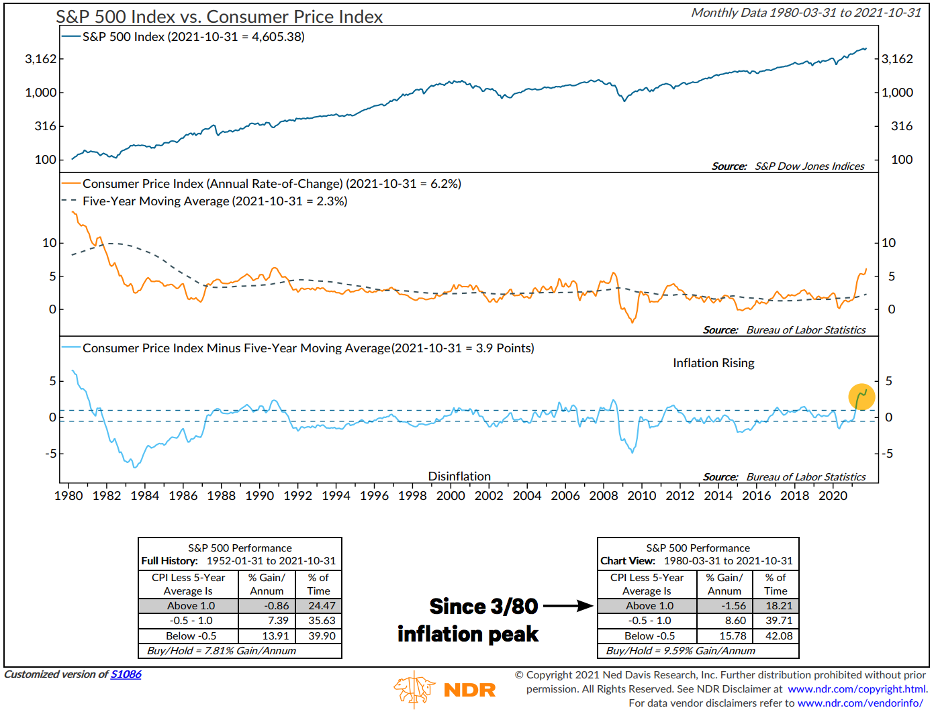
CMG Wealth’s Steve Blumenthal kindly shares this NDR chart showing that nominal equity returns turn negative when inflation is rising well above its 5-year trend:

TECHNICALS WATCH
Wide Selection of Stocks Pushes Market Higher Investors see the move as a promising indication of the rally’s durability, but signs of weakness are lurking beneath the surface of major indexes.
(…) The advance isn’t limited to shares of the biggest U.S. stocks. The Russell 2000 benchmark of small-cap stocks is up 2% in November, in line with the S&P 500’s advance, as investors bet on companies they hope can react quickly to rising inflation.
And a popular technical indicator for market breadth has trended higher. The share of S&P 500 stocks closing above their 50-day moving averages rose early last week to 75%, its highest level since May. (…)
Near the end of the week, however, there were signs of weakness under the surface of major indexes.
The percentage of S&P 500 members above their 50-day moving averages ticked lower. And even as the Nasdaq Composite closed at a record Thursday, 409 Nasdaq stocks made new 52-week lows, the highest daily number since March 2020, according to Willie Delwiche, investment strategist at All Star Charts.
“I don’t know if it will be the case this time, but when the market is heading for trouble, new low lists crescendo in size,” he wrote. “This is not unlike tremors before an earthquake.” (…)
My favorite technical analysis firm also notes that nearly 75% of NYSE stocks have dropped out of short-term uptrends and that some of the recent moves came with mediocre demand and poor breadth. The word is “watch small caps”. The good news is that the IWM’s moving averages have all turned back up.

Merkel Says Covid Spike ‘Worse Than Anything We’ve Seen’
China’s Central Bank Signals Easing as Economic Risks Mount: In its latest quarterly monetary policy report published Friday, the People’s Bank of China removed from its policy outlook a few key phrases cited in previous reports, including sticking with “normal monetary policy.”
U.S. Intel Shows Russia Plans for Potential Ukraine Invasion
FRIENDS AND FAMILY
A proposed U.S. tax credit for electric vehicles is stirring up disagreement at home and abroad. The provision would give consumers a $12,500 tax write-off for buying electric vehicles assembled by union workers using American-built batteries, but less for those made in nonunion factories.
The WSJ’s Julie Bykowicz and Siobhan Hughes report the element in President Biden’s social spending package has sparked fierce lobbying by nonunion auto makers like Tesla and Toyota who say it rewards the United Auto Workers and rival General Motors, which both pushed for a pro-union component, at the expense of the environment.
The shift away from combustion engines is a challenge for the UAW because electric vehicles are simpler to build, requiring fewer employees and potentially lower wages.
The proposal is also casting a cloud over a trilateral meeting with Canada and Mexico, whose leaders say it could divert auto investment dollars away from their countries. (WSJ)
Looks like the Biden team forgot to specify that batteries, the most important EV parts, must also be union-built.
Global IPOs Blow Past $600 Billion Mark in Best Year on Record
The Art Market Surges, Selling $2.3 Billion in Works Artists at Sotheby’s, Christie’s and Phillips broke records, trophies sold for 10 times their asking prices and Asian bidders phoned in to win works by Rothko, Giacometti, Guston
The art market is sizzling. The world’s chief auction houses sold more than $2.3 billion worth of art during a two-week sale series in New York that ends Friday. Back in person en masse for the first time since early 2019, collectors chased after high-end art with a voraciousness not seen since a few years before the pandemic.
Rarely do auction houses sell every single object they have to offer, but Sotheby’s and Christie’s achieved that feat a couple of times as collectors splurged on everything from classic paintings of windswept fields by Vincent Van Gogh to spray-painted images by street artists such as Banksy to a rare edition of the U.S. Constitution. (…)
Sotheby’s auctioneer Oliver Barker took bids in the cryptocurrency ether for some Banksy works, while NFT artists populated high-profile livestreamed sales. A group of cryptocurrency investors organized as ConstitutionDAO narrowly lost a bid to win the $43.2 million Constitution after crowdfunding $40 million-plus over a 72-hour span. Chicago hedge-fund billionaire Kenneth Griffin still outbid them all. (…)
“The art market is truly firing on all cylinders.”
Inflation is everywhere. Now read this:
Soggy French Fries? Blame the Cooking Oil Price Spike. ‘It’s Pretty Much Liquid Gold.’ Cooking oil costs are up, so restaurants are stretching supplies
If your french fries are tasting funny these days, it might be the oil.
A biofuels boom is driving up demand for vegetable oil, boosting costs for food manufacturers and restaurants who use it to bake bread and fry chicken, among other things. (…)
In some regions, restaurants are battling thefts of used oil, which has also risen in value. (…)
Futures prices for soybean oil, a key cooking oil, notched records this summer after climbing 70% in the first six months of this year. Used cooking oil recently sold for 66 cents a pound, nearly 80% higher than a year ago, according to price-reporting agency Fastmarkets The Jacobsen. (…)
Soybean Oil Prices
(Federal incentives and regulations in places such as California, designed to cut greenhouse-gas emissions, are pushing up demand for products such as soybean oil, animal tallow and used cooking oil, which are used to make renewable diesel.
Rising cooking-oil costs have helped drive menu prices for City Line’s chicken wings 20% higher this year (…).

Curious to know if the BLS caught this in the CPI?
Prices of “Other fats and oils including peanut butter” are up 11% YoY in October while CPI-Food is up 5.3%. Since “peanut butter” is up 6%, other oils must be up quite a bit more. “Other fats and oils including peanut butter” are up 20.2% annualized in the last 3 months, peanut butter “only” 14.7%.
Meanwhile, CPI-Food-away-from-home is up 5.3% YoY but “Limited-service-meals-and-snacks”, presumably including fast-food, are up 7.1% YoY and +9.1% a.r. in the last 3 months.
And FYI, CPI-Food-at-home is up 5.4% YoY but +10.8% a.r. in the last 3 months.
While the Fed talks about transitory used car prices, up 26.4% YoY but 3.3% of the CPI for something people buy only occasionally, food costs (14% of the CPI) are seen exploding every time people go to the supermarket or eat out.
I constructed a “CPI-Essentials” index weighing Food, Energy and Shelter by their respective weight in the CPI. It’s up 6.3% YoY in October:

Here’s the MoM trend: +8.1% a.r. in the last 3 months after +6.1% a.r. in the previous 7 months. This CPI-Essentials index peaked at +3.3% in 2018 and eased off to +2.4% in 2019 and +1.6% in 2020.

So far, energy and food account for most of the push. Shelter inflation as measured by the BLS is still relatively low at 3.5% YoY and +4.5% a.r. in the last 3 months but real world rents are rising at a faster rate per the Burns Single-Family Rent Index™ (BSFRI).

The push for COLAs will intensify.
BTW, CPI-carbonated-drinks is up 5.2% YoY but +14.3% a.r. in the last 3 months.
Wanna switch to coffee to get your caffeine fix? Coffee Nears Decade High on Mounting Supply Worries
Creamy coffee? “Milk output in the U.S. is on a historic weak streak, potentially signaling climbing costs for dairy products. (…) Farmers are probably feeding their animals less, said Donnay. The cost of grains like corn is soaring this year due to drought, storms and robust demand. Labor and energy costs are also more expensive. It’s all hurting farmers’ bottom lines and making it difficult to afford feed. (…) The dairy cow herd also continues to shrink. This should eventually lead to higher prices for consumers, Donnay said.” (Bloomberg)
BTW, gasoline prices in California average $4.75/g and are often posted at $4.95/g. And if you wish to visit Yosemite, better fill her up before going, otherwise you will pay $6.09/g in Lee Vining.
No wonder there are so many Teslas here.
But California EV owners are not getting it so much cheaper: the 23.9 cents per kWh Los Angeles households paid for electricity in October 2021 is 68.3% more than the nationwide average of 14.2 cents per kWh.
This inflation bout better be transitory because it’s now gotten big enough to impact the economy.