The enemy of knowledge is not ignorance, it’s the illusion of knowledge (Stephen Hawking)

It ain’t what you don’t know that gets you into trouble. It’s what you know for sure that just ain’t so (Mark Twain)

Invest with smart knowledge and objective odds

THE DAILY EDGE: 16 NOVEMBER 2021

ADVANCE MONTHLY SALES FOR RETAIL AND FOOD SERVICES, OCTOBER 2021

This a.m., more on this tomorrow:

Advance estimates of U.S. retail and food services sales for October 2021, adjusted for seasonal variation and holiday and trading-day differences, but not for price changes, were $638.2 billion, an increase of 1.7 percent (±0.5 percent) from the previous month, and 16.3 percent (±0.9 percent) above October 2020.

Total sales for the August 2021 through October 2021 period were up 15.4 percent (±0.7 percent) from the same period a year ago. The August 2021 to September 2021 percent change was revised from up 0.7 percent (±0.5 percent) to up 0.8 percent (±0.2 percent).

Retail trade sales were up 1.9 percent (±0.4 percent) from September 2021, and up 14.8 percent (±0.7
percent) above last year. Gasoline stations were up 46.8 percent (±1.6 percent) from October 2020, while food services and drinking places were up 29.3 percent (±3.9 percent) from last year.

It’s Mostly a Demand Shock, Not a Supply Shock, and It’s Everywhere

Excerpts from a long Bridgewater analysis:

Even as supply disruptions and higher inflation persist, markets are discounting that they will soon subside, leaving inflation at central bank targets and allowing for very easy monetary policy for a very long time. We disagree. While the headlines tend to focus on the micro elements of the supply shock (the LA port, coal in China, natural gas in Europe, semiconductors globally, truckers in the UK, etc.), this perspective largely misses the macro cause that is likely to persist and for which there is no idiosyncratic solution. This is not, by and large, a pandemic-related supply problem: as we’ll show, supply of almost everything is at all-time highs. Rather, this is mostly an MP3-driven upward demand shock. And while some drivers of higher inflation have been transitory, we see the underlying demand/supply imbalance getting worse, not better.

The mechanics of combined monetary and fiscal stimulus are inherently inflationary: MP3 creates demand without creating any supply. The MP3 response we saw in response to the pandemic more than made up for the incomes lost to widespread shutdowns without making up for the supply that those incomes had been producing. This is very different than post-financial-crisis MP2, where QE, by and large, was not paired with significant fiscal stimulus but instead offset a credit contraction and, as a result, was not inflationary.

We’re now seeing the inflationary mechanics of MP3 play out and observing just how potent a tool it is. And while the composition of the demand it fueled will evolve (e.g., shift from goods back toward services as COVID recedes), demand is likely to remain highly elevated. There are still large stockpiles of latent spending due to the transformative effects that MP3 has had on balance sheets and the ongoing incentive provided by extremely low real yields, and more fiscal stimulus is on the way. Choking off demand would require central banks globally to move toward restrictive policies quickly, which looks unlikely.

In this research, we paint a picture of the surge in demand and how supply is straining to meet it virtually everywhere you look. There are not enough raw materials, energy, productive capacity, inventories, housing, or workers. We start with this broad-brush picture because the demand-driven nature of the problem results in a game of whack-a-mole: alleviating a shortage in one area will likely just exacerbate the problem elsewhere in the supply chain. (…)

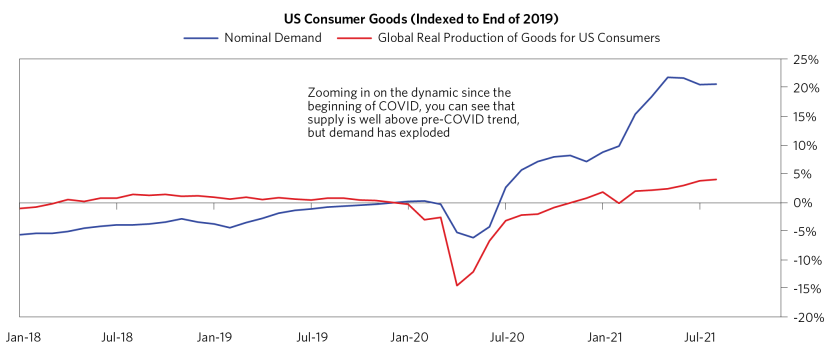
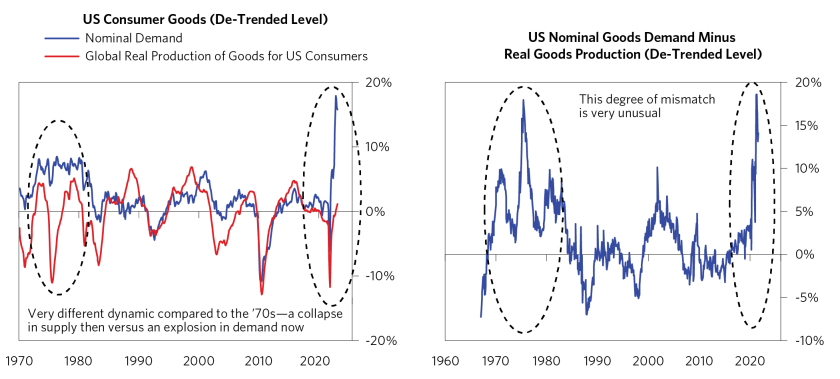
Goods Production Is Well Above Pre-COVID Trend, but Demand Has Exploded

Its Mostly a Demand Shock_01.pngIts Mostly a Demand Shock_02.png

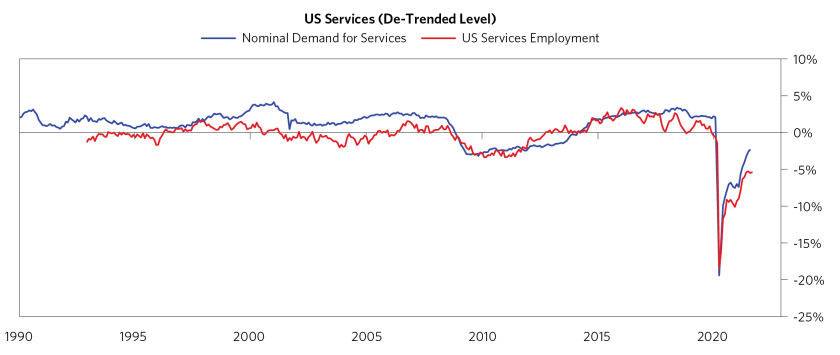
While some of the goods demand is unlikely to persist because of the unique circumstances of COVID prompting people to shift their spending from services to goods, the problem of shortages is also happening for services and is likely to build. The chart below shows that demand for services is rapidly returning to pre-COVID levels and services employment is lagging, as employers are having trouble finding workers. (…)

Its Mostly a Demand Shock_03.png

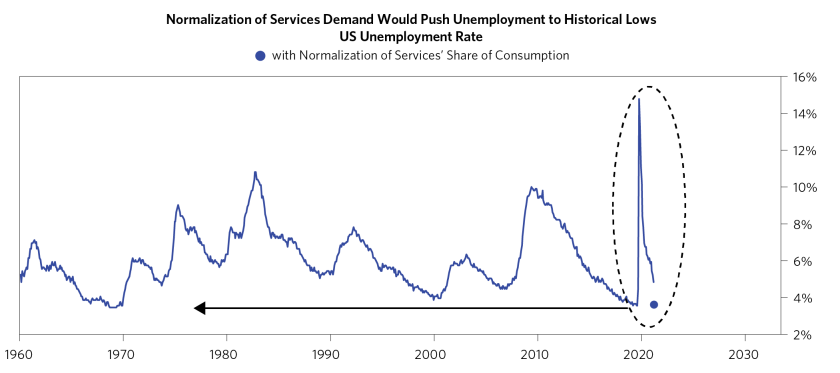
As a rough size of the magnitude of the problem, if you take the typical relationship of how much labor it takes to satisfy services demand, a return to pre-COVID levels of services demand would push unemployment to historical lows. Addressing this imbalance will mean placing upward pressure on wages to entice more workers to work longer as well as requiring investment to improve productivity.

Its Mostly a Demand Shock_04.png

Given the cause of massive demand, addressing these shortages is like a game of whack-a-mole. You can fix it in one place, but you can’t fix it everywhere in any simple way. It’s going to require a lot of investment and/or a lot of productivity enhancement to catch up. But right now, the gap is so large—and policy remains so loose that it’s encouraging demand further—that this gap is likely to be reasonably sustained.

In terms of household demand, (…) In short, households are wealthy, flush with cash, and ready to spend—setting the stage for a lasting, self-reinforcing surge in demand. (…)
  • Charted: Americans’ wealth

unnamed - 2021-11-16T075234.639

Data: Bureau of Economic Analysis; Federal Reserve Board; World Bank; McKinsey Global Institute analysis; Chart: Axios Visuals

  • It’s a global phenomenon, another lengthy analysis, this one from McKinsey:

The global balance sheet and net worth more than tripled between 2000 and 2020. Assets grew from $440 trillion, or about 13.2 times GDP, in 2000 to $1,540 trillion in 2020, while net worth grew from $160 trillion to $510 trillion. Average per capita net worth was $66,000, but large variations exist across economies, and even more so across households within an economy. In the countries in our sample, per capita net worth ranged from $46,000 in Mexico to $351,000 in Australia. Net worth ranged from 4.3 times GDP in the United States to 8.2 times GDP in China. (…)

Total balance sheets and net worth vary widely by country.

Among the ten countries, China accounted for 50 percent of the growth in net worth, or wealth, from 2000 to 2020, followed by the United States, at 22 percent. Japan, which held 31 percent of the ten economies’ wealth in 2000, held just 11 percent in 2020.

Within the household sectors of China and the United States, the top 10 percent of households own two-thirds of wealth. In the United States, the amount of the country’s wealth held by the top 10 percent of households grew from 67 percent in 2000 to 71 percent in 2019, while the bottom 50 percent of wealth owners’ share dropped from 1.8 percent in 2000 to 1.5 percent in 2019. In China, the top 10 percent of households owned 48 percent of the nation’s wealth in 2000, and by 2015, those households owned 67 percent. The bottom 50 percent of Chinese households owned 14 percent of wealth in 2000 and 6 percent in 2015. (…)

There are different ways to interpret the expansion of balance sheets and net worth relative to GDP. It could mark an economic paradigm shift, or it could precede a reversion to the historical mean, softly or abruptly. Aiming at a soft rebalancing via faster GDP growth might well be the safest and most desirable option. To achieve that, redirecting capital to more productive and sustainable uses seems to be the economic imperative of our time, not only to support growth and the environment but also to protect our wealth and financial systems.

In the first view, an economic paradigm shift has occurred that makes our societies wealthier than in the past relative to GDP. In this view, global trends including aging populations, a high propensity to save among those at the upper end of the income spectrum, and the shift to greater investment in intangibles that lose their private value rapidly are potential game changers that affect the savings-investment balance. These together could lead to sustainably lower interest rates and stable expectations for the future, thereby supporting higher valuations for assets than in the past.

In the opposing view, this long period of divergence may be ending, and high asset prices could eventually revert to their long-term relationship relative to GDP, as they have in the past. Increased investment in the postpandemic recovery, in the digital economy, or in sustainability might alter the savings-investment dynamic and put pressure on the unusually low interest rates currently in place around the world, for example. This would lead to a material decline in real estate values that have underpinned the growth in global net worth for the past two decades.

Not only is the sustainability of the expanded balance sheet in question; so too is its desirability, given some of the drivers and potential consequences of the expansion. For example, is it healthy for the economy that high house prices rather than investment in productive assets are the engine of growth, and that wealth is mostly built from price increases on existing wealth?

The smartest way forward, then, may be for decision makers to work to stabilize and reduce the balance sheet relative to GDP by growing nominal GDP. To do so, they would need to redirect capital to new productive investment in real assets and innovations that accelerate economic growth.

For business leaders, this would mean identifying new growth opportunities and ways to raise the productivity of the workforce with capital investment that complements rather than displaces their employees. Many corporations today have excess liquidity that they could deploy. Sustainability investments, for instance, could turn from a cost to a growth opportunity if framework conditions such as higher carbon pricing are put in place that require higher investment yet keep a level playing field between competitors. Could changes to the way intangibles are accounted for on corporate balance sheets result in higher investment? And how should business leaders think about providing new stores of value, justifying equity valuations, and building household wealth?

Leaders of financial institutions could seek to develop financing mechanisms aimed at deploying capital to new growth opportunities, while limiting debt creation for asset transactions at ever-rising prices. Also, the global balance sheet is directly reflected on their own balance sheets. Beyond risk assessments, what do the trends of the past 20 years and scenarios ahead mean for their balance sheets and revenue growth? How might they contribute to the evolution of the global balance sheet, and what would that mean for responsible banking?

For policy makers, rebalancing would require removing barriers to investment in gaps in the economy, such as sustainability and affordable housing. Tools already exist to achieve this, such as reforming zoning regulations that make real estate scarce; tax levers that alter the taxation of capital and property gains relative to income; and getting more serious about carbon pricing and regulation.

This research offers a new way of assessing the macroeconomic context in which businesses, governments, households, and financial institutions operate and live. It provides a platform for developing scenarios for the future and finding ways to hedge against risks and capture benefits should balance sheets rebalance and the economic environment change as a result. We expect to address some of these questions in further research, and we invite comments and insights.

Back to inflation:

From recent corporate conference calls, courtesy of The Transcript:

  • “The cost inflation we are seeing is pretty much global. It’s mainly — it’s a global phenomenon. From aluminum, chemicals, packaging and freight and everybody is impacted the same way. (…) We have already made 2 price increases. And so far, I can say these price increases have been accepted by our customers. We are now preparing for the third one, which will be even probably more significant than the other ones. I believe that there is overall an acceptance rate. I’m not saying that customers welcome that we increase prices, especially as the increase is starting to be very significant. You’re talking double-digit increase here. But overall, this is well understood by the market.” – Agfa-Gevaert (AFGVF) CEO Pascal Juery
  • “We expect both our construction and lot costs will continue to increase — In terms of lumber cost, that they are still rising. They rose further in our fiscal Q4. We’ve seen them rise further into October, so we do believe that we are seeing the peak of lumber cost. However, other costs are increasing as well, we’re seeing costs really increasing across-the-board so even when we see perhaps have some relief from lumber as we move further into fiscal 2022, I think that will be offset by other cost increases. (…) new home demand remains very strong and our local teams are continuing to restrict our sales order pace where necessary on a community-by-community basis based on the number of homes in inventory, construction times, production capacity, and lock position. ” – D.R. Horton (DHI) CFO Bill Wheat
  • “During the third quarter, we also experienced additional food cost inflation, namely in protein categories such as beef and pork. In addition, after seeing food cost inflation moderate in July, these costs accelerated again in August and September.”- OurUS Food (USFD) CFO Dirk Locascio
  • “…over the past year or so, we’ve talked about the increase in the price of content. You see the content, that because of just the competition for talent for everything that’s involved in productions, content costs have gone up. Where we see it directly in our parks business is primarily through the hourly wage inflation“ – Walt Disney (DIS) CFO Christine McCarthy
  • “…what we’re starting to accept is that there has been a fundamental change in what the job seekers are looking for from work, and that’s evidenced not just by the reluctance of the unemployed to resume searching for work but also the great resection where people who were currently employed who now feel safe are now leaving their jobs at record levels. You’re seeing an employer reaction to that, that is predictable with a record increase in wages, a record number of jobs that offer benefits, flexible schedules, and/or even remote work. So it seems like the job market is still in a state of flux as it reacts in response to what happened during COVID. And it’s yet to settle down and play itself out.” – Ziprecruiter (ZIP) CEO Ian Siegel
U.S. Empire State Manufacturing Activity Improved in November

The Empire State Manufacturing Index of General Business Conditions rose to 30.9 in November after falling to 19.8 during October. A reading of 20.8 had been expected in the Action Economics Forecast Survey. An increased 43.0% of respondents reported improved business conditions, up from 39.4% last month, while 12.1% reported that conditions had worsened, down from 19.5% in October. The latest survey was conducted between November 2 and November 9.

Haver Analytics constructs an ISM-adjusted Empire State diffusion index using methodology similar to the ISM series. The latest reading rose to 62.5, making up most of the decline to 60.0 in October. A reading above 50 signifies positive growth.

Movements amongst the component series were mixed this month. The new orders measure rose to 28.8 from 24.3 in October. The shipments reading improved to 28.2 from 8.9. The delivery time index declined to 32.2 from 38.0. A lessened 38.1% of respondents reported faster delivery speeds while a little-changed 5.9% reported slower order fulfillment. The unfilled orders series fell to 12.7 from 18.5 in October. Inventories fell in November to 9.3 from 12.0 last month.

The number of employees index rose to 26.0 in November after falling to 17.1 in October. It was a record high for the series which dates back to July 2001. An increased 29.2% of respondents reported more hiring while a lessened 3.2% reported less hiring. The average workweek reading rose to 23.1 this month and made up most of last month’s decline.

The prices paid index rose to 83.0 in November from 78.7 in October. The record was 83.5 in May. A higher 83.1% of respondents indicated higher prices while none paid less. The prices received measure increased to a record 50.8 in November.

The index of business conditions in six months fell sharply this month to 36.9 from 52.0 in October. It was the lowest reading in six months. Expectations for new orders, shipments and employment fell while prices paid, unfilled orders and delivery times rose. Expectations for capital spending as well as technology spending rose slightly.

 image image

Canada’s housing market soars again in October, with sales jumping nearly 9%

(…) CREA’s home price index, which adjusts for pricing volatility, rose 2.7 per cent to $770,000 for a typical home across the country. That is the highest monthly price increase since February and March, when homes in the Toronto and Vancouver suburbs were drawing dozens of offers. (…)

Throughout most of the pandemic’s property frenzy, home buyer demand has surged in the suburbs, smaller cities and semi-rural parts of the country. (…)

In the Toronto region, where prices were not rising as quickly as the suburbs, the home price index spiked to its highest level since the 2016-17 real estate boom. The price index for a typical home in the Greater Toronto Area rose 4.8 per cent to $1,139,400 from September to October. (…)

Federal mortgage insurer Canada Mortgage and Housing Corp. has warned that the country‘s housing market is overvalued and overheated. It has singled out Hamilton, Toronto, Ottawa, Halifax, Moncton and Montreal as highly vulnerable to a price downturn.

Bank of Canada says economic slack not yet absorbed, will not raise interest rate

The Bank of Canada will not raise its benchmark interest rate until the slack in the country’s economy is absorbed, which has not yet happened but is getting closer, Governor Tiff Macklem said in a newspaper opinion piece on Monday.

Macklem also noted that while inflation risks have increased – driven by pandemic-induced demand shifts, supply disruptions and higher energy prices – the central bank continues to view the recent dynamics as transitory.

“For the policy interest rate, our forward guidance has been clear that we will not raise interest rates until economic slack is absorbed. We are not there yet, but we are getting closer,” Macklem wrote in an op-ed for the Financial Times newspaper.

He added that the central bank’s policy framework – a flexible inflation target focused on the 2% midpoint of a 1-3% control range – means Canadians can be confident that inflation will be kept under control, while supporting a full recovery.

“What our resolve does mean is that if we end up being wrong about the persistence of inflationary pressures and how much slack remains in the economy, we will adjust. Our framework enables us to do just that,” Macklem said. (…)

Canada’s inflation rate rose to 4.4% in September and is expected to hit 4.7% in October, with that data due on Wednesday.

The Bank of Canada signaled last month that its first rate hike could come as soon as April 2022, though money markets are betting on a hike in March, with a total of five in 2022.

Resurgent Oil Supply Expected to Soothe Tight Market The tight supply and demand balance in the global oil market could be about to ease, the IEA said in its monthly report.

It expects output to rise by 1.5 million barrels a day in the remainder of 2021, with the U.S., Saudi Arabia and Russia accounting for around half of that amount.

At the same time, while demand for transportation fuels continue to recover and a supply shortage in the natural gas market has forced some power plants to switch to using oil and refined products, “new Covid waves in Europe, weaker industrial activity and higher oil prices will temper gains,” the Paris-based energy watchdog said. (…)

With the U.S. Energy Information Administration also forecasting growing supply from 2022, “it is not clear whether the Biden administration will still feel that it is necessary to take action,” said ING analyst Warren Patterson. (…)

The watchdog expects oil production to continue increasing after the end of 2021 as well, raising its 2022 forecast by 100,000 barrels a day to 1.9 million barrels a day. A combination of rising output from the Gulf of Mexico, where supply was severely affected by Hurricane Ida earlier in 2021, and fewer overall outages—the pandemic has meant more downtime and affected maintenance schedules—will drive that increase, the IEA’s report said.

The report said rising output, particularly from the U.S.—which the IEA expects to account for 60% of the non-OPEC+ supply increase—will go some way to meet rising demand, with vaccination campaigns allowing travel to continue to rebound, driving exceptional strength in gasoline demand and setting jet-fuel demand on a course to reach around 80% of 2019 levels by the end of next year.

SENTIMENT WATCH

Global investors ending 2021 ‘risk-on’ – BofA

Investors are heading towards the end of the year in a “risk-on” mood, having reduced cash allocations and lifted their overweight position on U.S. stocks to the highest since August 2013, BofA Securities’ monthly fund manager survey showed.

Inflation remains the biggest tail risk for markets but a majority of 61% believes it is transitory and expect the Federal Reserve to remain “well behind the curve” in setting its monetary policy, the U.S. investment bank added on Tuesday.

“Investors are not expecting the Fed to tighten aggressively (i.e. buy-in for Powell narrative on transitory inflation and modest tapering),” said Bofa adding that investors now see on average 1.5 Fed rate hikes next year, up from 1.1 last month. (…)

As fears about price pressures abated, investors rotated out of inflation assets, to discretionary and tech from energy, industrial and banks, while reducing value exposure to the benefit of growth.

The survey highlighted easing concerns over a macro slowdown with a net of 3% now saying the global economy will improve and only 6 out of 100 expecting a recession in the next 12 months.

It also said “Long Tech Stocks” was the most crowded trade at 37% followed by Bitcoin at 21% which a 59% majority thinks is in a bubble.

THE DAILY EDGE: 15 NOVEMBER 2021

U.S. JOLTS: Job Openings Rate Remains Elevated in September

The Bureau of Labor Statistics reported that on the last business day of September, the total job openings rate eased to 6.6% from 6.7% in August, revised from 6.6%. The rate hit a record 7.0% in July. The job openings rate is calculated as job openings as a percent of total employment plus jobs that have not yet been filled. The level of job openings fell 1.8% (+57.9% y/y) to 10.438 million from 10.629 million in August, revised from 10.439 million.

The level of hiring fell 0.6% (+8.9% y/y) as the hiring rate held steady at 4.4%. August was revised from 4.3%. The rate remained higher than the 3.8% low this past January. The overall layoff & discharge rate remained at the record low of 0.9%. The quits rate rose to a record 3.0% in September, well above its low of 1.6% in April 2020. The level of quits rose 34.1% y/y to a record 4.434 million. The JOLTS figures date back to December 2000.

The private-sector job openings rate eased to 7.1% from 7.2% and was below the record 7.4% in July. It has improved from 3.6% April 2020. (…) The government sector job openings rate held at 3.7% after plunging from 4.6% in July. The private sector job openings level declined 2.0% to 9.581 million, but remained up by nearly two-thirds y/y.

The private sector hiring rate held steady at 4.9% in September, but remained up from January’s 4.2% low. It was well below the record 7.2% in May of last year. (…) The level of private sector hiring improved 0.8% in September (10.4% y/y) to 6.19 million.

This chart helps explain the current labor market dynamics: wage gains (red) started to accelerate in mid-2017 when job openings (blue) clearly moved above hires (black). From mid-2018 through 2019, inflation (yellow) slowed and wage demands calmed down. Now, openings exceed hires by 50% and inflation is skyrocketing, prompting higher wage demands that employers, anxious to grow revenues and able to raise prices, are willing to accommodate.

fredgraph - 2021-11-13T062822.983

The Atlanta Fed data shows how job switchers improved their wages in recent months. But job stayers are also seeing better wage rates as employers seek to retain and keep loyal employees happy. The WSJ quotes an Indeed job site economist: “The vast majority of the quitting we’ve seen in 2021 has been job switching. Industries that usually hire people out of work may have shifted their approach towards poaching.”

atlanta-fed_wage-growth-tracker (1)

Workers 16 to 24 are reaping the best wage increases. Unfortunately, this next chart is a 12-month moving average, probably hiding the most recent gains in older age groups. For example, the same Atlanta Fed data reveal that prime-age workers’ wages are up 4.2% in October vs 3.8% for the 12-m m.a.. As to the 55+ age group, no wonder they are leaving the labor force… “Goldman Sachs economists point out 3.4 million of the 5 million who have exited the labor market since the pandemic are 55 or older, and many of them may have effectively retired.” (WSJ)

atlanta-fed_wage-growth-tracker (2)

Another WSJ article informs us that (my emphasis)

A group of Amazon.com Inc. AMZN 1.52% warehouse employees in the New York City borough of Staten Island have withdrawn their petition with the National Labor Relations Board to hold a union election at four company warehouses, a labor board spokeswoman said Friday.

The fledgling union, which calls itself the Amazon Labor Union, said it had to withdraw because the labor board, a federal agency that oversees collective bargaining, had communicated that it no longer had adequate support to move forward with an election.

To meet the requirement, unions typically have to collect signatures from 30% of workers showing support. The change came after many workers who had shown support for a union left the company, according to Chris Smalls, a former Amazon employee who leads the group. He said the union planned to collect more signature cards and refile for an election. (…)

Meanwhile, the more than 10,000 John Deere workers in Iowa, Illinois, Kansas, Colorado and Georgia will be voting Wednesday on a new contract to end the first strike at Deere since 1986.

The UAW, which represents more than 10,000 Deere production and maintenance employees, said the latest offer included “modest modifications” to a proposal that union members rejected Nov. 2 by a margin of 55% to 45%. Workers also turned down an offer on Oct. 10. [by 90%] (…)

The company’s prior offer included an immediate 10% increase in hourly pay, plus an $8,500 bonus for each worker. Additional 5% pay raises were proposed for 2023 and 2025, and lump sum bonuses in three other years. Deere had said that offer represented a $3.5 billion investment in compensation for the workers.

Striking employees have said Deere should provide bigger raises and benefit expansions at a time when the company’s farm and construction equipment sales are booming, and other manufacturers are offering significant pay increases and benefits to attract scarce workers. (…)

While on manufacturing, Bloomberg’s Brooke Sutherland explains how the pandemic could prove to be the real MAGA trigger:

Manufacturers Find There’s No Place Like Home Will the pandemic supply-chain disruptions prompt manufacturers to rethink where their factories are situated and build more plants closer to home? Roland Busch — chief executive officer of factory automation and software giant Siemens AG — says yes, for two reasons.

The first is that the majority of the world’s semiconductor and battery manufacturing capabilities are concentrated in Asia, and Western governments have realized that this dynamic is neither wise nor sustainable for such strategically important products. (…) the pace of announcements on new plants in recent months has been dizzying: Samsung Electronics Co. has made a $17 billion commitment; Taiwan Semiconductor Manufacturing Co. is building a $12 billion plant in Arizona and contemplating a factory in Germany; Intel Corp. is investing $20 billion in additional U.S. manufacturing capacity and planning to plow as much as $95 billion into new European factories over the next decade.

Meanwhile, Ford Motor Co. and South Korea’s SK Innovation Co. will spend $11.4 billion to build three battery factories and an assembly plant for electric F-Series pickup trucks in Tennessee and Kentucky. General Motors Co. plans to operate four electric-vehicle battery plants in the U.S. through a joint venture with South Korea’s LG Chem Ltd. Toyota Motor Corp. said this week it would invest $240 million in a new manufacturing line for hybrid transaxles at its existing plant in West Virginia. Electric-vehicle startup Rivian Automotive Inc. — whose more than $100 billion market valuation tops that of GM after an initial public offering this week — has a long list of expansion projects that reportedly include a second car manufacturing facility in the U.S., a plant in Europe costing billions of dollars and in-house battery production at a stand-alone facility.

“There is definitely some reshoring or redistribution of value” in these industries, Busch of Siemens said in an interview.

(…) the ripple effects of reversing that trend are large: These new factories need automation and manufacturing equipment but also air conditioning, lights and roads.

But announcements on U.S. factory expansions are starting to trickle out from other corners of the economy, too. U.S. Steel Corp. and Nucor Corp. are both planning to invest about $3 billion each in new mills. Peloton Interactive Inc. is spending $400 million to open its first U.S. manufacturing facility in Ohio, with an aim of mitigating geopolitical risk and easing shipping challenges. In mid-September, plastic-container maker Berry Global Group Inc. announced a more than $110 million investment to expand its food-service manufacturing capabilities in North America. And then just this week, Schneider Electric SE said it would add three manufacturing plants in North America and hire more than 1,000 new employees to increase production of circuit breakers, switchboards and other electrical equipment and help it speed delivery to domestic customers.

The Schneider (…) facilities are less about repositioning the supply chain and more about adding capacity to meet robust demand for data-center equipment and other electrical infrastructure, Annette Clayton, CEO and president of Schneider’s North American operations, said in an interview.

And that brings us to the second argument from Busch as to why a geographical reassessment of manufacturing capacity may be underway: Automation is the great equalizer that makes European and U.S. factories more economically attractive. (…)

“China’s labor population peaked already,” Busch said. “When you have less and less labor, you have to automate more. Once you’re automating and the salaries are increased, then what’s the advantage of having a footprint in China?” Labor costs aren’t the only consideration: Energy expenses and government subsidies also factor into companies’ manufacturing capacity decisions. One other benefit of producing goods in China is that there’s already a well-established ecosystem of component suppliers. But with trans-Pacific shipping costs so high and a growing number of companies taking actions to curb their carbon emissions, this moment “really cries out for rethinking where you would put an automated factory,” Busch said. (…)

U.S. Consumer Sentiment Drops to 10-Year Low on Inflation Fears

The University of Michigan’s preliminary sentiment index decreased to 66.8 from 71.7 in October, data released Friday showed. The November figure trailed all projections in a Bloomberg survey of economists which called for an increase to 72.5. (…)

Measures of sentiment, personal finances slump in November amid rising inflation

Consumers expect inflation to rise 4.9% over the next year, the highest since 2008, the report showed. They expect prices will rise 2.9% over the next five to 10 years, unchanged from the previous month. (…) About half of all families anticipate declines in inflation-adjusted incomes next year, according to the data. (…)

The Michigan report showed buying conditions for household goods deteriorated sharply, with a gauge falling to a reading of 78 that was the second-lowest in data back to 1978. There were more frequent mentions in the survey of higher costs for vehicles, durable goods and homes.

Twenty-four percent of households expect to be worse off in the coming year, the highest since June 2008, according to Curtin.

The gauge of current conditions dropped to 73.2, the lowest since 2011. A measure of future expectations decreased to 62.8, which was the weakest since 2013, according to the survey.

Americans are also more pessimistic about the economy’s prospects over the coming five years. The university’s gauge fell to the lowest since 2011.

ING:

In a major surprise move US University of Michigan consumer sentiment has fallen to a 10-year low, which underscores how concerned households are about inflation. A rise was expected given the improvement in jobs, wages and wealth, but $3.50/gallon for gasoline is clearly an issue that households feel strongly about.

(…) the chart below shows a massive disconnect between the Michigan survey and the Conference Board index so caution is warranted in over interpreting today’s number.

University of Michigan confidence versus Conference Board confidence measure

 Source: Macrobond, ING

From my lens, consumer confidence surveys are merely coincident indicators and, as several analysis have shown, tend to be highly sensitive to trends in gasoline prices.

Using more than thirty years of data on consumer sentiment and gasoline prices, we analyze the relationship between these two variables. Using regression analysis, we find a negative relationship between changes in gasoline prices and changes in consumer sentiment. This suggests that as gasoline prices rise (fall), this negatively (positively) impacts consumer sentiment. Further causality analysis provides support that changes in gasoline prices leads consumer sentiment and changes in consumer sentiment for 3, 6 and 12 month periods. This is expected given previous research has found that the demand for gasoline by consumers is inelastic in the short-run. We thus provide empirical support to the notion that changes in gasoline prices does impact consumers’ psyche. (Changes in Gasoline Prices and Consumer Sentiment)

As to their predictive usefulness, the Federal Reserve Bank of New York researched that in 1998:

Our empirical analysis suggests that consumer sentiment can help predict future movements in consumer spending; that forecasting power, however, depends on the survey in question. Measures of consumer attitudes available from the Conference Board have both economically and statistically significant explanatory power for several spending categories— including total personal consumption expenditures; motor vehicles; services; and durables, excluding motor vehicles—even when the information contained in other economic indicators such as income, interest rates, and stock prices is known. Measures available from the University of Michigan’s Survey Research Center, however, exhibit weaker forecasting power for most categories of consumer spending.

The above ING chart suggests that this conclusion still holds.

In another 2004 piece in the Journal of Economic Perspectives, Sydney C. Ludvigson, one of the researchers in the FRBNY paper cited above, confirms:

The evidence suggests that popular survey measures contain some information about future aggregate consumer expenditure growth. However, much of that information is found in other economic and financial indicators, and the independent information provided by consumer confidence predicts a relatively modest amount of additional variation in future consumer spending.

ING adds…

For what it is worth, confidence amongst Republicans hit new all-time lows (a 17 point drop), for Democrats there was a more muted 5.3 point drop. However, for people classifying themselves as independents there was actually a 3.4 point rise. Maybe if we all ignored the politics everyone would feel much happier!

…and finally posts this chart for Jay Powell’s attention:

Inflation expectations not looking quite so anchored at 2%

unnamed - 2021-11-13T104842.124

(Source: Macrobond, ING)

Ocean Shipping Rates Fall but Ports Are Still Jammed The cost to ship a container across the Pacific fell by more than one-quarter last week, signaling that demand is finally easing.

(…) The cost to move a container from China to the U.S. West Coast fell 26% last week compared with the week before to $13,295, according to the Freightos Baltic Index. That is still more than three times as high since the start of the year when the same box cost $4,200. (…)

China Economy Stabilizes as Spending, Power Supply Picks Up

Industrial output rose 3.5% in October from a year earlier, while retail sales growth accelerated to 4.9%, beating economists’ forecasts. Growth in fixed-asset investment eased to 6.1% in the first 10 months of the year, with tighter curbs on the real estate market continuing to weigh on the sector. The surveyed jobless rate was steady at 4.9%. (…)

Electricity shortages, which had been a key constraint on industrial output in September, eased last month, with power supply climbing 11.1% in October from a year earlier.

The property slump continued to weigh on output, with production of construction-related commodities, such as steel and iron, contracting. Investment in new construction declined for a fourth month, dropping 7.7% from a year ago. (…)

New-home prices in 70 cities slid 0.25% last month from September, when they fell for the first time in six years, National Bureau of Statistics figures showed Monday. Residential sales dropped 24% from a year earlier, the most since last year, striking a blow for developers during what is traditionally a busy season, Bloomberg calculations based on official data showed. (…)

Falling prices may dissuade homebuyers concerned about the value of their assets, making it harder for developers to sell properties and generate much-needed cash. Last month’s drop in prices, which excludes state-subsidized housing, deepened from 0.08%in September. Home values in the secondary market fell 0.32%, the largest decline since February 2015. 

At least 21 cities, mostly smaller and with weaker economies, have imposed floors on the lowest prices developers can sell to limit the market slump there, the China Business News reported Monday. Values dropped 0.37% in so-called tier-3 cities, bigger than tier-2 declines.

Property firms refrained from expenditure, resulting in a widening 5.4% year-on-year contraction in real estate development investments, according to Bloomberg calculations. New starts by developers, a leading indicator of investments, plunged 33% from a year earlier, and their land purchases shrank 24% from September. Projects completed by developers also dwindled 21% from a year prior likely due to hoarding of cash. (…)

EARNINGS WATCH

From Refinitiv/IBES:

Through Nov. 12, 459 companies in the S&P 500 Index have reported earnings for Q3 2021. Of these companies, 80.4% reported earnings above analyst expectations and 15.0% reported earnings below analyst expectations. In a typical quarter (since 1994), 66% of companies beat estimates and 20% miss estimates. Over the past four quarters, 85% of companies beat the estimates and 12% missed estimates.

In aggregate, companies are reporting earnings that are 10.3% above estimates, which compares to a long-term (since 1994) average surprise factor of 4.0% and the average surprise factor over the prior four quarters of 18.3%.

Of these companies, 76.7% reported revenue above analyst expectations and 23.3% reported revenue below analyst expectations. In a typical quarter (since 2002), 61% of companies beat estimates and 39% miss estimates. Over the past four quarters, 79% of companies beat the estimates and 21% missed estimates.

In aggregate, companies are reporting revenues that are 2.9% above estimates, which compares to a long-term (since 2002) average surprise factor of 1.2% and the average surprise factor over the prior four quarters of 4.1%.

The estimated earnings growth rate for the S&P 500 for 21Q3 is 41.5%. If the energy sector is excluded, the growth rate declines to 33.2%. The estimated revenue growth rate for the S&P 500 for 21Q3 is 16.7%. If the energy sector is excluded, the growth rate declines to 13.3%.

The estimated earnings growth rate for the S&P 500 for 21Q4 is 21.5%. If the energy sector is excluded, the growth rate declines to 14.0%

A good quarter, but the earnings surprises were not quite as strong as in recent years. The 10.3% overall surprise factor is way below the recent 18.3% level and was boosted by Financials (reversals of loan loss provisions) and Energy (higher prices). Excluding these 2 sectors, the median earnings surprise is +9.0% and the average +7.5%. The average revenue surprise was +1.9% excluding Fins and Energy.

Analysts remain upbeat and revising upwards…

image

image

image

…while more companies are warning down:

image

Estimates for 2022 are for earnings growth of 7.6%, down from 9.2% on October 1. The base effect will hurt growth rates in Q1 and Q2, bringing YoY growth close to the zero line.

image

Amid continued global supply issues, rising costs and demand risks as surging inflation on essentials erodes discretionary incomes, 2022 forecasts are particularly iffy.

Analysts are currently estimating S&P 500 companies will grow revenues 12.2% next year. Ed Yardeni illustrates the tight relationship between Business Sales and S&P 500 revenues. Since 1993, business sales growth only exceeded 10% in 2010 (+10.1%) and 2011 (+10.9%) exiting the terrible 2009 (-14.9%).

image

In fact, business sales rarely grow faster than nominal GDP which itself has not grown faster than 6.7% YoY between 1993 and 2020.

fredgraph - 2021-11-14T075356.234

Even during the inflationary seventies, nominal GDP growth exceeded 12% only in 1978 (+13.0%) and 1981 (+12.2%) when inflation (GDP deflator) reached 7.0% and 9.5% respectively. Let’s all hope we don’t go there again.

The other risk lies in profit margins if the costs of labor and capex rise faster than revenues, a clear trend economy-wide during the last decade. The pandemic helped boost margins when rescue money exploded demand. It is dangerous to extrapolate these highly unusual circumstances, particularly as costs are currently rising fast.

image

S&P 500 companies’ margins have performed better than average, thanks in large part to the weight (now 28%) of large technology companies. Margins were nonetheless decreasing across the boards after the 2018 tax rate bump. Time will tell if margins hold their pandemic levels but my guess is that revenue growth will normalize well before costs do.

image

Recall that the S&P 500 index is primarily a “goods” companies index whereas the overall economy is dominated by services. The splurge on goods has peaked and previous trends will reappear as the pandemic disappears. A return to trend for expenditures on goods (blue) would reduce demand by nearly 14%. I doubt a similar cut in costs can be achieved.

image

Today’s WSJ has an article (What Does Inflation Mean for American Businesses? For Some, Bigger Profits) depicting how companies have been able to boost profit margins by raising prices amid strong demand. Carrier finance chief sums it up succinctly: “Everyone, including customers, recognizes that in the current environment, there is little choice to get those increases and to pass them on.”

Nearly two out of three of the biggest U.S. publicly traded companies have reported fatter profit margins so far this year than they did over the same stretch of 2019, before the Covid-19 outbreak, data from FactSet show. Nearly 100 of these giants have booked 2021 profit margins—the share of each dollar of sales a company can pocket—that are at least 50% above 2019 levels.

Corporate nirvana…until the end customer runs out of buying power. People tend to spend their real labor income, which eventually declines when business people get carried away, focus on margins and forget the demand component. The red line below deflates the wage part of employment cost index (no compositional bias) with the CPI. Goods producers and distributors could well soon pay the price for both expenditures normalization and a squeezed consumer.

fredgraph - 2021-11-15T065945.984

Buyout Bosses Enjoying $1 Trillion Boom See Prices Go ‘Bananas’ There’s been one common topic hot on the lips of private equity bosses at this week’s major industry gathering in Berlin: eye-watering valuations.

Speaker after speaker at the SuperReturn conference lined up to warn masked attendees about the unsustainable prices being paid for assets in the current deal boom, while reassuring investors with their next breath that strong returns would stay intact.

Deal multiples, already a talking point before the pandemic, have gone “bananas,” said Allstate Investments Managing Principal Sarah Farrell. Apollo Global Management Inc. Co-President Scott Kleinman suggested the industry was deluded on valuations when he asked “how is this really feasible that a buyout can happen at 25 times Ebitda?” (…)

TECHNICALS WATCH

The analysis from my favorite technical analysis firm extends last week’s better readings as small caps continue to display greater investor enthusiasm.

Large caps are also back in vogue as the 13/34–Week EMA Trend shows:

THE OTHER RISKS (ECONOMIC AND OTHERS)

Winter is coming in Europe and North America and Covid-19 cases have turned back up, above their previous lows:

image

 image image

The U.S is far behind in vaccination with more than 1 in 4 Americans unwilling or uncertain.

In spite of:

image

image

The Brookings Institute:

Along party lines, however, the breakdown of vaccinated people was 92% of Democrats, 68% of Independents, and 56% of Republicans.

There is no reason to believe that these gaps in vaccination rates will disappear anytime soon. According to Gallup, 40% of Republicans “don’t plan” to get vaccinated, versus 26% of Independents and just 3% of Democrats. In response to a more sharply worded KFF question, 23% of Republicans report that they will “definitely not” get vaccinated, compared to 11% of Independents and just 4% of Democrats.

These national divergences are reflected at the state and county level as well, per data from Johns Hopkins University. Of the 21 states with vaccination rates above the national average, Joe Biden carried 20 last November. Of the 29 states below the national average, Donald Trump carried 24. At the county level, the vaccination-rate gap between the counties Biden and Trump won has increased nearly six-fold from 2.2% in April to 12.9% in mid-September, according to KFF.