The enemy of knowledge is not ignorance, it’s the illusion of knowledge (Stephen Hawking)

It ain’t what you don’t know that gets you into trouble. It’s what you know for sure that just ain’t so (Mark Twain)

Invest with smart knowledge and objective odds

THE DAILY EDGE: 8 NOVEMBER 2021: The Robots Are Coming! Slowly…

U.S. Jobs Growth Rebounded Last Month The U.S. added 531,000 jobs in October and the unemployment rate fell to 4.6%, as the labor market rebounded from a summer lull.

The U.S. labor market sprang back to life in October after a summer slowdown, with employers briskly adding jobs and nearly 200,000 women joining the labor force.

The economy churned out 531,000 new jobs last month, the biggest gain in three months, the Labor Department said Friday. Restaurants, consulting firms and factories all boosted hiring, suggesting broad strength across the economy. Nationwide job growth was also stronger in August and September than previously estimated, with new data boosting employment over that period by 235,000 jobs.

Even with last month’s pickup in job growth to an average of 582,000 jobs a month this year, growth remained below the monthly average of 641,000 jobs that the economy created in the first seven months of the year.

The unemployment rate fell to 4.6% in October from 4.8% a month earlier, and is down by more than half a percentage point in just two months. (…)

About 180,000 female workers aged 16 and older joined the labor force in October, as Covid-19 cases declined and schools reopened. (…)

The average hourly wage for private-sector workers rose 0.4% in October from a month earlier and 4.9% compared with a year ago. In the 15 years before the pandemic, wages grew an average 2.5% a year. (…)

In October, the labor force grew by 104,000 people, entirely due to an increase in female workers. Participation among men fell. But the overall gain in the labor force was modest, leaving the participation rate at 61.6%, near the lowest level since the 1970s. (…)

Good thing Powell made “maximum employment” fuzzier last week. Participation rates are not recovering:

fredgraph - 2021-11-08T071301.931

Aggregate weekly payrolls (employment x wages x hours) is up 9.3% YoY, stable growth since August. During the last 3 months, payrolls grew at a 10.2% annualized rate, very similar to the 10.0% rate of the previous 3 months. However, employment growth accounted for 28% of the growth since August, down from 51% during the May-July period. Wage growth is now running at a 5.3% annualized rate while weekly hours have stabilized at their cyclical peak.

fredgraph - 2021-11-08T061608.546

fredgraph - 2021-11-08T060946.800

Americans are gradually bringing their consumption growth in line with the growth in payrolls as the splurge on durable goods is abating. If employment keeps rising at about 600k per month (+0.4% MoM) and wages maintain their recent 0.4-0.5% pace, payrolls and nominal expenditures should keep rising 10% annualized through next spring. The “stag” part in stagflation seems unlikely for now.

fredgraph - 2021-11-08T063343.395

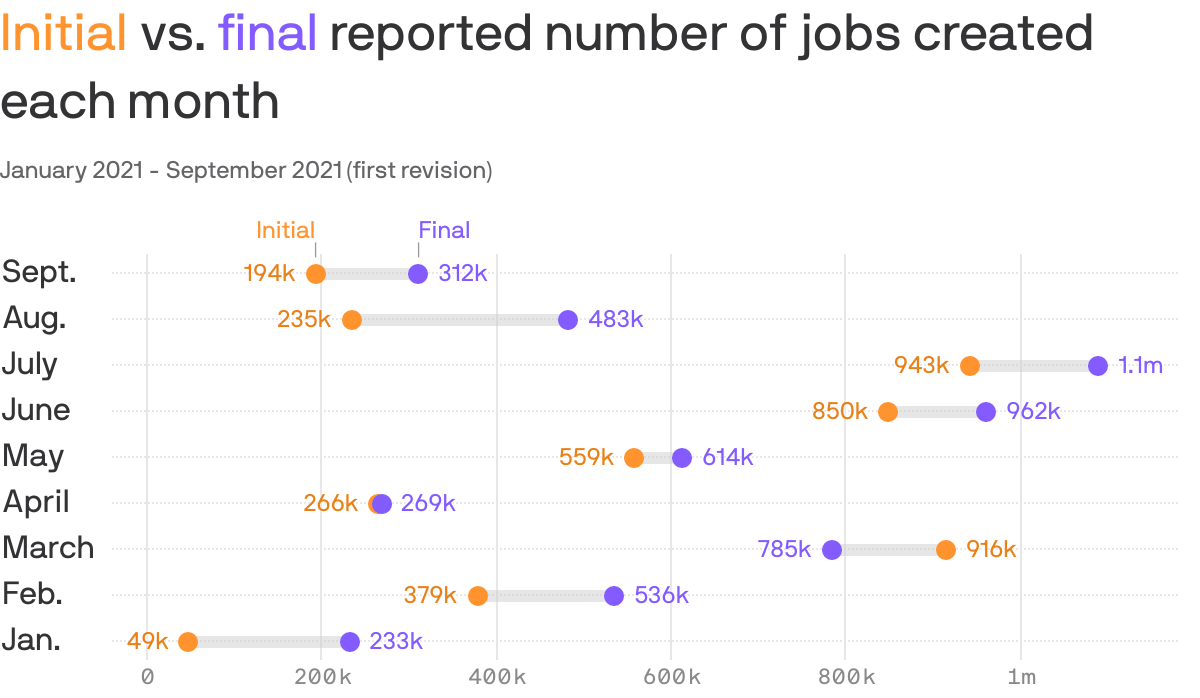
  • The year of revisions (Axios)

Sometimes the initial picture is only half the story. The October jobs report, out Friday, included considerable revisions to the tally of new jobs created in August and September — enough to change how we view the economy’s progress through the peak of the Delta variant.

It’s a reminder to step back and let the whole picture take shape. Throughout the pandemic recovery — a time with absolutely no modern economic precedent — the imperfections of gathering complex data have become all the more stark.

So far this year, the initial jobs number undershot the final estimate in all but one month, with an average of 99,000 in additional jobs per month subsequently added. In total, more than a million jobs have been added to the tally by way of revisions.

In the more predictable 2019, the average total revisions per month amounted to just 10,000, noted the White House Council for Economic Advisers in a tweet on Friday.

The data so far this year imply it would be reasonable to expect October’s red hot job gains to get revised even higher — and for September’s number to receive another lift as well.
Canada’s Jobs Engine Shifts Into Lower Gear With 31,000 Gain The economy added 31,200 jobs last month, Statistics Canada said Friday in Ottawa, missing expectations for a gain of 41,600 in a Bloomberg survey of economists. The unemployment rate fell to 6.7% from 6.9% in September, and total hours worked rose 1%. Average hourly wages for permanent workers were up 2.1% from a year earlier, suggesting the impact of rising consumer price inflation has yet to drive pay gains higher.

Canada employment exceeds pre-pandemic levels

But, why is that?

fredgraph - 2021-11-08T061020.458

A Hawkish Case for Fed Action on Inflation Emerges “Disruptions that initially appeared to be temporary bottlenecks driving up prices now look as if they may be more long-lasting,” Kansas City Fed chief Esther George said

(…) “I think transitory, to economists, means sort of not permanent,” Mr. Macklem said in an interview that aired on CTV’s Question Period. “I think to a lot of people, transitory means it’s going to be over quickly. … I don’t know exactly what the right word is, but it’s probably something like, ‘transitory but not short-lived.’”

Mr. Macklem pointed to the bank’s latest inflation projections, published on Oct. 27, which show the annual rate of inflation rising to close to 5 per cent for the remainder of the year, before dropping to around 2 per cent by the end of next year. The bank now expects inflation to average 3.4 per cent for the whole of next year, a full percentage point higher than its previous projection, from July. Inflation hit an 18-year high of 4.4 per cent in September. (…)

Unions Are on the Rise, But So Are the Robots

(…) There were a record 310,700 industrial robots operating in the U.S. last year, up 6% from 2019, according to a report from the International Federation of Robotics released late last week. New robot installations actually declined in the U.S. last year as the financial strains of the pandemic weighed on corporate spending, but manufacturing headcount also fell, boosting the ratio of robots to humans.

There were 255 industrial robots operating for every 10,000 manufacturing employees last year, compared with 229 in 2019, IFR data show. That growth boosted the U.S. two spots on IFR’s country-by-country comparison of robot density, and the country now sits in seventh place globally. But the real growth is just getting started. The IFR projects that North American robot installations will grow 17% in 2021 and that a “post-crisis boom” will continue to fuel low double-digit growth rates in 2022 and beyond. (…)

Indeed, the recently concluded earnings and fall conference season was littered with comments about automation investments. Garbage-hauler Waste Management Inc. found upgrading and rebuilding its single-stream recycling plants can reduce the labor needed to operate them by 35%-plus. The company has accelerated this overhaul and now expects to revamp 90% of this volume by 2023 or 2024. “Certain jobs simply don’t attract the interest they previously did,” CEO James Fish said.

In the biopharma sector, “we can get to the point where we’re automating a lot of the small-scale assembly and a lot of the inspection processes,” Rich Tobin, CEO of pump-maker Dover Corp., said at an investor conference in September. “Our ability to expand capacity in colder products on the biopharma side has not required the traditional amount of labor that [it would have] if we had done this project four or five years ago.” Air-conditioner maker Carrier Global Corp. has increased its investments in automation by 50% this year and expects those systems to have churned out 6 million hours of manufacturing work by the end of 2026, CEO Dave Gitlin said. Toolmaker Stanley Black & Decker Inc., which has committed to moving big chunks of its China-based supply chain to the U.S., highlighted automation projects underway at a facility in Charlotte, North Carolina. (…)

This IFR presentation has lots of interesting charts, most of which are not very flattering for the U.S. compared to China. It seems that robots did nit get the MAGA memo. Just when we really need a productivity boost.

image

image

image

image

 image image

image

Yes, America is forecast to grow its robots installations 30% between 2021 and 2021, bettering Australasia’s 21%. But compared to 2019, growth is 28% vs 48%.

image

EARNINGS WATCH

Through Nov. 5, 445 companies in the S&P 500 Index have reported earnings for Q3 2021. Of these companies, 80.7% reported earnings above analyst expectations and 14.6% reported earnings below analyst expectations. In a typical quarter (since 1994), 66% of companies beat estimates and 20% miss estimates. Over the past four quarters, 85% of companies beat the estimates and 12% missed estimates.

In aggregate, companies are reporting earnings that are 10.7% above estimates, which compares to a long-term (since 1994) average surprise factor of 4.0% and the average surprise factor over the prior four quarters of 18.3%.

Of these companies, 76.2% reported revenue above analyst expectations and 23.8% reported revenue below analyst expectations. In a typical quarter (since 2002), 61% of companies beat estimates and 39% miss estimates. Over the past four quarters, 79% of companies beat the estimates and 21% missed estimates.

In aggregate, companies are reporting revenues that are 2.7% above estimates, which compares to a long-term (since 2002) average surprise factor of 1.2% and the average surprise factor over the prior four quarters of 4.1%.

The estimated earnings growth rate for the S&P 500 for 21Q3 is 41.5%. If the energy sector is excluded, the growth rate declines to 33.2%. The estimated revenue growth rate for the S&P 500 for 21Q3 is 16.2%. If the energy sector is excluded, the growth rate declines to 12.8%.

The estimated earnings growth rate for the S&P 500 for 21Q4 is 21.8%. If the energy sector is excluded, the growth rate declines to 14.6%.

Analysts keep revising upwards:

image

image

image

Pointing up Even though more companies are warning negatively:

image

TECHNICALS WATCH

Last week’s bounce in small caps is a positive sign that investor interest is broadening.

iwm

The large caps 13/34–Week EMA Trend is back on its solid trend.

CANADA ON THE CHEAP!

image

image

From my old friend John Aitkens:

image

image

image

Fiera Capital’s excellent team of strategists currently expects that U.S. and international equities will offer negative returns in the next 12-18 months but that Canadian equities, thanks to their resource bias, will fare positively in a reflationary recovery scenario (50% probability). A stagflation scenario (40%) would take all investors in double digit red numbers however.

China Bond Rout Shifts From Evergrande to Other Big Developers

China property woes hit the nation's biggest developers

Xi lays groundwork for third term by adopting Mao and Deng’s power ploy Chinese president expected to be elevated into Communist pantheon at annual party meeting

THE DAILY EDGE: 5 NOVEMBER 2021: Fear is Gone, It Should Not

Payroll employment rises by 531,000 in October; unemployment rate edges down to 4.6%

Total nonfarm payroll employment rose by 531,000 in October, and the unemployment rate edged down by 0.2 percentage point to 4.6 percent, the U.S. Bureau of Labor Statistics reported today. Job growth was widespread, with notable job gains in leisure and hospitality, in professional and business services, in manufacturing, and in transportation and warehousing. Employment in public education declined over the month. (…)

The labor force participation rate was unchanged at 61.6 percent in October and has remained within a narrow range of 61.4 percent to 61.7 percent since June 2020. The participation rate is 1.7 percentage points lower than in February 2020. The employment-population ratio, at 58.8 percent, was little changed over the month. This measure is up from its low of 51.3 percent in April 2020 but remains below the figure of 61.1 percent in February 2020. (…)

Thus far this year, monthly job growth has averaged 582,000. (…)

The change in total nonfarm payroll employment for August was revised up by 117,000, from +366,000 to +483,000, and the change for September was revised up by 118,000, from +194,000 to +312,000. With these revisions, employment in August and September combined is 235,000 higher than previously reported.

U.S. Productivity Declines & Unit Labor Costs Surge in Q3’21

Nonfarm business sector productivity fell 5.0% (SAAR) during Q3’21 following a 2.4% Q2 increase, revised from 2.1%. It was the sharpest decline since Q2’81. A 1.8% decline had been expected in the Action Economics Forecast Survey.

Nonfarm business production grew 1.7% last quarter (6.1% y/y). The gain was the smallest in five quarters. Growth of hours-worked surged to 7.0% (6.7% y/y), the strongest rise in three quarters.

Compensation per hour rose 2.9% (4.3% y/y), the fourth straight quarter of growth.

The rise in compensation and the fall in productivity combined to lift unit labor costs 8.3% to a record level, following a 1.1% increase in Q2. A 5.6% increase had been expected.

In the manufacturing sector, productivity declined 1.0% after surging 8.5% in Q2. Output rose a steady 5.7% last quarter (6.3% y/y) and hours-worked increased 6.7% (3.8% y/y) after falling 2.5%.

Factory sector compensation rose 1.9% in Q3, firm for the fourth straight quarter. Unit labor costs rose 2.9% and reversed much of the Q2 decline.

This is the YoY trend:

fredgraph - 2021-11-05T060353.302

Since Q4’19, unit labor costs are up 4.4% annualized, way above trend. Let’s see how this, and biz sales, evolve as the economy “normalizes”.

image

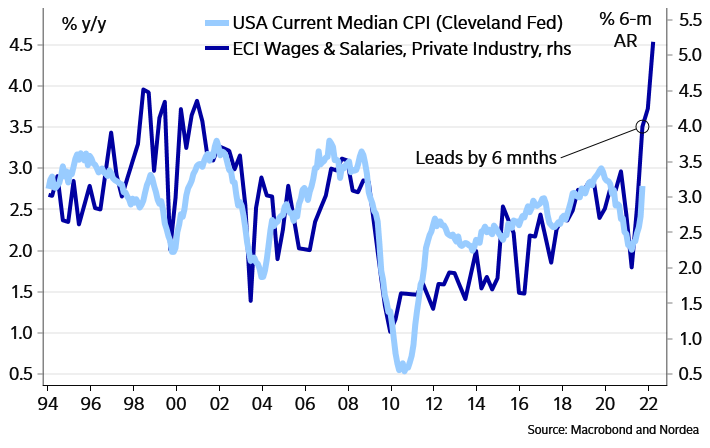
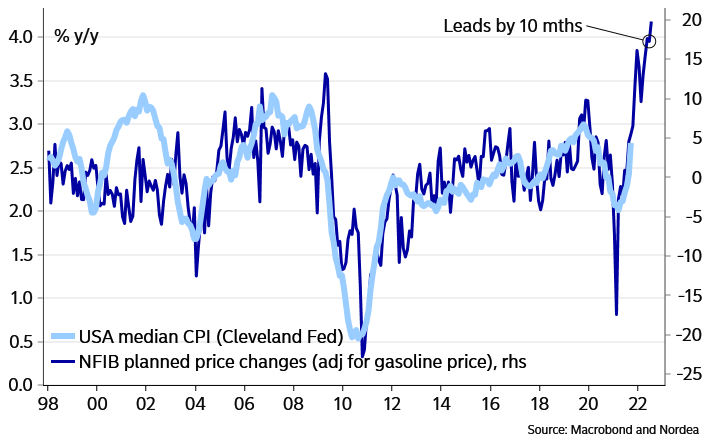
At its Wednesday presser, Powell said “The inflation that we’re seeing is really not due to a tight labor market.” He may be right, but he also could have added “yet” as these Nordea charts suggest:

High labour cost increases should lead to higher median CPI

US companies continue to signal major price hikes

BTW: “the Bakery, Confectionary, Tobacco Workers and Grain Millers’ Union yesterday declined to bring Kellogg’s latest proposal, termed its “best and final offer” by management, to those striking laborers for a vote. “There’s no question that today’s business environment is as challenging as we’ve ever seen it,” lamented CEO Steve Cahillane.” (ADG)

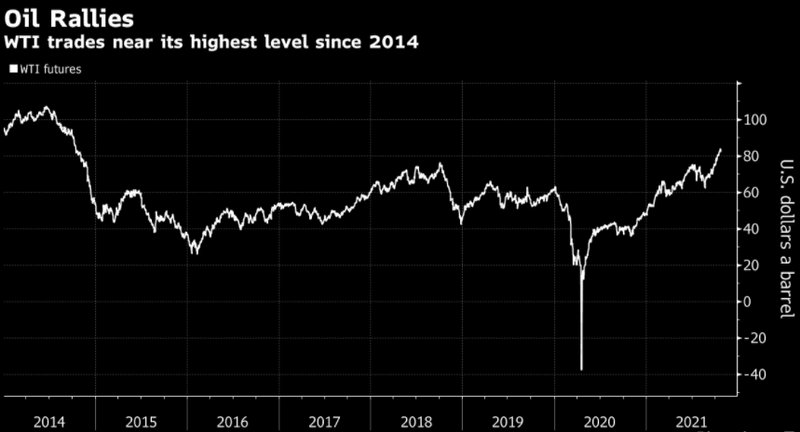
OPEC, Russia Stick to Gradual Oil Production Boost Producers reject U.S. pressure to boost output faster and ease prices

OPEC and a group of Russia-led producers agreed to keep to their gradual, monthly increase in oil output, deciding to boost production by 400,000 barrels a day next month and rebuffing stepped-up pressure from the U.S. to boost output and ease prices. (…)

In recent days, apart from public comments, U.S. officials have reached out to Saudi Arabia, the United Arab Emirates and Iraq, asking to get more oil to the market, according to people familiar with the matter. (…)

“If we increase output all of a sudden and demand is hit in one area because of a new wave of covid, the price would collapse,” a Saudi oil official said. “So bringing back more oil to the market rapidly is not on the cards at the moment.”

unnamed - 2021-11-05T071911.180

  • Other supply problems: the number of dairy cows in the U.S. is plunging at a pace not seen in more than a decade, leading to weak production. (…) Global stockpiles of milk powder, which are exported around the world and can be reconstituted into the beverage, have been dropping for four years. (Bloomberg)

Oil rallies

  • And meat:

image

U.K. Rate-Decision Surprise Ripples Across Global Bond Markets The Bank of England holds fire on an interest-rate move, triggering the biggest U.K. bond-yield drop in years.

The bank has said it expects to raise borrowing costs soon, moving ahead of the Federal Reserve and other major central banks in withdrawing stimulus to tame inflation.

But the bank held fire Thursday, surprising investors who had become convinced an increase was coming. Yields on one-year government bonds, known as gilts in the U.K., nearly halved within hours, dropping 0.22 percentage point, in their biggest daily move since the 2009 financial crisis. The move also sent the pound down 1.4% against the dollar to $1.349, its biggest one-day fall in more than a year. (…)

Yields on U.S. two-year Treasury notes slipped 0.07 percentage point to 0.41%. German one-year government-bond yields fell 0.08 percentage point to negative 0.83%, their biggest one-day drop since the coronavirus market panic of March 2020, according to FactSet. (…)

Mr. Bailey said he was clear the need for tighter policy was closely linked to developments in the labor market and on inflation.

“It was a very close call,” he said at a news conference. “We are in a situation where the calls are close, they’re quite hard.” (…)

New forecasts showed officials expect annual inflation will be close to 2% in two years and below 2% in three if interest rates are ratcheted higher, to around 1% by the end of next year, as implied by prices in financial markets when the BOE concluded its forecasts. That suggests officials anticipate a slower and steadier path of rate increases than investors. (…)

It expects supply-chain disruption and labor shortages to dog the U.K. throughout next year, pulling expected growth in 2022 to 5%, from a forecast of 6% previously. (…)

Euro zone retail sales record surprise fall on weak Germany

Retail sales, a proxy for consumer demand, in the 19 countries sharing the euro, fell 0.3% month-on-month in September and were up 2.5% from a year earlier, the European Union’s statistics office said.

Economists polled by Reuters had expected a 0.3% monthly rise in retail sales and a 1.5% year-on-year increase.

Part of the month-on-month miss, however, may be down to revisions as retail sales in August were now estimated to be up 1% compared with a 0.3% rise reported earlier. (…)

Eurostat said car fuel sales rose 1% on the month while food, drinks and tobacco sales rose 0.7%. But non food sales dropped by 1.5%, including a 1.4% decline in Internet and mail order sales.

Germany, the euro zone’s biggest economy, recorded the largest, 2.5% drop in retail sales but Finland and the Netherlands were also deep in negative territory.

U.S. Trade Deficit Deepens to New Record in September

The U.S. trade deficit in goods and services increased to $80.93 billion during September from $72.81 billion in August, revised from $73.25 billion. The latest deficit was a record for the series which extends back to January 1992. A deficit of $80.3 billion was expected in the Action Economics Forecast Survey. Exports declined 3.0% in September (+16.6% y/y) following a 0.6% August gain while September imports rose 0.6% (19.9% y/y) after increasing 1.3% in August.

The trade deficit in goods deepened to $98.2 billion in September from $80.2 billion in August, revised from $89.41 billion. It compared to a $96.25 billion deficit in the advance report issued last week. Exports of goods fell 4.7% (+16.8% y/y) after a 0.8% August rise. Holding back the export total, industrial supplies & materials exports fell 9.9% (31.3% y/y) following a 6.7% rise. Capital goods exports declined 3.6% (+12.3% y/y) after falling 1.9% in August. Auto exports fell 2.0% (-11.7% y/y) following an 8.0% drop. Food exports were off 1.2% (-3.6% y/y), the third decline in four months. Increasing were nonauto consumer goods exports which strengthened 3.7% (30.5% y/y) in September after rising sharply in four of the prior five months.

Imports of goods rose 0.9% in September (18.4% y/y), about the same as in August. Capital goods imports increased 4.0% (18.7% y/y) after falling in three of the prior four months. (…) Nonauto consumer goods imports eased 0.1% (+12.4% y/y), the third decline in four months. Auto imports dropped 7.7% (-16.6% y/y), and they’ve fallen 21.8% since December of last year.

Petroleum imports rose 4.3% in September and have roughly doubled y/y. The  monthly rise occurred despite a decline in the price of crude oil to an average $64.43 per barrel from $65.06 in August. The price was substantially higher than $37.60 per barrel one year earlier. Nonpetroleum imports rose 0.6% (14.3% y/y) after rising 1.0% in August.

The real (adjusted for price changes) trade deficit in goods deepened to $111.0 billion (chained 2012 dollars) in September from $101.5 billion in August. Real exports of goods fell 4.9% (+0.8% y/y) after a 0.5% rise. Real imports of goods increased 1.0% (9.9% y/y), the same as in August. (…)

The chart below plots imports and exports, nominal and real, with Q4’19 = 100. Imports are up 13.2% (5.9% real) while exports are unchanged (and down 9.3% in real terms).

fredgraph - 2021-11-05T055433.909

JPMorgan cuts China growth forecast for fifth time since August

JPMorgan cuts its fourth quarter growth forecast for China to 4.0% quarter-on-quarter from 5.0% on Friday, citing the impact of power shortages and the recurrence of COVID-19 clusters hitting consumer spending and services.

“Looking back, we have downgraded China’s growth forecasts five times since August,” JPMorgan’s Haibin Zhu said in a note, adding the bank now expected full-year growth of 7.8% and 4.7% in 2022.

China’s housing market is more than “adjusting”: watch commodities!

EARNINGS WATCH

We now have 420 reports in, an 81% beat rate and a declining +10.7% surprise factor, bested by Financials at +18.9% after having cut their loan-loss reserves.

Trailing EPS are now $197.49. 2021e: $204.21. 2022e: $220.63.

Q4’21 EPS are seen up 22.0%, in line with the 21.7% growth expected on Oct.1.

But 2022 growth has been reduced from +9.2% to +7.5%.

Pointing up We got the first tally of Q4 pre-announcements from Refinitiv/IBES: not off to a good start. Eight more companies than at the same time last year have pre-announced, all negative plus 2 more. Compared with Q3, the N/P ratio has tripled.

image

Meanwhile, fear is gone:

image

Canada’s Banks Get Green Light to Resume Share Buybacks, Dividend Increases

Fingers crossed Why a New Pill to Treat Covid Could Be a Game Changer Molnupiravir, an antiviral pill being developed by Merck & Co., has been touted as a potential game changer in the fight against Covid-19. The experimental medication was shown to reduce the risk of hospitalization or death by about half in a late-stage study of adults with mild-to-moderate cases. The promise of a drug that patients can easily get and take at home has prompted some governments to order supplies even before most regulators have decided whether to approve its use.

  • Pfizer said its antiviral pill was 89% effective at preventing people at high risk of severe Covid-19 from dying or needing hospitalization, as it plans to ask the FDA to authorize the drug’s use this month. (WSJ)