The enemy of knowledge is not ignorance, it’s the illusion of knowledge (Stephen Hawking)

It ain’t what you don’t know that gets you into trouble. It’s what you know for sure that just ain’t so (Mark Twain)

Invest with smart knowledge and objective odds

THE DAILY EDGE: 21 DECEMBER 2021

HAPPY HOLIDAYS!

The Daily Edge will be published sporadically in the next 2 weeks.

A special thank you to donators who help support this blog. Very, very much appreciated.

Apologies if  have not sent a personalized thank you note like I normally do. The recent weeks/months have been particularly busy for me.

On January 3rd, I will begin my 14th year blogging!

U.S. Leading Economic Indicators Strengthen in November

The Conference Board’s Composite Leading Economic Indicators index rose 1.1% (9.8% y/y) during November following an unrevised 0.9% October increase. The 0.3% September rise also was unrevised. It was the largest increase in six months and outpaced a 0.9% rise expected in the Action Economics Forecast Survey. The Leading Index is comprised of 10 components which tend to precede changes in overall economic activity.

Eight of the ten index components contributed positively to the November increase including the length of the average workweek, unemployment insurance claims, the ISM orders index, building permits, the interest rate spread between 10-year Treasuries and Fed funds as well as the leading credit index. Orders for consumer goods and materials as well as stock prices also contributed positively. The index of consumer expectations for business & economic conditions fell while real nondefense capital goods orders excluding aircraft held steady.

The Index of Coincident Economic Indicators rose 0.3% (3.6% y/y) in November after an unrevised 0.5% October increase. Stability in September also was unrevised. All four of the component series rose including nonagricultural employment, personal income less transfers, industrial production and real manufacturing & trade sales.

The Index of Lagging Indicators eased 0.1% during November (+0.8% y/y) following a 0.5% October rise, revised from 0.4%. September’s increase was revised to 0.9% from 1.0%. The average duration of unemployment, the change in labor costs per unit of output slipped as did the six-month change in the services CPI. The business inventory/sales ratio, commercial & industrial loans outstanding and the consumer installment credit/personal income ratio rose. The banks’ prime rate held steady.

image

U.S. Industrial Production Increases Moderately in November

Industrial production increased 0.5% (5.3% y/y) during November following a 1.7% October rise, revised from 1.6%. Motor vehicle parts shortages and recovery from Hurricane Ida affected production last month. A 0.7% rise had been expected in the Action Economics Forecast Survey. Manufacturing output rose 0.7% last month (4.6% y/y) following a 1.4% increase during October, revised from 1.2%.

Durable goods production rose 0.8% (4.9% y/y) last month after a 1.4% October gain. Motor vehicle production rose 2.2% (-5.4% y/y) following a 10.1% rise. Excluding the motor vehicle sector, factory output rose 0.6% (5.5% y/y) after a 0.8% gain. Elsewhere in the durable goods sector, high-tech product production rose 0.7% (6.3% y/y) after a 0.3% rise in October. (…)

In the nondurable goods sector, production improved 0.5% (4.7% y/y) after rising 1.3% in October. (…)

image

U.S. In-Store Holiday Shopping Holds Up Despite Omicron

Foot traffic to stores and shopping centers in the U.S. on Dec. 18 — the last Saturday before Christmas — rose 19% from a year ago, according to data from Sensormatic Solutions. (…)

Black Friday week and the first three weeks of December clocked foot traffic increases of 14% and higher compared to last year.

Pointing up While store visits jumped from last year — the first holiday season during the coronavirus pandemic — they didn’t fully rebound to 2019 levels. Shopper traffic on Saturday was down 26% from two years ago, according to Sensormatic Solutions, a subsidiary of Johnson Controls International Plc that analyzes foot traffic by counting mobile devices at stores.

The Chase consumer card spending tracker is up 1.2% from pre-Covid trends (7-day average through December 14). Millennials’ spending is up 8.3%, Gen x’s +0.7% and Boomers’ -5.3%. “Buy-Now-Pay-later”?

image

Shipping and Logistics Costs Are Expected to Keep Rising in 2022 Executives say the tight capacity and high demand that have sent prices surging this year will extend into next year

Transportation and logistics providers are seeking big boosts in prices for contracts for the coming year, signaling that the inflationary pressure driven by strong demand and tight capacity in freight markets is likely to persist.

With high shipping demand still far outweighing tight capacity across the freight sector, industry experts say transport operators have leverage to raise prices when negotiating new contracts. Ocean-shipping executives say they expect the rates set in many annual contracts will double compared with agreements struck earlier this year, before supply-chain bottlenecks squeezed capacity. Some trucking companies project double-digit growth in contract rates for 2022.

Prices have been rising across the freight sector, including in parcel delivery, trucking, ocean shipping and warehousing. Most freight-transportation contracts are negotiated annually, although many large shippers may have multiyear agreements with a variety of carriers. (…)

Overall, domestic shipping rates for moving goods by road and rail in the U.S. are up about 23% this year from 2020, according to Cass Information Systems Inc., which handles freight payments for companies.

A separate measure in the Logistics Managers’ Index that tracks overall logistics prices, including transportation, warehousing and inventory prices, reached a record in November, up 3.4% from October and a 14% increase year-over-year. The index was launched in 2016. (…)

Mr. Leathers, who said contract rates could rise by high single-digit to mid-double-digit percentages in 2022, expects price increases to moderate as transportation demand eases and companies finish replenishing depleted inventories. However, he said, “We don’t foresee that until 2023. All of 2022 we view as a capacity-constrained market with inflationary pressure and with significant equipment disruptions.” (…)

Delivery giants FedEx Corp. and United Parcel Service Inc. both said rates would go up an average of 5.9% next year across most services, the first time in eight years that either company had annual increases above 4.9%. (…)

Xeneta said the spot price to ship a 40-foot container from Shanghai to Los Angeles earlier this month was 75% higher than the same time last year. Carriers “go into contract negotiations right now holding the lion’s share of the aces,” said Peter Sand, Xeneta’s chief analyst.

Seko Logistics, an Itasca, Ill.-based freight forwarder, says its contracted rate to ship a 40-foot container from Asia to the U.S. West Coast could double next year to between $6,500 and $7,000. In 2019, the firm paid ocean carriers about $1,500 for the same service. (…)

Prices to lease industrial properties have jumped 25% on average nationwide over rates tenants paid at the end of five-year leases that expired in the third quarter, real-estate firm CBRE Group Inc. said in early December. (…)

Overall, transportation rarely exceeds more than 7% of the cost of goods being shipped, (…)

European gas prices hit record as Russian gas flows via Yamal reverse European gas prices hit a new high on Tuesday after Russian shipments to Germany via a major transit pipeline reversed direction, a move the Kremlin said had no political backdrop as one western firm said Gazprom was meeting its supply obligations.
Defensive bubble stocks = umbrellas in a hurricane When a bubble crashes, every part of it goes down

From Richard Bernstein Advisors:

(…) Many investors tried to take a similar approach during the late-90s, but unfortunately, with little success.

  • Strategy 1: Buy proven leaders. During the Tech Bubble, the largest stocks in the Tech sector were widely considered established winners with solid fundamentals, such as Microsoft, Cisco and Intel. Not only did the stocks of the ten largest “proven leaders” crash by an average of 84% during the bear market, half of them never recovered their peak, while those that did took an average of 15 years to do so.
  • Strategy 2: Buy tomorrow’s winners. What if investors were able to predict the future winners? Of today’s ten largest Tech stocks, also including Communication Services and Amazon, those that were publicly traded at the peak of the Tech Bubble fell by an average of 72% during the bear market and took over 11 years to recover their peak.

One of too many: Nikola Corp, which went public via SPAC last year, agreed to pay $125 million to settle with the SEC over charges that it defrauded investors. (SEC via Axios)
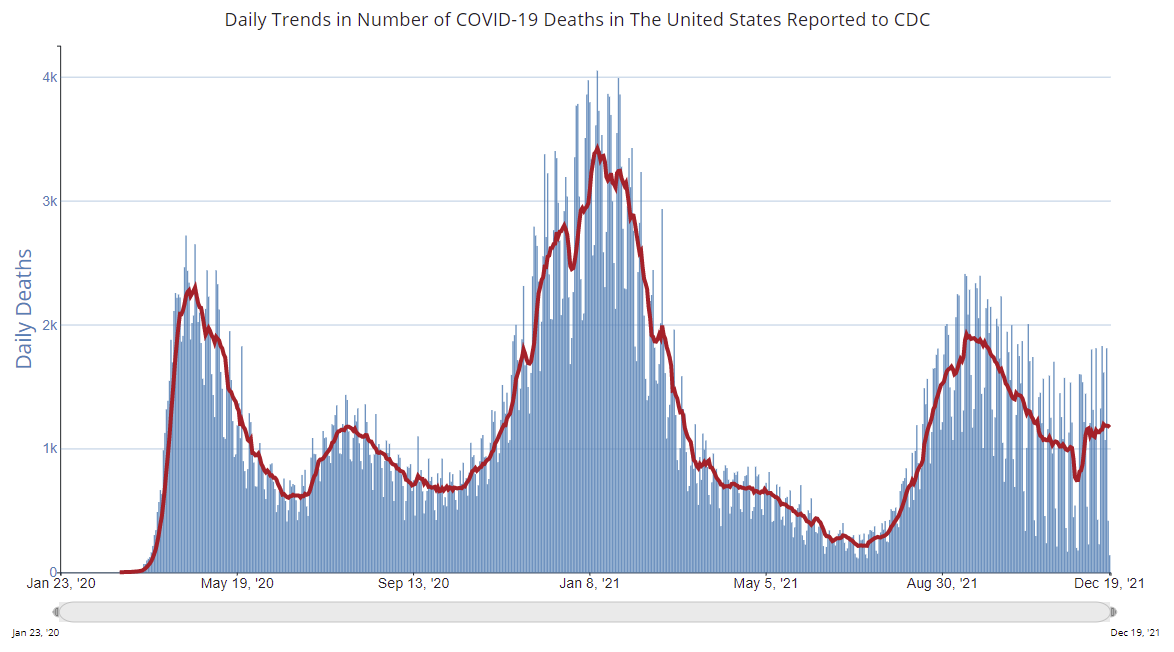
(CalculatedRisk)

THE DAILY EDGE: 20 DECEMBER 2021: Consumer Watch

CONSUMER WATCH

David Hay, the co-CIO at Evergreen-Gavekal invited Gerard Minack to contribute to their Macro Outlook for 2022. Minack is a smart and experienced strategist worth reading (here). Here’s the part dealing with the consumer:

(…) In most developed economies households saved much of the transfer payments. Consequently, they are now sitting on cash reserves that could fund spending in future.

image

The $2.75T in “excess savings” is the accumulation of the unspent income since March 2020. The positive spin is thus that a good part of this “unexpected” cushion will be spent in coming quarters/years. Nearly 15% of income to splurge with can sustain consumption for a long time.

Two questions: Where is this $2.75T excess bounty sitting and how much of it is there really?

  1. The latest Distribution of Household Wealth report by the Federal Reserve reveals that 70% of all liquid assets (deposits + money market funds) accumulated between Q4’19 and Q3’21 are in accounts owned by the wealthiest 20%. Cushion for the most cushioned.
  2. It is assumed that the money has been safely stashed away. I would not be so sure given how some of the excess savings seem to have been used, or misused as Lance Roberts shows. “A vast majority of 2020 and early 2021’s high-flying stocks are down significantly from their respective 52-week highs.”

Wipe Out, “Wipe Out” Below The Calm Surface Of The Bull Market

After the crash of 2008, the bottom half of U.S. households saw their share of the country’s wealth plunge close to zero. This time, so far, it’s different.

Since the pandemic began last year, there’s been the biggest increase on record in the wealth share held by the poorest 50% of Americans, according to Federal Reserve data published Friday. It rose to 2.5% as of Sept. 30, from 1.8% at the end of 2019 — after reaching a low of 0.3% a decade ago.

In dollar terms, that means the wealth held by the bottom half, some 65 million households, rose by $1.5 trillion in the pandemic to $3.4 trillion.

To be sure, the bottom half’s wealth share — while it’s now the biggest since 2004 — remains far below what was normal in the 1990s. It’s also just a sliver of the net worth held by the top 1%.

And the gains for the poorest Americans didn’t come at the expense of the richest. The top 1% enjoyed an even bigger jump in their portion, which rose by 1.3 percentage points. Those 1.3 million households now own almost $44 trillion in wealth, close to one-third of the national total, after adding more than $10 trillion in the pandemic.

It was the groups below the 1%, but still in the top half of the distribution, who saw their wealth shares decline.

On average, the wealth of the bottom 50% of households rose by $23k since the 4th quarter of 2019 to $52.3k. Seventy-five percent of the appreciation is accounted for by real estate and durable goods (used cars?). Hard, but illiquid, cushions for this group.

chart (14)

I am uncomfortable resting on a $42k average “excess savings” cushion primarily held by the wealthiest segment of the population averaging more than $2M in household net worth. Given their relatively low propensity to spend, they may not prevent a slowdown/recession. Since the start of the pandemic, this group increased their durable goods assets by 20% per the Fed data. The bottom 50%? +30%.

Then there is the matter of inflation which has stealthily eroded 8% of everybody’s purchasing power since the end of 2019. Gerard Minack is not worried:

In the US, for example, real labour income is now running over 6% above year earlier levels. To be fair, this is partly base effects, but the point is that wage and employment growth are both stronger now than at the start of any modern-day tightening cycle.

image

What does “partly” mean in “To be fair, this is partly base effects”? In this case, it means “a lot”.

This next chart plots aggregate weekly payrolls (employment x hours x wages) deflated by the CPI. The reality is that accelerating inflation has totally annihilated recent progress in employment and wages: aggregate payrolls (red), up 7.5% from February 2020, are back on trend but real payrolls (blue) are merely back to their pre-pandemic level, are 6% below trend and declining since September.

image

The $2.75T in “excess savings” are down to about 6% of income after inflation and remains under threat.

This next chart illustrates the tight relationship between total expenditures and payrolls. The current 4.5% gap between the two series will be closed one way or the other. Unless real payrolls truly accelerate, Americans will need to spend their excess savings. But we know that 50% of them don’t really have any and that 70% of those excess savings are held by the 20% wealthiest Americans who really don’t know what excess savings mean.

fredgraph - 2021-12-19T101433.243

Not worried for consumers, Minack is also unworried by central banks:

Ultimately what will slow growth is central bank tightening. So it’s crucial to note upfront that central banks have changed. For three decades central banks had a singular focus on inflation and aimed to set policy on a pre-emptive basis. That era is over. Central banks are now as focused on labour markets as inflation and are no longer pre-emptive. Exhibit 5 highlights how different the Fed is behaving in this cycle compared to history.

image

That in turn means that the economy will have more momentum – and more inflation – at the start of this tightening cycle than in any other cycle of the past four decades. (…)

When the Fed starts lifting rates will likely depend on labour market conditions – specifically, the extent to which labour supply recovers. If the participation rate were to fully recover its pandemic losses – something looking increasingly unlikely – the Fed may be able to delay tightening until early 2023. On the other hand, if there’s no further increase then a mid-year hike would be on the cards. I am expecting 2-3 moves in the second half of next year, but I’ll change my view if there is a sharp change in labour participation trends.

Obviously, Minack’s piece was written before last week’s events:

Central banks around the world seem to think or act “tightening” nowadays, not because the economic momentum is so strong compared with 2019 but because the inflation momentum is very much stronger.

Last week, we also got this Bloomberg headline:

My comments last week:

Real retail sales actually declined 0.5% in November after rising 0.8% in October and 0.3% in September. Last 3 months: +2.4% annualized, not bad but not “really strong”, especially if there actually was some pre-buying as Shilling (and I) have warned.

In effect, real retail sales (goods demand) peaked last March and are down 2.5% since. They remain 12.9% above their pre-pandemic level and 8% above trend. By comparison, gradually recovering real expenditures on services are 1.3% below their pre-pandemic level and 5% below trend.

The Chase consumer card tracker through December 12 supports the pre-buying thesis:

image

In fact, investors, and retailers, may be in for a nasty surprise if nothing changes. The post Black Friday holiday shopping season is trending weaker than in both 2019 and 2020.

image

It may be Omicron, employment, inflation or, likely, all of that. But this does not look like a strong finish.

Interestingly, Chase data reveal that Millennials are still spending merrily while Boomers, those with more wealth and savings, are retrenching. Recently, Amazon launched its own BNPL program, apparently very popular with Millennials.

Try it to see how simple it is
1. Select Affirm as a payment method at checkout.
2. See what plans are available for your purchase.
3. Make payments at Affirm.com or in the Affirm app.

Pay in 3-48 equal monthly payments depending on your total cart amount. Rates are from 10-30% APR.
No hidden fees

Affirm helps you break up your purchases into payments you can count on. With no fees or surprises, you always know exactly what you owe.

“No fees, no surprises”, as long as you understand what 10-30% APR means!

Last Friday, Almost Daily Grant had this story:

Time to pay the piper? Yesterday, the Consumer Financial Protection Bureau announced an investigation into the bourgeoning “buy now, pay later” industry, the millennial- and Gen Z-friendly alternative to traditional credit cards and retail layaway programs. The format has caught on like wildfire of late, simultaneously allowing cash-strapped consumers to shift lump sum payments into monthly installments and presenting a lever for retailers to goose sales without incurring credit risk, though fees can run to as high as 5% of the total purchase price.

Among the regulator’s areas of interest: whether the platforms allow consumers to run up unduly heavy debt burdens, whether sensitive customer data are being properly handled and whether the entities undertake required regulatory disclosures. A breakneck pace of growth colors Washington’s interest. Industry mainstay Affirm, Inc. (AFRM on the Nasdaq) generated $269 million in revenues during the third quarter, up 54% from a year ago, while peer Afterpay Ltd. boasted 28,400 merchant partners as of June 30, up more than six-fold over the previous two years. (…)

A September survey of 1,044 U.S. shoppers from Credit Karma suggests there may be something to his argument:  44% of respondents reported using the BNPL service this year, with 34% of that contingent missing at least one payment. Within that cohort of slow-payers, 72% believed their credit score has been negatively impacted as a result, with 31% considering the damage “significant.”

From the BNPL operator’s perspective, the pandemic era has been a dream, featuring explosive growth and bountiful share price appreciation, despite recent hiccups. (…)

ADG goes on with its own bearish analysis of AFRM but my interest is more in the effect BNPL has had on retail sales this year and its impact when the inevitable surprises arrive…

Build Back Busted

Goldman cut its forecast for U.S. first-quarter GDP to 2% from 3% after Manchin’s announcement. Economists wrote that the likely failure of the Build Back Better legislation would reduce second- and third quarter growth too. (Bloomberg)

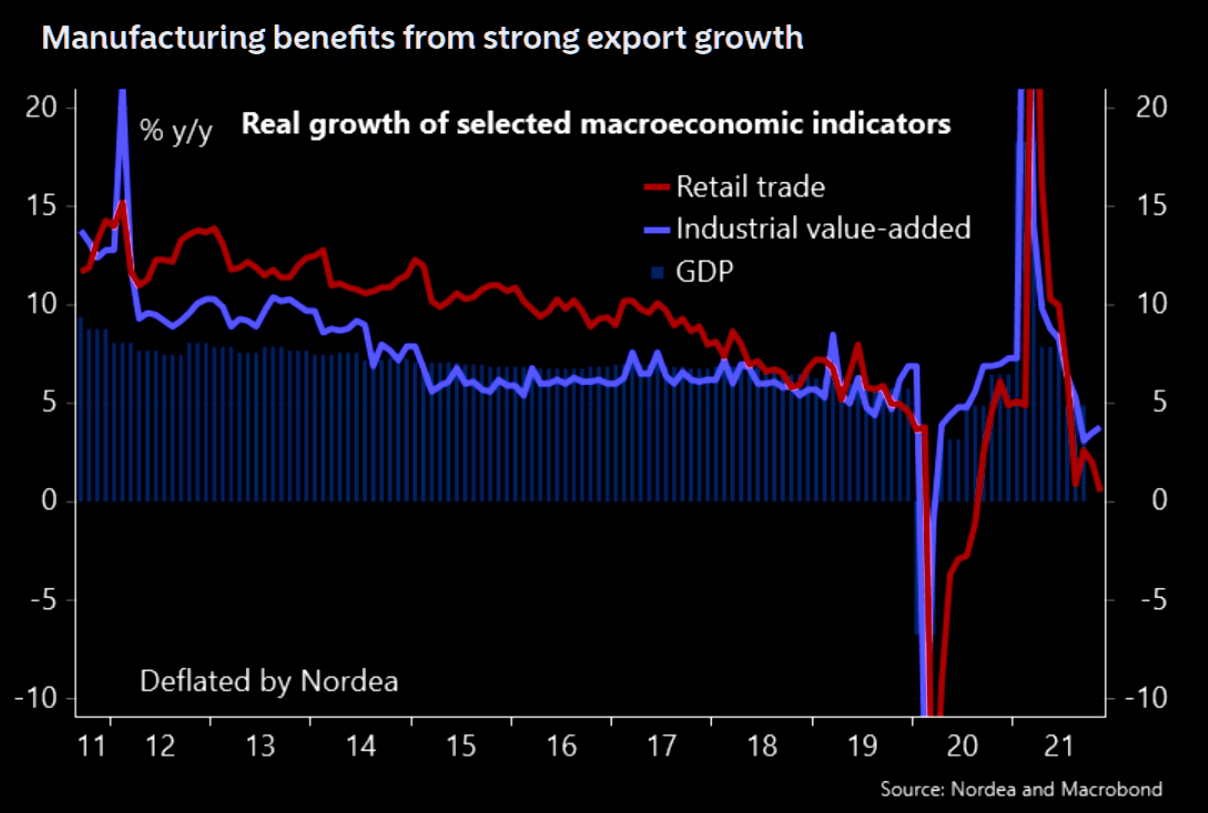
Chinese Banks Cut Borrowing Costs To Counter Economic Slowdown

The one-year loan prime rate was set at 3.8% versus 3.85% in November, the first reduction since April 2020, according to a statement from the People’s Bank of China on Monday. The five-year loan prime rate, a reference for mortgages, was unchanged at 4.65%.

The cut comes as the central bank and government increase support for the economy and follows the PBOC’s decision earlier this month to cut the amount of cash banks must hold in reserve, which freed up 1.2 trillion yuan ($188 billion) of cheap long-term funding for banks. Monday’s decision means the strongest companies will be able to borrow at a slightly cheaper rate and also reinforces the shift to looser policy as the leadership aims for stability in 2022. (…)

In another sign of support, China will focus on supporting “quality” property developers buying the real estate projects of large companies which are experiencing difficulties, Financial News, a newspaper co-founded by the PBOC, reported Monday, citing a notice from the central bank and the banking regulator. (…)

(Nordea via The Market Ear)

TECHNICALS WATCH

Strong demand remains MIA with only a few mega caps supporting the main indices. The excellent Lowry’s Research calculates that half of “operating companies” small cap stocks are in bear market territory. Add the growing weakness in tech stocks and the collapse in “meme” stocks, you get a rather narrowly rising equity market.

iwm

The large cap 13/34–Week EMA Trend is still positive:

FYI: