The fate trade:
Fed officials pushed back against the idea that higher inflation would last long enough to put pressure on the U.S. economic rebound. Governor Lael Brainard, Atlanta Fed President Raphael Bostic and St. Louis’s James Bullard all said that the price-growth momentum would prove temporary. The dollar sank to the lowest level since January as the comments helped calm investor nerves about tightening monetary policy. (Bloomberg)
(…) “Businesses are trying to cope with the (labor) shortage in different ways but we aren’t seeing industry-wide wage pressures,” said Daniel Gschwind, chief executive of the Queensland Tourism Industry Council. (…)
Minutes from the Fed’s April meeting included the observation that some businesses were either downsizing or “focused on cutting costs or increasing productivity, particularly through automation”. (…)
A May survey by IHS Markit cited rising salaries as a factor behind the biggest increase in cost pressures in the UK services sector since July, 2008.
But the Office for National Statistics warned that first-quarter headline annual pay growth of 4.0% was misleading because, as in the United States, lower-paid workers are more like to have lost jobs in the pandemic in the past year.
Adjusting for this, it estimates pay growth is around 2.5% – close to its long-run average.
In the euro zone, several months behind the United States and Britain on the recovery curve, pay conditions are typified by the April 13 agreement between Europe’s largest carmaker Volkswagen and trade union IG Metall for a modest 2.3% rise from next January – short of initial union demands of 4%. (…)
So far, PMI surveys are not flagging wages as a significant cost problem and the Atlanta Fed’s Wage Tracker is rather quiet.

The key words are “so far” as Goldman Sachs tries to explain the +0.7% jump in average hourly earnings in April’s employment report:
The relationship between labor market tightness and AHE growth has been highly nonlinear during the pandemic, and a surge in labor demand due to reopening may have tightened the labor market enough to rapidly push up wages. This explanation is consistent with the commentary on the release from the Bureau of Labor Statistics.
We also suspect that some employers may have been forced to raise wages to compete with the generous UI benefits discussed above. AHE growth was strongest in April for low-wage production and non-supervisory employees in the leisure and hospitality and retail sectors, which are most likely to receive more income by collecting UI benefits than by returning to work at their previous wage.
Some special factors also seem to have contributed to the upside surprise to wage growth in April, however. For example, AHE for workers at restaurants and bars fell in the first few months of the pandemic and have rebounded sharply since January. We suspect that this pattern reflects a loss and subsequent recovery in gratuity income due to customer limits. In addition, slower job growth mean that the unwinding of the workforce composition boost which we expected would weigh on AHE in April was delayed, although we still expect it to create a drag on overall AHE growth in coming months.
Nevertheless, the size and breadth of the upside earnings surprise in Friday’s report suggests that much of the increase in AHE reflects genuinely strong wage growth in a tighter labor market than the unemployment rate suggests.
CEOs clearly have fate:

The Altar of Economic Growth and the 2% Corrections
This is from my old friend Hubert Marleau (my emphasis):
The GFC has fundamentally changed economic thought, which has, in turn, transformed the investment landscape and revised trading habits. On the one hand, the long-term trajectory of the stock market appears to be connected to money. On the other hand, the daily trading of stocks seems to be tied to interest rate movements. Accordingly, the investment and trading logic of the broad market looks different than how it used to.
Not so long ago, Economics 101 was about the efficient allocation of scarce resources. Now, economic growth at any expense is the new mantra. Put simply, policymakers have forsaken liberal capitalism in favour of state capitalism. Growth for the sake of growth has been put on the altar to be adored. While stock and sector selection are determinants of superior stock market returns, the long-term trajectory of aggregate stock prices is essentially connected to the quantity and velocity of money. Meanwhile, trading securities is no longer about providing pockets of liquidity for listed securities, but about taking on short or long positions for quick capital gains, which are closely related to interest rate movements.
If you are an investor and in for the long haul, it’s probably a good idea to buy the dips, because there is no more recession in sight. People believe that the government has the means to prevent economic downturns. In this regard, they would be annoyed if the politicians were not to use those tools to fight them. Thus, there is no going back, because large stimulating budgets, combined with accommodating monetary policies will be used to pacify populist and polarized electorates. The next time there is a hint of a recession, rest assured the people will demand powerful monetary and fiscal policies from the politicians. Given the willingness of policy makers to acquiesce, the expectation is high that they will do what they can to reduce the probability of having severe and extensive downturns: thus, buying dips as an ongoing strategy isn’t stupid.
If you are a speculator, however, and have to worry about everything, it may be better to tread carefully. Markets are more volatile and moving faster than they use to, because the quants have replaced the specialists and the old-fashioned traders. Quants use algorithms essentially linked to minute interest rate changes to get ahead. These mathematical trading machines have led to more corrections, whose duration and amplitude seem to be getting respectively shorter and smaller. In other words, these guys can easily create days of high volatility by changing trading liquidity at will. Quant-traders use derivatives and leverage to assault the market even when a singular piece of bad news like an undesirable economic print or a comment from an official unexpectedly arises.
Thus, fast but short-term volatility eruption in everything financial has become the new trading norm. Given that most of us tend to be an investor in our brain and a speculator in our heart, it may be a good idea to think slowly when rationality is needed and to think fast when the price is right. It is a simple investing formula that has worked well over the last ten years.
So long the independent Fed?
THE RULE OF 20!
Very, very few people discuss the Rule of 20, let alone use it. This chart could make the rounds, however, rubber stamped as a Peter Lynch valuation method. The famous stock picker may have used it but he sure did not invent it. The creator of the Rule of 20 is Jim Moltz, a strategist at C.J. Lawrence, just to show my age…

China’s Next-Generation Tech Firms Hit Hard by Market’s Pullback Stock in former darlings such as Meituan, Pinduoduo and Kuaishou has dropped by more than one-third from highs reached earlier this year
A chill has fallen over China’s new generation of tech giants, with stock in former market darlings such as Meituan, Pinduoduo Inc. PDD 0.87% and Kuaishou Technology 1024 -11.46% dropping by more than one-third from highs reached earlier this year.
The up-and-comers have proved especially vulnerable to a series of shifts in market sentiment, leading their shares to suffer more than more established rivals such as Tencent Holdings Ltd. TCEHY 1.53% and Alibaba Group Holding Ltd.
Like technology stocks everywhere, those of newer Chinese companies have suffered as investors have regained their appetite for more modestly valued old-economy businesses. Those stocks are likely to do well as the U.S. and other countries rebound from the pandemic. The Chinese companies are also caught up in an official clampdown on China’s tech sector alongside Alibaba and other big players. (…)
Although everyone is suffering, there is a distinction between China’s profitable and pre-profit tech companies, said Hyde Chen, an equity analyst with the chief investment office of UBS Group AG’s global wealth-management unit.
Shares in Meituan, China’s leading food-delivery group, hit a closing high in mid-February. They had more than quadrupled in the previous 12 months, as investors grew more bullish about the post-pandemic outlook for online food shopping in the country. As of Monday’s close, though, the stock had retreated 40% from that peak.
As of Monday, U.S.-listed e-commerce company Pinduoduo had fallen 36% from its recent peak. By the same measure, electric-vehicle maker NIO Inc. has fallen 43%, while video-app operator Bilibili Inc. has lost more than a third of its value.
On Tuesday in Hong Kong, Kuaishou stock tumbled after first-quarter results disappointed investors, taking its shares to roughly half their peak closing level from earlier this year. (…)
“This is kind of a rebalancing taking place globally, and you’ve seen an element of this in the U.S., in Taiwan, and in South Korea,” Mr. Ahern said. He said that in the U.S. newer players such as cloud-computing company Snowflake Inc. that haven’t become profitable, had also sold off more heavily recently. (…)
The ARKK fund in the U.S. is down 32% from its mid-February high. Even TSLA, now profitable by some measures, is down 33%.
Also interesting in this “re-opening” theme, the stock of the ultimate consumer-centric company, AMZN, has gone sideways since July 2020 while the S&P 500 is up 32%. AMZN is now sitting on its flattening 200 dma. In the last 12 months, AMZN’s trailing EPS have have multiplied by 2.5x and its trailing cashflow is up 43% on a 40% jump in sales per share.

So, as Goldman Sachs asks: Is FAAMG now Value?

Meanwhile,
The Upside-Down World of Negative Bond Yields Is Getting Smaller Europe’s improving economy is pushing up rates, which means more investors can get paid—and more borrowers could feel a pinch.
For the first time in years, the global supply of debt with a negative yield is in meaningful decline. The trend is strongest in Europe, where subzero bonds have been an everyday reality for investors. Although the shift will be welcomed by those seeking safe income from new investments, it means current bondholders are losing money.
It also signals that higher borrowing costs are on the way for everyone from governments to corporations to homeowners. It could be an especially nasty jolt for junk-rated companies and emerging-market governments, which have been able to gorge themselves on debt at much lower rates than they’re used to as investors took on more risk in search of better return.
If sustained, rising yields could mark the end of a phase in which a key assumption of investors—that you get paid for lending money—has been turned on its head. The worldwide amount of subzero bonds began seriously building up in 2014, then spiked in 2016. The yield on the 10-year German government bond, a benchmark for safe investments, has been below zero since May 2019. But it’s climbed from a low of -0.9% to a recent -0.14%. The 30-year German bond, which was negative for most of last year, now pays 0.42%. The global total for negative-yielding debt has dropped to about $12 trillion, from a high of more than $18 trillion in December. (…)
G7 is close to deal on taxation of world’s largest companies Accord would curtail the ability of companies to shift profits to low tax jurisdictions
COVID-19
Fans Are Back and Acting Crazy. Sports Are Back to Normal. Ecstatic crowds engulfed Phil Mickelson. Knicks fans chanted obscenities at Madison Square Garden. It’s a sign that the end of the pandemic is in sight.

- Colbert to return to live audiences. “The Late Show with Stephen Colbert” on CBS will return June 14 to episodes with a full studio audience, AP’s David Bauder writes. Audience members will have to provide proof that they have been vaccinated against COVID before attending shows at New York’s Ed Sullivan Theater. Masks will be optional.
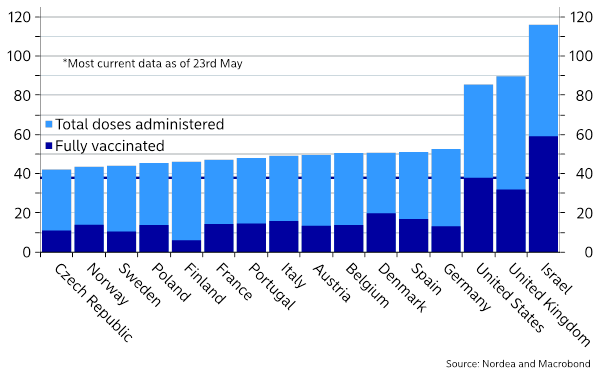
Doses administered and fully vaccinated people as percent of population
 In the War on Cancer, Science Is Winning Promising and amazing advances in vaccination, diagnostic tests, immune therapy and gene testing.
(…) Panelists [at the Fifth International Vatican Conference] described progress on many fronts in the battle against cancer:
• New vaccines against human papillomavirus, which causes cervical and throat cancer, are in late-stage trials. Scientists are also testing vaccines for melanoma, leukemia, lung and renal cancers.
• In five years there may be a simple blood test costing less than $500 that can detect 70% of all cancers in the earliest stages. When patients with breast, prostate and thyroid cancer spot the disease early, their five-year survival rate is 99%.
• New Crispr gene-editing technology deploys a molecular defense system borrowed from bacteria, which use this system to kill invading viral cells by unzippering their DNA to rip it apart. Scientists are using Crispr to repair or rewrite flawed genes. The therapy cured sickle-cell anemia in the first three patients to receive it, and soon it will take on cancer. Many trials of Crispr therapies in the U.S. now are in phase 2 for leukemia, lymphoma, myeloma and more. In China, Crispr is showing promise against lung cancer.
• Immunologist Carl June pioneered the use of CAR T-cell therapy to fight HIV in the 1990s, after which simpler drugs arose and turned AIDS into “kind of like a treatable illness, just like high blood pressure,” he says. Now this therapy is used against breast cancer and leukemia and shows broad promise. (…)
Now cancer doctors can isolate one flawed gene among the 22,000 that make up the human genome. “We can define it, we can address it with a drug, and, pretty soon, we’re going to be able to genetically fix it,” said Dr. Pecora. (…)

 (Haver Analytics)
 (Chart-of-the-Day)


 (Credit Benchmark via John Authers)