High Gasoline Prices Take Up Big Share of March Retail Spending Increase Sales rose 0.5% as consumers spend more on essentials like gasoline and food
Retail and restaurant spending rose by 0.5% in March compared with the previous month, the Commerce Department said Thursday, down from the revised monthly increase of 0.8% in February. Gasoline sales jumped 8.9% in March over the previous month after Russia’s invasion of Ukraine triggered higher oil and gasoline prices.
Excluding gasoline sales, retail sales fell by 0.3%. (…) on an adjusted basis, retail sales fell by 0.7% last month, according to the Federal Reserve Bank of St. Louis and economist estimates. (…)
This chart plots both nominal and real retail and food services sales, highlighting the large and rising impact that inflation is having: compared to February 2020, nominal sales are up 26.6% and rising while real sales are up a much lower 14.0% and trending down since April 2021:

March real sales declined 0.7% following -0.2% in February. But the 4.4% jump in January after December’s -3.3% saves the first quarter, up 1.9% QoQ after +0.3% in Q4’21.
Another way to show the impact of inflation is to plot YoY growth in nominal and real sales: in March, the former is up 6.8% but the latter is down 1.5%.

It is the first time since the pandemic that growth in retail sales (blue below) falls below that of labor income (aggregate payrolls in black) and seemingly below that of total expenditures (red). Annual comparisons will worsen considerably during the higher base April-June period.

The next chart plots YoY changes in labor income (Blue) and headline CPI. Pre-pandemic, aggregate payrolls were rising 4.0-5.0% with inflation below the Fed’s 2.0% target until November 2019. Post-pandemic, payrolls growth hovered around 10.0% while inflation accelerated from 5.0% in May 2021 to 8.6% in March.

To get a better sense of consumer trends, it is best to look at monthly sequential data:

The quarterly trends:

Advisor Perspectives has this long-term chart of real retail sales, making us wonder what is the “next normal”:

Mortgage Rates Hit 5% for First Time Since 2011 The monthly cost of buying a typical home has surged by more than a third over the past year by one estimate, yet demand remains robust.
(…) Rates’ fastest three-month increase since 1987 has made the housing market ground zero for the Federal Reserve’s efforts to tame inflation. (…)
A year ago, buying the median American home at prevailing rates meant a monthly mortgage bill of about $1,223 after a 20% down payment, according to calculations by George Ratiu, an economist at Realtor.com. At recent rates, such a purchase would require a monthly payment of nearly $1,700—a 38% increase, he estimated. (…)
The Mortgage Bankers Association’s index tracking the volume of loan applications for home buying was down 6% this week from a year earlier, the trade group said Wednesday.
Wells Fargo, which issued more mortgages than any other U.S. bank in 2021, said Thursday that mortgage originations fell 27% from a year ago. JPMorgan Chase, another big home lender, reported Wednesday that its mortgage originations dropped 37%.
Refinancings have crashed as higher rates cut the share of homeowners who can save money with a fresh mortgage. The MBA’s index for refinancing volume is down 62% from a year ago. (…)
As rates rise, the local real-estate market is showing signs of cooling off, Mr. Richards added, noting that pricier mortgages are thinning the pool of qualified buyers. (…)
(…) To provide market diagnostics, the Dallas Fed’s International House Price Database team, in partnership with a network of scholars from around the world collaborating under the International Housing Observatory, produces datasets and statistics that characterize potential market exuberance. The methodology uses novel statistical methods to continuously monitor housing markets—in the U.S. and around the world—to detect symptoms and signal the presence of emerging housing booms.
When the statistics derived from these techniques are significant, the periods are date-stamped to signify exuberance—prices growing at an exponential rate exceeding what economic fundamentals would justify. The indicators are computed quarterly. A test outcome above a 95 percent threshold signifies 95 percent confidence of abnormal explosive behavior, or housing market fever.
The history of the U.S. exuberance indicator is shown against the 95 percent threshold in Chart 1. The statistic plotted in the bottom panel delivers a market temperature reading, like that from a personal thermometer. The exuberance indicator shows the temperature, and the confidence upper bound is the abnormality threshold. The current reading indicates that the U.S. housing market has been showing signs of exuberance for more than five consecutive quarters through third quarter 2021. (…)
Our evidence points to abnormal U.S. housing market behavior for the first time since the boom of the early 2000s. Reasons for concern are clear in certain economic indicators—the price-to-rent ratio, in particular, and the price-to-income ratio—which show signs that 2021 house prices appear increasingly out of step with fundamentals.
While historically low interest rates are a factor, they do not fully explain housing market developments. Other drivers have played a role, including pandemic-related U.S. fiscal stimulus programs and COVID-19-related supply-chain disruptions and associated policy responses. The resulting fundamental-driven higher house prices may have fueled a fear-of-missing-out wave of exuberance involving new investors and more aggressive speculation among existing investors.
Based on present evidence, there is no expectation that fallout from a housing correction would be comparable to the 2007–09 Global Financial Crisis in terms of magnitude or macroeconomic gravity. Among other things, household balance sheets appear in better shape, and excessive borrowing doesn’t appear to be fueling the housing market boom. (…)

Here are the key early indicators that tell us demand is softening at a time of year it typically springs up:
- Fewer people searched for “homes for sale” on Google—searches during the week ending April 9 were down 3% from a year earlier.
- The seasonally-adjusted Redfin Homebuyer Demand Index—a measure of requests for home tours and other home-buying services from Redfin agents—has declined 3% in the past four weeks, compared to a 5% increase during the same period last year. The index was up 2% from a year earlier.
- Touring activity from the first week of January through April 10 was 23 percentage points behind the same period in 2021, according to home tour technology company ShowingTime.
- Mortgage purchase applications were down 6% from a year earlier, while the seasonally-adjusted index increased 1% week over week during the week ending April 8.
- For the week ending April 14, 30-year mortgage rates rose to 5%—the highest level since February 2011. This was up from 4.72% the prior week, and the fastest three-month rise since May 1994.
We’re also closely watching the accelerating share of home listings with price drops, which is climbing at its fastest spring pace since at least 2015, another sign that demand is not meeting sellers’ expectations.
“There really is a limit to homebuyer demand, even though the market over the past few years has made it seem endless,” said Redfin Chief Economist Daryl Fairweather. “The sharp increase in mortgage rates is pushing more homebuyers out of the market, but it also appears to be discouraging some homeowners from selling. With demand and supply both slipping, the market isn’t likely to flip from a seller’s market to a buyer’s market anytime soon.”
Despite these early signs that the market is slowing, it still feels as hot as ever for homebuyers, with new records set for home-selling speeds and price escalations, based on data going back to 2015. Forty-five percent of homes that went under contract found a buyer within one week, and the average home that sold went for 2.4% above its asking price. (…)


ECB to Trail Fed in Tightening Monetary Policy Despite Rising Inflation European Central Bank’s plans push the euro lower against the dollar, as officials seek to contain rising prices without derailing economic rebound
(…) Speaking at a news conference on Thursday, Ms. Lagarde emphasized that the eurozone’s recovery is less advanced than that of the larger U.S. economy and faces a bigger economic headwind from the war and related sanctions, which aim to isolate an important trading partner. (…)
“Our economies do not compare and… this is likely to be accentuated by the fact that the euro area is probably going to be more exposed and will suffer more consequences as a result of the war by Russia against Ukraine.”
The ECB confirmed in a statement that it would likely end its bond-buying program, known as quantitative easing, or QE, by September, while leaving its key interest rates unchanged. (…)
The market was pricing in around two 0.25 percentage point rate increases by the end of the year after the meeting compared with three before the ECB’s policy decision was published. (…)
China’s Economy Grew 4.8% in First Quarter, Beating Expectations GDP accelerated even as lockdowns closed factories and kept tens of millions confined to their homes. However, Beijing faces a major test this year to keep the economy firing.
(…) Chinese officials said GDP expanded 1.3% in the first three months of the year when compared with the fourth quarter of 2021, slowing from the 1.6% quarter-on-quarter increase in the previous quarter.
(…) Most of the first quarter’s growth was squeezed into January and February. In March, lockdowns to contain Covid-19 outbreaks had spread to major industrial centers including Shenzhen, Shanghai and the northeastern industrial province of Jilin. Most of those lockdowns remain in place, raising questions about the second quarter.
Data show factory output weakened last month as restrictions thinned workforces and snarled up supply chains. Industrial production rose 5% in March compared with a year earlier, slowing from the 7.5% year-on-year increase in the January-February period. Recent trade data show Chinese imports falling in March for the first time in almost two years as export growth slowed.
Retail sales fell 3.5% in March from a year earlier, down from a 6.7% year-on-year increase in the first two months of the year, as lockdowns kept people indoors and shut stores. That was a bigger drop than the 2% decline economists polled by the Journal were anticipating.
Home sales by volume plunged 25.6% in the first quarter compared with a year earlier, while new construction starts measured by floor area dropped by 17.5%. Both of those declines were sharper than in the first two months of the year. (…)
EARNINGS WATCH
From Refinitiv/IBES:
Through Apr. 14, 34 companies in the S&P 500 Index have reported earnings for Q4 2021. Of these companies, 79.4% reported earnings above analyst expectations and 17.6% reported earnings below analyst expectations. In a typical quarter (since 1994), 66% of companies beat estimates and 20% miss estimates. Over the past four quarters, 83% of companies beat the estimates and 13% missed estimates.
In aggregate, companies are reporting earnings that are 9.5% above estimates, which compares to a long-term (since 1994) average surprise factor of 4.1% and the average surprise factor over the prior four quarters of 13.3%.
Of these companies, 76.5% reported revenue above analyst expectations and 23.5% reported revenue below analyst expectations. In a typical quarter (since 2002), 62% of companies beat estimates and 38% miss estimates. Over the past four quarters, 80% of companies beat the estimates and 20% missed estimates.
In aggregate, companies are reporting revenues that are 1.9% above estimates, which compares to a long-term (since 2002) average surprise factor of 1.2% and the average surprise factor over the prior four quarters of 3.7%.
The estimated earnings growth rate for the S&P 500 for 22Q1 is 6.3%. If the energy sector is excluded, the growth rate declines to 0.7%. The estimated revenue growth rate for the S&P 500 for 22Q1 is 10.9%. If the energy sector is excluded, the growth rate declines to 8.3%.
The estimated earnings growth rate for the S&P 500 for 22Q2 is 6.4%. If the energy sector is excluded, the growth rate declines to 1.4%.
Trailing EPS are now $211.55. 2022e: $227.29. Forward 12 months: $233.83e.
These are the data to watch: so far, analysts are merely fine tuning their estimates, mainly downward.


Factset reveals that corporate officers’ costs challenges are increasing and broadening:

It is interesting to note that despite the negative impacts cited by these 20 companies, they have reported aggregate (year-over-year) earnings growth of 18.5% and average (year-over-year) earnings growth of 22.7%. It appears most of these companies are raising prices to offset these negative impacts, as 18 of these 20 companies (90%) discussed increasing prices or improving price realization on their earnings calls.
- Rivian CEO Warns of Looming Electric-Vehicle Battery Shortage Much of the battery supply chain isn’t built, challenging an industry aiming to sell tens of millions of EVs in coming years, RJ Scaringe says.
TECHNICALS WATCH
My favorite technical analysis firm remains downbeat on equities, judging that most measures of demand, including continued underperformances by smaller-cap stocks, suggest continued softness, even a potential major top.
The median S&P 500 stock is down 15.3% from its 12-month high. That’s 250 stocks, of which 192 (38% of the index) are down 20% or more, i.e. in a bear market, and 82 (16%) are down more than 30%.
Funnily, another 192 stocks are down less than 10% , but not a single S&P 500 stock is positive over the last 52 weeks.
The S&P 500 Large Cap Index – 13/34–Week EMA Trend is wavering between signals as shown by the CMG Wealth chart.

A close up view shows that we are only 0.4% from another reversal…

…while supply volume remains dominant as NDR illustrates (courtesy of CMG Wealth):


SENTIMENT WATCH
Investor Movement Index Summary (March 2022)
The Investor Movement Index, or the IMX, is a proprietary, behavior-based index created by TD Ameritrade designed to indicate the sentiment of individual investors’ portfolios. It measures what investors are actually doing, and how they are actually positioned in the markets. The IMX does this by using data including holdings/positions, trading activity, and other data from a sample of our 11 million funded client accounts. (…)
It’s best to review IMX trends over time, rather than focusing on one month’s score. If a score increases month over month, that likely means that investors are getting more bullish. If a score decreases month over month, that can either mean that investors are becoming bearish, or that they are less bullish than before. There are no defined bullish/bearish thresholds for the index. Scores should be viewed relative to other periods (…).
For example: If the index decreased from one month to the next after hitting a new high, that may be because investors are taking profits and reducing exposure to the market. But relative to other periods, the score is still high – indicating that portfolios are still bullish.
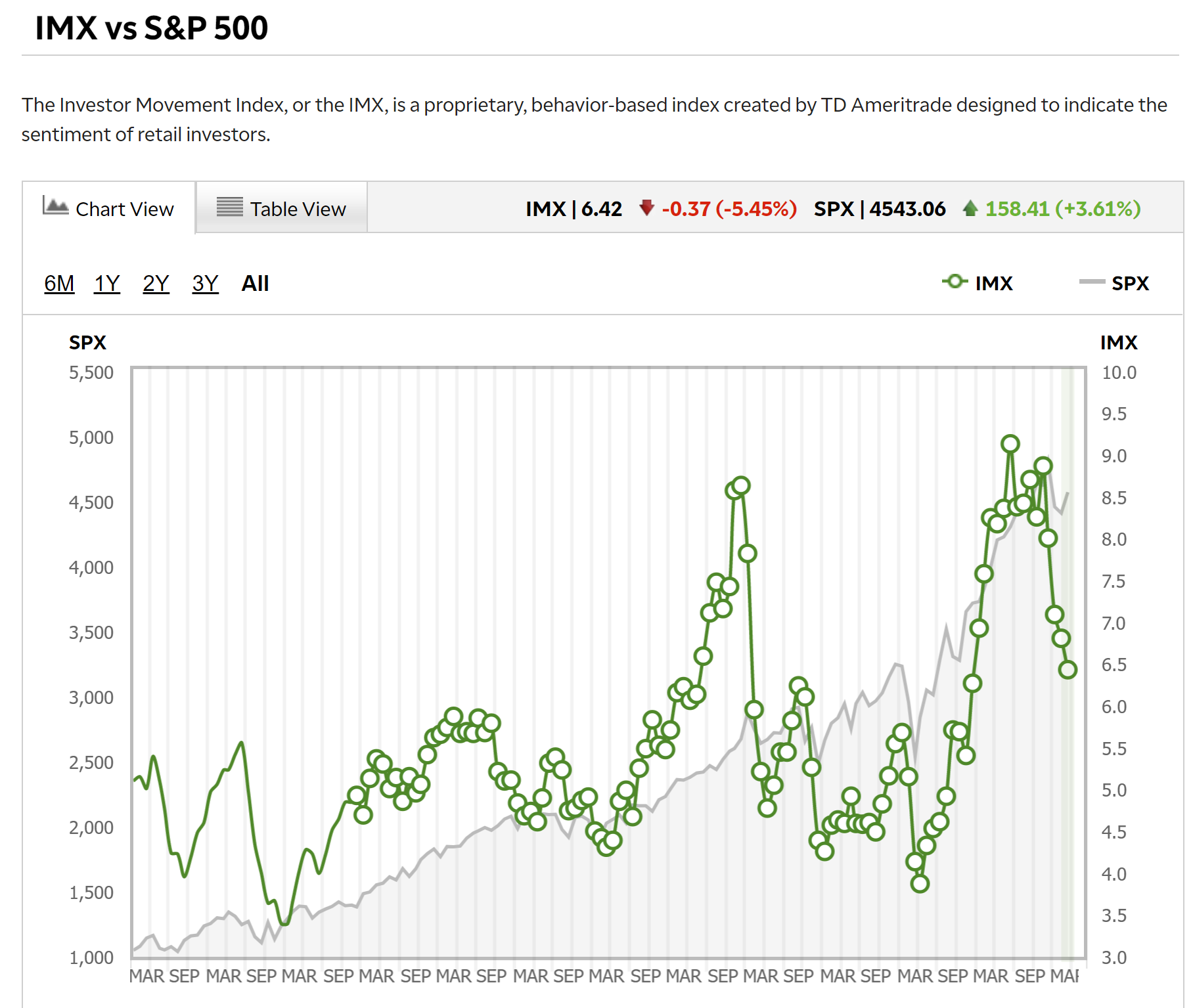
TD Ameritrade clients were net buyers of equities in March although at lower levels than previous IMX periods. The sector mix showed buying interest in Consumer Discretionary, Financials, and Industrial sectors; while there was strong selling in the Energy, Information Technology, and Materials sectors. While equities were net bought, fixed income products were also net bought over the period.
The month started with strong demand for equities, which quickly faded before turning to outright selling. Demand for equities made a slight recovery as the month came to an end, however, TD Ameritrade clients remained cautious.
There is the IMX, but there is also the IMI, S&P Global’s Investment Manager Index, a survey-based indicator of sentiment derived from active fund managers at institutional investment firms and designed to provide a view of forward-looking investment appetite in U.S. equity markets. The monthly survey asks respondents for their subjective view on risk outlook and appetite over the next 30 days, market performance and key drivers, upside and downside risks, and sector outlooks.
The Risk Appetite Index from S&P Global’s Investment Manager Index™ (IMI™) monthly survey, which is based on data from around 100 institutional investors operating funds with assets under management of around $845bn, rose from -32% in March to -29% in April but remains in deeply negative territory to signal the second highest degree of risk aversion recorded since the survey began in October 2020. Investors have now been risk averse on average for four successive months, but the cautious mood has become far more widespread following Russia’s invasion of Ukraine.
Expectations of near-term US equity market returns likewise remain strongly pessimistic, picking up only slightly from March to register the third-lowest degree of sentiment in the history of the survey.
The widely known Investors Intelligence sentiment survey puts the Bull/Bear ratio at 1.12 on April 12. A measure below 1.0 ( as seen a few weeks ago) is generally recorded near the end of corrections as Ed Yardeni illustrates.

The percentage of bears at 32.1% is lower than 40%+ level that typically sets the corrections lows (bear market lows are at 45-50%). This is also reflected in the high forward P/E given the level of pessimism, the result of the significant concentration of investors’ portfolios in a few high priced stocks. The 5 largest weights total 23.5% of the S&P 500 index, averaging a 45.8 forward P/E.

And if you wonder if the median P/E can give you comfort, Mr. Yardeni has this:

The real problem seems to be investors’ relative obsession with larger cap equities. We have been in this movie before.

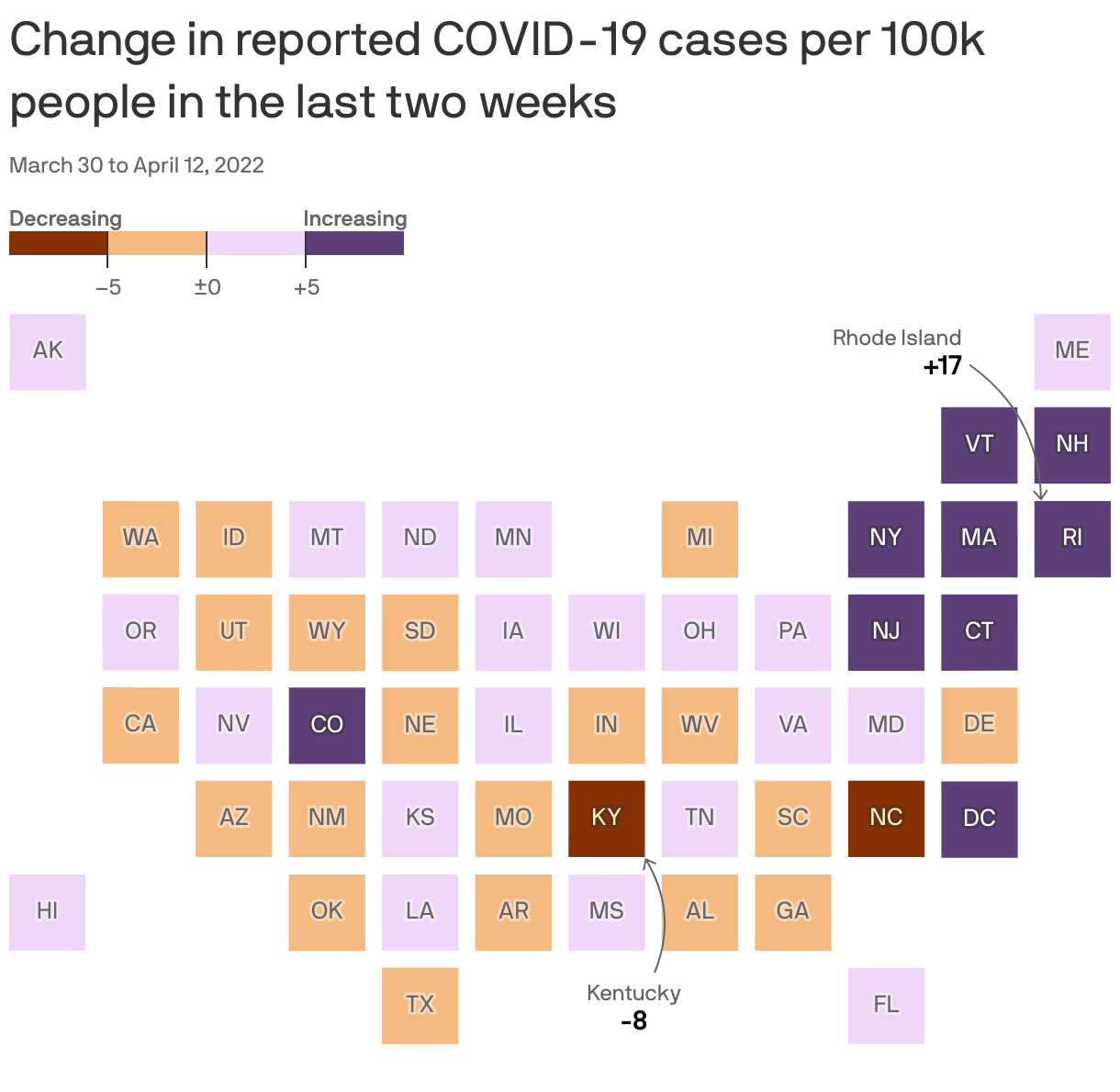
BA.2 Proves the Pandemic Isn’t Over, but People Are Over It
(…) Part of that reaction comes from the fact that while cases are ticking up in some areas, hospitalizations remain low. In addition, people in many places got on with their lives long ago and are unwilling to return to a pandemic crouch. There is a psychological element, too: Avoiding a potential problem can be a way of trying to protect ourselves emotionally when we are depleted, say psychologists. (…)
Nearly three-quarters of Americans polled by Monmouth University in mid-March agreed that Covid is here to stay, and people should get on with their lives. (…)
Figures from the Department of Health and Human Services show testing peaked at 7.74 tests per 1,000 people on Jan. 9 and has since declined to 1.91 tests per 1,000 people, according to an analysis from researchers at the University of Oxford’s Our World in Data. These data only account for PCR tests, said researchers, which are lab-reported and easier to track than at-home rapid tests, which have boomed in popularity.
The shift to home testing along with shutdowns in testing sites have made public-health experts concerned that official case tallies are a significant undercount. (…)

 (Haver Analytics)

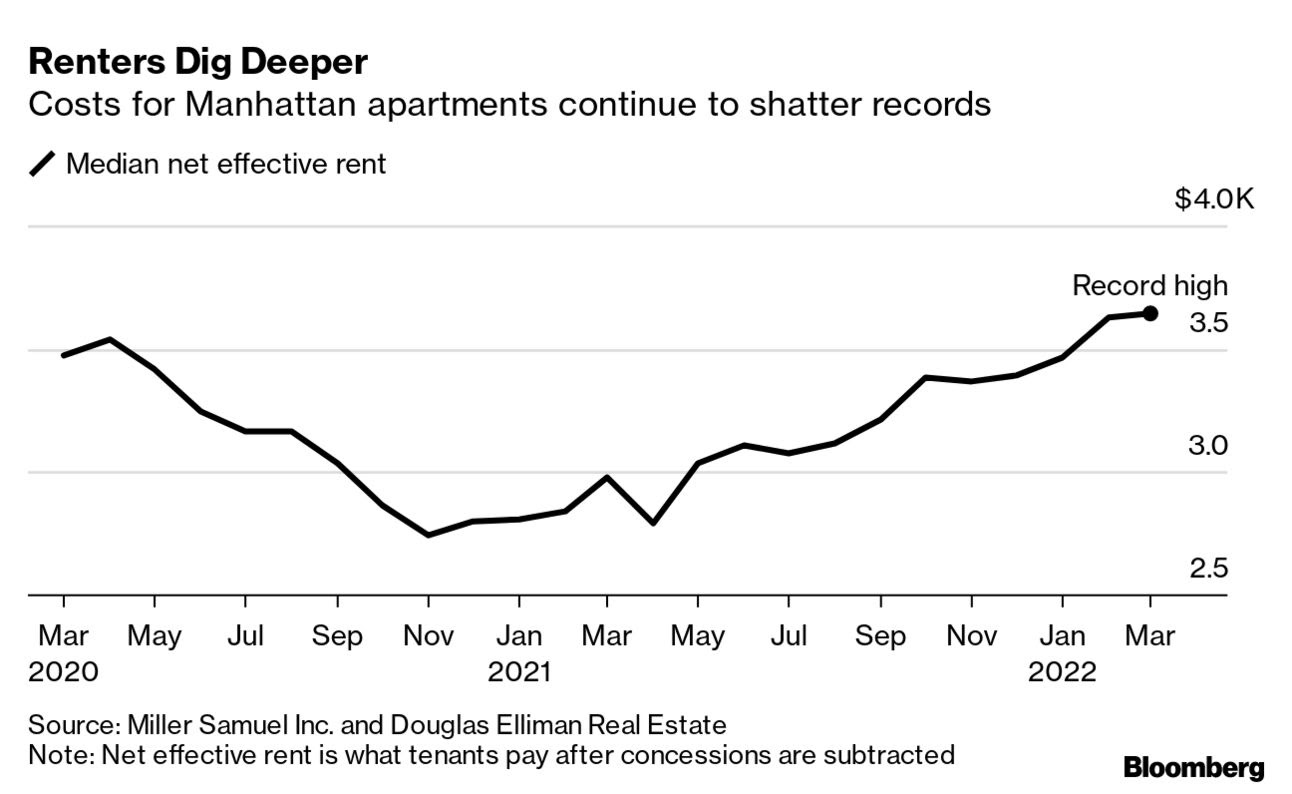


 When asked how much they are increasing wage/salary offerings for hard-to-fill positions, the variance was high, but roughly 80 percent of firms indicated they are raising starting offers by more than 5 percent, with an overall average starting salary increase of 10.4 percent.


 Data:
Data: