The enemy of knowledge is not ignorance, it’s the illusion of knowledge (Stephen Hawking)

It ain’t what you don’t know that gets you into trouble. It’s what you know for sure that just ain’t so (Mark Twain)

Invest with smart knowledge and objective odds

THE DAILY EDGE: 30 SEPTEMBER 2022

U.S. Jobless Claims Fall to Five-Month Low Applications for unemployment benefits have fallen below the prepandemic average as employers hold on to workers in a tight labor market

This chart shows unemployment claims with the scale set to reflect levels between 2014 and 2019. The horizontal line is the average for that period. The low in claims was in March.

fredgraph - 2022-09-30T062441.779

  • Why Are Companies Still Hiring When GDP Is Shrinking? A persistent economic puzzle is why the labor market is still strong amid slowing growth and high inflation. Many employers say they continue to struggle with staffing shortages and are reluctant to cut head count.

(…) Layoffs and other involuntary discharges, at 1.4 million in July, were about 20% below their average monthly level in 2019, when GDP was growing more quickly. (…)

“Inflation is a challenge, but we can measure it. We can work to overcome it. Not having enough people in the supply chain—that has proven to be much more difficult,” [Raytheon] chief executive Greg Hayes told analysts this summer. “The only thing that’s going to solve labor availability, I hate to say this, is a slowdown in the economy because right now, there just simply aren’t enough people in the workforce for all of our suppliers.” (…)

But even employers not seeking to raise head count have to keep hiring to fill vacancies caused by historically high rates of turnover. In July, 2.7% of workers quit their jobs, up from 2.3% in February 2020, when the jobless rate matched a half-century low. (…)

“We just keep hiring and replacing, hiring and replacing—wash, rinse, repeat,” said Ms. Henry. “Efficiency goes to hell when you continuously hire since the person who is training them isn’t going at their normal pace because they’re stopping to explain things,” she said. Many new hires leave before that training yields return, she added. (…)

Construction industry layoffs are still below prepandemic levels, though new home sales have fallen sharply this year and housing starts have dropped because of higher mortgage rates. Residential builders are struggling with the legacy of job cuts undertaken during the housing crisis of 2007-09, with employment in residential construction 12% below its 2006 peak. (…)

The Fed’s concern on employment is about wages so it wants to reduce job openings to ease the pressure. According to the Atlanta Fed’s wage tracker, wage growth in the last 12 months was highest in Leisure and Hospitality (6.3%), Trade & Transportation (6.2%) and Manufacturing 5.9%) vs the U.S. average of 5.5%. These sectors have not shown much slowdown in their respective openings compared with their pre-pandemic levels.

fredgraph - 2022-09-30T061429.302

On the other hand, the unemployment rate in Leisure and Hospitality is 6.1% while it is 4.3% in Trade & Transportation. Manufacturing is at 3.3%, below the national average of 3.8%.

U.S. GDP Growth is Unrevised in Q2’22, Posting Second Straight Quarterly Decline

Real GDP growth during Q2’22 was unrevised at -0.6% (+1.8% y/y) after declining an unrevised 1.6% in Q1. The latest figure matched expectations in the Action Economics Forecast Survey. GDP increased at a 2.1% annual rate from 2016 to 2021, up 0.2 percentage points from the earlier estimate.

The Q2 gain in corporate profits after-tax was revised up to 7.4% (7.7% y/y) from 6.1%. Domestic nonfinancial profits rose 7.9% (9.8% y/y). Financial sector earnings declined 9.0% (-10.2% y/y) while foreign sector profits rose 5.8% (21.8% y/y).

Real personal consumption expenditure growth last quarter was revised up to 2.0% (2.4% y/y) from 1.5%. Durable goods outlays fell 2.8% (-3.7% y/y) while nondurable spending declined 2.4% (-1.1% y/y). Services outlays rose 4.6% (4.8% y/y). Business fixed investment growth was revised lower to 0.1% (2.4% y/y). Residential investment declined 17.8% (-7.2% y/y), revised from -16.2%.

Government spending fell 1.6% (-1.3% y/y) last quarter, revised from -1.8%. Federal government spending declined 3.4% (-4.0% y/y), revised from -1.9%. Defense spending rose 1.5% (-3.9% y/y). State & local government spending weakened 0.6% (+0.5% y/y).

The contribution of inventory investment was revised minimally to a 1.9 percentage point subtraction from GDP growth. (…)

The GDP price index was revised higher to 9.0% (7.6% y/y) from 8.9%. This remained the fastest pace of GDP price inflation since Q1’81. The rise in the PCE price Index was revised to 7.3% (6.6% y/y) from 7.1%. The PCE price index less food & energy increased 4.7% (5.0% y/y), revised from 4.4%, and has risen at about that rate for roughly a year. (…)

The WSJ has this important info :

The report, which included five years of benchmark revisions, also revised downward gross domestic income—a measure of corporate profits, wages and benefits, self-employment income, interest and rent—to a 0.1% increase in the second quarter. That largely closed a gap between output and income that had pointed to a stalling economy rather than a recession.

But Axios did the digging to explain:

One driver behind the downward GDI revision was slower labor compensation than initially reported. In other words, worker wage growth wasn’t as hot as we thought.

In Q1, inflation-adjusted GDI increased by 0.8%, lower than the initial estimate of 1.8%. The latest estimate of Q2 GDI shows it increased 0.1%, not the 1.4% the government first reported.

For 2021, the change in GDI was revised down, while GDP was revised up slightly. That brings the gap between the measures to -0.6% last year. That’s a much more normal discrepancy than the -2.3% gap previously reported.

Nike warns of inventory glut, price cuts (CNBC)
Mortgage Rates Rise to 6.7%, Highest Since 2007 Mortgage rates are more than double where they were a year ago, adding pressure to the already cooling U.S. housing market.

large image(Haver Analytics)

Homes in Canada Have Never Been So Unaffordable, RBC Says

  • CMHC Cuts Home-Price Outlook, Projecting Drop as Deep as 15%
  • “Our G10 home price model suggests sizable nominal home prices declines from the peak of around 15% in Canada, 5-10% in the US, and under 5% in the UK. The declines are larger for real home prices at just over 20% in Canada, just over 10% in the US, and 10% in the UK.” We view the risks to these estimates as tilted to the downside because of a sharp deterioration in our descriptive home price outlook scores and evidence of strong mean reversion in regional data. (Goldman Sachs)
China’s Service Sector Slows in Latest Economic Warning Sign Chinese economic activity remained feeble, with the services sector slipping into contraction, offering fresh evidence of the damage that Beijing’s Covid-prevention measures and a real estate slide are inflicting on the economy.

(…) A subindex measuring the services sector fell to 48.9 in September from 51.9 the previous month, China’s National Bureau of Statistics reported Friday. The poor performance in the services sector dragged the broader official nonmanufacturing purchasing managers index down to 50.6 in September, from 52.6. A reading below 50 indicates contraction. (…)

As of Friday, cities under some form of Covid restrictions accounted for 25% of gross domestic product, down from 28% a week earlier, according to Goldman Sachs. (…)

The official manufacturing purchasing managers index ticked up to 50.1 in September from 49.4 the previous month, according to official data. The reading followed two consecutive months of contraction. (…)

A subindex of the official manufacturing PMI tracking new export orders showed overseas demand continuing to weaken in September. The subindex slipped to 47, the lowest level in four months, the data showed.

Separate data released on Friday by Caixin Media Co. and S&P Global, focused on smaller-scale and private-sector manufacturers, pointed to weaker factory activity as new orders contracted for a second straight month. The China Caixin manufacturing purchasing managers index fell to 48.1 in September from 49.5 a month earlier. (…)

On Thursday, China’s central bank said it would allow some cities that are suffering from falling home prices to further slash mortgage rates for first-time home buyers, adding to previous administrative measures aimed at stabilizing the faltering market. (…)

S&P Global’s China PMI:

Business conditions across China’s manufacturing sector deteriorated modestly in September, as efforts to contain the COVID-19 virus weighed on performance. Total new business dropped for the second month in a row, which led to a renewed fall in output, while firms also trimmed their purchasing activity and inventories. Reduced demand for inputs placed further downward pressure on prices, with input costs falling at the quickest rate since the start of 2016. Companies often looked to pass on any cost savings to clients to help improve sales, which led to the quickest fall in selling prices since December 2015.

The headline seasonally adjusted Purchasing Managers’ Index™ (PMI™) declined from 49.5 in August to 48.1 in September, to signal a back-to-back deterioration in the overall health of the sector. The reading was consistent with only a mild rate of contraction, however.

A key factor driving the headline index lower was a faster fall in new orders during September. New business fell for the second month in a row, and at the quickest rate since April, with panel members often commenting that restrictions around travel and operations had dampened customer demand. Foreign sales also fell again, and at a solid rate that was the fastest for four months. (…)

 image image

Eurozone Inflation Hits 10% as Power Suppliers Scramble for Reserves Consumer prices in the currency area are now rising at a much faster pace than in the U.S., with the ECB set for a series of interest rate rises

(…) According to Eurostat, household energy prices were 40.8% higher in September than a year earlier.

The higher energy costs facing most businesses are percolating through the economy. Prices of services were 4.3% higher than a year earlier, driving a pickup in core inflation to 4.8% from 4.3%. (…)

The Organization for Economic Cooperation and Development on Monday said it now expects the average rate of inflation in the eurozone to be 8.1% this year, up from 7% when it last released forecasts in June. In the U.S., it expects average inflation to be 6.2%, up from 5.9% in June. In 2023, it expects eurozone inflation to average 6.2% and U.S. inflation to average 3.4%. (…)

Taiwan Warns Exports to Struggle in Rest of 2022 as Demand Slows

(…) Growth in overseas shipments might slump to single-digits in the fourth quarter of 2022, Su said in an interview in Manila on Friday. (…)

August export growth slowed to just 2%, the slowest pace in more than two years, prompting Ministry of Finance chief statistician Beatrice Tsai to warn at the time that “winter is coming” earlier than expected. She also cautioned that September exports could even shrink by as much as 3% from a year earlier.

Export orders have also slowed. While orders gained 2% in August, reversing a decline in July, purchases from China and Hong Kong fell more than 25% last month. Almost 40% of Taiwan’s exports went to Hong Kong and China for the first eight months of the year, data from the finance ministry showed. (…)

Sad smile According to Garry Evans, Chief Strategist, Global Asset Allocation at BCA Research, the current trend in the business cycle indicates that global earnings growth will slow into negative territory by January 2023, and continue further into May 2023.

SENTIMENT WATCH

Investors dump global bond and equity funds on recession risks

Global bond and equity funds witnessed massive outflows in the week ended Sept. 28 as worries about a recession grew, with the U.S. Federal Reserve determined to keep interest rates higher to tame inflation pressure. (…)

Investors offloaded a net $22.07 billion worth of global bond funds, in their biggest such weekly net sales since June. 22, data from Refinitiv Lipper showed.

Fund flows: Global equities bonds and other market

Global bond fund flows in the week ended Sept. 28

Fund flows: Global equity sector funds

John Authers: Gatsby, the Dollar, and Staring Blankly at the World Falling Apart

(…) The dollar has never regained its pre-Plaza highs from early 1985. But now, wishful thoughts are returning to the Plaza Accord once more. As the chart shows, the dollar is still far below its 1985 high in nominal terms. On a real effective basis, taking account of inflation, Citibank’s index show that it is almost back to its high since inception in 1989, after the accord was reached. (…)

Interventions by three of the four largest economies outside the US in the space of a week show that the dollar’s strength is beginning to cause real stress. But there are at least two sides to any currency trade, and no meaningful limit to the dollar is possible without willing participation by the US. (…)

According to the IIF’s estimates of fair value, the euro and the pound are still overvalued and have further to fall, despite the damage they have already sustained. That might vitiate any Plaza-style attempt to limit the dollar. And it also confirms that this dollar surge is likely to create more pain in western Europe than in the emerging world. (…)

While US inflation is elevated, it seems difficult to countenance why the US would proactively participate in an inflationary dollar policy, and without US participation, we see little chance of success. (…)

We think that policymakers are aware of a hard truth: They don’t have enough FX reserves to make a sustained difference. Back in 1985-87, the last time we had a coordinated intervention to weaken USD, daily FX turnover was near US$200 billion per day (on a net-gross basis) but, as of the last reported BIS figure in 2019, daily turnover is over 40 times higher at US$8.3 trillion per day. The G10 collectively has US$2.8 trillion in FX reserve assets (deposits and securities, so excluding gold). (Morgan Stanley) (…)

China’s Rival Aircraft to Boeing, Airbus Jets Wins Certification China is angling to disrupt the dominance of Boeing and Airbus in commercial jetliner manufacturing. However, it’s not clear when, if ever, the C919 will be a competitive threat to the duopoly. Comac hasn’t attracted much interest for its products overseas, and the nation’s airlines still favor Airbus and Boeing as the workhorses of their fleets.

(…) Comac has said it already has 815 orders from 28 Chinese customers for the C919, though the majority aren’t confirmed and many are from aircraft lessors yet to place the jet with an airline. China’s so-called big three — China Eastern, Air China Ltd. and China Southern Airlines Co. — and Hainan Airlines have 2,241 Boeing and Airbus narrowbody aircraft between them, and at least 546 on order. (…)

For now, the plane will only be allowed to fly within China until it is certified by foreign regulators. (…)

THE DAILY EDGE: 29 SEPTEMBER 2022

INFLATION WATCH

Families will Pay 17.2% More for Home Heating this Winter Between 2020-21 and 2021-23, the cost of home energy would increase by more than 35%.

Amazon Raises Pay for Hourly Employees as It Prepares for Holidays Average starting pay for warehouse employees to increase from $18 to $19 an hour.

The company on Wednesday said it was increasing average starting pay for its front-line warehouse employees from $18 to more than $19 an hour, with many employees earning between $16 and $26 an hour depending on their location in the U.S. Amazon said the raises represent a nearly $1 billion investment over the next year.

Amazon’s last notable pay increase came about a year ago, when it raised pay for hundreds of thousands of workers to an average starting salary of $18 an hour. (…)

The company shed almost 100,000 employees during the second quarter this year, though it appears to be adding hourly staff again. (…)

The company has shut down, called off or pushed back the openings of more than 60 delivery stations, fulfillment centers and other facilities, according to recent data from supply-chain consulting firm MWPVL International Inc. (…)

This month, the retailer said it would invest $450 million to fund wage increases and other benefits for delivery drivers employed by members of its Delivery Service Partners network. Investments also include up to $5,250 a year for drivers to pay for educational programs, and financial support for a 401(k) investment plan. (…)

fredgraph - 2022-09-29T054540.984

Amazon employed more than 1.1 million people in the US at the end of 2021. The company’s minimum level of $15 an hour for all hourly workers in the US remains unchanged. (Bloomberg)

  • Police departments raise bonuses to draw new hires.

The small city of Warner Robins, Ga., budgeted for $4,000 retention and recruitment bonuses this year. Ithaca, N.Y., offers $20,000 bonuses for hires from other agencies. And Seattle has approved $30,000 bonuses for lateral hires and $7,500 for new recruits. A tight labor market is compounding what police chiefs describe as waning interest from job seekers, put off by heightened scrutiny of officers’ actions, a less favorable view of the profession by some Americans and a surge in violent crime. (WSJ)

Return of Inflation Makes Deficits More Dangerous Britain’s proposed tax cut shows political leaders still stuck in prepandemic world of limitless borrowing

(…) Elected leaders, though, are still stuck in prepandemic times. They acknowledge inflation is a problem but continue to borrow as if limits don’t exist. After the stimulus-inflated levels of 2020 and 2021, budget deficits fell sharply across developed markets this year, to an average 4.3% of gross domestic product, according to independent economist Phil Suttle. He estimates that will rise to 6.1% next year and 6.9% in 2024. (…)

But the country that resembles the U.K. most closely is the U.S. While the reserve status of the dollar and Treasury debt insulates the U.S. from some of the pressures buffeting Britain, its fiscal policy is just as miscalibrated. While President Biden touts the Inflation Reduction Act, which lowers deficits by $240 billion over a decade, he has also signed into law increased spending on veterans benefits, infrastructure and semiconductors, while taking executive actions that vastly expand food stamp and Obamacare benefits and cancel student debt worth $400 billion to $1 trillion.

Adding that to last year’s stimulus and associated interest, the Committee for a Responsible Federal Budget estimates Mr. Biden will increase deficits by $4.8 trillion, or 1.6% of GDP over a decade—comparable to the amount by which Ms. Truss is boosting the British deficit. The relaxed attitude toward debt is shaped in part by Mr. Biden’s economists’ assumption that real interest rates—the nominal rate minus inflation—will remain around zero for the coming decade. Federal debt is much more manageable when real rates are lower than the economic growth rate. They have some justification: Real rates were well below the economy’s growth rate for the decade before the pandemic.

On the other hand, massive deficits, Fed tightening in response to flare-ups of inflation and diminished private saving could all elevate real rates in coming years—as occurred after then-Fed chairman Paul Volcker crushed inflation in the early 1980s. Here’s one troubling sign: The real yield on five-year inflation-indexed Treasury bonds this week touched 1.91%, about equal to the U.S.’s expected long-term growth rate. On Wednesday, it fell back to 1.63%.

If Greg Ip’s piece sounds too esoteric, Stan Druckenmiller has real world stuff for us: https://twitter.com/i/status/1575134672706748419. Two minutes to understand why the Fed needs to stop inflation now. Financially, economically and socially, we simply can’t afford high interest rates.

U.S. Pending Home Sales Fall Further in August

The Pending Home Sales Index produced by the National Association of Realtors fell 2.0% (-24.2% y/y) to 88.4 in August following a 0.6% easing in July, revised from -1.0%. The August decline was the ninth in ten months. Pending home sales have fallen 30.9% since the August 2020 high.

Pending home sales declined in most regions in August, except the West where they rose 1.4% (-31.3% y/y), up for the second straight month. Sales were 38.1% below the August 2020 peak. Sales in the South fell 0.9% (-24.2% y/y) after a 1.3% July drop. They were 29.4% below the August 2020 high. Sales in the Northeast fell 3.4% (-19.0% y/y) following a 1.9% July shortfall. Sales were one-third below the August 2020 peak. Sales in the Midwest declined 5.2% (-21.1% y/y) in August after easing 0.5% in July. Sales fell 26.3% from the August 2020 high.

 image

Rental market:

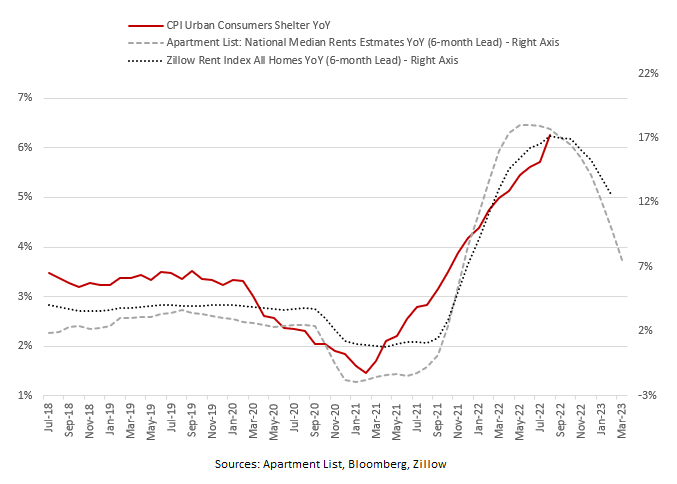
Welcome to the October 2022 Apartment List National Rent Report. Our national index fell by 0.2 percent over the course of September, marking the first time this year that the national median rent has declined month-over-month. The timing of this slight dip in rents is consistent with a seasonal trend that was typical in pre-pandemic years. Assuming that trend continues, it is likely that rents will continue falling in the coming months as we enter the winter slow season for the rental market.

Despite the monthly decline, rent growth over the course of this year continues to outpace the pre-pandemic trend, even as it has slowed significantly from last year’s peaks. So far in 2022 rents are up by a total of 6.8 percent, compared to 17.1 percent at this point in 2021. Year-over-year growth is continuing to decelerate, and now stands at 7.5 percent, down from a peak of nearly 18 percent at the beginning of the year.

This cooldown in rent growth is being mirrored by continued easing on the supply side of the market. Our vacancy index now stands at 5.2 percent, after nearly a year of gradual increases from a low of 4.1 percent last fall. That said, today’s vacancy rate remains well below the pre-pandemic norm, and spiking mortgage rates that continue sidelining first-time homebuyers could contribute additional tightness to the rental market.

MoM rent growth sept22vacancy index sept22

Keep in mind that the above data reflect new leases. The BLS measures for rent account for on-going leases which can lag considerably MoM….

Image(CalculatedRisk)

…although we may soon see YoY growth in CPI Shelter peak out.

Image

@C_Barraud

Immigration Drives Fastest Canada Population Growth Since 1957

The number of people living in Canada rose by 0.7%, or 284,982, to 38.9 million in the second quarter of 2022, according to Statistics Canada estimates released Wednesday in Ottawa. That’s the highest pace for quarterly growth since 1957 and represents an increase of about 3,100 people per day. (…)

Canada’s pace of population growth is the highest among the Group of Seven. Immigration has been one of the main drivers of the Canadian economy, and accounts for almost all of the nation’s employment growth.

From April 1 to July 1, international migration accounted for a gain of nearly 270,000 people, or 95% of the quarterly growth, the highest increase from international migration since comparable records have existed in 1971. This was in part due to high numbers of asylum claimants and permit holders, including people affected by the Russian invasion of Ukraine.

The country’s population grew by 1.8% in the 12-month period that ended June 30. (…) [USA: +0.3%]

The Unstoppable Dollar Is Wreaking Havoc Everywhere But America

(…) By some measures the US currency is already stronger than ever, eclipsing the highs of the Covid-19 pandemic from early 2020. The pain it’s inflicting has echoes of the mid-1980s, when foreign exchange chaos forced the world’s most important finance officials to join hands and impose a solution on markets. Right now, though, it’s every country for itself as the US administration pushes back on the idea of coordinated market action. (…)

Right now the problem bedeviling officials from Frankfurt to Seoul is high inflation—and weak currencies add fuel to that by increasing the cost of imported products and stimulating domestic growth. So some governments and central banks need to respond to the ongoing battering. (…)

The currency situation is also forcing central banks around the world to consider ratcheting up their own interest rates further, which risks driving their economies into recession. (…)

From the Fed’s perspective, a strong dollar actually helps the fight against inflation. By crimping the competitiveness of US business on the international stage, it acts to curb growth, in turn removing some inflationary pressure. This gives officials reason not to pull punches as they press the most aggressive monetary tightening since Paul Volcker wrestled with runaway inflation in the 1980s. The dollar’s strength was also a problem then until the so-called Plaza Accord reined it in. One key difference: The 1985 agreement between the UK, France, West Germany, Japan, and the US came only after Volcker had already broken the back of inflation, whereas the outcome of the present battle is very much undecided. (…)

The Treasury secretary said Sept. 27 that she thinks “markets are functioning well,” while White House economic adviser Brian Deese was even more explicit in saying that he doesn’t expect another 1985-type agreement among major economies to counter the dollar’s strength. (…)

International turmoil could conceivably slow the pace of Fed rate hikes. It’s not out of the question that conditions in major foreign economies—and in global financial markets—could so deteriorate that they drag down prospects for growth in the US. If this alleviates inflationary pressures in the US, that could potentially allow the Fed to pause its relentless tightening. (…)

  • “In terms of where we are. I think we’re in the ‘things break’ stage. Now, typically when we enter the ‘things break’ stage the Fed is able to get dovish and arrest the move. However, inflation is at 8% and the Fed won’t have confidence it is sustainably falling until the unemployment rate rises a bit. So this is the problem now, and why this rendition of the doom loop is more severe, the Fed doesn’t have its usual off ramp because they are in panic mode over US inflation. The whole global economy is basically waiting for the US unemployment rate to tick up to 4%.” (Jon Turek of JST Advisors via Bloomberg)
  • Mexico and Colombia are poised to tighten further today as policymakers hold firm in their inflation fight. Banxico will probably hike rates by 75 basis points to 9.25%. Colombia is seen lifting its benchmark 150 bps to 10.50%. (Bloomberg)
  • U.S. Goods Trade Deficit Continues to Narrow in August

The advance estimate of the U.S. international trade deficit in goods narrowed to $87.3 billion in August from $90.2 billion in July. It was the shallowest deficit since last October. The deficit reached a peak of $125.7 billion in March of this year. An $89.0 billion deficit had been expected by the Action Economics Forecast Survey.

Exports of goods declined 0.9% during August (+20.8% y/y) while imports fell 1.7% (+13.1% y/y).

The falloff in exports last month reflected an 8.9% drop (+10.7% y/y) in exports of autos & auto parts. Industrial supplies & materials weakened 3.5% (+29.8% y/y). Auto & auto parts exports fell 8.9% (+10.7% y/y). Working higher, nonauto consumer goods exports rose 8.0% (16.0% y/y). Exports of “other” goods surged 4.8% (37.1% y/y). Exports of foods, feeds & beverages gained 0.8% (24.6% y/y) while capital goods exports rose 0.4% (10.7% y/y).

The August import decline was led by a 6.9% drop (+17.7% y/y) in industrial supplies & materials imports. Capital goods imports declined 1.8% (+13.2% y/y) while nonauto consumer goods imports eased 0.2% (+7.9% y/y). To the upside, auto & parts imports gained 3.8% (22.9% y/y) while imports of foods, feeds & beverages rose 2.4% (11.7% y/y). Imports of “other” goods rose 1.0% (-5.9% y/y).

image

fredgraph - 2022-09-29T065117.208

China Central Bank Warns Against Yuan Speculation After Currency Sinks

(…) “The foreign exchange market is of great importance, and maintaining its stability is the top priority,” it stated. It said investors shouldn’t be betting on the unilateral appreciation or depreciation of the yuan, and called on banks to curb such activity. It also said some companies have been engaging in currency speculation or flouting regulations, without giving details.

The yuan “has withstood the test of many rounds of external shocks,” it said. “You will lose if you keep betting.” (…)

The steep decline of the yuan against the dollar makes it increasingly difficult for China’s central bank to cut interest rates to boost the country’s sagging economy, according to analysts. A widening gap in interest rates between China and the U.S. has been a key driver of the Chinese currency’s weakness. (…)

Plunging business and consumer confidence in China since a lengthy Shanghai Covid-19 lockdown in the second quarter has played a role in weakness of the yuan against the dollar, said Larry Hu, chief China economist at Macquarie. “The prerequisite for stabilizing the yuan is stabilizing the economy,” he said. (…)

A yuan index published by the China Foreign Exchange Trading System, which measures the performance of the yuan against a basket of 24 currencies, has been stable this year and is trading at roughly the same level as January.

Ding Shuang, regional head of economic research for China and North Asia at Standard Chartered, said the Chinese central bank cares more about the basket because “that reflects yuan’s external competitiveness and therefore serves as an anchor.” He added that the central bank likely won’t stand in the way of the yuan’s depreciation against the dollar—unless it moves so much that the yuan’s value against the basket falls significantly. (…)

RBC Says Hope Overwhelms Reality in Keeping Earnings Estimates Most sell-side analysts are not pricing in the full impact that rising interest rates could have on corporate profits, said Stuart Kedwell of RBC Global Asset Management Inc.

(…) Corporate management teams often use third-quarter earnings season as a chance to “reset the guidance” for the following year, said Irene Fernando, a senior portfolio manager at RBC. It’s only then that most equity analysts start changing their own estimates. (…)

image

image

Bank Stocks No Longer a Haven From Rising Rates In a recent survey of investor clients by Piper Sandler analysts, 55% of respondents said that credit risk was the biggest short-term risk to banks. In a survey last year, just 5% said that.
Right hug Left hug Kagan v. Roberts: Justices Spar Over Supreme Court’s Legitimacy The liberal justice suggested recent court decisions are sapping “reservoirs of public confidence,” while the chief justice and Justice Samuel Alito said institution’s status stands above its opinions.

During the summer months when the Supreme Court was out of session, new arguments arose between the justices themselves on whether the court’s legitimacy, in the eyes of the American public, was imperiled after it overturned longstanding precedents in its most recent term.

Liberal Justice Elena Kagan, in a series of public appearances, said the court’s conservative majority had diminished the high court’s credibility with decisions that track Republican priorities. Chief Justice John Roberts, speaking at a separate event, retorted that the court’s decisions have no bearing on its legitimacy as it carries out its mandate to interpret the Constitution. On his side was fellow conservative Samuel Alito, author of the majority opinion in the term’s landmark case overturning Roe v. Wade, eliminating a woman’s constitutional right to an abortion.

Across the court’s history, “The very worst moments have been times when judges have even essentially reflected one party’s or one ideology’s set of views in their legal decisions,” Justice Kagan said last week at Salve Regina University in Newport, R.I. “The thing that builds up reservoirs of public confidence is the court acting like a court and not acting like an extension of the political process.” (…)

“If, over time, the court loses all connection with the public and with public sentiment, that is a dangerous thing for democracy.” (…)

Chief Justice Roberts earlier this month took issue with Justice Kagan’s critique.

“Simply because people disagree with an opinion is not a basis for questioning the legitimacy of the court,” he told a judicial conference in Colorado Springs, Colo. The high court’s role, grounded in the Constitution, ”doesn’t change simply because people disagree with this opinion or that opinion or disagree with the particular mode of jurisprudence,” he said.

In a comment Tuesday to The Wall Street Journal, Justice Alito said: “It goes without saying that everyone is free to express disagreement with our decisions and to criticize our reasoning as they see fit. But saying or implying that the court is becoming an illegitimate institution or questioning our integrity crosses an important line.” (…)

Americans’ opinions of the Supreme Court are the worst they have been in 50 years of polling, according to a new survey from Gallup being published Thursday. (…)

image

Justice Kagan was on the losing side in nearly every major case last term: not only the landmark opinion overruling Roe v. Wade but also decisions that expanded access to concealed weapons; limited the Environmental Protection Agency’s power to fight climate change; and increased religion’s presence in the public education system. (…)

Court precedents, she said, should be respected except in the most extraordinary circumstances. “It just doesn’t look like law when some new judges appointed by a new president come in and just start tossing out the old stuff,” she said, in an apparent reference to the positions of Justices Neil Gorsuch, Brett Kavanaugh and Amy Coney Barrett, who were all confirmed during President Donald Trump’s single term in office.

Justice Kagan added that courts should act incrementally rather than issuing sweeping pronouncements that disrupt the legal order, a point often made by Chief Justice Roberts, including in his explanation for not joining Justices Alito, Clarence Thomas, Gorsuch, Kavanaugh and Barrett in reversing Roe v. Wade’s half-century precedent. (…)