The enemy of knowledge is not ignorance, it’s the illusion of knowledge (Stephen Hawking)

It ain’t what you don’t know that gets you into trouble. It’s what you know for sure that just ain’t so (Mark Twain)

Invest with smart knowledge and objective odds

THE DAILY EDGE: 5 JUNE 2023: Ineffective Playbook

Strong May Hiring Shows Labor-Market Resilience U.S. employers added 339,000 jobs in May, and the prior two months’ payrolls were revised up by nearly 100,000—complicating the Fed’s next decision on rates.

U.S. employers added a seasonally adjusted 339,000 jobs in May and the prior two months’ payrolls were revised up by nearly 100,000, the Labor Department said Friday. Workers gained more than 1.5 million jobs in 2023, more evidence of economic vitality, including robust consumer spending and a stabilizing housing market. (…)

The U.S. unemployment rate rose to 3.7% in May, still near historic lows but an uptick from April’s 3.4%, the Labor Department said. Average hourly earnings grew a solid 4.3% in May over the prior year, similar to annual gains in March and April. (…)

The average workweek fell to 34.3 hours, the lowest since April 2020 near the start of the pandemic. As a result of fewer hours worked, average weekly earnings advanced at a slower rate than hourly earnings, and gains have cooled since the start of the year.

The labor-force participation rate, the share of Americans who are working or actively seeking jobs, remained flat in May at 62.6% and below the February 2020 prepandemic level of 63.3%. That partly reflects the aging U.S. population. Among workers age 25 to 54, the participation rate rose to 83.4%, a level last touched in 2007.

May’s job gains were broad-based. (…)

Average hourly earnings rose 0.33% and April was revised to +0.4% from 0.5%. Wages are up 3.8% annualized YtD, down from +4.7% during H2’22. However, wages for production and nonsupervisory workers (80% of the total) rose 0.45% in May up from 0.35% in April and 0.39% in March. They are up 4.6% annualized YtD, down from +5.0% during H2’22.

This payrolls chart illustrates the resilience of labor income growth, +6.2% YoY in May, and the tight fit with total consumer expenditures:

fredgraph - 2023-06-03T070302.057

On a MoM basis, aggregate payrolls rose 0.27% in May, right on the average of the previous 3 months. The stacked payrolls contribution chart below shows that wage growth (black) has been steady at +3.7% annualized this year while the sum of jobs and hours worked grew 1.7% a.r.. Excluding the outsize January (warm weather), the labor market and its components have been very steady in the past 12 months.

fredgraph - 2023-06-03T065912.638

(…) Friday’s report was the 14th-straight time payroll growth has exceeded Wall Street forecasters’ estimates. Given that streak, “it is hard not to conclude that the labor market just has more momentum than standard models suggest,” said Krishna Guha, vice chairman of Evercore ISI, in a report Friday.

But the contradictory data from the two Labor Department surveys, which can occur at times when economic growth is slowing, “offers a rationale for skipping June with a default to hike again in July unless the data shows more signs of cooling by then,” he said.

The establishment survey has been pretty steady in the past year, unlike the household survey. Household employment declined 310k in May which caused the unemployment rate to spike to 3.7%.

fredgraph - 2023-06-03T072406.935

The household series has been unusually erratic post-pandemic suggesting that relying on the unemployment rate to assess the labor market could be dangerous. In fact, the BLS tells us that when adjusted to the payroll definition, household employment was actually up 394,000 in May. It seems better to fade May’s rise in the unemployment rate.

fredgraph - 2023-06-03T065534.066

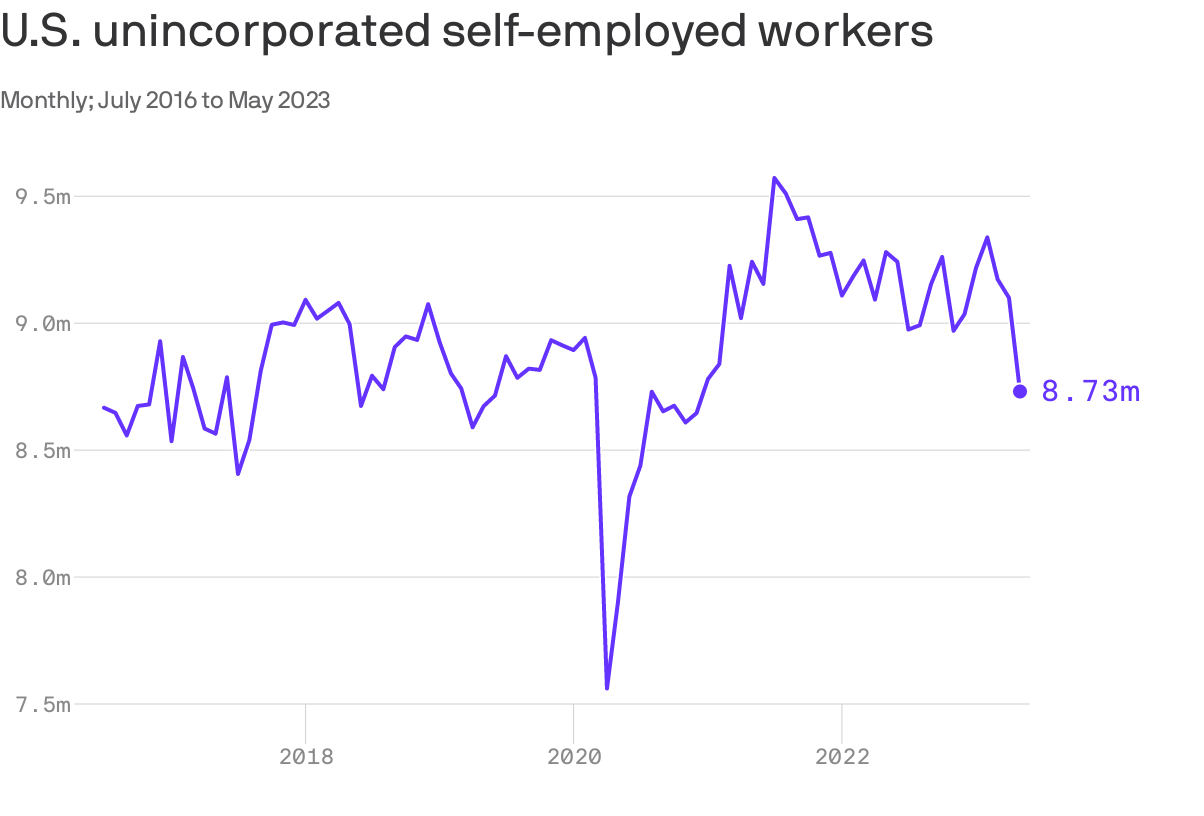
In May, the number of unincorporated self-employed Americans fell by 369,000, dragging the household survey down. There are now 8.73 million Americans who are self-employed without owning their own company. That’s down from a peak of 9.51 million in August 2021, and it’s even lower than the 8.89 million registered in January 2020, before the pandemic hit. (Axios)

Data: FRED; Chart: Axios Visuals

Some of the fall in May in this volatile series might be attributable to the Hollywood writers’ strike, notes The American Prospect’s David Dayen.
Looking at labor supply, the participation rate of Americans aged 25-54 is now exceeding its pre-pandemic level (by 0.5%). But all other age groups remain well below, particularly those aged 55+ who are 5% below and still declining:

fredgraph - 2023-06-03T075920.078

Actual employment levels for all age groups are above pre-covid levels except the 55+ group whose employment remains 1.7% below and declining.

fredgraph - 2023-06-03T081652.857

This seems to reflect another “unexpected” (overlooked) effect of rising interest rates. Personal interest income jumped $160B (+9.5%) since the Fed started to hike, benefitting savers, largely retired/retiring people who had endured a decade of Fed financial repression.

fredgraph - 2023-06-04T054638.021

Another example of why the normal monetary policy playbook is not effective.

  • The Fed wants to curb demand with higher interest rates which normally primarily hit housing and vehicle demand and hurt construction and manufacturing employment. Combined employment in these swing sectors remains 2.5% above its pre-pandemic level and is up 3.5% since the Fed first hike and has yet to show any weakness. Why? Multi-family construction, government infrastructure spending, reshoring, and worker shortages.
  • The 70 million baby boomers (21% of the total population) have a net worth of $73.1 trillion (52% of the total), up $43T (145%) since 2009 thanks to the explosion in house prices (+102%) and equity values (+275%) as the Fed kept interest rates lower for longer post the GFC. Per Ed Yardeni: “During April, consumers had record or near-record amounts of proprietor’s income ($1.9 trillion), interest income ($1.8 trillion), dividend income ($1.7 trillion), and rental income ($0.9 trillion).” The pandemic and financial repressions are over and boomers are spending, much of it on services like travel, eating out, and health care. Higher rates are actually boosting such spending.
  • Total household debt servicing was 9.7% of disposable income in Q4’22, unchanged from the end of 2019 and down from 12.4% on average before the last 3 recessions (ex-covid).
  • Significantly, mortgage debt and HELOCs account for 72.6% of consumer debt in the U.S. We can easily assume that most of it is 30-year mortgages at fixed interest rates much lower than today’s. Mortgage debt servicing is now 4% of disposable income.
  • Even the so-called “goods recession” did not dent “goods employment”, still up 450k (+2.5%) since 2019.
image
  • Meanwhile, the much larger services sector has seen its number of employees swell by 3.3M (+2.5%). During the first 5 months of 2023, services jobs have been rising by 295K per month on average, twice the pace between 2017 and 2019.

  • The reality is that the goods sector, now less than 14% of all employment, is not responding much to tighter monetary policies, even less so when consumers are still flush with helicopter money. Demand for services is much less impacted by rising interest rates, even less so when baby boomers spend their wealth accumulated during years of extremely loose monetary policies and now boosted by rising interest rates which also contributes to reduced labor supply. Not only are Fed policies not effective, they are in many ways counter productive.

  • It’s true that monetary policy works with lags, but one has to admit that even after a 500bps jump in 15 months, higher interest rates have yet to show any visible effect on employment, consumption and even core inflation, all well above pre-covid levels and all still in uptrends:

fredgraph - 2023-06-04T074729.814

In all, the tight monetary policy is actually having little, if any, impact on consumer demand, employment and inflation. The conventional monetary policy playbook is not doing its normal job in the current unusual environment following the monetary and fiscal experiments after the GFC.

What could “save” a pausing Fed and produce the desired immaculate disinflation?

  • Excess savings are gradually being exhausted. Goldman Sachs estimates a Q4’23 end.
  • Federal student loans will need to be serviced again by the fall, after a 42-month pause. That will impact 34 million borrowers who have saved about $15,000 each over that period. But was it actually saved…or spent?
  • Commodity prices, including energy prices, could keep declining, particularly if China underperforms.
  • Corporations could stop hoarding labor if overall demand drops and/or profit margins decline.

In truth, nobody really understands this rather unusual economy. But what if the Fed keeps lifting rates?

  • Larry Summers: “We’ve still got a tight, hot labor market. If they don’t raise rates in June, I think they have to be open to the possibility that they may have to raise rates by 50 basis points in July if the economy continues to stay way hot and if inflation figures are robust”.
  • KKR sees “six percent short rates as the ‘red line’ where Fed policy dramatically retards growth and capital formation required to sustain positive, forward momentum.”

What would 6% rates do to a market widely expecting rate cuts this year?

Last week, Steve Blumenthal alerted subscribers to his Trade Signals of “A Rare –4 Zweig Bond Model Reading”

It’s not often that the Zweig Bond Model reaches a –4 Sell Signal reading. The last time it registered a –4 reading was in 2007. Prior to that was in 1989. And of course, there was the inflation era in the 1970s early 1980s.

Ned Davis Research calculates that when the Zweig Bond Model is on Sell, bonds provide negative returns in nominal terms vs +9.8%/annum when on Buy.

All four of Blumenthal’s fixed income indicators are currently giving sell signals.

Vehicles Sales at 15.05 million SAAR in May; Up 19.6% YoY

The BEA estimates sales of 15.05 million SAAR in May 2023 (Seasonally Adjusted Annual Rate), down 6.5% from the April sales rate, and up 19.6% from May 2022.

We are still 2M short vs pre-covid trends. Hence:
Saudi Arabia Cuts Oil Output After OPEC Members Clash Over Quotas Riyadh and some other producers also extend earlier voluntary curbs

Saudi Arabia said Sunday it would cut 1 million barrels of oil a day as part of a deal between OPEC and its allies after one of the most contentious production meetings in recent years amid concerns over slowing global energy demand.

Saudi Arabia said the output cut was for July and on top of previously announced curbs, which would be extended until the end of 2024. The United Arab Emirates and some other large producers also extended their previously announced cuts.

The Saudi announcement came soon after the Organization of the Petroleum Exporting Countries and its Russia-led allies said the group had agreed to stick to current production targets until the end of the year. Each member of the cartel, called OPEC+, is allotted a production quota, but sometimes members don’t hit that level. (…)

OPEC+ announced adjustments to collective targets that would reduce the cartel’s overall production ceiling by almost 1.4 million barrels a day next year. Russia, along with three African countries—Nigeria, Angola and Congo—will bear the brunt of those cuts while the U.A.E. received a bigger allocation, for which it has lobbied hard for years. (…)

The decision to keep the additional 1-million-barrel cut in July open for extensions is “likely put in place to discourage future short positioning,” it said. (…)

Saudi officials and other people familiar with Saudi oil policy say Riyadh is under pressure to maintain higher oil prices, with its budget requiring an estimated $81 a barrel to break even. In recent months, Saudi economic advisers have privately warned senior policy makers that the kingdom needs elevated oil prices for the next five years to keep spending billions of dollars on ambitious projects that have so far attracted meager investment from abroad.

  • According to Airportia data, air traffic remains strong, still up more than 200% YoY. (@C_Barraud)

Image

US hotel developers run out of cash as construction lending dries up

Tighter lending standards from regional banks are making it harder for U.S. hotel developers to secure funding, slowing construction of new hotels at a time Americans’ appetite for travel is ripe.

Hotel developers, private equity firms, and general contractors told Reuters the financial stress on regional banks — the largest lenders to hotels and other commercial real estate markets — has forced developers to postpone projects or find other creative ways to raise capital. (…)

Following the collapse of Silicon Valley Bank in March, California developer Shopoff Realty Investments paused construction of Dream Las Vegas, a 21-story hotel and casino resort, and said the firm was trying to secure more financing.

Since March, 59 of the 98 total U.S. hotel projects that broke ground or were in the pre-construction phase this year have been paused, according to previously unreported data shared with Reuters by Build Central Inc., a subscription-based research and analytics firm used by some large hotel brands to gauge market opportunities by location.

“The regional banks that used to be active for us 9 to 12 months ago are not showing up to finance hotels for us today,” said MCR Hotels Chief Investment Officer Joseph Delli Santi, the third-largest U.S. owner-operator of hotel brands including Hilton.

Over the past year, access to loans and higher construction costs have delayed projects across Florida, Texas, and California, said James Hansen, executive vice president of business development of hotel developer and operator Hotel Equities, adding that the regional bank upheaval had extended wait times for construction loan approvals.

Chief executives of major hotel companies, Hilton Worldwide Holdings Inc (H.N) and Marriott International (MAR.O), have also alluded to the issue – warning of a reduction in hotel developments as credit becomes more expensive and less available, in their latest earnings calls. (…)

As lending criteria grew more stringent, smaller hoteliers without existing lending relationships began to hit roadblocks, said Andy Ingraham, a hotel developer and president of the National Association of Black Hotel Owners, Operators, and Developers.

Ingraham said he and other members are struggling to get financing for various projects.

In some cases, private equity firms have stepped in to fill in funding gaps for construction loans, but at steeper costs, said Evens Charles, chief executive of Frontier Development and Hospitality Group, a Washington D.C. developer whose portfolio includes 10 hotels.

“I’m hearing 9-10% (interest rates) and it’s coming from a 4% environment two-and-a-half years ago,” he said. (…)

Banks started to reduce their hotel loan portfolios in the first quarter of 2023, an analysis by S&P Global Market Intelligence found. Based on available data from regulatory filings, the study showed 14 of 24 banks that held more than $125 million in outstanding hotel and motel loans reported quarter-over-quarter decreases. (…)

Elevated interest rates and inflated raw material costs due to supply chain backlogs were already hurting hotel developers even before the regional banking crisis, said Mitchell Hochberg, president of Lightstone Group, a New York-based private real estate investor and developer with a $3 billion portfolio of hotel properties.

The firm is putting the brakes on new projects.

“It’s getting harder to pencil in a good hotel deal,” he said. “A lot of developers would prefer to sit on the sidelines until rates come down rather than be burdened with the excess costs.”

The latest Fed data through May 29 show loans and leases are still growing, even more so at smaller banks:

fredgraph - 2023-06-05T065608.437

EARNINGS WATCH

We got 9 new pre-announcements last week, 2 positive an 5 negative. Compared with after Q1, half as many companies guide negatively so far.

image

Q2 EPS are now seen down 5.4%, worse than the -3.9% expected on April 1.

image

Trailing EPS are now $220.02. Full year 2023: $220.89. Forward 12m: $225.50.

image

TECHNICALS WATCH
  • The 13-34w EMA trend:

image

  • The 200d m.a. has flattened:

image

  • Extended:

image

  • The equal-weight S&P 500 200dma is turning down:

image

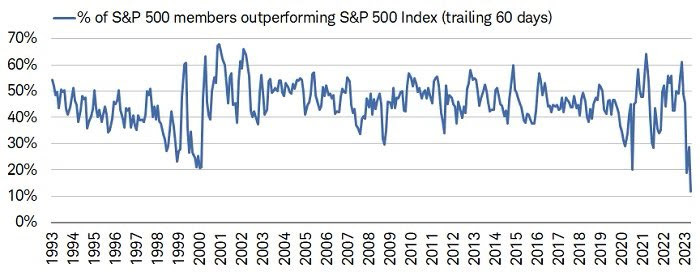
  • Bad breadth:

@Growth_Value_

Image

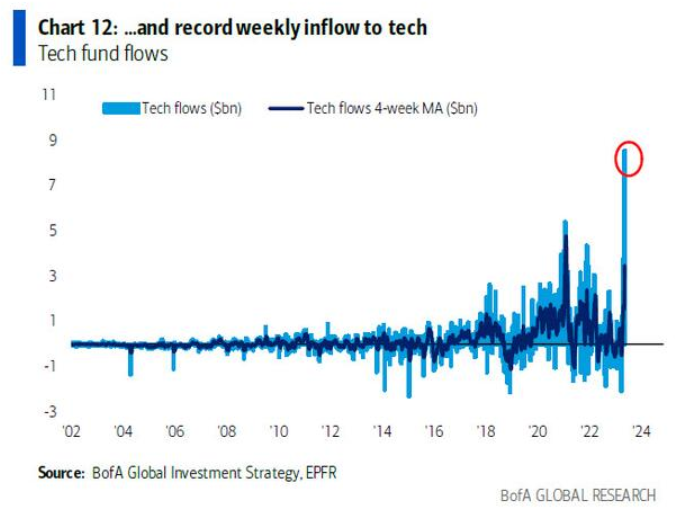
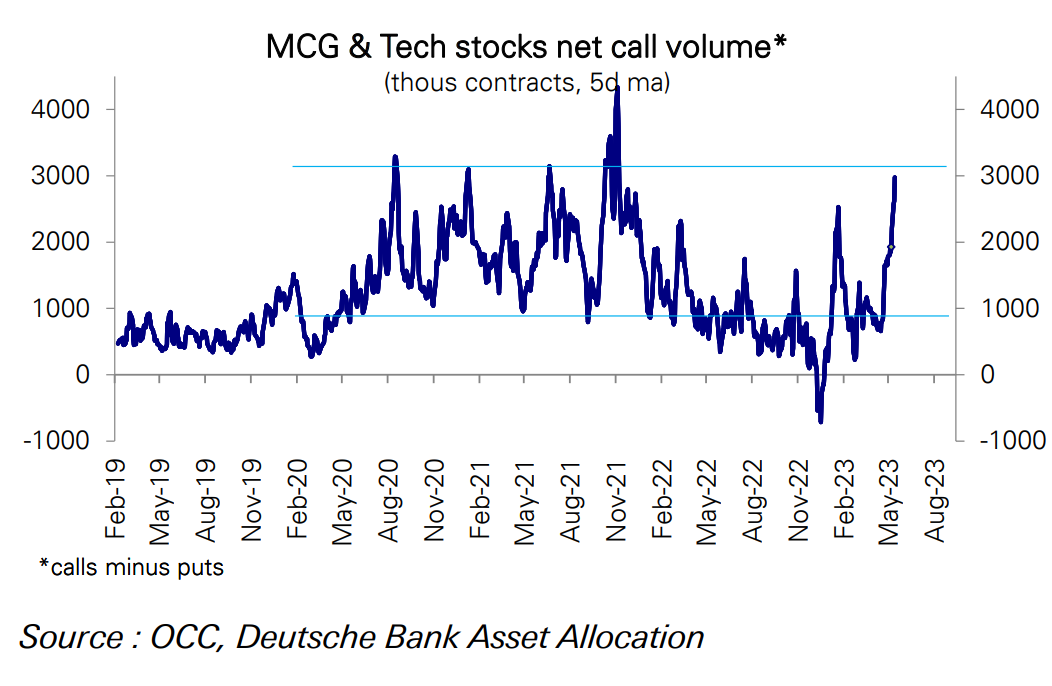
  • Speculative fervor is coming back as well. In a note to clients at the end of last week, Deutsche Bank pointed out that the volume of call-option buying in tech and Mega Cap Growth is nearing its highest levels of the pandemic era. (Joe Weisenthal)
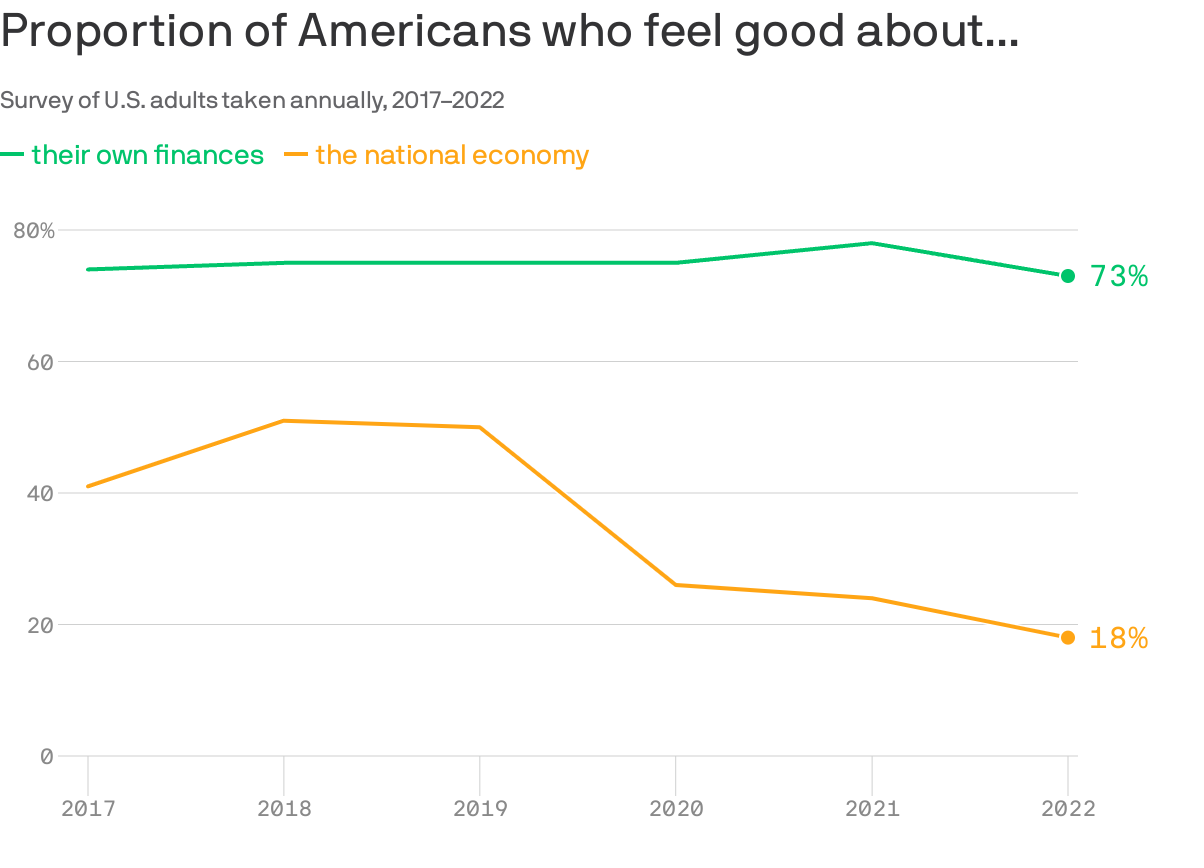
  • Americans feel good…about themselves…

Data: Federal Reserve “Survey of Household Economics and Decisionmaking.” Chart: Axios Visuals
Big Banks Could Face 20% Boost to Capital Requirements Those relying on fees might need bigger buffers to absorb losses under planned rules.

U.S. regulators are preparing to force large banks to shore up their financial footing, moves they say will help boost the resilience of the system after a spate of midsize bank failures this year.

The changes, which regulators are on track to propose as early as this month, could raise overall capital requirements by roughly 20% at larger banks on average, people familiar with the plans said. The precise amount will depend on a firm’s business activities, with the biggest increases expected to be reserved for U.S. megabanks with big trading businesses.

Banks that are heavily dependent on fee income—such as that from investment banking or wealth management—could also face large capital increases. Capital is the buffer banks are required to hold to absorb potential losses.

The plan to ratchet up capital is expected to be the first of several steps to beef up rules for Wall Street, a shift from the lighter regulatory approach taken during the Trump administration. (…)

Institutions with at least $100 billion in assets might have to comply, effectively lowering an existing $250 billion threshold for which regulators have reserved their toughest rules. (…)

The new framework was completed in 2017, but efforts to implement it in the U.S. were delayed by the pandemic. The Fed is playing a leading role in crafting the measure, along with the Federal Deposit Insurance Corp. and the Office of the Comptroller of the Currency.

All three agencies are expected to seek comment on the proposed capital rules. They would have to vote again to complete the changes, likely implementing them over the coming years.

They are also expected to propose ending a regulatory reprieve that had allowed some midsize banks to effectively mask losses on securities they hold, a contributing factor in the collapse of SVB. Supporters of the change say it would have forced SVB to address the issue earlier as interest rates began rising and the value of its holdings declined.

THE DAILY EDGE: 2 JUNE 2023

U.S. Manufacturing PMIs:

S&P Global: Renewed decline in manufacturing sector conditions as weak demand drags on performance

The seasonally adjusted S&P Global US Manufacturing Purchasing Managers’ Index™ (PMI™) posted 48.4 in May, down from 50.2 in April, but broadly in line with the earlier released ‘flash’ estimate of 48.5. The latest figure indicated the fastest deterioration in operating conditions since February.

image

Contributing to the latest overall decline was a renewed and solid fall in new orders at manufacturing firms in May. The decrease was the sharpest in three months. Lower new sales were often attributed to sufficient inventory levels at customers and previous hikes in selling prices which served to dampen demand conditions. Foreign client demand also weakened midway through the second quarter, as new export orders fell at a sharp pace that was the quickest in three years.

Nonetheless, output at manufacturers continued to increase, thereby extending the current sequence of expansion to three months. The rate of growth slowed to only a marginal pace, however, as firms linked the rise to greater hiring and the timely delivery of inputs.

Manufacturers noted that the greater availability of candidates for existing vacancies helped boost workforce numbers in May. Employment grew at a solid pace that was among the fastest in two years. The diversion of resources towards the clearing of backlogs of work amid lower new order inflows led to the steepest fall in outstanding work for three years.

Meanwhile, input prices decreased at a modest pace midway through the second quarter, with firms recording a notable turnaround from the sharp uptick in costs seen in April. Shorter lead times for inputs and subdued input demand led to suppliers reducing their costs, according to panellists.

In response to lower operating expenses, goods producers moderated the pace at which output charges rose. Selling prices increased at only a marginal rate that was the slowest since July 2020. Firms attributed the softer pace of inflation to efforts to remain competitive and drive sales, alongside some reports of the pass-through of lower costs to clients.

May data signalled further efforts among manufacturing firms to reduce their inventory holdings as new orders moved into contraction territory. Stocks of both purchases and finished goods fell at the fastest rates for three months. At the same time, input buying was cut for the tenth successive month, and at the sharpest rate since February.

The ISM: Manufacturing PMI at 46.9%

  • imageThe May Manufacturing PMI® registered 46.9 percent, 0.2 percentage point lower than the 47.1 percent recorded in April. 
  • The New Orders Index remained in contraction territory at 42.6 percent, 3.1 percentage points lower than the figure of 45.7 percent recorded in April.
  • The New Export Orders Index reading of 50 percent is 0.2 percentage point higher than April’s figure of 49.8 percent.
  • The Production Index reading of 51.1 percent is a 2.2-percentage point increase compared to April’s figure of 48.9 percent.
  • The Backlog of Orders Index registered 37.5 percent, 5.6 percentage points lower than the April reading of 43.1 percent.
  • The Employment Index indicated another month of expansion, registering 51.4 percent, up 1.2 percentage points from April’s reading of 50.2 percent.  
  • Of the six biggest manufacturing industries, only one — Transportation Equipment — registered growth in May.
  • Of the 18 sub-sectors, 4 reported growth in May, 14 reporting contraction.
  • Seventy-six percent of manufacturing gross domestic product (GDP) is contracting, up from 73 percent in April.
  • A larger number of industries contracted strongly, as the proportion of manufacturing GDP registering a composite PMI calculation at or below 45 percent — a good barometer of overall manufacturing weakness — increasing to 31 percent in May, compared to 12 percent in April.

WHAT RESPONDENTS ARE SAYING

  • “Overall impact for our business is mixed. Our scientific instrumentation business continues to be weakened by lending to support capital purchasing, while services and consumables stay on track and continue to increase in some markets. Hiring has slowed in response to continued global uncertainty on inflation and unrest in Europe.” [Computer & Electronic Products]

  • “Demand continues to gain momentum due to new business pipelines finally yielding billable production. Personal care and home care are drivers.” [Chemical Products]

  • “We continue to have a strong backlog for our customer orders; however, new orders are slowing. Our supplier on-time delivery continues to be a challenge for us, and we still face price increases on a weekly basis. Labor shortages are getting better within our organization and throughout our supply chain.” [Transportation Equipment]

  • “Pricing seems to be becoming the primary focus of supply and sourcing teams, as customers and consumers are beginning to push back. While inflation is easing on some discretionary goods, high food costs persist across most categories.” [Food, Beverage & Tobacco Products]

  • “Business is returning to pre-pandemic levels. There is increased demand in commercial/government markets and reduced demand in residential/consumer markets.” [Machinery]

  • “Less volatility in customer demand from one month to six months out; seeing signs of slowing in the second half of 2023 and potentially into early 2024. Logistics, particularly from East Asia, continue to return to historical-level transit times; Europe and India remain elevated. Supply shortages are limited to select items only. Suppliers are still seeking price increases but are too late to be asking now.” [Fabricated Metal Products]

  • “Although sales are slightly lower, they are holding at current rate — soft, not catastrophic.” [Furniture & Related Products]

  • “Moderate increase in customer orders/demand, supplier deliveries improving, and raw material prices stable to soft.” [Plastics & Rubber Products]

  • “Business conditions are good, demand remains strong, and we are continuing to ramp up production to keep up.” [Miscellaneous Manufacturing]

  • “Industrial and high-tech demands are pushing out, as a slowdown is clear. This is stunting growth and currently making 2023 demand look flat to only slightly up, compared to original projections of 10-percent growth.” [Electrical Equipment, Appliances & Components]

Note that of the 18 manufacturing industries tallied, only 5 reported employment growth in May.

Considering weakish production (51.1%), very weak new orders (42.6%) and even weaker backlogs (37.5%), steady positive employment readings indicate labor hoarding. Positive during the weak period but no tailwind when demand recovers.

This chart is up to March 2023. Productivity looks set to get worse in Q2.

fredgraph - 2023-06-01T120435.715

U.S. first-quarter productivity revised up; labor costs growth lowered

U.S. worker productivity slumped in the first quarter, though not as steep as initially thought, according to government data on Thursday, which also showed sharp downward revisions to labor costs last quarter and in the final three months of 2022.

Nonfarm productivity, which measures hourly output per worker, dropped at a 2.1% annualized rate last quarter, the Labor Department said. That was revised up from the 2.7% pace of decline estimated last month.

Productivity decreased at a 0.8% pace from a year ago, instead of the previously reported 0.9% rate. That marked the fifth quarter that productivity dropped on a year-on-year basis.

Weaker productivity is putting pressure on profit margins. Corporate profits have declined for three straight quarters.

Unit labor costs – the price of labor per single unit of output – surged at a 4.2% rate in the first quarter. They were revised down from the previously reported 6.3% pace of growth. They dropped at a 2.2% rate in the fourth quarter, rather than growing at a 3.3% pace as previously estimated.

Unit labor costs increased at a 3.8% rate from a year ago, revised down from the previously reported 5.8% pace. Despite the downward revisions, labor costs are rising too quickly to be consistent with the Federal Reserve’s 2% inflation target.

Hourly compensation increased at a 2.1% pace last quarter. It was previously reported to have advanced at a 3.4% pace.

Compensation fell at a 0.7% rate in the October-December quarter instead of growing at a 4.9% pace as previously reported. It rose at a 3.0% rate compared to the first quarter of 2022, revised down from the previously estimated 4.8% pace.

With business sales up 2.3% YoY in Q1, operating margins are being squeezed by labor costs rising 5%.

fredgraph - 2023-06-02T073403.607

QoQ, employment costs are rising at a steady 1.2% rate, or 4.8% a.r..

The Fed’s Inflation Fight Faces a New Challenge: A Dry Panama Canal Weight restrictions and surcharges are lifting cargo prices and worrying economists about inflation risks

(…) Just as the world’s delivery bottlenecks are easing, Panama’s drought and worrisome weather patterns elsewhere threaten to revive some of the chaos of 2021, when a surge in shipping costs and consumer demand resulted in shortages of goods, helping to drive US inflation to a four-decade high. (…)

The drought already is making it more expensive to move goods. The canal authority has steadily reduced draft levels – how low a vessel can sit in the water – since February. To comply with lower drafts, large ships must lighten their loads by taking fewer containers overall or by dividing the same amount of cargo among more containers. Either way, the result is higher price tags for consumer and industrial goods that move through the canal. Some ocean carriers also began charging per-box container fees on June 1 in response to the draft limits. (…)

Still, large volumes of cargo are moving, with demand at about the same level as in 2019, according to Peter Sand, who is chief analyst for Oslo-based Xeneta AS, which tracks shipping rates. (…)

The draft limit for the larger vessels is now 44.5 feet, down from the normal 50 feet, and is set to fall again to 44 feet on June 13. That could result in a 40% reduction of cargo, according to Nathan Strang, head of ocean freight at Flexport Inc., a freight forwarder.

If water levels hit 78.2 feet as the canal authority predicts, the maximum draft will decline to 43 feet, reducing cargo capacity even more. (…)

The 2021 bottlenecks, which caused a six-fold spike in shipping costs from pre-Covid levels, increased inflation by more than 2 percentage points in 2022, said Ostry, the Georgetown economist. “Shipping costs can be a canary in the coal mine for future inflation spikes” since it takes 12 to 18 months for those costs to feed through the economy.

His research shows a 20% increase in shipping costs boosts the inflation rate by 0.15 percentage point a year later. (…)

Weather patterns worldwide are off, Zheng said. “If you put Panama’s low water levels into the big picture, actually you see that it’s just one signal and globally you will probably see more and more coming.”

Zheng points to the Rhine River in Europe, where high temperatures and scarce rainfall last year caused delays and increased shipping costs for commodities. Already this year, areas of Southeast Asia have experienced their hottest days ever recorded, and low water levels in the Yangtze River, a vital inland freight route in China, are also impeding shipping, she said. (…)

Goods deflation, supposed to help offset services inflation (black), has not happened just yet in spite of subdued import prices.

fredgraph - 2023-06-02T064515.828

On a MoM basis, goods prices stopped deflating in December. They are up 2.4% annualized since with import prices up 1.1% a.r.. The USD is down 8.7% since its October 2022 peak.

fredgraph - 2023-06-02T064321.143

Canada: GDP starts 2023 strongly

Canada’s first-quarter GDP surprised economists’ consensus, as the monthly measure understated the rebound in GDP after a weak fourth-quarter performance. For the second consecutive quarter, international trade was a strong contributor to growth, but domestic demand was solid in Q1 whereas it was flat the quarter before.

The performance of consumer spending was eye-catching, with growth of 5.7%, the strongest in 3 quarters. We knew that consumers had assets at their disposal, notably a savings rate that remained above its pre‑pandemic level, and thus an accumulation of excess savings that seems to have been put to good use. Growth in the first quarter was therefore stronger than the Bank of Canada had anticipated in its latest Monetary Policy Report.

However, we need to put things into perspective. Like us, the central bank probably underestimated the economy’s potential GDP, which is currently being boosted by an unprecedented demographic boom. If the unemployment rate and falling job vacancy rates in the economy are any guide, this growth does not seem to be pushing the economy further into excess demand.

In light of this morning’s data, we do not change our view that the economy will slow significantly over the next four quarters as interest rate hikes continue to weigh on the economy. The third consecutive quarter of declines in corporate profits and investment does not suggest that the appetite for hiring will continue in the months ahead.

A softer labour market is also likely to dampen the enthusiasm of consumers, who have been able to afford high levels of consumption despite a decline in disposable income, a situation that will not last much longer with the savings rate now back to pre-pandemic levels.

 image image

  • Real GDP increased by 3.1% annualized in 2023 Q1, above consensus expectations for +2.5% annualized growth.
  • Compensation per employee grew +7.2% a.r. but a large decline in net transfers received led to a contraction in household net disposable income.
  • The household saving rate declined sharply to 2.9% in Q1.
  • Preliminary information indicates that real GDP increased by 0.2% in April.
OPEC+ Challenge Is Overcoming an Internal Squabble Saudi-UAE tension on production quotas could determine fate of the crude market for months.

On the surface, everyone is unified in the OPEC+ family. Listen to the ministers ahead of their meeting on Sunday, and everyone is making the right noises. Don’t be surprised if the cartel doubles down on its production cuts, at the very least on paper, to try to juice flagging oil prices.
Behind closed doors, it isn’t as smooth, however.

While Russia, Iran and Venezuela are pumping more oil than expected right now, despite Western sanctions, the key country to watch going into 2024 is the United Arab Emirates, the fourth-largest producer within the OPEC+ alliance.

For several years, the UAE has fought an unsuccessful campaign for a higher quota, commensurate with its rising production capacity. The Emirati push erupted into public in July 2021, when Riyadh and Abu Dhabi clashed at an OPEC+ meeting, forcing the group to adjourn the gathering. The meeting didn’t re-start until after the UAE several days later backed off from its demands under Saudi pressure.

Almost two years later, the market has largely forgotten about that episode. But the feud hasn’t gone away, and it could become central in the next few months as OPEC+ starts to plot its 2024 production policy. The difference from 2021 is that Riyadh appears to be ready to oblige its neighbor. (…)

If Riyadh allows Abu Dhabi to pump more oil in 2024, as it seems the deal is, I believe the UAE will be happy to stay at OPEC.

With the oil market already in surplus, largely due to Russian production, it’s difficult to see how committing to add supply would be anything but bearish. Oil prices have fallen to nearly $70 a barrel, down almost 30% from late last year. And that decline is even worse when adjusted for inflation. Currently, the purchasing power of a barrel of oil, in real terms, is back to where it was in 2005.

If supply and demand behave in the second half of the year as OPEC currently expects, tightening the market in late 2023 and early 2024, allowing the UAE to boost its production could be easy. The increase would be soaked up by demand for extra oil. But if the market remains loose, any increase could put pressure on prices. (…)

Based on the latest deal among a handful of OPEC nations in late April, the UAE has a “voluntary” production level of 2.875 million barrels a day. But the country says its can produce more than 4 million. (…)

If you believe the chatter of Middle East-based diplomats, Abu Dhabi and Riyadh have already agreed in private to a compromise increase. The midpoint, around 3.5 million barrels a day, is probably a good bet. Both sides could claim victory.

If, as I expect, the UAE wins a higher quota in 2024, it’s likely to be the first step in a series of increases. Last year, Abu Dhabi brought forward its plan to reach a production capacity of 5 million barrels a day to 2027, from an initial target of 2030. (…)

China Mulls New Property Support Package to Boost Economy

Regulators are considering reducing the down payment in some non-core neighborhoods of major cities, lowering agent commissions on transactions, and further relaxing restrictions for residential purchases under the guidance of the State Council, the people said, asking not to be named because the matter is private.

The government may also refine and extend some policies laid out in the sweeping 16-point rescue package it rolled out last year, the people added. The plans have yet to be finalized and may be subject to change, according to the people. (…)

Signs of renewed weakness are emerging in the residential market, with a rebound in home sales slowing in May to just 6.7% from more than 29% in the previous two months. (…)

China's Housing Inventory Remains Elevated

Despite a broad range of policies last year, a mountain of developer debt — equal to about 12% of China’s GDP — is at risk of default and poses a threat to financial stability, according to Bloomberg Economics. (…)

A number of developers are struggling to get creditor support for their restructuring plans after China’s real estate sector defaulted on more than 100 dollar bonds.

Two of the country’s most high-profile developers Dalian Wanda Group Co. and China Evergrande Group are showing escalated signs of distress.

Wanda is on an asset-selling spree to generate more liquidity, while seeking a loan relief plan that may allow it to extend principal repayments for some borrowings from Chinese banks, people familiar said in May.

Evergrande said this week it faces more than a thousand lawsuits involving 350 billion yuan. The embattled property developer has yet to win enough support from creditors for its overseas debt restructuring plan. (…)

Investors across Asia earmarked China’s ballooning levels of municipal borrowing as the region’s number one financial risk this year in a survey that ranked their biggest concerns. (…)

With a slew of data showing China’s economic rebound is faltering, focus is once again turning to troubled spots in the world’s second largest economy. In one recent example, a last minute bond payment by a local government owned firm highlighted weakening debt serviceability that’s threatening to extend worries beyond the country’s credit traders and into other markets.

The vehicles are a key method of funding China’s public infrastructure as well as its property market. S&P Global Ratings put the total debt of LGFVs at more than 46 trillion yuan ($6.5 trillion) at the end of last year. Of that, onshore bonds due in 2023 are at a record high at about 4.3 trillion yuan. Goldman Sachs Group Inc. estimates China’s total government debt is about $23 trillion, a figure that includes the hidden borrowing of thousands of financing companies set up by provinces, cities and state policy banks.

“We believe any hawkishness by Beijing on local debt would intensify the financial vulnerabilities of local governments, jeopardizing the budding economic recovery,” said Carl Liu, economist at KGI Securities in Taipei. “We think LGFVs’ debt-servicing ability is weak, and it seems that LGFVs rely on new financing to service debt, strengthening the default risk.” (…)

The worry is that defaults of shadow bank instruments could lead to souring of publicly traded bonds, creating financial risks that weigh on an already sluggish economy further down the line. (…)

In China, a property debt crisis has kept the mortgage-backed debt issuance market effectively shut for almost a year and a half. There have been no sales of residential mortgage-backed securities in yuan since February 2022, one of the longest dry spells on record. (…)

Lots of work still being done at home

In May, 30% of U.S. employers had a structured-hybrid plan, where workers come in a minimum number of days per week, Axios’ Emily Peck writes from Flex Index data from the hybrid-work software company Scoop. Back in February, only 20% of firms in the database were doing structured-hybrid.

Data: Flex Index. Chart: Axios Visuals