FLASH PMIs
Eurozone: Flash PMI signals steepening downturn in August, price gauges tick higher
At 47.0, down from 48.6 in July, the seasonally adjusted HCOB Flash Eurozone Composite PMI Output Index, based on approximately 85% of usual survey responses, fell in August to its lowest since November 2020. If pandemic months are excluded, the latest reading was the lowest since April 2013.
Output has now fallen for three consecutive months, led by a fifth successive monthly decline in manufacturing output. Although the rate of decline of factory output eased slightly in August, it remained the second-strongest recorded by the survey over the past 11 years barring only the initial COVID-19 lockdowns.
The eurozone service sector meanwhile also fell into decline in August, with activity contracting for the first time since last December, albeit at a much softer rate compared to the goods-producing sector.
Demand conditions continued to worsen across both sectors. New business inflows fell overall for a third straight month, with the rate of decline accelerating to the fastest since November 2020. Excluding the pandemic, the drop in new business was the steepest since October 2012. New orders for goods continued to fall at the one of the sharpest rates since the global financial crisis, accompanied by a second month of deteriorating demand for services. The latter contracted in August at a pace not seen since May 2013 if COVID-19 lockdown months are excluded.
Employment came close to stalling, with the August flash PMI survey registering the smallest rate of job creation since headcounts began rising after the pandemic lockdowns in February 2021. A marginal loss of manufacturing jobs was recorded for a third successive month, while hiring in the larger service sector continued to slow from April’s recent peak to register only a marginal rise, signalling the smallest net job gain in the sector since February 2021.
The near stalling of hiring reflected an increasingly sharp decline in companies’ backlogs of work, which points to the development of excess capacity relative to demand. The drop in backlogs was the largest since November 2012 if the initial COVID-19 lockdown months are excluded. While manufacturing backlogs fell sharply again, dropping for a fifteenth consecutive month, service sector backlogs fell for a second month running; the rate of decline the sharpest since February 2021.
The deteriorating order book situation played a key role in further denting business confidence in prospects for the year ahead. Companies also cited concerns over broader economic slowdowns at home and in export markets, as well as worries over the impact of higher prices. Companies’ expectations of output levels in the coming year consequently fell for a sixth month in a row, dropping to their lowest since last December and descending further below the survey’s long-run average to thereby signal subdued optimism by historical standards.
Manufacturers also continued to scale back their purchasing of inputs sharply in August, in line with reduced production requirements, helping to further reduce their raw material inventories at an historically marked pace. Stocks of finished goods were likewise reduced.
The reduced purchasing of inputs by manufacturers meanwhile took pressure off supply chains, which in turn facilitated a seventh successive monthly improvement in average supplier delivery times.
Inflationary pressures meanwhile picked up in August, both in terms of average selling prices and input costs, albeit with both measures signalling far weaker inflation rates than seen throughout the two years prior to the summer.
Average prices charged for goods and services rose at an increased rate for the first time in seven months, pushing the rate further above the survey’s long-run average albeit registering the second-slowest rate since March 2021. Goods prices fell for a fourth month running, though the rate of deflation moderated. Service sector charges meanwhile rose at the slowest rate since October 2021.
The rate of input cost inflation across both sectors edged higher for the first time in 11 months, though remained marginally below the survey’s long-run average. A steep fall in manufacturers’ costs, albeit at a reduced rate of deflation compared to July, was accompanied by a slight upturn in service sector input cost inflation, the latter commonly linked to rising wage pressures.
Looking at growth across the euro area, the steepest downturn was recorded in Germany, where output across both goods and services fell for a second month and at a rate not seen since May 2020 (and since June 2009 if the pandemic is excluded). A severe and steepening decline in manufacturing output was accompanied by the first fall in German service sector activity since last December.
France reported a third successive monthly drop in output, the rate of decline unchanged on July, which had seen the sharpest decline since May 2013 barring only four months of pandemic lockdowns. The rate of contraction moderated in manufacturing, though remained sharp, and meanwhile accelerated in services.
The rest of the region suffered a moderate decline in output compared to France and Germany, yet the reduction was notable in being the first recorded since December amid an ongoing loss of manufacturing output alongside a near stagnation of activity in the service sector.

Japan: Output growth quickens amid solid service sector expansion
- Flash Composite Output Index, August: 52.6 (July Final: 52.2)
- Flash Services Business Activity Index, August: 54.3 (July Final: 53.8)
- Flash Manufacturing Output Index, August: 49.0 (July Final: 48.9)
Growth across the Japanese private sector picked up pace during August, with the service sector again driving the overall expansion amid ongoing improvements in new orders. Manufacturing continued to disappoint, however, again failing to generate growth. Nevertheless, the rates of reduction in output and new orders were less pronounced than in July
With overall new orders continuing to rise, firms upped their staffing levels accordingly. The weakness in manufacturing demand acted to deter hiring there, however, with no change in employment ending a 28-month sequence of factory job creation
Rising oil prices were a key feature across the latest survey, with firms across both manufacturing and services reporting an impact on input costs. Overall, input prices increased at the fastest pace in four months. Another area of common ground across the two monitored sectors was with regards to business confidence, which waned across the board amid concerns around longer-term economic conditions.

The U.S. flash PMI is out later today.
In the meantime, here’s a condensed version of the latest PwC survey (between August 1 and August 8, 2023) of 609 US executives from public and private companies in six sectors: industrial products (27%), consumer markets (22%), financial services (19%), technology, media and telecom (18%), health industries (7%) and energy and utilities (6%).
- Recessionary concerns are easing. Just 17% of business executives strongly agree that there will be a recession in the next six months, a drop from 35% in October 2022.
- Business risks are less pronounced. Executives still point to the same risks as in 2022 (and rank them in roughly the same order): more frequent and severe cyber attacks, an uncertain economy and talent acquisition (only 26% of executives now say finding and keeping talent is a serious risk vs 38% a year ago). But a smaller share of executives cite these as direct threats to their business.
- But for 59% of CFOs, reducing costs is a top priority, up from 38% a year ago.
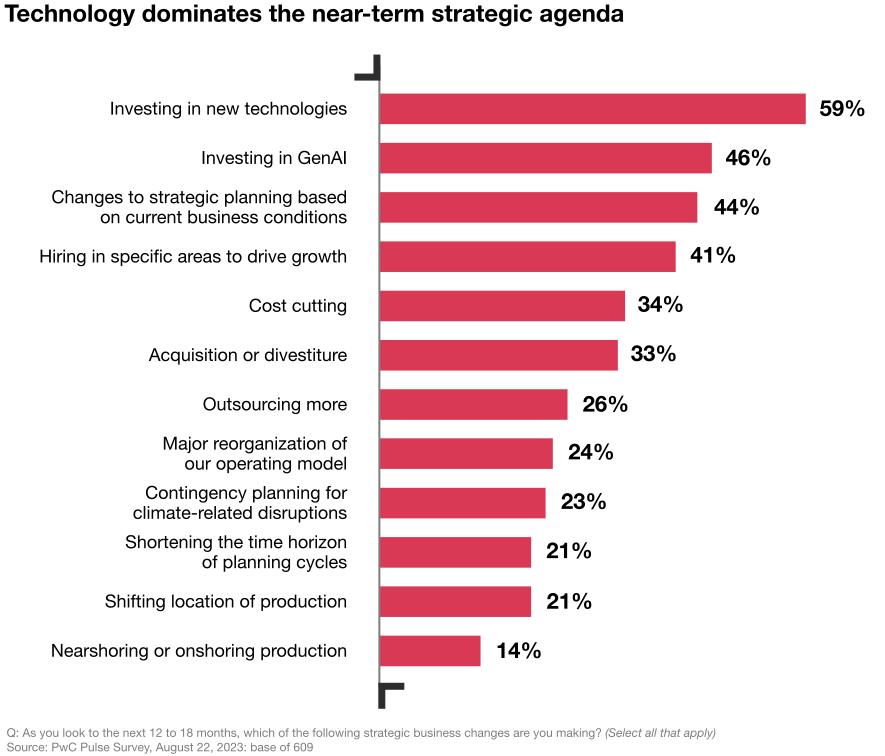
- Executives are far more likely to invest in future growth rather than hunker down. More than a quarter (27%) want to embed new technologies into their business model, and 24% are focused on new revenue streams — more than any other strategic priority.
- Tech implementation remains a key challenge to transforming. Companies are willing to make the upfront investment, but they struggle to capture value from new tech once it’s in place. The vast majority (88%) say achieving measurable value from new technology is a challenge, followed by updating their operating model to support their new vision (85%), covering the cost of new technology (85%) and training the workforce (84%) on new tech.
- Executives are largely happy with their current workforce strategy. Nearly three-fourths (74%) say they can attract and retain the talent they need. Similarly, 74% say they have the right culture in place for reinvention.
- Half of executives cite climate change as a risk to their business. Only 19% see it as a serious threat, down from 23% in 2022. Companies are more likely to comply with sustainability reporting disclosures and SEC requirements, but only 23% are planning for climate-related disruptions.
The challenge is that in a rapidly changing tech environment, many companies are still waiting for the payoff from their last round of tech investments. When asked about challenges to transformation, a staggering 88% of executives point to achieving measurable value from new tech, more than any other issue. Similarly 85% point to the cost of adoption for new technologies, and 84% cite training talent on new tech. (…)
Dick’s Sporting Goods, Macy’s Flash Warnings Over Consumers The retailers’ shares traded sharply lower after they posted weaker earnings and gave tepid forecasts for the rest of the year, signals that the recent strength in consumer spending has its limits.
(…) The sporting-goods chain slashed its profit targets for the year after missing Wall Street forecasts for the second quarter. Sales slowed after a pandemic-fueled surge for outdoor gear, leaving it with excess inventory. Executives said thefts of merchandise were also higher than they expected.
Macy’s reported declining sales in the June quarter and warned that more shoppers are late on their credit-card payments. (…)
Earlier this month Walmart, the country’s largest grocery seller, and e-commerce retailer Amazon reported strong earnings and sales. TJX, which owns chains such as T.J. Maxx and HomeGoods and is known for discounts, also posted strong sales and profit. (…)
The debate on the remains of the so-called pandemic “excess savings” continues. The San Fran Fed recently posted an analysis claiming that the bounty will be exhausted by the end of September.
Citigroup’s analysts reckon that there is still $1.4T left.
To clear the air, I put my whole team on it. For what it’s worth, they came back with this chart showing trends in total deposits (nominal and CPI-adjusted). Nominal deposits are still $1.8T above trend but inflation adjusted deposits are back on trend.

This next chart only looks at households but includes money market funds (data indexed at Feb. 2020 = 100). Inflation-adjusted “excess savings” are likely gone by the end of Q3.

Whatever, it’s not what it has been. Add the termination of the student loans holiday and slowing employment job growth, we can expect more volatility on the consumer side of the economic equation.
Hollywood Studios Make Public Their Latest Offer to Striking Writers Among the concessions the studios said they offered are a guaranteed minimum length of employment, controls around the use of generative AI and wage increases.
(…) In touting its offer, the AMPTP said it includes a compound 13% wage increase over the three-year contract. In addition, there is a 15% bump for writers who also serve as producers on a television show in the first year of the new deal.
It is also offering a 21.5% jump in worldwide residuals for high-budget streaming shows. (…)
U.S. Home Sales Fell in July, Extending Prolonged Slump Buyers face a limited supply of properties and high mortgage rates
Sales of existing homes, the majority of purchases, decreased 2.2% in July from the prior month to a seasonally adjusted annual rate of 4.07 million, the National Association of Realtors said Tuesday. That was the slowest monthly sales pace since January, and the slowest July pace since 2010. (…)
The national median existing-home price rose 1.9% in July from a year earlier to $406,700. It was the fourth time on record that this figure had risen over $400,000, NAR said. (…)
Total sales inventory stood at 1.11 million units in July, down 14.6% from the same month last year, NAR said. (…)
VettaFi’s snapshot below is an overlay of the NAR’s annualized estimates with a population-adjusted version.

The effective rate on total outstanding mortgage debt is 3.6% as of Q2-2023, significantly below current mortgage rates. The recent leg up in rates will likely further discourage prospective sellers from listing their homes for sale, which means inventories are likely to remain low for the foreseeable future. (Wells Fargo)

Source: U.S. Department of Commerce, Freddie Mac and Wells Fargo Economics
- 71% of U.S. mortgage borrowers have a mortgage rate below 4%

Source: @NewsLambert
Bespoke illustrates the inventory situation in housing. What was not a demand problem is becoming one with mortgage rates above 7%:

(Bespoke)
 Data: FRED Economic Data, St. Louis Fed, Mortgage News Daily. Chart: Axios Visuals
- While rents are down on a year-over-year basis, they continue to rise. (The Daily Shot)
 Source: realtor.com
Office Tenants Are Renewing Leases—but for Far Less Space The need for less workplace space reflects how employers across the U.S. have embraced hybrid strategies that allow employees to work more from home.
(…) In the second quarter, U.S. businesses signed new leases for an estimated 97.5 million square feet, up from 57.4 million square feet in the second quarter of 2020, the low point of the pandemic, according to data firm CoStar Group.
Yet in the second quarter, the average U.S. office lease size was 3,275 square feet, or 19% less than the average lease size between 2015 and 2019, CoStar said. (…)
Look for this trend to continue, Mobley said, since more than half the leases signed before 2020 have yet to expire. The U.S. office vacancy rate has increased to 13.2% from 9.5% before the pandemic. CoStar is forecasting that it will increase to more than 17% by the end of 2026. (…)
Currently 61% of U.S. companies allow employees remote work part or all of the week, up from 51% at the beginning of the year, according to Scoop Technologies, a software firm that developed an index monitoring workplace strategies.
The number of companies requiring workers to be in the office full time has declined to 39% from 49% at the beginning of the year, Scoop said. That number will likely continue to decrease because newer companies tend to embrace flexible work practices more than older companies, according to Robert Sadow, Scoop’s chief executive and co-founder. (…)
The market is sagging under a record 216.8 million square feet of sublease space. The amount of occupied space declined in the first half of 2023 by more than 35 million square feet, CoStar said. (…)
Huawei Is Building a Secret Network for Chips, Trade Group Warns Tech giant is reportedly getting $30 billion in state support
The leading association of global chip companies is warning that Huawei Technologies Co. is building a collection of secret semiconductor-fabrication facilities across China, a shadow manufacturing network that would let the blacklisted company skirt US sanctions and further the nation’s technology ambitions.
Huawei, a controversial telecommunications gear maker at the heart of US-China tensions, moved into chip production last year and is receiving an estimated $30 billion in state funding from the government and its home town of Shenzhen, according to the Washington-based Semiconductor Industry Association. It’s acquired at least two existing plants and is building at least three others, the group said in a presentation to its members seen by Bloomberg.
The US Commerce Department put Huawei on its entity list in 2019, eventually prohibiting it from working with American companies in almost all circumstances. But if Huawei is constructing and buying facilities under the names of other companies without disclosing its involvement, as the SIA said, the telecom giant may be able to circumvent those restrictions to indirectly purchase American chipmaking equipment and other supplies that would otherwise be prohibited. (…)
China is pouring unprecedented amounts of money into its domestic semiconductor industry. The SIA estimates there are at least 23 fabrication facilities in the works in the country with planned investments of more than $100 billion by 2030, according to the presentation. By 2029 or 2030, China is on track to have more than half the industry’s global capacity in older-generation semiconductors, those made with 28-nm or 45-nm technology, the group said.
China is pouring unprecedented amounts of money into its domestic semiconductor industry. The SIA estimates there are at least 23 fabrication facilities in the works in the country with planned investments of more than $100 billion by 2030, according to the presentation. By 2029 or 2030, China is on track to have more than half the industry’s global capacity in older-generation semiconductors, those made with 28-nm or 45-nm technology, the group said. (…)
The size of the projected financial support for Huawei is also staggering. At $30 billion, the money would be almost as much as the manufacturing incentives in the US Chips and Science Act that will be split among multiple companies. (…)
One long-term risk from the US standpoint is that Huawei and other Chinese companies will use investments in older-generation technologies to build knowledge and expertise in semiconductor manufacturing. With enough experience and production volume, a company with Huawei’s technical prowess could advance to more sophisticated semiconductors.
That was the path followed by TSMC and Samsung, which were once dismissed as having no hope of catching the likes of Intel. Now, after decades of work, they lead the industry in producing more and more sophisticated chips.
FYI: Also for what it’s worth in today’s strange environment:
We have just hit the 595th straight day with the S&P 500 failing to reach a new cycle high. And everyone thinks we are in a new bull market! Such a long stretch without making a new high has happened just seven other times in the past seven decades! And each one was in the throes of a fundamental bear market and only one (1987) did not take place ahead of or during an outright recession. (David Rosenberg)
A new variant: BA.2.86 A new COVID-19 variant turning heads even among the calm, cool, and collected scientists.
(…) As of now, we’ve only seen 7 cases in 4 countries. Usually, this isn’t enough to warrant concern, but some details are noteworthy:
Mutations. The new variant has 35 mutations on the spike protein relative to what is currently circulating. (We pay attention to the spike protein because it’s the key to our cells.) This is an insane amount of change at once; it’s as big of an evolutionary jump as Wuhan → Omicron. (…
There is vast geographical distribution of the cases identified (Israel, the U.S., Denmark, and the U.K.). And we are seeing BA.2.86 in country-level wastewater samples (without corresponding reported cases). All of these point to undetected community transmission—it’s spreading.
The 7 sequences are very similar, which means this variant hasn’t had time to change. In other words, it’s spreading quickly.
One U.S. lab found that BA.2.86 has 16 known mutations that significantly escape our front-line immunity—antibodies. In other words, this will likely infect many people, regardless of prior immunity.
We don’t know if this is more severe than Omicron or Delta, but it’s probably about the same severity level. This is because SARS-CoV-2 has historically evolved to escape antibodies (first line of defense) rather than T-cells (second line of defense) that primarily protect us from severe disease.
There’s a ceiling to contagiousness. It’s hard to imagine BA.2.86 spreading much better than Omicron, but nothing is ruled out yet.
Epidemiologically, we don’t know whether this will cause a wave yet; it may be a dud. But with more cases, it becomes more likely. Again, we are flying blind. We don’t have testing or case data like we did 2 years ago.
There is good news.
This is still COVID-19. We aren’t returning to March 2020; our immune systems will still recognize the highly mutated variant, albeit suboptimally. This will protect a lot of us from severe disease.
We can detect BA.2.86 on a PCR. Usually a swab has to go to a special lab for genome sequencing to know which variant caused the infection. However, BA.2.86 has a unique signal on the PCR directly—when positive, it lights up two channels instead of three. This is fantastic news because it means we can track this virus much easier and more quickly worldwide. CDC is doing this right now.
Scientists are on top of it. While much of the public has moved on, public health is still working just as hard. WHO and CDC announced last week that they are monitoring this variant. U.K. came out with a fantastic risk assessment on Friday.
What’s next?
We are at the mercy of time to see what this variant does. Like a hurricane, we don’t know if it will fizzle away, become a category 5 disaster, or somewhere in between.
Regardless, our next moves include:
WHO will determine if this is a new variant of concern—the highest risk classification. If so, it will be assigned a Greek name; next in line is “Pi.”
Scientists are actively trying to understand how our immune systems react to BA.2.86 and if this impacts “real world” patterns. Their results should be coming in a few weeks.
Companies will confirm (or deny) whether our tools (like the vaccines, Paxlovid, and antigen tests) work against BA.2.86.


 American Airlines pilots approve sweetened labor deal with big raises


 During a recent road trip through Vermont, New Hampshire, Maine, New Brunswick and Québec, we experienced the sharp increase in hotel and restaurant costs. Bar Harbor, Maine was particularly expensive (USD$38 lobster rolls!!!). Restaurants are still struggling with staff shortages. We have seen many suggesting 20-22% tips over the taxed total.