Employers added 223,000 jobs in December, the smallest gain in two years, the Labor Department said Friday. Average hourly earnings were up 4.6% in December from the previous year, the narrowest increase since mid-2021, and down from a March peak of 5.6%. (…)
Friday’s report sent markets rallying as investors anticipated it would cause the Fed to slow its pace of rate increases. The central bank’s next policy meeting starts Jan. 31. The Fed’s aggressive rate increases aimed at combating inflation didn’t significantly cool 2022 hiring, but revisions to wage growth showed recent gains weren’t as brisk as previously thought. (…)
The unemployment rate fell to 3.5% in December from 3.6% in November, matching readings earlier in 2022 and just before the pandemic began as a half-century low. Fed officials said last month the jobless rate would rise in 2023. December job gains were led by leisure and hospitality, healthcare and construction. (…)
The labor force participation rate, which measures the share of adults working or looking for work, rose slightly to 62.3% in December but is still well below prepandemic levels, one possible factor that could make it harder for employers to fill open positions.
The average workweek has declined over the past two years and in December stood at 34.3 hours, the lowest since early 2020.
Hiring in temporary help services has fallen by 111,000 over the past five months, with job losses accelerating. That could be a sign that employers, faced with slowing demand, are reducing their employees’ hours and pulling back from temporary labor to avoid laying off workers. (…)
The combination of slower employment growth (revisions cut 28k jobs on October and November) with reduced hours and slowing wages brought growth in aggregate weekly payrolls (labor income: employment x hours x wages) down to +0.17% MoM in December after +0.23% in November. Last 2 months: +2.4% a.r., a marked slowdown from +9.0% for the year and +6.8% in the second half.
Weekly hours (brown bar) unusually declined MoM two consecutive months. On a YoY basis, employment rose 3.0% in December but weekly hours are down 1.4%, leaving labor demand up a low 1.6%.
Hourly earnings (black) rose 0.27% MoM or 3.2% annualized in December (4.6% YoY). For Q4, the growth was 4.2% a.r., slower than the 4.8% rate in the first 9 months of the year.

Weekly overtime hours have been cut sharply throughout 2022 but they dropped 7.6% from 3.9 to 3.6 in the last 2 months to levels that historically were only reached during recessions:

The big surprise in the December NFP report is the large revisions to wages for October and November which meaningfully changes the trend as can be seen in the next 2 charts:
Average Weekly Earnings (MoM) after the November report

Average Weekly Earnings (MoM) after the December report

The substantial acceleration in October and November disappeared and December growth is half that of the previous 3 months. Note also that the downward revisions to wages were larger for service-producing workers, potentially helping keep services inflation lower than expected.
In all, this report shows that the labor market is not as hot as feared: demand for labor is “nicely” slowing and wage gains are actually decelerating.
Actually, the FOMC could soon shift its focus away from wages and inflation towards jobs demand. Employment keeps rising but weekly hours have declined in the last 2 months and employment for temporary workers, often the canary in the coal mine, has now declined for 4 consecutive months and at a particularly fast clip.

Surely, scenarios calling for a wage spiral and stagflation must be downgraded, if not eliminated.
The probability of recession rises with this report but a soft landing also gains credibility, assuming the Fed agrees.
The WSJ’s Nick Timiraos, often called the Fed’s mouthpiece, wrote on Friday night:
(…) Fed officials have kept their options open for their Jan. 31-Feb. 1 meeting by declining so far to spell out what might lead them to approve another half-point rate rise or to step down to a more traditional 0.25-point increase. “I am very open to both,” said Atlanta Fed President Raphael Bostic during a panel discussion Friday at an economics conference in New Orleans. (…)
The report offered little evidence that the Fed’s rapid rate rises last year have significantly slowed hiring. Employers added 223,000 jobs in December and the unemployment rate dropped to 3.5% from 3.6% in November, returning to a 50-year low.
But revisions to figures on wage growth showed recent gains weren’t as brisk as previously thought and instead indicated they continued slowing through the end of the year. (…)
After the release of Friday’s reports, investors saw a roughly 75% probability of a 0.25-point rate increase at the Fed’s coming meeting, and a 25% probability of a larger half-point bump, according to interest-rate futures market prices compiled by CME Group. (…)
Job openings held nearly steady at historically high levels in November, adding to evidence the labor market remained strong heading into 2023, according to a separate Labor Department report released Wednesday. The figures showed layoffs stayed low and a larger share of workers quit their jobs in November than a month earlier, a sign Americans were still confident in their employment prospects.
The data point to a solid overall job market even though some large technology companies are announcing layoffs. (…)
Officials are trying to balance the risk of raising rates too much and creating unnecessarily higher unemployment with the risk of not doing enough to slow down spending and investment, which could allow higher inflation to become entrenched.
Mr. Powell said at the news conference it was “broadly right” that the Fed’s best way to manage the risk of over-tightening would be to slow rate increases to smaller, more traditional 0.25-point increments as soon as the central bank’s next meeting. (…)
More broadly, Mr. Bullard said [Thursday] recent economic data buoys the Fed’s chances of slowing inflation without a serious economic downturn—achieving a so-called soft landing.
“The probability of a soft landing has increased compared to where it was in the fall of 2022, where it was looking more questionable,” Mr. Bullard said. “The labor market has not weakened the way many have predicted,” suggesting the economy is more resilient and providing Fed officials “a little more time to get inflation down to the 2% level,” he said.
Inflation readings have been encouraging recently, but the Fed’s fight against rising prices isn’t over, the leaders of the Richmond and Kansas City Federal Reserve banks said Friday.
The U.S. central bank must remain vigilant on reducing inflation even as rising interest rates could boost the risk of recession, Richmond Fed President Tom Barkin said at a forum in Durham, N.C.
“I get a lot of questions about whether the Fed should remain this committed given that risk,” Mr. Barkin said. “I guess my simple answer is that everyone hates inflation, and we are the ones mandated to address it. The Fed’s objective isn’t to hurt the economy; it’s to reduce inflation.”
At an event in Kansas City, Esther George, the president of the Kansas City Fed, said that “even as goods prices have started to decline, services prices continue to rise, boosted by a tight labor market.” (…)
“The experience of the ’70s showed that if you back off on inflation too soon, it comes back stronger, requiring the Fed to do even more, with even more damage,” he said. “If you change the target before it is achieved, as some have recently advocated, you put the Fed’s credibility at risk, which in turn increases the sacrifice required in order to control inflation. And if you think supply-chain improvements and our actions to date are enough to bring inflation down quickly, then our more gradual rate path should limit the harm.”
Ms. George said that the Fed’s aggressive action last year “has demonstrated its commitment to restoring price stability.”
“This may explain why measures of longer-run inflation expectations have remained relatively stable even as realized inflation has proven to be stubbornly high,” she said.
Federal Reserve governor Lisa Cook noted recent signs that inflation has cooled, but said it has to fall much more to reach acceptable levels.
“Inflation remains far too high despite some encouraging signs lately, and is therefore of great concern,” Ms. Cook said in remarks prepared for delivery Friday at the Allied Social Science Associations conference here.
“I would caution against putting too much weight on the past few favorable monthly data reports,” she added. (…)
Fed officials, including Ms. Cook, have noted that price increases for goods have slowed recently, in part because supply-chain bottlenecks have eased. Housing costs, another main source of price pressures, are expected to ebb in the coming months.
She said, however, that the Fed remains concerned about inflation in other services because of rapid wage growth in the tight labor market.
“Inflation in other core services—a large category that covers activities as varied as travel and recreation to medical and legal services—has remained stubbornly high,” Ms. Cook said.
 Not true: core services ex-shelter prices, the largest component of core PCE price inflation, were down MoM in October and unchanged in November; last 4 months +3.2% annualized.
Macy’s Reports Uneven Holiday Season Shoppers spent less on electronics and jewelry but more on food, as inflation continued to pressure consumers.
The department-store chain on Friday said that it expects sales for its year-end period to be at the low-to-midpoint of its previous range of $8.16 billion to $8.4 billion.
It also reaffirmed its fourth-quarter earnings guidance of $1.47 to $1.67 a share and said that it continued to make progress in reducing its inventory levels.
“Based on current macroeconomic indicators and our proprietary credit card data, we believe the consumer will continue to be pressured in 2023, particularly in the first half,” Macy’s Chief Executive Jeff Gennette said Friday. (…)
According to Mastercard SpendingPulse, which measures in-store and online retail sales across all payment types, retail sales from Nov. 1 through Dec. 24 increased 7.6% compared with the same period a year prior. The figures aren’t adjusted for inflation and include restaurants, gas stations and convenience stores but not car dealerships.
Restaurants had the biggest gain, according to Mastercard, with sales up 15.1%, as people dined out more now that Covid-19 restrictions have eased. Apparel sales rose 4.4%, but sales of electronics and jewelry fell 5.3% and 5.4%, respectively.
Online sales grew 10.6%, while sales at bricks-and-mortar stores rose 6.8%, Mastercard said. (…)
As I reported last week, BofA’s card spending per household grew 1.2% YoY during the holiday shopping season.
We also learned that vehicles sales were 13.31 million SAAR in December 2022 (Wards Auto estimate), down 5.9% from the November sales rate, and up 4.7% from December 2021.
Per the aggregate weekly payrolls, consumer spending should be up about 6.5% YoY in December, down from 8.1% in October and 7.6% in November. PCE inflation was 5.5% in November down from 6.1% in October. Real expenditures could thus be around +1.5% YoY in December after +2.0% in November and 1.9% in October.

The sharp slowdown in labor income in the last 2 months points to a tougher retail environment during the first half of 2023.
 Rising Auto Loan Interest Rates Drive Share of $1,000+ Monthly Payments to Record Levels in Q4
New data from Edmunds reveals:
- The average annual percentage rate (APR) on new financed vehicles climbed to 6.5% in Q4 2022 compared to 5.7% in Q3 2022 and 4.1% in Q4 2021. The APR on used financed vehicles climbed to 10% in Q4 2022 compared to 9% in Q3 2022 and 7.4% in Q4 2021.
- 15.7% of consumers who financed a new vehicle in Q4 2022 committed to a monthly payment of $1,000 or more — the highest it’s ever been — compared to 10.5% in Q4 2021 and 6.7% in Q4 2020. 5.4% of consumers who financed a used vehicle in Q4 2022 committed to a $1,000+ monthly payment — also a record high — compared to 3.9% in Q4 2021 and 1.5% in Q4 2020.
- The average down payment for new and used vehicles hit record highs in Q4 2022, climbing to $6,780 and $3,921, respectively.
- Edmunds data reveals that new-vehicle lease penetration dropped to 16% in Q4 2022, compared to 29% in Q4 2019. Luxury new-vehicle lease penetration dropped to 26% in Q4 2022, compared to 53% in Q4 2019.
“Just as new and used car prices finally started to cool off in Q4, rapidly rising interest rates created an even greater barrier to entry for consumers who rely on financing — which is the vast majority of car shoppers,” said Ivan Drury, Edmunds’ director of insights. “Although the last quarter of the year typically skews toward luxury vehicle purchases, this near-record percentage of vehicles that are being purchased rather than leased reflect tougher market conditions far more than affluent consumers shelling out a bit more than usual to treat themselves over the holiday season.”
Edmunds analysts caution that the combination of costlier vehicle financing and cooling used car values could spell trouble for some consumers down the road if they do not budget or plan accordingly. Edmunds experts conducted a deeper dive into the share of new vehicle sales with a trade-in that had negative equity in Q4 2022, which reveals:
- 17.4% of new vehicle sales with a trade-in had negative equity in Q4 2022, compared to 14.9% in Q4 2021 and 31.5% in Q4 2020.
- The average amount owed on upside-down loans was $5,341 in Q4 2022 compared to $4,141 in Q4 2021 and $5,059 in Q4 2020.
“Vehicle equity is really a tale of two gears for consumers over the past few years,” said Drury. “At the onset of the pandemic, consumers benefited from low interest rates and elevated trade-in values, helping shield even the more questionable financing decisions from resulting in negative equity. This unique confluence of market forces resulted in some vehicle owners being able to take advantage of positive equity on their loans and even their leases. But as we shifted toward an environment with diminished used car values and rising interest rates over the past few months, consumers have become less insulated from those riskier loan decisions, and we are only seeing the tip of the negative equity iceberg.”
Almost Daily Grant’s adds:
Mark Cohen, professor at Vanderbilt University, apprises Bloomberg that the $1,000 bogey represents about 17% of the monthly income of the median U.S. household, whereas the pre-2020 era typically featured auto payments equivalent to 4% to 6%.
 Beer Sales Drop as Consumers Balk at Prices U.S. demand for beer fell at the end of last year after a strong run of defying inflation.
In the 12 weeks before Christmas, beer prices rose an average of 7% higher than the year-earlier period, according to an analysis of Nielsen data by the Bump Williams Consulting Co., an industry consulting firm. And in some beer categories—including American lagers like Bud Light and Coors Light—prices soared 10% or more. U.S. demand for beer fell as consumers reacted with sticker shock. Corona brewer Constellation Brands Inc. STZ 2.66%increase; green up pointing triangle now says it plans to make “more muted” price increases in the coming fiscal year, because higher-than-usual price increases in October slowed its sales growth.
“The consumer is overly sensitive to pricing actions,” Constellation Chief Executive Bill Newlands told analysts Thursday when the company lowered its earnings forecast, sending shares down nearly 10%. “We need to be careful in balancing our growth profile and our pricing profile.” (…)
U.S. retail-store sales volume of imported beers such as Modelo Especial grew 4.2% in 2022, but fell 0.5% in the four weeks before Christmas, according to Bump Williams Consulting. Superpremium domestic beer brands such as Michelob Ultra grew 0.8% in 2022, but fell 2.3% in the same December period.
The October price increases offset these declines, and kept dollar-sales growth at around 5% in the last quarter of 2022. In December, however, the dollar-sales gains shrank and the sales-volume decline accelerated, said Dave Williams, vice president of analytics and insights at Bump Williams Consulting.
Another troubling figure for the beer industry: Beer imports to the U.S. dropped more than 10% in November from the same month a year earlier, according to an analysis of U.S. Department of Commerce data released this week by the Beer Institute, a national trade association.
“The sharp drop in volume trends is concerning, and a concerning sign for the true health of the category moving forward,” Mr. Williams said. “Price sensitivity can only be stretched so far, even for beer.” (…)
Constellation Thursday said that higher costs for raw materials, packaging, fuel and freight costs had hurt its operating margins in the quarter ended Nov. 30. The company said that in its 2024 fiscal year, it will stay within its traditional price-increase range of 1% to 2%. (…)
 Canada’s employment jumps the equivalent of 1 million U.S. jobs!
The labour market ended the year on a high note with an increase of 104K jobs in December, shattering consensus expectations. This concludes 2022 with an employment gain of 394K, while the population over age 15 grew at its fastest rate since at least 1976 (+497K) thanks to massive immigration.
As a result, the unemployment rate fell by a full percentage point over the past year to 5.0%, just above the record low of 4.9% recorded in June and July.
(…) not only is the overall figure spectacular, but so are the details. After a slump earlier in the year, full-time and private employment rose for the fourth consecutive month in December to record levels. Surprisingly, the sector that contributed most to the December employment increase was construction, despite weakness in the residential sector.
While [Friday’s] data is unquestionably very strong, we continue to believe that the job market will moderate in the coming months. While payrolls continue to grow, total hours worked have essentially stalled since Q1. Historically, consumers have been clairvoyant in perceiving reversals in the labor market. The most recent data from the Conference Board tells us that optimism about the labor market outlook is fading, with the indicator returning to its 2019 level after reaching historic highs in 2021.
The CFIB survey indicates that small businesses still perceive significant labor shortages, but that hiring intentions are fading. Indeed, the number of firms planning to increase their workforce is similar to those planning to decrease it, suggesting a hiring freeze at the aggregate level.
This morning’s data does not change our view that the Bank of Canada should be cautious about considering further rate hikes after the very aggressive tightening orchestrated in 2022. With extremely tight monetary policy and consumers simultaneously suffering from a loss of purchasing power, an interest payment shock and an unprecedented negative wealth effect, we continue to expect the economy to be near stagnant in the first half of 2023. (NBF)
Goldman Sachs:
Hourly wage growth of permanent employees decreased by 0.2pp to +5.2% year over year. Monthly sequential wage growth of permanent employees slowed down markedly to +0.2% (GS sa) in December (vs. +0.6% in November). On a three-month annualized basis, wage growth was +6.1% (GS sa, vs. +6.0% in November) and has been roughly flat at this level since September.
The higher-than-expected headline change in employment increases the likelihood of a 25bp hike in January, as we forecast. However, we think the implications for the BoC are probably more limited than the headline increase on its own would imply because the participation rate also moved up and sequential wage growth declined. We maintain our forecast that the BoC will pause in March but see a higher risk of another 25bp hike.
November 2022 was another strong month for eurozone labour markets. Unemployment was unchanged from October at 6.5%, the lowest rate since the data series began in 1998, with many of the larger countries seeing the rate decline, such as France, Italy and Spain, however large increases in Austria and Portugal offset these developments.
Overall, the resilient labour market is a positive for Europeans who are already seeing incomes come under pressure due to high inflation. This dampens the negative economic consequences of the inflation shock.
With a mild recession as the most likely economic outcome for this winter, there is some cooling of the labour market to be expected. Still, with a labour market this tight, it is unlikely that unemployment will run up enough to make labour shortages a thing of the past. That makes this a key risk for the ECB at the moment.
While inflation expectations are fairly well anchored right now, chances of higher trending wage growth remain an upside risk to inflation for this year. While there is no evidence of a wage-price spiral so far, the ECB has taken a hawkish turn and will remain worried about wage growth rising further anyway.
The Biden administration is delaying the replenishment of the nation’s emergency oil reserve after deciding the offers it received were either too expensive or didn’t meet the required specifications, according to people familiar with the matter. (…)
The department will put off the purchase it had originally planned for next month, but its program, which used a new approach that accepts fixed-price offers, will continue, one of the people said.
The Biden administration had planned to start buying crude when it dropped around $70 a barrel. Oil fell during the fourth quarter and US benchmark prices fell close to those levels last month. (…)
Goldman:
As this winter is shaping up to be one of the warmest on record for Europe, apparent in last week’s 14-day ahead forecast showing the first three weeks of January as over 2 std warmer than normal. This unseasonable heat impacts not just Europe but also the US, where the January warmth is set to have twice the impact of the December cold, driving down demand for all winter fuels significantly lower.
In the past two weeks natural gas on both sides of the Atlantic collapsed by nearly 20%, with oil down 8.5%, and grains 3.8%. Oil demand is hit not only by the lost heating demand, but also by the lost gas-to-oil substitution in Europe with European gas price prices back to September 2021 levels at €70/MWh. Weaker energy prices then pulled down grains prices despite tightening Argentine supply.
We estimate that the immediate spot demand hit to oil could be as much 1.5 million b/d and should European gas prices remain weak for the rest of this year, the extended loss of gas-to-oil substitution would lower our oil price forecast by $4/bbl for 2023.
However, this doesn’t take into consideration a faster reopening of China, a stronger underlying European economic outlook as a result of relaxed energy constraints and a more benign inflationary backdrop. We estimate a faster reopening of China is alone worth +$5/bbl on the 2023 oil price forecast. Accordingly, we maintain our 2023 bullish outlook on oil and commodities with this latest warm weather posing downside risks to our gas price targets.
The world’s second-largest economy is expected to quickly rebound because of the country’s optimized Covid-19 response and after its economic policies continue to take effect, Guo Shuqing, party secretary of the People’s Bank of China, said in an interview with People’s Daily published on Sunday. (…)
Guo pledged to use financial policies to boost the income of people affected by Covid outbreaks to meet basic demands and enhance consumption. The financial sector should also develop products that will encourage home and car purchases, he said. (…)
- Goldman Sachs: Mobility continued to improve: The three mobility measures that we track, including the 100-city traffic congestion index, 19-city subway ridership, and domestic passenger flights, continued to show improvements in early January. The year-over-year decline of the 100-city traffic congestion index narrowed from its trough of around 20% in late December to 5-10%. Of the 19 cities with subway data, we observe increases in subway ridership in all of them now. The level of activity remains low – most cities’ subway ridership is 30-40% below this time last year – but the speed of the recovery appears high.
Traffic congestion was around 5% below year-ago level in latest reading

Source: Wind, Goldman Sachs Global Investment Research
EARNINGS WATCH
The Q4 earnings season kicks in this week.
Goldman Sachs:
S&P 500 revenues are expected to grow by 8% year/year, with all sectors positively contributing. Nominal economic growth has remained strong and explains most of sales growth in our top-down model. The recent 4% decline in the trade-weighted dollar represented a declining headwind for the translation of foreign sales since approximately 30% of S&P 500 sales are generated internationally.
In contrast, the outlook for profit margins remains challenged. S&P 500 margins contracted year/year for the first time in 3Q (-45 bp) and analysts expect this degradation to accelerate in 4Q (-81 bp to 11.2%). At the sector level, Energy is expected to expand margins the most (+364 bp). Excluding Energy, S&P 500 margins are estimated to contract 134 bp to 11.0%.
Consensus expects the aggregate S&P 500 index will post 0% EPS growth in 4Q 2022 vs. 4Q 2021. S&P 500 earnings growth decelerated from +12% in 1Q to just +3% in 3Q. S&P 500 ex. Energy EPS is expected to fall 5%.
More than 20% of S&P 500 market cap has pre- announced in 4Q 2022, the highest share since 1Q 2020. Similarly, the 3-month trend of S&P 500 FY2 EPS revision sentiment stands at -31%, the most negative reading outside of the 2008 and 2020 recessions. (…) on net, we see greater downside risks and expect further negative revisions.
For 2023, we forecast flat annual EPS growth compared with bottom-up consensus expectations of +3%. The gap reflects our assumption of greater margin compression than consensus expects. Excluding Energy, which benefits from high commodities prices and capital control, S&P 500 profit margins in 2023 will fall by 50 bp to the pre-pandemic levels of 11.3%.
Factset:
During the fourth quarter, analysts lowered EPS estimates for the quarter by a larger margin than average. The Q4 bottom-up EPS estimate decreased by 6.5% (to $54.01 from $57.78) from September 30 to December 31.
Here is the average decline in the bottom-up EPS estimate during a quarter during the past:
-
Five years (20 quarters): 2.5%
-
Ten years, (40 quarters): 3.3%
-
Fifteen years, (60 quarters): 4.8%
-
Twenty years (80 quarters): 3.8%
At the sector level, nine of the 11 sectors witnessed a decrease in their bottom-up EPS estimate for Q4 2022 from September 30 to December 31, led by the Materials (-18.8%), Consumer Discretionary (-13.5%), and Communication Services (-11.8%) sectors. On the other hand, two sectors witnessed an increase in their bottom-up EPS estimates for Q4 2022 during this time: Energy (+2.0%) and Utilities (+2.0%).
While analysts were decreasing EPS estimates in aggregate for the fourth quarter, they were also decreasing EPS estimates in aggregate for CY 2023. The bottom-up EPS estimate for CY 2023 declined by 4.4% (to $230.51 from $241.20) from September 30 to December 31.
Here is the average decline in the bottom-up EPS estimate for the next year during the fourth quarter during the past:
-
Five years (20 quarters): 0.2%
-
Ten years, (40 quarters): 1.3%
-
Fifteen years: 2.7%
-
Twenty years (80 quarters): 2.2%
At the sector level, nine sectors witnessed a decrease in their bottom-up EPS estimates for CY 2023 from September 30 to December 31, led by the Communication Services (-10.0%), Consumer Discretionary (-8.8%), and Materials (-7.7%) sectors. On the other hand, two sectors witnessed an increase in their bottom-up EPS estimates for CY 2023 during this time: Utilities (+1.0%) and Energy (+0.9%).
 But the earnings season has already started with 20 early reporters: (Refinitiv)
Through Jan. 6, 20 companies in the S&P 500 Index have reported earnings for Q4 2022. Of these companies, 75.0% reported earnings above analyst expectations and 25.0% reported earnings below analyst expectations. In a typical quarter (since 1994), 66% of companies beat estimates and 20% miss estimates. Over the past four quarters, 76% of companies beat the estimates and 21% missed estimates.
In aggregate, companies are reporting earnings that are 5.1% above estimates, which compares to a long-term (since 1994) average surprise factor of 4.1% and the average surprise factor over the prior four quarters of 5.3%.
Of these companies, 65.0% reported revenue above analyst expectations and 35.0% reported revenue below analyst expectations. In a typical quarter (since 2002), 62% of companies beat estimates and 38% miss estimates. Over the past four quarters, 73% of companies beat the estimates and 27% missed estimates.
In aggregate, companies are reporting revenues that are 0.1% below estimates, which compares to a long-term (since 2002) average surprise factor of 1.3% and the average surprise factor over the prior four quarters of 2.5%.
Note, however, that the actual earnings for these 20 companies are down 10.7% on a 3.7% increase in revenues in Q4. These same 20 companies reported Q3 earnings up 3.8% on a 12.2% revenue gain. The basket includes 12 consumer centric companies, 5 ITs, 2 Industrials and 1 Financial.
Morgan Stanley Warns US Stocks Risk 22% Slump US equities face much sharper declines than many pessimists expect, according to bank strategist Michael Wilson.
Michael Wilson — long one of the most vocal bears on US stocks [and ranked No. 1 in last year’s Institutional Investor survey]— said while investors are generally pessimistic about the outlook for economic growth, corporate profit estimates are still too high and the equity risk premium is at its lowest since the run-up to 2008. That suggests the S&P 500 could fall much lower than the 3,500 to 3,600 points the market is currently estimating in the event of a mild recession, he said.
“The consensus could be right directionally, but wrong in terms of magnitude,” Wilson said, warning that the benchmark could bottom around 3,000 points — about 22% below current levels. (…)
Wilson, however, warned while a peak in inflation would support bond markets, “it’s also very negative for profitability.” He still expects margins to continue to disappoint through 2023. (…)
John Authers:
Even though the employment numbers at first blush suggest that the Fed has done a good job of tightening money without breaking anything, it’s also likely that the central bank will be unhappy about this.
The Fed’s strategy is to use a tightening of financial conditions to spur the corporate sector into driving the kind of economic slowdown that will help bring price rises under control. Strengthening stocks and falling bond yields make conditions easier (and the weaker dollar that accompanies them tends to make liquidity far more easily available for much of the rest of the world).
According to Bloomberg’s index of US financial conditions, which combines a number of different measures, they’re now their loosest since October, and almost back to their norm for the last decade (marked by a 0). The tightening of financial conditions that the Fed engineered last year is now in danger.


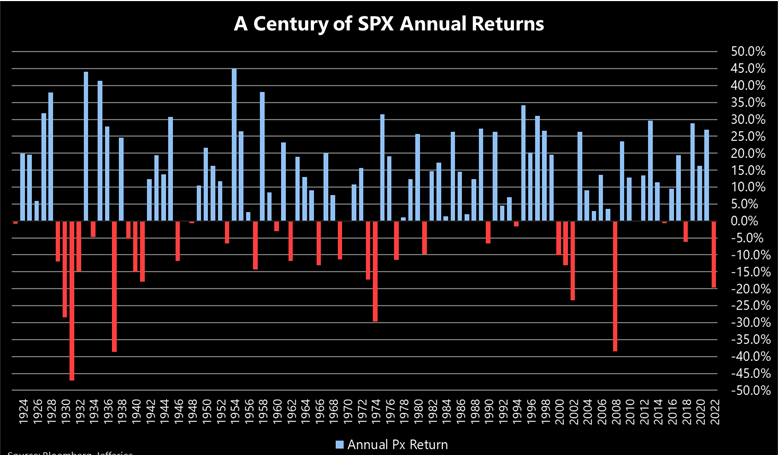


 But here’s an even better indicator: over the past 100 years, no bear market associated with a recession has bottomed before the recession has even begun.