The enemy of knowledge is not ignorance, it’s the illusion of knowledge (Stephen Hawking)

It ain’t what you don’t know that gets you into trouble. It’s what you know for sure that just ain’t so (Mark Twain)

Invest with smart knowledge and objective odds

THE DAILY EDGE: 14 NOVEMBER 2023

NFIB October Survey
image 

 image

image

image

image

image

Consumer spending fell in October, according to new CNBC/NRF Retail Monitor tracking card transactions

The consumer took a spending break ahead of the holiday season, with October retail sales, excluding autos and gas, falling by 0.08%, and core retail, which also removes restaurants, declining by 0.03%, according to the new CNBC/NRF Retail Monitor.

The new Retail Monitor, debuting Monday, is a joint product of CNBC and the National Retail Federation based on data from Affinity Solutions, a leading consumer purchase insights company. The data is sourced from more than 9 billion annual credit and debit card transactions collected and anonymized by Affinity and accounting for more than $500 billion in sales. The cards are issued by more than 1,400 financial institutions. (…)

October Retail Monitor

Year over year, overall retail and core retail sales are both up 2.6%. (…)

The number of seasonal positions publicly advertised this fall fell to the lowest level in a decade, according to outplacement-services firm Challenger, Gray & Christmas. The National Retail Federation estimates that between 345,000 to 445,000 seasonal workers will be hired this year, down as much as 40% from a recent high in 2021.

Shipping company XPO said it expects its head count to stay flat in the last three months of the year. The U.S. Postal Service said it would hire about one-third of the seasonal workers added last year. Macy’s announced that it was seeking about 3,000 fewer seasonal workers than in 2022. Target and United Parcel Service are expected to bring on a similar-size extra staff as last year. (…)

The National Retail Federation expects spending this holiday season, which it defines as Nov. 1 through Dec. 31, to grow 3% to 4%. That would be down from a 5.4% increase in holiday sales last year and a 12.7% jump in 2021, according to Commerce Department figures.

Second, retailers and logistics companies have caught up on pandemic staffing shortfalls and can meet additional demand by having current part-time employees work more hours. (…)

Warehouses and transportation companies employed 25,000 fewer people in October than a year earlier, after adding more than 400,000 workers over the prior year, according to the Labor Department. Retailers added 60,000 workers in October from a year earlier, a smaller annual increase than in the two previous years in the month when seasonal hiring starts to pick up.

Job openings in both sectors were down more than 15% at the end of September from a year before. (…)

Alien Companies unable to find workers in recent years also invested in labor-saving technology, and now may need fewer workers. For example, nearly a third of grocery-store transactions used self-checkout last year, according to FMI, the Food Industry Association. (…)

The new World Robotics report recorded 553,052 industrial robot installations in factories around the world – a growth rate of 5% in 2022, year-on-year. By region, 73% of all newly deployed robots were installed in Asia, 15% in Europe and 10% in the Americas.

image

(…) “In 2023 the industrial robot market is expected to grow by 7% to more than 590,000 units worldwide.”

China is by far the world´s largest market. In 2022, annual installations of 290,258 units replaced the previous record of 2021 by growth of 5%. This latest gain is remarkable since it even tops the 2021 result that was a 57% jump compared to 2020. To serve this dynamic market, domestic and international robot suppliers have established production plants in China and continuously increased capacity. On average, annual robot installations have grown by 13% each year (2017-2022). (…)

In the Americas, installations were up 8% to 56,053 units in 2022, surpassing the 2018 peak level (55,212 units). The United States, the largest regional market, accounted for 71% of the installations in the Americas in 2022. Robot installations were up by 10% to 39,576 units. This was just shy of the peak level of 40,373 units achieved in 2018. The main growth driver was the automotive industry that displayed surging installations by +47% (14,472 units). The share of the automotive industry has now grown back to 37%, followed by the metal and machinery industry (3,900 units) and the electrical/electronics industry (3,732 units).

The two other major markets are Mexico – here installations grew by 13% (6,000 units) – and Canada, where demand dropped by 24% (3,223 units). This was the result of lower demand from the automotive industry – the strongest adopter. (…)

Facts video on industrial robot shipment at the IFR YouTube channel: https://youtu.be/mtxMYJz4v2Y

China Mulls $137 Billion of New Funds to Aid Housing Market The plan is Beijing’s latest effort to shore up the struggling property market.

The People’s Bank of China would inject funds in phases through policy banks with the money ultimately trickling down to households for home purchases, the people said, asking not to be identified discussing a private matter. Officials are considering options including the so-called Pledged Supplemental Lending and special loans, the people said, adding that the government may take the first step as soon as this month. (…)

Dubbed by some as “helicopter money,” PSL allows the central bank to provide low-cost funds through policy and commercial lenders to the developers of the shantytown renovation projects. Developers then use the money to buy land from local governments, which in turn give cash subsidies to households whose old homes were demolished so they can purchase newly-built or existing apartments, driving up demand. (…)

China has ordered its local governments to halt public-private partnership projects identified as “problematic” and replaced a 10% budget spending allowance for these ventures with a vetting mechanism by Beijing as it tries to curb municipal debt risks. (…)

Local government debt reached 92 trillion yuan ($12.6 trillion), or 76% of China’s economic output in 2022, up from 62.2% in 2019, according to the latest data from the International Monetary Fund.

In an effort to constrain the accumulation of further debt, Beijing will eliminate a regulation allowing local governments to earmark up to 10% of their annual public budget expenditures toward these projects, the sources said.

The 10% expenditure threshold will now be replaced with government authorities’ review of each PPP project, they said. The move comes after numerous local governments’ PPP expenditure hit the upper limit of the threshold in recent years.

The State Council also asked the local governments to halt “problematic projects”, identified in inspections conducted by the National Audit Office (NAO) earlier this year, and address the identified issues, said the sources.

Projects designated as “problematic” are those riddled with irregularities including in which local government financing vehicles (LGFVs) posed as the “private” partner, spurring excessive debt accumulation, one of the sources said.

In addition to those measures, all PPP projects that have not finished bidding process to find partners by February this year will have to be suspended, said the two sources, who have direct knowledge of the State Council document.

Since 2014, Beijing has promoted a PPP model to channel private money into public infrastructure projects, to increase capital investment while easing the burden on heavily-indebted local governments.

But the PPP boom has alarmed authorities who say some local governments have used public-private partnerships, government investment funds and government procurement services as “disguised channels” for raising debt. (…)

As of the end-2022, China had implemented more than 14,000 PPP projects with the value of investment worth 20.9 trillion yuan ($2.87 trillion), or roughly the size of France’s economy, according to a research note by Bank of China. (…)

Reuters reported last month, citing sources with knowledge of the matter, that China has told state-owned banks to roll over existing local government debt with longer-term loans at lower interest rates.

The National Development and Reform Commission (NDRC), the top planner, and the finance ministry last week issued rules to encourage private firms to invest in PPP programs and allow them to take controlling stakes in some of those projects. (…)

Investors Dump Cash to Chase Bonds, BofA Survey Shows Investors turn to the first equity overweight since April 2022

(…) The BofA survey showed the conviction of peak Fed rates is now the strongest since the poll began asking investors to time the end of the rate hiking cycle. That’s prompted cautious investors to cut cash levels to 4.7% from 5.5%, down to a two-year low. (…)

“Investor playbook for 2024 is soft landing, lower rates” and a weaker dollar, the strategist wrote. (…)

But Reuters tells us that

U.S. corporate bond investors were focusing on companies deemed best able to withstand an economic downturn, according to a November survey by Bank of America (BAC.N) which found 59% of those surveyed listing a potential mild recession as their top concern, up from 56% in its prior survey.

Some 31% of survey participants saw a soft landing: slower but positive growth and lower inflation which translated to a relatively benign outlook for the U.S. economy in 2024. (…)

‘Great Quarter, Guys’ Fades for CEOs on Tougher Earnings Calls Kudos during earnings calls are down 29% so far this quarter

“Good quarter,” “congratulations” and similar plaudits are drying up on quarterly earnings calls for S&P 500 companies, setting up 2023 for the biggest such annual decline since the Great Recession. The drop is even more pronounced when compared with the pandemic era, running 35% below the average pace in the previous three years.

“Fewer companies are doing well,” said Alex Zukin, an analyst covering software companies at Wolfe Research. “There’s a higher volume of companies that are in a difficult environment really for the first time.”

It’s not that the recent quarterly results have been atrocious – in fact, 82% of S&P 500 members that have issued results so far topped analysts earnings expectations by an average of 7.6%, according to data compiled by Bloomberg, about double the average beat last year.

Still, even when the numbers are good, analysts may refrain from complements when the economic backdrop appears to be deteriorating. “There’s some sensitivity around giving someone a pat on the back in a tougher environment,” Michael Turrin, an analyst covering enterprise software stocks at Wells Fargo & Co., said in an interview. (…)

THE DAILY EDGE: 13 NOVEMBER 2023

LABOR MARKET WATCH

Some subtle shifts in the U.S. labor market:

  • Since August, 43% of Americans who entered the labor force had not found a job by mid-October.

image

  • Since August, the number of unemployeds rose 11.4% and is now 12.1% above its pre-pandemic level. Meanwhile, continuing unemployment claims turned up in September, back to their April level, meaning that it now takes longer to find jobs after losing one.

image

  • The next BLS measure of private job openings (for October in early December) is likely to show a meaningful drop judging by trends in Indeed Job Postings:

image

Consumer credit is already deteriorating amid a solid Q3 economy. The combo of high financing costs and rising unemployment could really accelerate the trend.

 Image Image

A few more stats:

  • Fitch Ratings reports that 6.1% of subprime auto loans were 60 days+ overdue in September, highest since 1994. Yes, 1994, not 2008 or 2009 as we would suspect. They peaked at 5.0% in January 2009. Student loan payments resumed in October.
  • Moody’s says that delinquency rates on newly opened credit card accounts are back to their 2008 levels.
  • Several companies, from staples producers (e.g. General Mills) to luxury goods merchants (e.g. Harley Davidson, Malibu Boats) recently warned of changing consumer behavior impacting their Q4 revenues.
  • A recent survey of auto dealers revealed that financing availability for new car buyers is tougher to get across 62% of auto dealers.
  • In October, more than 90% of Affirm’s interest-bearing volume was offered with annual percentage rates up to 36%. And it has managed to keep its credit performance steady. Its 30-plus-day delinquency rate, excluding for its pay-in-four installments, was 2.4% in the quarter, down from 2.7% a year prior. Hmmm…
US Consumer Long-Term Inflation Expectations Reach 12-Year High Inflation views over 5-10 years rose to 3.2% in November

Consumers expect prices will climb at an annual rate of 3.2% over the next five to 10 years, up from 3% a month earlier, according to the preliminary November reading from the University of Michigan. They see costs rising 4.4% over the next year, compared to last month’s 4.2%, according to data released Friday. (…)

Nearly one in five consumers surveyed said that unemployment will cause more hardship than inflation over the coming year. The government’s latest jobs report showed hiring was concentrated in only a few sectors, while the unemployment rate climbed to the highest level since the start of 2022. (…)

An index of buying conditions for durable goods slumped from a month earlier by the most since November of last year. A record 36% of consumers spontaneously blamed high borrowing costs or tight credit conditions for poor motor-vehicle purchase conditions. The share of consumers blaming similar factors for poor home and durable goods buying conditions was the highest since 1982. (…)

China’s Consumption Recovery Is Losing Momentum, Data Show Alternative indicators show weakening consumer demand

An indicator of Chinese consumer demand for recreation and transport published by Paris-based QuantCube Technology, along with an independent survey of consumer sentiment by US company Morning Consult, both fell in October from the previous month. A poll of private business sentiment from the Cheung Kong Graduate School of Business also declined in the month. (…)

The QuantCube indicators are based on alternative data sources, such as web search queries, transportation figures reflecting people’s movements, and consumer reviews. (…)

Retail sales growth generated by China’s biggest online shopping festival, which runs from October through November, was slower than in previous years. The value of sales rose 2.1% from last year, significantly lower than the 14% increase recorded in 2022, and apparently the lowest in many years, Nomura Holdings Inc. economists led by Lu Ting said in a note citing third party data.

China’s property sector also shows signs of worsening this month, Nomura said, with sales in 21 major cities falling 44% from 2019 levels in the early weeks of November. That’s similar to the pace of contraction in July, before Beijing started a new round of property easing measures, the bank said. (…)

Data provider Syntun, meanwhile, estimated cumulative gross merchandising volume (GMV) sales across major e-commerce platforms rose 2.08% to 1.14 trillion yuan ($156.40 billion) compared with growth of 2.9% last year. (…)

The GMV figures take into account the value of all orders placed, and do not capture the amount that will be returned later.

Analysts and industry executives expect return rates to be high this year as consumers buy more in order to obtain larger discounts on checkout, only to return the items they do not need.

A Bain and Company report released last week found that 77% of the 3,000 consumers it surveyed had planned to spend less or the same amount on Singles Day compared with last year. (…)

(…) The lobby association expects nominal sales growth of 1.5% for November and December — a drop of 5.5% after taking the annual increase in consumer prices into account.

For the full year, including the food sector, it confirmed its prediction for sales to increase by some 3% to about €650 billion ($695 billion) — a decline of 4% after factoring in inflation. (…)

US Credit-Rating Outlook Changed to Negative by Moody’s Assessor cites risks from deficits, political polarization

The US was threatened with the loss of its last top credit rating on Friday, as Moody’s Investors Service signaled it was inclined to downgrade the nation because of wider budget deficits and political polarization.

The rating assessor lowered the outlook to negative from stable while affirming the nation’s rating at Aaa, the highest investment-grade notch. Amid higher interest rates, without measures to reduce spending or boost revenue, fiscal deficits will likely “remain very large, significantly weakening debt affordability,” Moody’s said.

“Interest rates have shifted materially and structurally higher,” William Foster, a senior credit officer at Moody’s, said in an interview. “This is the new environment for rates. Our expectation is that these higher rates and deficits around 6% of GDP for the next several years, and possibly higher, means that debt affordability will continue to pressure the US.” (…)

Moody’s sees federal interest payments relative to revenue and gross domestic product rising to around 26% and 4.5% by 2033, respectively, from 9.7% and 1.9% in 2022, according to Friday’s report. Those projections reflect the likelihood of higher-for-longer interest rates, the company said, with the average annual 10-year Treasury yield peaking at around 4.5% in 2024. (…)

Nordea:

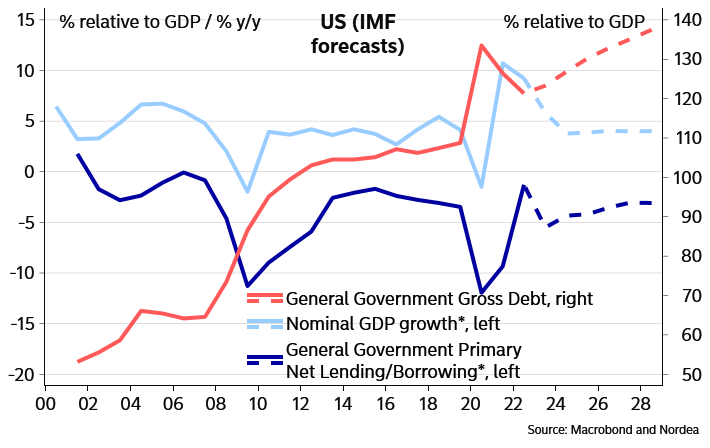
A US debt crisis is seldom seen as an imminent threat, and we do not expect such a crisis to surface any time soon either. (…) But the outlook is more worrying due to the massive primary deficits the US is running. One does not need to do any stress testing on the IMF baseline forecasts to find a rising debt-to-GDP ratio.

US public debt on a worrying path

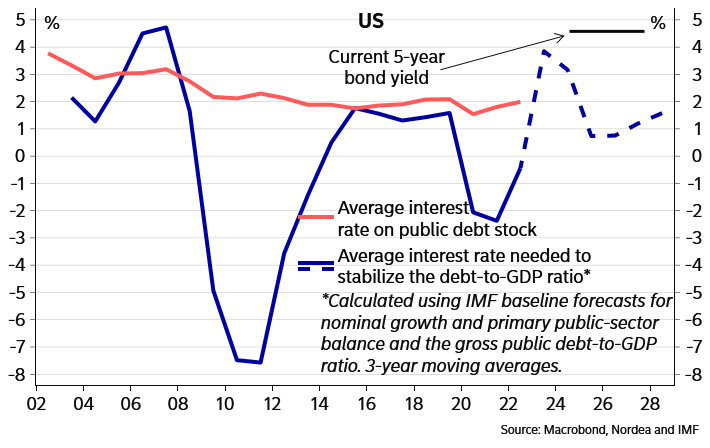
On a path set by the IMF forecasts for the following five years, the average interest rate that would stabilise the debt-to-GDP ratio is in the order of 1-2%. This is not far from the average interest rate on the debt stock of around 2% last year, but at current yield levels the average interest rises rapidly (around a third of US public debt matures over the next 12 months), putting the US debt on an unsustainable trajectory.

US debt metrics not compatible with the current level of interest rates

This is not to say that we expect to see a US debt crisis in the near future. Far from it. The global role of the dollar and the Treasury market allow the US to run irresponsible fiscal policies for longer than other countries, and we are unlikely to be close to the breaking point. And buying by the Fed also serves as a backstop, if needed. As we have argued before, cyclical considerations and new signals from central banks are a more likely driver of long bond yields than rising debt worries.

However, this does not mean that the US fiscal outlook would not pose considerable risks. Market focus could easily stay on the debt outlook and the huge amount of bonds that private investors have to buy at a time when the central bank is reducing its holdings, which could yet propel yields higher.

Government debt burdens can quickly become unsustainable if the willingness to finance new borrowing vanishes. The higher the debt burden, the higher the risk of this happening. As stated above, we do not think we are near such a point, but such risks certainly cannot be disregarded.

EARNINGS WATCH

Pre-announcements look ok only when compared with Q3’23 at the same time but last week was quite poor: of last week’s 18 pre-announcements, 16 were negative. Are we going to see the inverse of the Q2 trend which started poorly (3.0 N/P on July 28 with 112 pre-announcements but gradually improved in subsequent weeks? Remember GDP jumped 4.9% in Q3 with strong consumer spending.

image

Analysts keep revising upward however:

image

image

Yet, estimates for Q4 EPS are +5.8%, down from +11.0% on Oct. 1 and down from +7.0% last week. Go figure!

Note also that FactSet numbers are weaker:

  • For the third quarter, the S&P 500 is reporting (year-over-year) earnings growth of 4.1%. [LSEG is at +6.3%]
  • For the fourth quarter, analysts are now projecting (year-over-year) earnings growth of only 3.2%. [LSEG is at +5.8%]

Trailing EPS are now $218.73. Full year 2023: $220.62e. Forward EPS: $236.29e. Full year 2024: $245.31e. All per LSEG/IBES which most pros use.

Rosenberg Research:

While headline S&P 500 earnings per share (EPS) growth is running at +2.5% in Q3, that glow is being masked by just 7 stocks. Like the price action throughout much of 2023, the “Magnificent 7” (Tesla, Nvidia, Meta, Amazon, Alphabet, Microsoft and Apple) is doing all the heavy lifting — earnings are growing at a whopping +59% YoY pace.

The remaining companies are seeing a profit decline of -13%. This trend is expected to continue into the next quarter as well, with the Magnificent 7 projected to see a +45% net income surge with the rest at -2%.

(…) if we update our guidance tracker, which looks at available Bloomberg data and compares S&P 500 company projections to analyst expectations, we note that nearly 80% of revenue guidance for the coming Q4 reporting season have missed estimates; for EPS that number is at 60%.

Looking at full year guidance, 60% of revenue guidance has missed while 40% of EPS have done so as well. The fact that companies look to be facing pressure on the sales front is rather concerning for two reasons: i) it makes any growth in EPS of lower quality (managing costs rather than a demand pick-up) and ii) the close ties with nominal GDP growth.

This chart is from Goldman Sachs:

I have shown before how rising interest expense is biting into corporate profits. This chart via Callum Thomas shows how cash rich companies are benefitting from Fed tightening. All of the “Magnificient Seven” contribute to the grey line:

Source:  Substack Notes Platform

Feeling contrarian?

Hezbollah Fires at Israeli Infantry Across Border