August CPI: Probably a 25 bps Rate Cut Next Week
The 0.2% increase in headline CPI was in line with expectations, while the 0.3% [0.28%] increase in core CPI was slightly higher than consensus forecasts. Another month of tepid food inflation and falling energy prices kept headline inflation in check.
(…) A larger-than-expected drop in prices for core goods was more than offset by faster-than-expected services inflation. (…)
Primary shelter inflation also came in high relative to our expectations and at odds with leading indicators from private sector data sources. Overall, we see the lingering split between goods and services inflation as a sign that the unwinding of pandemic-era effects on prices is taking somewhat longer, rather than as an indication disinflation is running out of steam. (…)
The ongoing deterioration in the labor market has become an increasing focus for the FOMC, and inflation is slowly but surely returning to 2% on trend. The core CPI has increased at a 2.1% annualized pace over the past three months, a slow enough pace that 50 bps rate cuts at future meetings remain squarely on the table if the labor market data spur faster action. Regardless, all signs point to additional rate cuts beyond next week in our view.
(…) Based on the limited data available for September and the recent trend in oil prices, another decline in energy prices appears likely to come in next month’s CPI release. Food inflation also continued its run of relatively benign gains, rising 0.1% in August. Price growth for food consumed away from home (0.3% month-over-month and 4.0% year-over-year) once again outpaced inflation at the grocery store (prices unchanged over the month and up 0.9% compared to one year ago).
Monetary policymakers like those at the Federal Reserve tend to focus on inflation excluding food and energy given that these two components are quite volatile and their prices are often determined by factors other than the stance of monetary policy. That said, headline inflation better reflects the price growth that consumers experience in their daily lives. Much slower food and energy inflation over the past year has brought good news for households on the inflation front. The 2.5% increase in the headline CPI over the past 12 months is more or less in line with where this indicator was on the eve of the pandemic (2.3% in February 2020).
Core inflation picked up in August, rising 0.3% after a 0.2% gain in July. The slower pace of disinflation when excluding food and energy comes amid what is still rather sticky services inflation.
Core services prices advanced 0.4% in August, the largest increase since April. The moderation in shelter inflation remains painfully slow. Despite the notably lower pace of rental inflation signaled by private sector measures, primary shelter (the weighted average of rent of primary residences and owners’ equivalent rent) rose 0.5% in August. We have not given up the view that shelter inflation should slow more materially ahead, with the BLS’s All Tenant Rent Index having fallen sharply. That said, the stubbornly high pace of official shelter inflation raises some doubts about the extent to which it may ultimately ease further this cycle.
Core services ex-shelter also got a boost in August from higher travel-related prices (lodging away from home +1.8%, airfares +3.9%). Given that these categories are some of the more volatile components of core services, we are less concerned about their monthly rise in the context of further services disinflation ahead. (…)
While core prices rose more in August relative to the prior three-month average pace of monthly gains (0.13%), the early summer pace likely understated the trend in inflation just as the first quarter’s average gain of 0.37% seemed to overstate it. August’s figures likely give a somewhat cleaner read, in our view. The three-month annualized rate of core CPI inflation was just 2.1% in August, below the year-over-year pace of 3.2%. With food and energy related commodity prices having retreated of late and ongoing cooling in the labor market, we expect inflation to remain in check in the months to come. (…)


The Fed’s luck continues (see Lucky Fed):
- Goods deflated 0.2% MoM in August after –0,3% in July. They are down 1.9% YoY. Not because the Fed succeeded to tame demand (real spending on durables is up 6.4% in the last 2 years, +2.9% YoY in July), but because China keeps flooding the world with surplus goods shunned by its own consumers. Nothing on this chart suggests that tight money tamed demand for goods.

- CPI-Energy dropped 0.8% MoM after declining 4.0% sequentially in the previous 3 months. It is down 10.1% YoY, all because oil prices declined (electricity costs are up 3.9% YoY). The IEA revealed yesterday that “Chinese [oil] demand contracted in July for a fourth straight month, and fuel use elsewhere is “tepid at best,” the report said. Beijing’s oil imports have dwindled to the lowest in almost two years amid an economic slowdown marked by weak consumer confidence.
“Chinese economic growth is slowing down, and the penetration of the transportation system by electric cars is going at a very strong pace,” Fatih Birol, the agency’s executive director, said in an interview from Paris.” - We all look at core CPI, but energy is a large part of service providers costs and thus impacts services inflation not to mention how it also helps transportation and heating costs for just about everything.
- CPI services rose 0.4% MoM in August after +0.3% in July, +4.3% a.r. in the last 2 months. It is up 4.8% YoY in August, and even after removing shelter, was still up 4.3%. Non-housing services prices increased 0.33% last month, +4.1% annualized and the most since April.
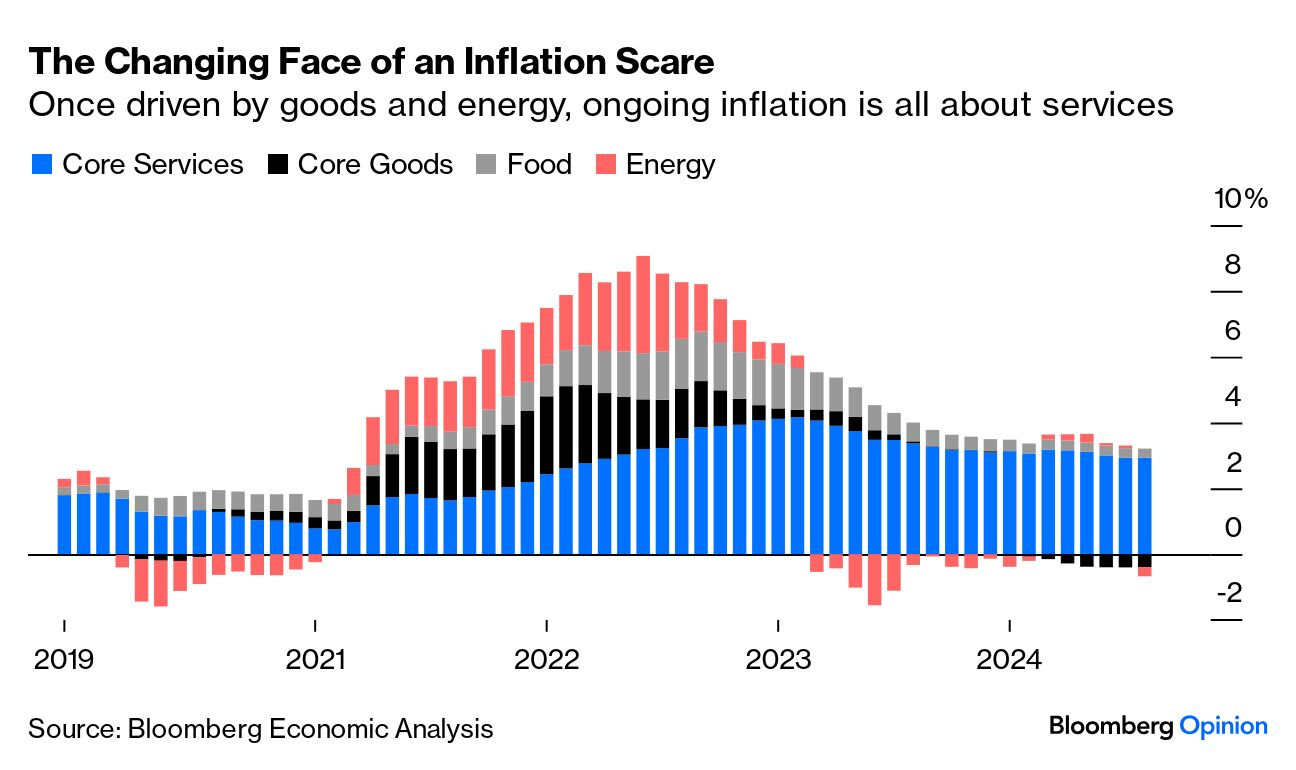
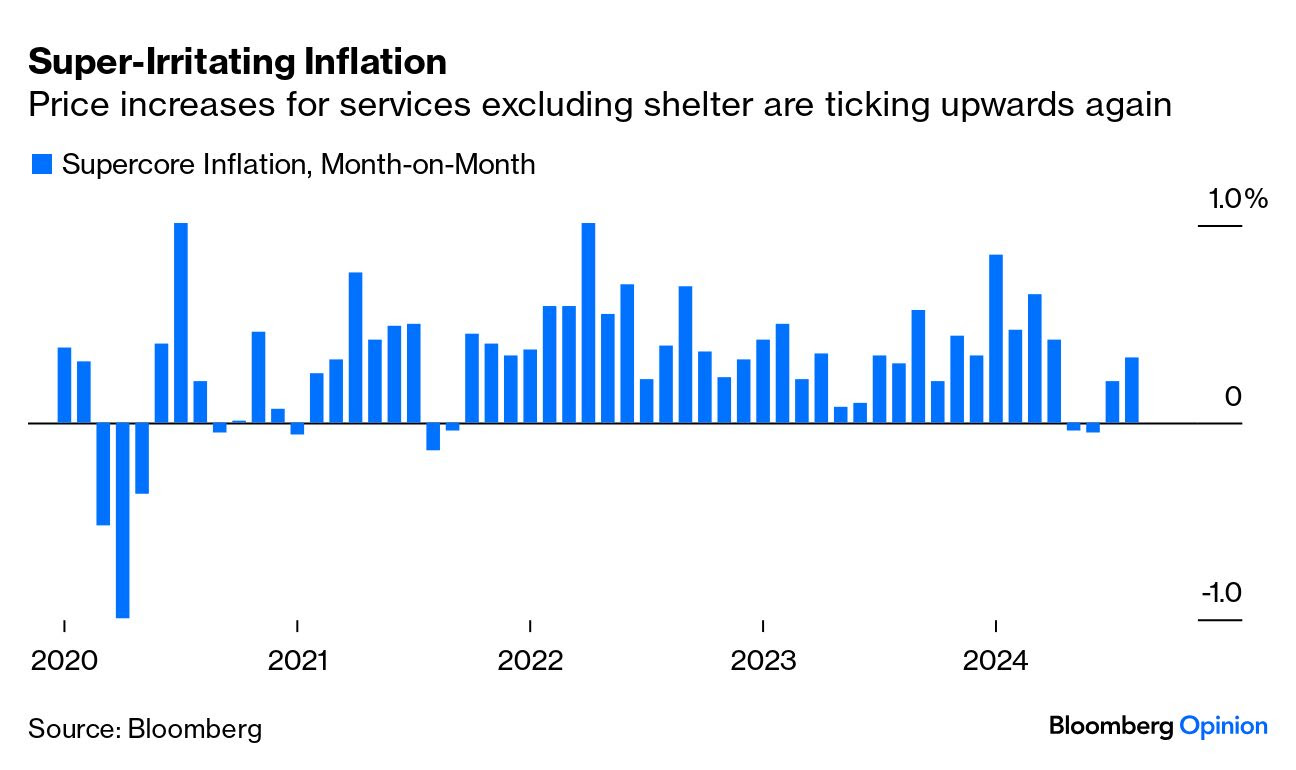
- As John Authers show, “the anti-core — an index of just food and energy — is now, remarkably, showing deflation. As calculated by Bloomberg Opinion’s data editor Carolyn Silverman, anti-core now stands at -0.1%. The peak above 20% two years ago matched anything seen during the shocks of the 1970s, but it’s over. The Fed has set much store by the “supercore” measure of services excluding shelter. This is most directly exposed to wages, and should therefore be drivable by monetary policy (unlike food and fuel). It’s proving stubborn, and on a month-on-month basis has ticked up very slightly.
- Is this a sustainable trend?

- And those stubborn rents: shelter prices, the largest category within services, climbed 0.5%, the most since the start of the year. That marked the second month of acceleration and defied widespread expectations for a downshift.
In all, there is no such thing as an immaculate disinflation. China’s inability to boost its domestic economy deflated imported goods and oil prices which kept inflation and inflation expectations anchored. Part of the normalization of the labor market came from surging immigration.
Meanwhile, Beijing keeps trying to boost its domestic demand.
China to Cut Rates on $5 Trillion Mortgages as Soon as September
China is poised to cut interest rates on more than $5 trillion of outstanding mortgages as early as this month, according to people familiar with the matter, as it accelerates a move to reduce the borrowing costs for millions of families to spur consumption. (…)
Some homeowners may enjoy up to 50 basis points of immediate rate reduction, one of the people said. (…) The proposed cuts will likely come in two steps totaling about 80 basis points, people familiar with the matter said. (…)
Existing mortgages carry an average interest rate of about 4%, compared with 3.2% on newly-issued loans for a first home and 3.5% for a second home, according to data compiled by China Real Estate Information Corp in late August.
China’s outstanding amount of mortgages, which count as prime assets at Chinese lenders, stood at 37.79 trillion yuan ($5.3 trillion) at the end of June, the lowest level in nearly three years. Further rate reductions would pile pressure on the banks, which have already seen their margin tumble to a record low of 1.54% as of end-June, well below the 1.8% threshold regarded as necessary to maintain reasonable profitability.
Homeowners would save more than 300 billion yuan in annual interest expenses assuming an 80 basis points cut, analysts at Shenwan Hongyuan Group estimated. For a household with 1 million yuan of 30-year mortgages, its monthly payment will drop by about 9%, they said. (…)
US businesses’ optimism in China falls to record low, survey shows
Only 47% of U.S. firms were optimistic about their five-year China business outlook, a drop of five percentage points from last year, according to the survey published on Thursday by the American Chamber of Commerce in Shanghai. This was the weakest level of optimism reported since the AmCham Shanghai Annual China Business Report was introduced in 1999. Also at record lows were the number of firms profitable in 2023, at 66%. (…)
The 306 U.S. firms polled were from a range of industries. U.S. foreign direct investment into China fell 14% to $163 billion in 2023 from the previous year, according to the U.S. State Department. (…)
The bilateral relationship was cited by 66% of respondents as their biggest challenge and by 70% as the greatest challenge to China’s economic growth.
On a marginally positive note, there was a slight uptick from last year – to 35% – in businesses reported believing China’s regulatory environment is transparent. However, there was also a rise to 60% in companies that reported favouritism toward local companies.
- Western Firms That Flocked to China Are Now Pulling Back As China’s growth slows and the difficulty of doing business there rises, Western companies have stopped plowing money into the country
(…) China has noticed. In August, the Shanghai city government said one of its most pressing economic challenges was the hollowing out of the “fruit chain”—a reference to Apple’s move to diversify production of some electronics to countries such as India and Vietnam.
Driving these decisions are a prolonged economic slump, intensifying local competition, geopolitical tensions and the rise of alternative manufacturing destinations in Asia. Business chambers say profit margins in China no longer outshine other markets. (…)
Last year, foreign investment into China fell 8% from the previous year in yuan terms. According to United Nations figures, Indonesia, with a far smaller population than China, is drawing more so-called greenfield investment in which facilities are built from the ground up.
To be sure, most companies aren’t abandoning China. The majority are trying to maintain existing operations, with some saying that staying abreast of Chinese technology helps them sharpen their competitive edge. (…)
In an annual survey by the EU chamber conducted in May, 15% of the respondents said China was their top investment destination. For years, about 20% of the respondents had said so.
In another poll, about 20% of the 306 respondents surveyed by the American chamber in Shanghai said they would be cutting investment in China this year, citing concerns about growth and moves to redirect investments to places such as India and Vietnam. (…)
Shanghai’s economic-planning agency said last month that the decline in foreign investment in Shanghai was partly because of multinational companies such as suppliers to Apple shifting production capacity out, according to The Paper, a news outlet backed by the Shanghai government. (…)
Even so, for companies with the right product, China is still too big to ignore. In cars, it is the world’s largest market by unit sales.
If domestic demand picks up, China will return to becoming a top investment priority for multinationals again, said Allan Gabor, the chair of the American chamber in Shanghai. (…)
Adam Tooze on the Big Misconceptions of the Chinese Economy Should we really be talking about excess capacity?
There’s a constant line of argument that China is unfairly flooding the world with unprofitable goods and creating huge, unsustainable imbalances. Western countries, particularly the US (but also Europe), have responded by raising tariffs and engaging in domestic industrial policy in order to compete. On this episode of the podcast, we speak with Columbia Professor Adam Tooze, the author of several books, as well as the popular Chartbook newsletter. He argues that the overcapacity framing is misguided, and that the US may be making a mistake putting its chips down on an industrial revival. He talks us through some of the actual weaknesses of the Chinese model, as well as its global political reverberations.
 BTW: Earlier this week, S&P lowered its forecast for U.S. 2024 EV sales penetration to 9% from 12%. Its EV penetration forecasts for ‘30/’35 was also revised down from 46% to 36% & 64% to 58%, respectively. Evercore/ISI estimates that China/EU account for 80% of global EV sales and forecasts ~16.5MM global NEV sales this year (+17-19% YoY).
Yesterday, BYD said that it now expects its sales to reach 4M (prev 3.6M) for 30%+ YoY growth. BYD’s Chinese NEV market share is mid-30% as well as export of ~500K vehicles in ‘24. “BYD is now 2x+ TSLA and accounts for 1 out of 4 NEVs sold GLOBALLY!” (EvrISI)