The so-called core personal consumption expenditures price index, which excludes food and energy items, increased 0.1% from October and 2.8% from a year earlier, according to Bureau of Economic Analysis data out Friday. The monthly advance was the slowest since May.

The data marks one of the first reports indicating renewed progress on inflation after stalling in recent months. That had prompted Fed officials to update forecasts earlier this week showing a higher path for prices and interest rates in 2025, which helped trigger a broad market selloff.
“Overall, this is just what the Fed ordered — US economic strength continues, but with muted price pressures,” Paul Ashworth, the chief North America economist at Capital Economics, said in a note.
New York Fed President John Williams, speaking on CNBC just minutes after the release of the data, called the latest numbers “encouraging,” adding that he expects the central bank to continue moving its benchmark rate down toward a neutral level. (…)
Details on prices showed a broad-based deceleration. Core services prices — a closely watched category that excludes housing and energy — rose 0.2% from a month earlier, the slowest since August. Core goods prices — which excludes food and energy — fell for the first time in three months.
The report also showed healthy increases in incomes and spending. Adjusted for inflation, spending advanced 0.3%, indicating consumer resilience during the critical holiday shopping season.
That was mostly driven by purchases of goods, which rebounded from the prior month due in part to cars. Meanwhile, real spending on services was the weakest since the start of the year.
Spending continues to be supported by solid earnings. Wages and salaries grew 0.6% in November, the most since March. However, overall disposable income rose just 0.3%, restrained by declines in dividend income and government benefits. (…)
Right after the FOMC expressed a renewed, and justifiable, inflation angst, November core PCE inflation slumped to +0.11% (+1.3% a.r.) thanks to PCE-services inflation slowing from +0.33% on average in Sep-Oct. to +0.17% (+2.0% a.r.), breaking a 5-month streak of accelerating inflation rates.

Remarkably, goods inflation was zero across both durables and nondurables and PCE-services inflation was cut in half to +0.17% after averaging +0.3% since June. Even Supercore PCED was a low 1.9% annualized.
Inflation nirvana?
Alas, no. This PCE-inflation nirvana may not survive one or two months because the CPI-inflation data suggest otherwise.
PCE and CPI-services inflation are understandably highly correlated with annual CPI-services inflation averaging 0.3% above PCE-services inflation over the last 20 years.
Curiously, the monthly volatility between the two series has greatly increased since the summer of 2023 with the PCE measure displaying unusually erratic monthly swings. Five times since July 2023, PCE-services had monthly drops unconfirmed by the CPI and every time these corrected towards the CPI data which, incidentally, came in at +0.31% MoM in November, in line with the previous 3 months.

That said, let’s not forget the latest flash PMI survey for December:
Inflationary pressures meanwhile cooled further at the headline level in December (…). Average prices charged for goods and services rose only very modestly, increasing at the slowest rate since prices began rising in June 2020.
The latest easing pushed the rate of inflation further below the pre-pandemic long-run average, with an especially low rate of inflation again evident in the services economy, where charges rose only marginally and at the slowest rate since May 2020.
This in spite of
The headline S&P Global Flash US PMI Composite Output Index rose from 54.9 in November to 56.6 in December, signaling the fastest expansion of business activity since March 2022. Activity levels were expanded at an increased rate in December in response to strengthening demand. New orders rose at the sharpest rate since April 2022.
If pandemic months are excluded, the latest service sector expansion was the strongest recorded since March 2015 (…). New orders for services rose at a rate not witnessed since March 2022.
Employment edged higher in December, up for the first time in five months, reflecting a second successive monthly rise in manufacturing jobs and the first increase in service sector employment since July. The increase in both sectors was only modest, however.
The productivity boom is alive and well, even amid surging demand. The U.S. is in an economic slowflation boom.
KKR illustrates the post-Covid productivity gains and provides a solid analysis, suggesting non-inflationary government spending:

Technology diffusion continues to exert an important influence on the economy. Much of this stems from advancements made during the pandemic, including surging cloud and virtualization investment, which we see as ongoing tailwinds to worker productivity. Additionally, AI is now finally beginning to play a role. Beyond what we are starting to see in our portfolio companies, a recent survey by Morgan Stanley showed that around 90% of the businesses surveyed are seeing ROI on AI-related initiatives meeting or exceeding expectations, particularly in areas like call center operations and salesforce efficiency.
Fiscal policy has been a significant enabler of productivity gains. Government programs such as the IIJA, CHIP Act, and IRA have led to a private manufacturing boom (though the pace has slowed). Instead of crowding out the private sector, we believe that strategic industrial policy helped companies overcome initial hurdle rates, as the private sector became more confident that the government was there to backstop final demand.
We believe fiscal policy remains expansionary. The deficit isn’t contracting, particularly concerning CHIPS and IRA spending, which — while no longer surging — still should support net growth. For instance, companies will now need to spend on equipment to outfit the new facilities they have built.
Our job growth forecasts are slightly below consensus, but we believe the growth of GDP-per-employee is now running at a higher run-rate. Against this backdrop, we expect the U.S. to outperform from a growth perspective.

November’s Personal Income and Outlays release has more than inflation data.
- Growth in Compensation of employees accelerated further to +0.6% MoM from a +0.45% monthly average in the previous 3 months. Last 3 months annualized: +6.1%.
- Same data for Wages and Salaries.
- Disposable Income rose 0.3%, +5.7% a.r. in the last 3 months.
- Real expenditures rose 0.3%, +3.6% a.r. in the last 3 months, after +2.4% in the previous 3 months.
- Real spending on goods remains very strong at +0.7%, +7.4% a.r. in the last 3 months. Durables: +1.8% MoM, +14.3% a.r. in the last 3 months. On a YoY basis: +5.7% in November!
- Real spending on services rose only 0.07%, a sharp slowdown from the +0.22% monthly growth rate in the previous 5 months. I find this November number dubious given the strong demand seen in the PMI surveys.
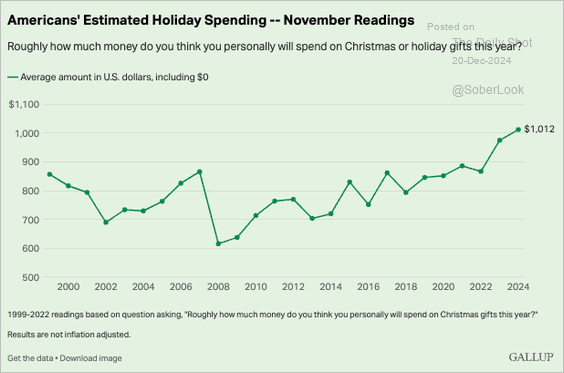
Estimated holiday spending
 Source: Gallup
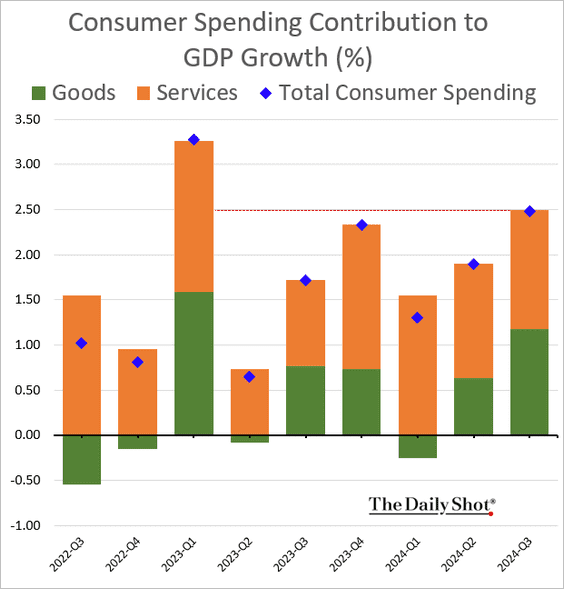
The Daily Shot illustrates the driving force the consumer has on the economy.
Under the agreement announced Friday, VW said it would gradually reduce staffing levels “in a socially responsible way,” through early retirement and other measures. Workers will also forgo pay increases and lose certain bonuses. In exchange, the company agreed to not make any forced job cuts until 2030 and to keep all its German factories open. (…)
VW had said in September that it was considering closing factories in Germany for the first time in its history in a bid to boost its competitiveness. The weak recovery of Europe’s car market following the pandemic had left it with capacity to make very roughly 500,000 more cars than it needed—two factories’ worth, the company said at the time. (…)
At the heart of the deal is a novel cost-control tactic initially proposed by the union. Pay increases won’t go directly to workers but will instead fund measures such as early retirement to help the company cut costs without relying on layoffs.
The staffing and bonus reductions will reduce VW’s annual costs by 1.5 billion euros, equivalent to $1.7 billion. Taken together with factory-capacity adjustments and other measures, annual savings will rise to €4 billion, the company said.
While the deal avoids factory closures today, Volkswagen’s two smallest German plants face an uncertain future. Its factory in Osnabrück doesn’t have a clear purpose after 2027, when production of the VW T-Roc convertible will end, while production of the ID.3 EV in Dresden will stop in about a year’s time. VW said it is looking for alternative uses.
VW is the largest automaker in Europe, where vehicle sales are running almost a fifth below their prepandemic level. (…)
VW isn’t alone in its struggles. Stellantis, Europe’s second-largest carmaker with brands such as Peugeot, Opel and Fiat, has repeatedly paused production in its Italian factories to keep inventories under control, leading to a standoff with unions and the government in Rome.
Foreshadowing the truce at VW, Stellantis moved to ease tensions in Italy earlier this week, committing to maintaining its current factory footprint and staffing levels in the country.
While the compromises bring workers relief ahead of the Christmas holiday period, they only partially address the fundamental problem that many European car factories are underused following the protracted sales slump, with little sign of relief.
Stellantis’s factories in the region will only run at 64% of their capacity on average this year, the lowest in the peer group, according to an analysis by brokerage Jefferies. Ford and Nissan, which have both announced big layoffs, also have weak capacity utilization, the numbers show.
Volkswagen’s European factories are producing 84% of their maximum output, adjusting for the planned closure of an Audi factory in Belgium, but the numbers in its German home territory are weaker, Jefferies noted.
“We will manage so we don’t have to fire people,” said a person close to Stellantis in Italy. “But everything in terms of job levels is dependent on levels of sales.”
Germany’s Gerhardi Kunststofftechnik GmbH weathered Napoleon’s invasion, the Great Depression and two world wars. But Europe’s current auto slump has brought the plastics manufacturer to its knees.
Founded in 1796, Gerhardi started out making metal products before riding Germany’s postwar automotive boom. Its mastery of injection molding and hot stamping made it a trusted supplier of grills, handles and chrome trims for Mercedes-Benz Group AG. But last month, after a protracted period of rising costs and withering demand, the company filed for bankruptcy, plunging its 1,500 employees into an uncertain future.
Gerhardi — which makes the plastic star mounted on the grill of Mercedes sedans — is one of hundreds of small manufacturers in Europe’s automotive supply chain that are struggling to stay afloat as carmakers slash production to cope with weak sales and a rocky transition to electric vehicles. With painful cuts planned at Volkswagen AG, Stellantis NV and Ford Motor Co., their situation could get worse.
France’s Forvia SE, which makes components for Stellantis and Volkswagen, is cutting thousands of jobs as the shift to EVs makes traditional products like transmissions and exhaust systems obsolete. But suppliers linked to EVs — like Swedish battery maker Northvolt AB — are also sufffering after governments pulled back subsidies and sales cratered.
This year, European parts makers have announced 53,300 job cuts, most of which in Germany, according to the CLEPA industry lobby. That’s more than during the coronavirus pandemic, when factories and showrooms shuttered for months. And with the continent’s high energy prices, red tape and the threat of worsening trade ties with the US, next year looks similarly grim, said Matthias Zink, the group’s president.
“It’s a perfect storm,” Zink said in an interview. “Companies have invested heavily in anticipation of a surge in electric vehicle sales that hasn’t happened.”
Automotive suppliers employ around 1.7 million workers across the European Union and spend some €30 billion ($31.2 billion) each year on research and development. They range from large conglomerates like Germany’s Robert Bosch GmbH to the hundreds of smaller hidden champions that are often the economic backbone of their communities.
According to consulting firm McKinsey, one in five auto suppliers expects to lose money next year after two-thirds reported margins of 5% or less in 2024. (…)
And while Northvolt’s US bankruptcy filing has been the most high-profile setback, the fallout is spreading, with 11 out of 16 planned European-led battery factories delayed or canceled, according to a Bloomberg News analysis. (…)
“Manufacturers are slowing down and stopping production lines, which is having a profound impact on the supply base.” (…)
“Numerous suppliers and the entire retail and service structure depend directly or indirectly on the company overcoming the crisis and being securely positioned for the future,” the local branch of union IG Metall said. (…)
Wall Street’s biggest firms have issued their latest forecasts for the S&P 500 in 2025. They sound a lot like the predictions they made over the last few years. And the years before that.
If hearing the brokerages’ average 2025 forecast of a 9.1% gain is giving you a sense of déjà vu, you’re onto something. Over the past 25 years, 53% of the 376 firm forecasts surveyed by Bloomberg clustered between 0% and 10%.

This might be understandable if annual market returns were scattered in the same way. In reality, they’re far more volatile:

(…) In seven of the past eight years, the market’s returns were outside the range of all forecasts compiled, often collectively underestimating the index’s return potential.

In fact, a similar pattern holds not just over the forecasting period, but over the prior century as well. Large gains and losses were more frequent than single-digit gains, which occurred just 14 times in 97 years.
Naturally, this disparity between forecasts and the historical record must lead to some unflattering results. Strategists on average missed the mark by more than 15 percentage points, though some were better than others. Still, even the “best” firm was off by an average of 10 points.
These errors tend to fall on the side of being too pessimistic, as 57% of all forecasts analyzed were less than the actual market returns, while 43% proved to be too high.
Professional forecasters prefer the 0 to 10% range because it aligns with the historical average, says Elliott Appel, a financial planner in Madison, WI. Clients may tolerate a mid-range miss more than an extreme one. “You look silly if you forecast 30% and the market is down 20%. If you forecast 10% and the market is down 20%, you are closer, and it’s easier to make an excuse for why the market went down. You can tell a story that sounds good that preserves your reputation.”
So what should average investors do with any given stock-market forecast they come across? Nothing, according to Elliott. “They should treat it as entertainment, much like you would a sports match.”
Quote of the year?
“What’s so bad about deflation?” he (Xi Jingping) asked his advisers, according to people close to Beijing’s decision-making. “Don’t people like it when things are cheaper?”


