The enemy of knowledge is not ignorance, it’s the illusion of knowledge (Stephen Hawking)

It ain’t what you don’t know that gets you into trouble. It’s what you know for sure that just ain’t so (Mark Twain)

Invest with smart knowledge and objective odds

YOUR DAILY EDGE: 14 May 2025

Airplane Note: I am travelling until mid-May. Postings will be irregular.

The Great Trump Tariff Rollback The President started a trade war with Adam Smith. He lost.

The WSJ Editorial Board:

Rarely has an economic policy been repudiated as soundly, and as quickly, as President Trump’s Liberation Day tariffs—and by Mr. Trump’s own hand. Witness the agreement Monday morning to scale back his punitive tariffs on China—his second major retreat in less than a week. This is a win for economic reality, and for American prosperity.

Make that a partial win for reality. The Administration agreed to scrap most of the 145% tariff Mr. Trump imposed on Chinese goods on April 2 and later. What remains is his new 10% global base-line tariff, plus the separate 20% levy putatively tied to China’s role in the fentanyl trade, for a total rate of 30%. In exchange, Beijing will reduce its retaliatory tariff to 10% from 125%. The deal is good for 90 days to start, as negotiations continue.

Investors are cheering at this border-tax reprieve, since this is a step back from mutual assured trade destruction. (…)

The 30% tariff is still exceptionally high for a major trading partner, but the 90-day rollback spares both sides from what looked like an impending economic crackup. U.S. consumers were facing widespread shortages, while China feared growing unemployment.

As with last week’s modest British agreement, the China deal is more surrender than Trump victory. Apart from the tariff rollback, neither side announced any broader concessions on the substantive trade issues that weigh on the U.S.-China relationship. Those include China’s barriers to American firms, especially in services such as digital and financial, and its chronic intellectual-property theft.

Many of these bad Chinese practices have become worse under President Xi Jinping’s strong-arm economic management. One tragedy of Mr. Trump’s shoot-America-in-the-foot-first approach is that he’s hurt his chances of rallying a united front of countries against Beijing’s mercantilism. By targeting allies with tariffs, Mr. Trump has eroded trust in America’s economic and political reliability.

Beijing now also has the benefit of concrete experience to reassure the Communist Party that Washington would struggle to impose economic sanctions in a crisis such as a Chinese blockade or invasion of Taiwan. If there’s a silver lining to the tariff fiasco, it’s the timely reminder to Congress to get serious about true military deterrence again.

Taking a step back, where are we now after nearly four months of Mr. Trump’s protectionism? The President’s concessions since his initial tariff announcements include: exemptions for goods from Canada and Mexico produced under the terms of the USMCA; a 90-day pause on his reciprocal tariffs against everyone except China; exemptions on China tariffs for iPhones and electronics; the mini-deal with the United Kingdom; and now the 90-day rollback on China tariffs.

The landing spot coming into view is a 10% global tariff, and higher (but not 145%) for China. The negotiations allegedly underway with dozens of countries while the reciprocal tariffs are paused may make some marginal headway opening markets for American firms. But so far there’s scant sign of the substantial trade deals that Mr. Trump promises.

So after weeks of market turmoil, the economy is left with higher trade costs and greater uncertainty for business, but at least a step back from Smoot-Hawley 2.0. Investors, businesses and households probably would welcome this outcome, which is considerably better than Mr. Trump’s initial plan.

But a 10% across-the-board tariff is still four times the average U.S. tariff rate before Mr. Trump took office. It keeps the door open to the economically and politically destructive special pleading for tariff breaks for well-connected industries and companies at the expense of everyone else. U.S. companies protected by high tariffs will gradually lose their competitiveness against the rest of the world.

If there’s a silver lining to this turmoil, it is that markets have forced Mr. Trump to back down from his fever dream that high tariff walls will usher in a new “golden age.” The age didn’t last two months, and it was more leaden than golden. White House aide Peter Navarro, the main architect with Mr. Trump of the Liberation Day fiasco, has been repudiated.

Mr. Trump will not want to admit it, but he started a trade war with Adam Smith and lost. He’s not the first President to learn that lesson.

(…) The port’s executive director, Gene Seroka, said he expects imports at the port to end May down 25% year-over-year. He said a move to temporarily lower the base tariff rate on Chinese imports to 30% from 145%, announced Monday, is unlikely to lead to a sudden surge in cargo volume.

“Even at a 30% tariff with a 90-day reprieve, it’s not going to dramatically change what we’re seeing right now,” Seroka said in an interview Monday with The Wall Street Journal.

Seroka said companies that supply critical goods like healthcare products and sellers of holiday merchandise like toys might use this moment to restock. “But your refrigerator, outdoor patio set, regular stuff is not just going to come and flood the marketplace because we’ve gone from 145% to 30%,” he said.

The National Retail Federation said some retailers might find short-term relief in the lowered levies as they stock up for the peak back-to-school and holiday seasons. Some shippers might now rush inventory sitting in China that they had waited to ship to the U.S. under the 30% duty rate, Seroka said.

However, “I don’t see all of the normal cargo coming back to the levels that we had witnessed in recent weeks and months,” he said. “Reason being, you’re not going to be frontloading at 30%.”

Shipping rates have stayed relatively flat amid the trade turmoil. The average daily spot rate to ship a 40-foot container from Asia to the U.S. West Coast was $2,321 for the week ended May 7, roughly in line with the previous week, according to the Freightos Baltic Index.

Judah Levine, head of research at Freightos, said rates will likely rise but not skyrocket under the 30% base tariff. “The volume rebound will probably signal the start of an early peak season that will keep rates elevated,” he said.

Seroka said he expects spot rates might tick up as carriers shift capacity back to China-to-U.S. shipping lanes.

Bloomberg:

(…) Because the process of bringing goods to the US starts months in advance of their appearance on store shelves, a whole host of disruptions has already been baked into the rest of 2025, even if the average person can’t see them yet. In particular, it could be slim pickings for many seasonal goods commonly imported from China—prom and wedding dresses, fireworks for the Fourth of July, new TVs for football season, laptops for kids going off to college, and toys and gadgets and beauty product gift sets for Christmas—just as Americans head to stores looking for them.

An extended period of shortages and financial strain on regular people might lead us into a very tariffed holiday season. (…)

Even if the tariffs disappeared tomorrow—a best-case scenario—“you probably have another six months to wrestle through it before you can get somewhat back to normalcy,” says Rob Holston, the global and Americas consumer products sector leader at EY. “The spike has been put into the system, and it’s not like you can just pull it back.” In an interview on Bloomberg Surveillance, Gene Seroka, the executive director at the Port of Los Angeles—the country’s busiest container port and the one that handles the bulk of Chinese imports—estimated that most US retailers have only about a five- to seven-week stockpile of pre-tariffed goods left on hand. (…)

It’s not just a lack of finished goods that could become a barrier to stocking gifts on shelves. China churns out almost a third of the world’s plastic and is the world’s largest supplier of paper packaging products, which means that a major component of many everyday goods has suddenly become more expensive, and demand for those components from countries with smaller export operations has spiked. Too many buyers for too little packaging can create short-term shortages just as effectively as a lack of the product itself. (…)

The FT:

  • China-based exporters greeted the announcement on Monday of the tariff rollback with relief. Shipments to the US are expected to “significantly increase” in the coming few weeks, according to Wang Xin, head of the Shenzhen Cross-Border E-Commerce Association, which represents more than 2,000 Chinese merchants.
  • Exporters also noted that the reduced tariffs were significantly higher than before Trump took office in January.
  • A Shenzhen-based freight agent who asked not to be named said that she expected many clients would stock up in advance of Thanksgiving and Christmas. “Currently, shipping companies have not raised prices, but the trend should be upward,” she added.  Ken Huo, a supervisor at the Foshan Foreign Trade Association, said some exporters were shipping goods as fast as possible to ensure they arrived within the 90-day timeframe.
  • But “tariffs are still a big challenge”, he added. “There is a little bit [of relief]. But the situation is still very severe.”
State of U.S. Tariffs: May 12, 2025 

(my emphasis)

  1. The Budget Lab (TBL) estimated the effects all US tariffs and foreign retaliation implemented in 2025 through May 12, including the effects of the lower rates with China, the deal with the UK, and the recent announced auto tariff rebate. TBL analyzed the May 12 tariff rates as if they stayed in effect in perpetuity.

  2. Judged by effects on the price level and GDP, the May 12 changes to the China rate alone reduce the negative economic impact of all 2025 tariffs to date by 40%; the US-UK trade deal and auto tariff rebate have only minor impacts.

  3. Current Tariff Rate: Consumers face an overall average effective tariff rate of 17.8%, the highest since 1934. The reduction since the April 15 report is almost entirely due to the lower rates on Chinese imports—the US-UK trade deal has minimal effects on average tariff rates. Even after consumption shifts, the average tariff rate will be 16.4%, the highest since 1937.

  4. Overall Price Level & Distributional Effects: The price level from all 2025 tariffs rises by 1.7% in the short-run, the equivalent of an average per household consumer loss of $2,800 in 2024$. Annual pre-substitution losses for households at the bottom of the income distribution are $1,300. The post-substitution price increase settles at 1.4%, a $2,300 loss per household.

  5. Commodity Prices: The 2025 tariffs disproportionately affect clothing and textiles, with consumers facing 15% higher shoe prices and 14% higher apparel prices in the short-run. Shoes and apparel prices stay 19% and 16% higher in the long-run respectively.

  6. Real GDP Effects: US real GDP growth is -0.7pp lower from all 2025 tariffs. In the long-run, the US economy is persistently -0.4% smaller respectively, the equivalent of $110 billion annually in 2024$.

  7. Labor Market Effects: The unemployment rate rises 0.4 percentage point by the end of 2025, and payroll employment is 456,000 lower.

  8. Long-Run Sectoral GDP & Employment Effects: In the long-run, tariffs present a trade-off. US manufacturing output expands by 1.5% but more than crowds out other sectors: construction output contracts by 3.1% and agriculture declines by 1.1%.

  9. Fiscal Effects: All tariffs to date in 2025 raise $2.7 trillion over 2026-35, with $394 billion in negative dynamic revenue effects. This is $300 billion more than under the higher 145% China tariffs, showing how far from revenue-optimal levels those rates were.

  10. Without the lower China tariffs—but with the US-UK trade deal and auto rebates—the average effective tariff rate would have been 27.6% pre-substitution, the highest since 1903, GDP growth would have been 1.1pp lower over 2025, and PCE prices would have been 2.9% higher in the short-run, the equivalent of a $4,800 per household consumer loss in 2024$.

The distinction between pre-substitution metrics (before consumers and businesses shift purchases in response to the tariffs) and post-substitution (after they shift) is a crucial one. One metric where the difference is meaningful is the average effective tariff rate.

Measured pre-substitution—assuming there are no shifts in the import shares of different countries—the 2025 tariffs to date are the equivalent of a 15.4 percentage point increase in the US average effective tariff rate. That calculation assumes that, for example, the share of imports from China remains at 14%, where it was in 2024. This is the right way to think about the tariffs from the perspective of consumer welfare, since it reflects the full cost faced by consumers before they start making difficult spending choices. This increase would bring the overall US average effective tariff rate to 17.8%, the highest since 1934.

Post-substitution—after imports shift in response to the tariffs—the 2025 tariffs are a 14.0 percentage point increase in the US average effective tariff rate, due to the substantial fall in China’s share of US imports as American consumers and businesses find alternatives for Chinese imports. China’s import share goes from 14% to 6% as a result of the tariffs, which, compositionally, means that fewer Americans are paying the China tariffs and means therefore it has less “weight” in the post-substitution average effective tariff rate calculation. The 14.0pp increase brings the overall US effective tariff rate to 16.4%, the highest since 1937.

The timing of the transition from “pre” to “post” substitution is highly uncertain. Some shifts are likely to happen quickly—within days or weeks—while others may take longer.

Goldman Sachs:

In light of yesterday’s US-China trade agreement, our economists now expect a 13pp increase in the US effective tariff rate for 2025 on the whole, versus +15pp previously.

Incorporating that change, as well as the easing in financial conditions over the past month, they have raised their 2025 growth forecast by 0.5pp to 1.0% (on a Q4/Q4 basis), lowered their odds of a recession in the next 12 months by 10pp to 35%, and pushed back their call for Fed cuts, now looking for cuts in December/March/June, to an unchanged terminal rate of 3.5% – 3.75%.

John Authers:

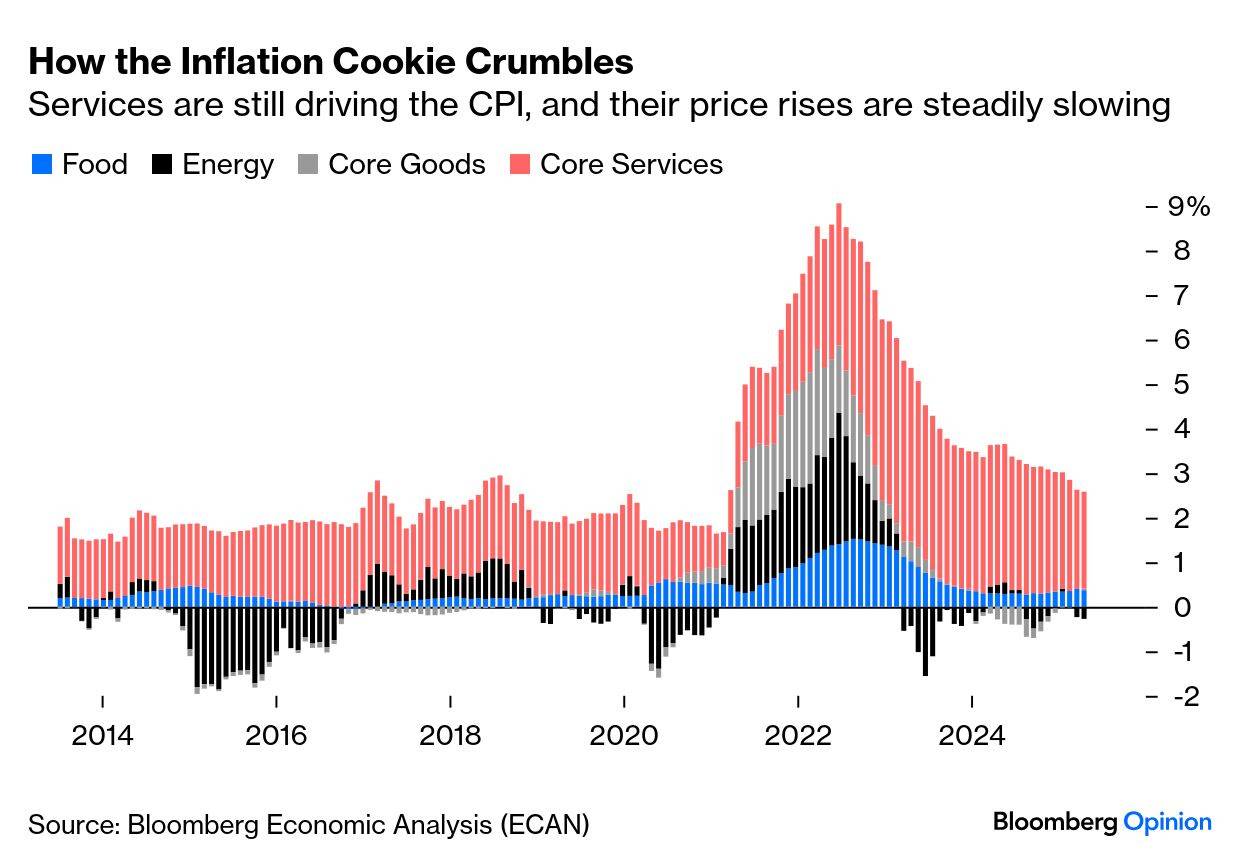
It’s a good sign when inflation data no longer seem to matter that much. The latest readout of the US consumer price index, with a headline rise of 2.3%, was indeed comfortingly dull. In April, when import tariffs briefly hit their highest rates in more than a century, steady disinflation continued as though nothing had happened. This was the third month in succession that inflation declined and came in below expectations.

It’s possible that companies did a good enough job of boosting their inventories before the tariffs to save them from dilemmas over whether to pass on price rises to customers; it could still be too early to see a tariff inflation. Meanwhile, services continue to be the greatest obstacle to lowering overall inflation to the Federal Reserve’s targets, even though it’s coming down only very slowly. Falling fuel prices improved the picture. (…)

The “supercore” measure of services excluding shelter prices, emphasized by Fed Chair Jerome Powell, is down to 2.7%, its lowest since 2021, while prices that tend to be sticky (meaning they’re hard to reduce) are falling. The same is true of the trimmed mean, which excludes the greatest outliers in either direction, and takes the average of the rest:

(…) All of this would normally boost hopes for Fed rate cuts, as lower inflation allows the central bank to offer easier money. The problem is that the CPI data is balanced by growing optimism that a recession can be avoided, which means less urgency to ease. (…)
FYI: Sony Sees $700 Million Tariff Hit on Underwhelming Outlook

YOUR DAILY EDGE: 12 May 2025

Bessent Hails ‘Productive’ U.S.-China Trade Talks Treasury secretary cites progress and promises more details Monday; Beijing says the two sides agreed to start a formal negotiation process

(…) The talks were “productive,” Bessent said, adding that the U.S. side will share more details Monday.

During the same briefing Sunday in Switzerland, Greer suggested that some sort of agreement had been reached with the Chinese side without providing specifics.

“It’s important to understand how quickly we were able to come to agreement, which reflects that perhaps the differences were not so large as maybe thought,” Greer said. He noted the U.S.’s massive trade deficit was why President Trump declared a national emergency and imposed tariffs on China and other countries. “We’re confident that the deal we struck with our Chinese partners will help us to work toward resolving that national emergency,” Greer said.

The White House issued a statement after the duo’s briefing, which was titled “U.S. Announces China Trade Deal in Geneva.” The statement included Greer and Bessent’s remarks from Switzerland, but nothing else.

The state-run Xinhua New Agency said both sides agreed to establish an “economic and trade consultation mechanism” that would involve recurring discussions. The agency said the U.S. and China would release on Monday a joint statement—a rare occurrence in recent years as bilateral relations have been strained. (…)

Bloomberg:

The US and China both reported “substantial progress” after two days of talks in Switzerland aimed at de-escalating a trade war, marking what Chinese Vice Premier He Lifeng called “an important first step” toward resolving differences. (…)

“As we say back in China, if the dishes are delicious, the timing doesn’t matter,” Chinese Vice Commerce Minister Li Chenggang, who last month was appointed trade representative, told reporters in Geneva. “Whenever it gets released, it will be good news for the world.”

Negotiators sought to convey a positive tone in separate comments to reporters, with He complimenting the US side’s professionalism and US Trade Representative Jamieson Greer suggesting trade clashes between the two sides may be overrated. (…)

Fears of empty shelves may have contributed to the urgency for the meetings, with Chinese exports to the US plummeting by 21% last month. Trump and his economic team have gotten pleas from retail executives who explained in meetings with senior officials that the result of sustained high tariffs would be pandemic-level shortages and supply-chain shocks. (…)

The US and China already have a trade deal on the books, which was signed at the end of Trump’s first term in January 2020. At the time, the president called it “historic” and said it was “righting the wrongs of the past.” (…)

Japan won’t accept any initial trade agreement with the US that excludes auto tariffs, according to Prime Minister Shigeru Ishiba.

Ishiba on Monday made his stance clear when asked in parliament about the possibility that Washington might urge Tokyo to strike a provisional agreement that doesn’t address US tariffs on car imports. (…)

A local media report over the weekend indicated an agreement would likely be reached in early July around the time Japan announces a national election.

Public broadcaster NHK reported that Japan has so far proposed expanding auto-related investment in the US and enhancing cooperation in shipbuilding in an effort to reach a compromise. (…)

John Authers:

(…) the US now clearly wants an exit ramp from the tariffs it currently has in place. As there is virtual unanimity in financial markets that tariffs are a really bad idea, that is cause for celebration.

The problem is the total lack of detail about the Chinese discussions (which may be corrected Monday) and the lack of any small print in the British agreement, which is little more than a format for further dialogue. All the difficult issues, which would in pre-Trump days have been thrashed out over years in tedious negotiations at another Geneva venue, the World Trade Organization’s headquarters, lie ahead. Such arguments normally play out with minimal attention and little or no market impact. In the strange world of 2025, an agreement to enter into boring talks is reason to buy. (…)

The market base case is that the retreat is on, and the hoopla for a nothing deal with the UK indicates that the US administration is shameless. Such an approach is cynicism piled on cynicism; traders believe that Trump 2.0 never really meant its own trade rhetoric.

Cynicism is often justified. In this case, it might not be. There’s no big constituency pushing for tariffs in the US, and all the signs are that they aren’t good politics (certainly compared to culture war issues). Trump himself has been banging the drum for protectionism for decades. He is still holding out for a traumatic shift in the global trading order.

At this point, the cynics might more wisely direct their energies against the market. A base case at present might be a universal 10% tariff plus a massive levy of as high as 80% on China. Four months ago, that would have been described as a nightmare scenario. It still is. An awful lot is now riding on the administration never having meant a word it was saying. (…)

Meanwhile, the fall in inflation suggests that it has no choice but to stimulate, and do so in a big way. Headline CPI is now running very slightly negative, and the country has now swapped places with the US. While the Federal Reserve needs to be cautious about cutting rates, the People’s Bank of China does not. (…)

China’s deflation issue is most dramatic if we look at the producer price index for consumer durables, which is now deflating at an annual rate of almost 4%, the lowest in two decades. This suggests the country is swamped with products it can no longer sell to the US, while domestic demand is still insufficient to fill the gap:

The authorities have started to ease, and they have a lot further they could go. It has been their aim to wean the country off credit and ensure that China avoids its own Lehman moment, which is why it has eschewed monetary stimulus for an unusually long time since the pandemic. That gives space to expand now:

The path seems clear; China is going to have to open the taps again. That could store up more risk of financial turmoil for the future. In the present, it implies good things for both Chinese bonds and stocks. (…)

Trump Says 10% Tariff Baseline Unless ‘Exceptional’ Offer Made

President Donald Trump said that he would “always” impose a minimum 10% tariff on trading partners — before quickly adding that “there could be an exception,” underscoring the difficulty discerning the US approach to dozens of trade deals under negotiation.

“You are going to always have a baseline,” Trump said at the White House on Friday. “I mean, there could be an exception. At some point we’ll see somebody does something exceptional for us. It’s always possible. But basically, you have a baseline of a minimum of 10% and some of them will be much higher.” (…)

Hubert Marleau:

On the geopolitical front, Mark Carney, the Canadian election-victor, said that Canada will implement a trade diversification strategy, engaging with other global trade partners, strengthening relationships with reliable allies who share and uphold similar values that the world respects. He added that he intends to lead the world if the US is not willing to do the job.

His pronouncement mimics a 2018 Foreign Affair essay, written by Ivo Daalder, President of the Chicago Council on Global Affairs, and James Lindsay, Chair of the Council on Foreign Affairs, who lamented the fact that Trump was abandoning the international order that Washington had painstakingly created over 70 years.

The authors called on Australia, Canada, France, Germany, Italy, Japan, South Korea, the UK and the EU to form the “G-9,” a group dedicated to maintaining global rules “based on collective security, open markets, and democracy.” The countries included would have to learn how to work without the United States – “and, if necessary, around it”- to “supply the leadership that the Trump Administration will not.”

“The Godot Recession”?

Ed Yardeni argues that the Godot recession, widely expected but never happening, may be back in 2025.

(…) we remain believers in the resilience of the economy. It withstood the tightening of monetary policy over the past three years. We expect it will withstand this year’s tariff turmoil.

We are now lowering our odds of recession back down to 35% because we believe that China and the US both may be ready to suspend their tariffs on each other while they negotiate a trade deal. In other words, both sides may be starting to blink. Neither side can bear the pain of a trade war, which might be more painful for China’s economy than America’s economy.

On the other hand, Americans have less tolerance for pain than the Chinese.

We also expect that Trump will declare victory in his trade war with the rest of the world. By the end of the 90-day postponement period of his Liberation Day reciprocal tariffs, the US is likely to have signed numerous agreements with America’s major trading partners. Stragglers might come around during a second 90-day postponement period. Trump needs to put the trade issue behind him to reduce the odds of a recession, which would harm the Republicans’ chances of holding onto their slim majorities in both houses of Congress.

Trump also needs to get this issue resolved quickly now that numerous court cases have been filed challenging his constitutional authority to impose tariffs under his claim that they are warranted by a national crisis that he declared.

We aren’t dismissing the possibility of a recession. There could still be supply disruptions resulting from the still unresolved trade war with China. Regional and national business surveys show weakening economic activity and rising prices during March and April. Measures of consumer confidence are at recessionary levels, especially those that track consumer expectations. The latter is one of the 10 components of the Index of Leading Economic Indicators (LEI), which has been forecasting a recession since late 2022.

Meanwhile, the Index of Coincident Economic Indicators (CEI) has been rising to new record highs since then through March!

The CEI probably edged up to another record high during April. That’s because nonfarm payroll employment in private industries, which rose to a record high in April, is one of the four components of the CEI. It tends to boost two of the other components, i.e., real personal income and real manufacturing and trade sales. The fourth CEI component is industrial production, which probably declined in April along with manufacturing aggregate weekly hours, as shown in April’s employment report.

We are betting on the resilience of consumer spending, which has been boosted by the spending of retiring Baby Boomers. We had been concerned recently about the negative wealth effect on consumption because of the drop in stock prices. Now we are less concerned given the subsequent rebound in stock prices. We are also betting on business spending to remain resilient. While tariff-related uncertainties may weigh on capital spending, we expect that spending related to cloud computing and onshoring will remain strong.

Hubert Marleau agrees:

The US economy has strong internal underlyings, and is therefore capable of absorbing an-across-the-board average tariff shock of 10%, plus a mid-double-digit one on China, especially if US productivity trends in strategic industries remain advantageous.

No less an authority than the Yale Budget Lab estimates the tariffs will reduce GDP between half and one percentage point – not great, but also no recession.

As a matter of fact, many trade numbers have been exaggerated. For example, 22% of Chinese-made goods, classified as essential, are exempt from levies, and the volume of container ships departing China has fallen by 50% since mid-April; yet the activity level is still high and has remained consistent with activity seen during much of 2023. Moreover, tariffs are bound to have some domestic import substitution effect.

There is no question that tariffs are not a good idea and can be very disruptive; however, the signals for an upcoming recession are just not there, perhaps because adjustments will take place through the price mechanism and the expectation that a world-wide trade war is avoidable.

Recessions usually do not happen

  • when the yield curve is not inverted (10s minus 2s is 50 bps);
  • when the energy bill as a % of N-GDP is as low as it is presently (2.1%);
  • when the increase is the money supply is accelerating (3.7% to 5.8%);
  • when the swap market is predicting a forthcoming reduction in the policy rate of about 60 bps;
  • and when the dollar becomes competitive, the DXY being down 5.0% y/y.

All of that is particularly promising as there is more optimism around China, stabilization in earnings revisions, and few headcount reductions in corporate America. (Incidentally, despite high recession expectations, the Atlanta Fed’s GDPNow model estimate for real GDP in Q2 is 2.2%, while the other NowCast model sees Q2 GDP at +1.4% and Q3 at 1.3%. Both models signal a slowdown, not a contraction.

So far, companies are not announcing large widespread layoffs and claims are not deteriorating:

Canada is already feeling it however. Canada lost more than 30,000 manufacturing jobs in April as U.S. tariffs take aim at the automotive sector and feed into economic uncertainty. Statistics Canada’s Labour Force Survey on Friday said employment increased by 7,400 nationally, though that figure was padded by an increase in election-related hiring (+37k). The overall unemployment rate rose to 6.9%, up from 6.7% in March.

Since April 3, imported cars have faced a 25% tariff on their non-U.S. content. The effect of U.S. tariffs goes beyond the automotive industry, with layoffs in the aluminum and steel sectors as well. The U.S. continues to impose 25% levies on aluminum and steel imports and on goods that are not compliant with the USMCA, plus a 10% rate on energy imports.

image

Ed Yardeni continues:

At the start of the year, our S&P 500 target for the end of this year was 7000. When we raised our odds of a recession on March 5 to 35%, we lowered our target to 6400. We lowered it again on March 31 to 6000, when we raised the odds of a recession to 45%.

Now that we are lowering the odds of a recession back to 35%, should we be raising our S&P 500 target back to 6400? We are inclined to do so given the power of the V-shaped rally in the S&P 500.

However, we aren’t ready to do so given the following two issues:

(1) Earnings. The outlook for S&P 500 earnings is deteriorating. Tariffs are first and foremost taxes on domestic importers. The 10% baseline tariff on all imports from most countries was announced by Trump on Liberation Day and imposed on April 5. There is also a 25% tariff on autos, aluminum, and steel. The 145% tariff on China remains in force as well.

Over the past 12 months through March, corporate tax receipts totaled $502.19 billion. The currently active tariff rates could raise over $300 billion in import duties over the coming 12 months. That would be a significant increased tax burden on corporate profits unless they are passed through to consumer prices. Some companies, such as those in the auto industry, might find that hard to do.

(2) Valuation. The valuation multiple of the S&P 500 bottomed at 18.1 on April 8. It was back up to 20.5 on Friday. It is very unlikely to bounce back to the 22.1 at which it began the year.

CONSUMER WATCH

Credit and debit card spending per household increased 1% YoY in April after a gain of 1.1% YoY in March, according to Bank of America aggregated card data. Seasonally adjusted (SA) spending per household was flat month-over-month (MoM), with the seasonally adjusted annualized growth rate (SAAR) remaining at 1.6% again for April.

image

Reading the consumer is particularly tricky this year. In the chart above, I focus on the monthly trend (red line) which show that spending growth has stalled in April in spite of a late Easter. Also consumers front loaded some durables earlier this year.

Importantly, we also must factor in the 14% YoY decline in gas prices, likely to drop further in coming weeks. This is considerably helping mid-lower income Americans and could sustain discretionary income when tariffs start to bite.

image

(…) In March, Honda Motor Co. recorded a 13% jump in US sales, while Nissan Motor Co. said volumes rose 10%. The US annual selling rate—which extrapolates an entire year’s sales from a monthly pace—came in at 17.8 million in March and 17.3 million in April. Last year about 16 million new cars were purchased in America.

But this frothy auto market will likely leave some buyers with a financial hangover, especially since there already have been signs that more car buyers are missing payments. Delinquencies on auto loans have been rising, and car repossessions spiked to 2.7 million last year, almost double the rate of repos in 2021, according to the Recovery Database Network. Despite an average new-car loan rate of more than 9%, banks this spring began extending more loans to subprime buyers, according to researcher Cox Automotive. At the same time, prices remain stubbornly high, with average monthly payments for a new vehicle costing $734 in March, up about 27% since early 2020, according to automotive researcher Edmunds.com Inc.

To cope, new-car buyers have been extending the length of their loans, with one in five now taking out a seven-year note, Edmunds says. That’s likely to leave more owners upside down on their loans. One-quarter of trade-ins now are worth less than what’s owed on the loan, a situation known as negative equity. (…)

Nothing too serious yet:

image
GOP Tax Bill Seeks to Put Cash in Taxpayers’ Pockets in Early 2026 Proposal boosts standard deduction, increases maximum child tax credit

The bill released late Friday would increase the standard deduction by $1,000 for individuals and $2,000 for married couples starting in tax year 2025, above and beyond the Trump tax cuts’ expansion of that basic level where income taxes don’t apply. The standard deduction is currently $15,000 for individuals and $30,000 for married couples.

The maximum child tax credit would increase to $2,500 from $2,000, also starting this year. Those changes would mean that many taxpayers who don’t change their withholding would see larger-than-expected refunds in spring 2026. For a middle-income married couple with two children in the 12% tax bracket, that means a $1,240 tax cut for tax year 2025.

In addition, the proposal from the House Ways and Means Committee adds an extra inflation adjustment to tax brackets for tax year 2026—a benefit that would show up in smaller paycheck withholding in January.  (…)

Friday’s bill is incomplete and will likely be changed substantially before the committee vote. It is silent on some of the issues that are dividing Republicans, including the cap on the state and local tax deduction and the fate of clean-energy tax credits that Democrats created in 2022. It doesn’t include the tax-rate increase for the highest-earning Americans that Trump has been floating in recent days. (…)

Democrats are expected to oppose the bill. They argue that the tax-cut extensions give too much to upper-income households and warn that middle-income Americans would be hurt by the GOP plan’s expected Medicaid cuts and by Trump’s recent tariffs.  (…)

The bill also includes few of the potential tax increases that Republicans have been considering, and has no mention of such ideas as higher taxes on university endowments, limits on deductions for executive pay and caps on businesses’ ability to deduct state and local taxes. It doesn’t yet include versions of Trump’s desired proposals, such as faster write-offs for factory construction projects and removing taxes on tips, overtime pay and Social Security benefits.

The bill does include a permanent extension of higher estate-tax exemptions, setting that at $15 million per person in 2026 and indexing it to inflation. It would also permanently extend the deduction for certain closely held businesses that pay taxes through their owners’ individual returns, boosting that break to 22% from 20% while changing some rules. The top tax rate on that income from closely held businesses would drop to 28.9% from 29.6%. Multinational companies would avert tax increases on certain foreign profits and some income from U.S. exports.

The plan also retains some key limits on deductions that Congress created in 2017, such as a rule that caps at $750,000 the amount of mortgage debt that can generate deductible interest. It would permanently repeal miscellaneous itemized deductions, such as legal fees and unreimbursed business expenses. Moving expenses in most cases would remain nondeductible. (…)

China’s Consumer Deflation Extends as Tariffs Take Toll

The consumer price index fell 0.1% from a year earlier, the National Bureau of Statistics said Saturday, similar to the drop in the previous month. It also matched the median forecast of economists surveyed by Bloomberg.

Factory deflation persisted for a 31st month, with the producer price index recording a decline of 2.7% compared to 2.5% in March. (…)

EARNINGS WATCH: +16.1%!

From LSEG I/B/E/S:

450 companies in the S&P 500 Index have reported earnings for Q1 2025. Of these companies, 75.8% reported earnings above analyst expectations and 19.1% reported earnings below analyst expectations. In a typical quarter (since 1994), 67% of companies beat estimates and 20% miss estimates. Over the past four quarters, 77% of companies beat the estimates and 17% missed estimates.

In aggregate, companies are reporting earnings that are 6.8% above estimates, which compares to a long-term (since 1994) average surprise factor of 4.3% and the average surprise factor over the prior four quarters of 6.8%.

Of these companies, 61.9% reported revenue above analyst expectations and 38.1% reported revenue below analyst expectations. In a typical quarter (since 2002), 62% of companies beat estimates and 38% miss estimates. Over the past four quarters, 62% of companies beat the estimates and 38% missed estimates.

In aggregate, companies are reporting revenues that are 1.0% above estimates, which compares to a long-term (since 2002) average surprise factor of 1.3% and the average surprise factor over the prior four quarters of 1.2%.

The estimated revenue growth rate for the S&P 500 for 25Q1 is 4.9%. If the energy sector is excluded, the growth rate improves to 5.3%.

The estimated earnings growth rate for the S&P 500 for 25Q1 is 14.1%. If the energy sector is excluded, the growth rate improves to 16.1%.

The estimated earnings growth rate for the S&P 500 for 25Q2 is 6.3%. If the energy sector is excluded, the growth rate improves to 8.0%.

Another amazing corporate quarter. +16.1% earnings growth on revenues up 5.3%. Profit margins expanded by 111 bp to 12.1% to reach the highest level since 2Q 2022.

Energy EPS fell 16.6% as Brent dropped 8% on average during the quarter, helping non-energy margins.

Trailing EPS are now $251.52, up 4.0% from January while forward EPS at $270.96 are down 0.7% from January.

We had 25 pre-announcements last week, 9 positive and 15 negative but the ratio of negative to positive has improved vs at the same time after Q1.

image

Goldman Sachs:

The elevated level of uncertainty has also been reflected in management guidance. Companies were less likely than usual to guide full-year EPS higher (26% vs. 41% average) and more likely to maintain full-year guidance (58% vs. 41% average), and many companies that maintained guidance did not incorporate the impact of tariffs

Our economists maintain an estimated 45% probability of US recession during the next 12 months. Despite this risk, resilient recent earnings and economic data alongside incrementally positive tariff developments have caused the market to focus squarely on the optimistic modal outlook of continued growth. The result is a surprisingly tight equity risk premium, with the S&P 500 trading at a current forward P/E of 21x on unrealistically inflated consensus EPS estimates.

During the next few months, however, economic data are likely to deteriorate, and investors will need to grapple with a meaningful deceleration of earnings growth that is likely to occur in coming quarters.

We think it will be hard for stocks to rally significantly in the short-term against this backdrop. Ultimately, however, the avoidance of an economic recession, increasing confidence in EPS reacceleration in 2026, and insurance cuts by the Fed later this year should drive continued US equity gains during the next 12 months.

We expect 3% EPS growth to $253 in 2025 (vs. 7% bottom-up and 4% top-down consensus) and 6% growth to $269 in 2026 (vs. 14% bottom-up and 11% top-down consensus). At the sector level, our 2025 S&P 500 EPS estimate reflects weakness in cyclical sectors offset by strength in Info Tech and Comm Services. The bottom-up consensus expects 50 bp of margin expansion to this year 12.1%, which we view as too optimistic.

image

1Q operating results also showed a reacceleration in mega-cap tech earnings growth relative to the rest of the market. The Magnificent 6 (excluding NVDA, which reports on May 28th) beat consensus EPS estimates by 16% in aggregate and sales estimates by 1%.

Bottom-up consensus expects the difference between earnings growth for the Magnificent 7 and the S&P 493 to narrow from 32 pp in 2024 (36% vs. 4%) to 10 pp in 2025 (15% vs. 5%) and just 2 pp in 2026 (15% vs. 13%). However, YTD consensus 2025 EPS revisions continue to be more negative for the S&P 493 than the Magnificent 7 (-4% vs. 0%).

The mega-cap tech stocks also signaled a continuation of the AI capex cycle. META increased the guided capex range for 2025 to $64 – $72 billion from the previously announced $60 – $65 billion range, mostly geared toward generative AI and core business needs. GOOGL reiterated prior guidance of $75 billion of capex in 2025 aimed at alleviating supply constraints against elevated demand for computing capacity and broader AI initiatives.

We forecast capex will remain the largest use of cash for the S&P 500 in 2025 ($1.2 trillion, 9% growth) driven by the hyperscalers. In contrast, capex growth for the median S&P 500 stock will likely be subdued due to economic uncertainty and slowing earnings growth. Soft data show a meaningful slowdown in capex expectations, and capex revision breadth has recently deteriorated.

  • Earnings Revision (losing) Momentum:  Analysts have already made up their minds, earnings revisions momentum has plunged (this combines the signal from earnings revisions ratios and short-term forward earnings rate of change). Now some of this might just be sentiment; analysts are people too, they get it wrong, they react to news and market movements, they move after the fact… But either way there is a clear shift underway here. (Callum Thomas)

Source:  Topdown Charts Professional

image

image
QUIET BORDERS

Quiet illegal and legal crossings

  • Air Canada bookings to U.S. decline by ‘low teens’ amid trade tensions, CEO says