The enemy of knowledge is not ignorance, it’s the illusion of knowledge (Stephen Hawking)

It ain’t what you don’t know that gets you into trouble. It’s what you know for sure that just ain’t so (Mark Twain)

Invest with smart knowledge and objective odds

YOUR DAILY EDGE: 7 October 2025

EMPLOYMENT REPORTS

Carlyle Unveils Proprietary Data Showing Weak US Employment

The US Labor Department’s September employment report, whose scheduled release on Oct. 3 was among those that have been postponed since the shutdown began last week, was expected by economists in a Bloomberg poll to show a 54,000 increase in nonfarm payrolls from August’s total of about 159 million. Carlyle estimates that just 17,000 jobs were created, among the weakest results since the US economy emerged from the 2020 recession.

Carlyle for more than a decade has been calculating its own estimates of US GDP, consumer spending and inflation “to serve as timely proxies when government data is delayed or unavailable,” and has released them selectively from time to time in that circumstance.

Besides the estimate of nonfarm payrolls in September, they include gauges of US GDP growth, corporate spending and various consumer price indexes. Those indicators broadly portray a resilient, if cooling, US economy, according to Carlyle.

“What’s so interesting about the moment we’re in is the discrepancy between payrolls and the other economic indicators we’re looking at,” said Jason Thomas, Carlyle’s head of global research and investment management. “If you looked at the employment data, you’d think it’s an economy that’s on the cusp of or in a recession. That is nowhere else in the data.”

In particular, he said, “inflation looks much more widespread than just looking at the durable goods that would be subject to tariffs,” the implementation of which beginning in April has thus far caused less inflation than was anticipated. (…)

Automatic Data Processing Inc., the payrolls processing company whose ADP Research unit publishes an estimate of private-sector payrolls growth two days before the BLS, is based on 26 million employees. And Revelio Labs makes estimates based on more than 100 million US job profiles that cover two-thirds of the US workforce.

ADP estimated that private payrolls shrank by 32,000 in September, while Revelio reported an increase of about 60,000.

  • Indeed Job Postings have collapsed 3.1% in September (through Sep. 26) after stabilizing during the summer.

image

  • What can Bank of America internal data tell us about the current state of the labor market? In our view, our data suggests a continued slowdown in the pace of job growth in September.

We use Bank of America internal data to estimate a payrolls series by looking at how the number of customer accounts receiving a paycheck is changing. This data can be fairly noisy, partly due to seasonal variation. However, looking at a three-month moving average, Exhibit 1 suggests some further softening in payrolls growth occurred in September. Note the growth in this series is also weaker than in the ADP (Automatic Data Processing) private payrolls in September, which was also a soft print.

image

Using unemployment payments into Bank of America customer accounts as a guide to continuing unemployment claims, Exhibit 2 shows that in October the year-over-year (YoY) percentage rise in unemployment payments was around 10%, compared to a 5% YoY rise in BLS continuing claims in August. In our view, this suggests some upward momentum to unemployment.

image

Finally, we consider pay growth. In September, Bank of America deposit data showed after-tax wage and salary payments increased 4.0% YoY for higher-income households, 2.4% YoY for middle-income households and 1.4% YoY for lower-income households. While this reflects an acceleration for all three cohorts, the data continues to show a large divergence between the pay growth of middle- and higher- income households compared to that of lower-income households. Though, in September, this did not widen further.

image

What strikes me in this last chart is that wage growth for lower and middle income Americans is increasingly negative in real terms.

  • “I think you’re probably hearing the same thing from just about everybody in consumer packaged goods on this is — it is kind of this barbell economy, where you’ve got higher income consumers and that are showing more resiliency and they’re still spending. You’ve got lower income consumers across different age groups that are being more discerning. They are absolutely doing what they’ve got to do to kind of maximize their household balance sheet. So we’ve got to deal with that.” – Conagra Brands ($CAG ) CEO Sean Connolly
  • “Restaurant traffic at several customer channels was flat in the quarter”. – Lamb Weston ($LW ) VP Bernadette Madarieta
  • “In fact, booking trends have continued to improve since our last update nicely outpacing capacity growth at higher prices and setting a record for bookings made on sailings 2 years out. And with nearly half of 2026 already on the books at higher prices, we feel pretty good about next year.” – Carnival ($CCL ) CEO Joshua Weinstein
German Factory Orders Unexpectedly Fall Again Amid Tariff Uncertainty Economists polled by The Wall Street Journal expected a 1.5% rise

Total orders tumbled 0.8% on month in August, from a 2.7% fall in July, Germany’s statistics agency Destatis said Tuesday.

Orders rose in the first quarter in the run-up to the announcement of expected tariffs from the Trump administration at the start of April. Since then, they have slumped. (…)

“With U.S. front-loading now behind us, German industrial order books are back at where they were at the start of the year: empty,” said ING’s global head of macro research Carsten Brzeski in a note to clients.

However, while the headline orders figure shows renewed weakness of German industry, it masks diverging trends. While foreign orders surged until May then collapsed, domestic orders remained subdued until July but strongly increased in August, Brzeski said.

In August, foreign orders dropped by 4.1%, with orders from outside the euro area declining by 5.0%. By contrast, domestic orders rose by 4.7%, the data said.

That offers a sign that domestic demand could drive the traditionally export-led German industrial base, helped further by new large investments unlocked by the German government—as much as 1 trillion euros in defense and infrastructure. European Central Bank interest-rate cuts in the last year also might have freed up businesses to invest more.

Still, some of Germany’s chief sectors suffered in August. Overall automotive orders fell 6.4% on month, while in the pharmaceutical industry they declined 13.5%, Destatis said.

August’s decline in orders would have been worse without large-scale orders worth more than 50 million euros, or $58.6 million. When excluding large-scale items, orders fell 3.3%, Destatis said.

Image

ING: “With US front-loading now behind us, German industrial order books are back at where they were at the start of the year: empty (…) another illustration that Germany’s industrial slump is not about to end any time soon.”

Is the semiconductor industry no longer cyclical?

Ed Yardeni:

That is the verdict of the stock market, where the S&P 500 Semiconductors industry is trading at a forward P/E of 30.0. Following the Great Financial Crisis (GFC) until the onset of the Great Virus Crisis (GVC), this valuation multiple fluctuated mainly between 10.0 and 15.0. The industry’s forward earnings per share mostly rose during this recession-free period, but it experienced cyclical dips along the way

The same can be said for the forward revenues per share of the S&P 500 Semiconductors industry. It rose between the GFC and GVC, but was prone to cyclical dips. Since the GVC, there was a significant downturn in 2022. However, it has been a solid uptrend for forward revenues in record-high territory since OpenAI introduced ChatGPT in late 2022.

Nevertheless, we doubt that the industry is no longer cyclical. Competition is bound to increase over the next couple of years. That will depress the industry’s profit margin, at least on a cyclical basis.

A Devastating Fire at a Major Ford Supplier Will Disrupt Business for Months Novelis plant supplies about 40% of aluminum sheet used in auto industry

The plant’s operator, Atlanta-based Novelis, supplies about 40% of the aluminum sheet used by the auto industry in the U.S., according to industry analysts. Novelis said a major portion of its Oswego, N.Y., plant has been knocked offline until early next year.

Ford is the biggest user of the plant. Its F-150 pickup, the top-selling vehicle in the U.S. and the automaker’s main profit driver, is one of the industry’s biggest users of aluminum. (…)

Novelis produces more than 350,000 metric tons of sheet aluminum annually for the automotive industry, according to industry analysts. Around a dozen automakers get aluminum from Novelis, including Ford, Toyota, Hyundai, Volkswagen and Jeep maker Stellantis, according to a regulatory filing. (…)

Novelis, which is part of India’s Hindalco Industries, said it is turning to some of its plants overseas to supply aluminum for its U.S. customers. The company operates rolling plants in Europe, Brazil and South Korea. But Novelis is currently subject to a 50% U.S. tariff on imported aluminum. (…)

Industry analysts say Arconic, Constellium and other aluminum-rolling companies that supply the automotive industry likely don’t have much excess production available for automotive aluminum. (…)

IEA Cuts US Renewable Growth Forecast in Half on Trump Policies

The International Energy Agency slashed in half its forecast of US renewable energy growth by 2030, even as the rest of the world races to double its green power capacity over the same period.

The reduction compared to last year’s analysis is due to several policy changes imposed under President Donald Trump, the IEA said. Those include the early phaseout of federal tax credits for clean energy installations, import restrictions, suspension of new offshore wind leases and permit restrictions for solar and wind projects on federal land.

Global renewable power is expected to increase by 4,600 gigawatts by the end of the decade, an amount equivalent to adding the generation capacity of China, the European Union and Japan, the IEA said. Solar will account for almost 80% of that increase, according to the report.

The global forecast was revised down by 5% compared to a year ago as a result of policy changes in the US and China. The data show renewable power will continue to expand rapidly across the globe despite a pullback by the Trump administration.

EMBER, a global energy think tank, recently published China Energy Transition Review 2025, highlighting China’s much different philosophy:

Interviews with China experts conducted for this report show that for China, the clean electricity transition involves more than decarbonisation – it is a strategic pivot to reimagine development. As the fossil-fuelled growth model – once central to China’s economic rise – reaches its limits, the country is pioneering a pragmatic, phased path to “green growth,” where environmental and economic goals reinforce each other. This dynamic is creating self-sustaining momentum, towards China’s broader ambition to build an “ecological civilisation” –aligning long-term prosperity with sustainability.

Within China, the rationale for China’s clean energy transition extends far beyond climate concerns or the falling costs of electro-technologies. Official documents and expert conversations reference the growing belief that the fossil fuel economy has run its course, and that it can and should be replaced by a new, better system centred on manufactured goods that generate and run on renewable electricity.

Government plans for the energy transition treat it as a progressive transformation, unfolding over decades, that addresses socioeconomic and environmental goals simultaneously. The multiple benefits already being realised make a slowdown highly unlikely. (…)

For decades, climate action in China, as in many countries, was framed as a trade-off between environmental gains and economic sacrifice, encapsulated in the argument that “the right to emit is equal to the right to develop.” Underlying this lies an ethical paradox: how can developing economies reconcile their legitimate aspirations for prosperity with the reality of finite planetary boundaries?

The clean energy transition offers a solution. It ensures domestic energy security, provides affordable power, enables industrial upgrading and facilitates supply chain expansion. In short, it is a better way to develop, reducing the environmental pressures of the fossil fuel age while creating new opportunities for sustainable growth.

First proposed in 2007 and embedded in the constitution in 2018, this vision emphasises “harmony between humanity and nature” and upholds the belief that “lucid waters and lush mountains are invaluable assets.”

At its core, it champions green development, with environmental goals and green electrification serving as “systemic” levers – addressing environmental challenges while unlocking new avenues for economic growth and global competitiveness.

For China, pushing this transition does two big things. First, it locks in China’s role as the global manufacturing hub for the clean energy age. Second, it fixes a major vulnerability – reliance on imported fossil fuels.

The dangers of war in the grey zone Russia’s resort to hybrid warfare is a sign of weakness. But it still requires a response

The warnings are coming thick and fast. Over the past week, Friedrich Merz, the German chancellor, has said that, when it comes to Russia, “we are not at war, but we are no longer at peace either”. Danish Prime Minister Mette Frederiksen told the FT: “We are now in the most difficult situation in Europe since the end of the second world war.” She warned “we are running out of time”. And Eliza Manningham-Buller, a former British intelligence head, mused that it “may be right [in saying] we’re already at war with Russia”.

All three were responding to a wave of Russian “hybrid warfare”— aggressive acts that stop short of actually killing people. As Frederiksen explained, it is “drones one day, cyber attacks the next day, sabotage on the third day.”

European concerns have risen sharply in recent weeks, following the incursion of Russian drones over Poland and a sustained violation of Estonian airspace by Moscow’s jets. Both the Copenhagen and Munich airports were temporarily shut in response to drones. The Danes seem pretty certain that Russia was the source of their problem.

But while hybrid warfare is making more headlines, it is not new. Last year, Russia was linked to arson attacks across Europe, as well as to a plot to put parcel bombs on DHL cargo flights. Nato also accused Russia of planning to murder the CEO of Rheinmetall, a German arms manufacturer. There were several previous Russian incursions over Estonian airspace that did not make headlines. The latest was simply longer and more provocative.

A crucial question about hybrid warfare is whether to regard it as an alternative to conventional “kinetic” warfare — or simply as a prelude to it? That shapes the debate about how to respond.

One argument is that Russia’s resort to hybrid warfare reflects weakness and uncertainty rather than strength and determination. The Russians are enraged by western aid for Ukraine and threatened by the success of Kyiv’s missile strikes on energy facilities, which imperil a key source of Russian export revenue. Almost half of Russia’s oil refineries have been hit by Ukrainian drones or missiles.

The Kremlin argues that by providing Ukraine with long-range missiles and vital intelligence, the western alliance is waging a proxy war on Russia. Western officials have long weighed the possibility that Moscow might respond by striking targets on Nato territory — such as the military bases that are used as a staging post for aid to Ukraine.

But, for now, Russia is using disruptive hybrid attacks that stop short of military action against Nato territory. That relative restraint is evidence that western deterrence is working.

An alternative view is that Russia’s hybrid warfare measures are probing attacks aimed at testing western responses and dividing the Nato alliance. If that is right, Putin’s current actions could simply be a prelude to actual kinetic warfare in Europe.

These two views point to different policy responses. If the Kremlin has been successfully cowed into staying beneath the level of actual warfare, then it would be a mistake for Nato countries to respond too forcefully. Shooting down Russian planes that violate Nato airspace — a threat made by Radosław Sikorski, the Polish foreign minister — would, in this view, be a needless and dangerous escalation.

One former US official argues that there remains a “bright red line” between aggressive Russian acts that kill people — and those that do not. His view is that the argument that hybrid and conventional warfare are on a seamless continuum is a mistake. As this former official puts it: “If it turns into a conventional war, people will soon notice the difference.”

The alternative view is that if Putin can keep upping the ante, without provoking a forceful and united western response, he might be able to demonstrate that Nato’s collective defence provisions are empty. The fact that last week’s EU discussions on setting up a drone wall to counter Russia were inconclusive and acrimonious was probably noted in the Kremlin. If western unity dissolves, then smaller and weaker members of the alliance could eventually be isolated and attacked.

It is possible, of course, that neither theory is completely true — and that the biggest risk is an accidental conflict caused by Russia’s increasingly reckless use of “grey zone” tactics. What if Russian sabotage of a cargo plane, or an arson attack, caused mass casualties? DHL parcels are carried not only on cargo planes but also on passenger flights. If Russian sabotage had caused a plane to crash over Europe, killing hundreds on board, many would see that as an act of war. Putin might believe that, even in those circumstances, Europe would be all too eager to accept the Kremlin’s assurances that it was all an unfortunate accident.

So Russia’s current actions do require a response that both makes it clear that there is a price to be paid for hybrid warfare — and avoids crossing the threshold into direct combat. The best response to Russian hybrid warfare may be a western version of grey zone tactics. By its nature, hybrid warfare is asymmetrical and relies on imagination. The western alliance cannot emulate Russian recklessness. Arson attacks are off the menu. But the US, Britain and France all have offensive cyber capabilities. Presumably, they are there for a reason.

Bloomberg adds:

(…) The indicators, just from the past few weeks, are legion. Persistent drone overflights have scrambled European air traffic. Russian warplanes violated Estonian airspace. Moscow’s agents reportedly tried , unsuccessfully, to tilt the outcome of Moldova’s recent elections. In August, Russia allegedly jammed the navigational systems of European Council President Ursula von der Leyen’s plane.

Then there is the larger pattern of cable-cutting in the Baltic, bids to inflame the Balkans, and menacing surveillance of crucial undersea fiber optics in the Atlantic. Russian sabotage, assassination plots and political interference have plagued much of the continent for years. Putin is chiseling away at Europe as he hammers away at Ukraine.

His motives are layered. Hybrid war is meant to punish Europe for supporting Ukrainian resistance. It warns European countries against deploying troops to Ukraine after a potential ceasefire. More fundamentally, the hybrid war is meant to debilitate and destabilize the eastern half of the transatlantic alliance that has long checked Russian influence, while also dividing it from its western half. (…)

With an ambivalent Atlanticist in the White House, Moscow aims for provocations that sow fear in Europe but elicit a ho-hum response from Washington. If Moscow increases the pressure, while the US pivots toward other priorities, an under-armed Europe will find itself on its own. (…)

Russia’s subversive stunts are tremendously dangerous: Moscow’s agents apparently came close to bringing down a cargo plane over Germany, with potentially lethal results. (…)

Putin’s Russia is only getting nastier. The political system has become violent and quasi-fascist. The economy is thoroughly mobilized for war. Putin is forging deeper ties with other US adversaries, like China and North Korea. He believes his country is already locked in an existential conflict with “the collective west.” (…)

Pointing up “To all of those young people of TikTok — I saved TikTok so you owe me big” (Trump)

YOUR DAILY EDGE: 6 October 2025

US Services PMIs

S&P Global: Business activity growth softens, while selling prices rise at weakest rate in five months

The headline S&P Global US Services PMI Business Activity Index recorded 54.2 in September, down from 54.5 in August. Remaining above the critical 50.0 no-change mark, that separates growth from contraction, the index has now signaled continuous service sector expansion for 32 months. Furthermore, over the third quarter, average monthly growth was the best recorded over a calendar quarter in 2025 so far.

image

That said, the index has now fallen for two months in a row, representing a slowdown from July’s year-to-date peak. This reflected a similar softening of sales growth to a three-month low amid some reports that tariffs and broader uncertainty had limited gains in overall market demand. Foreign sales were a bright spot, however, with new export business up modestly and for the first time since March.

Despite evidence of ongoing capacity pressures – backlogs of work rose solidly for a seventh successive month in September – slightly softer rates of demand and activity growth led to some reluctance amongst US service companies to add to their staffing levels. The net result was only a marginal overall increase in employment, albeit still extending the current period of continuous payroll expansion to seven months.

Business confidence also improved in September, strengthening to its highest since May. Whilst there remains some uncertainty in the outlook, especially around tariffs, lower interest rates in some instances were reported to have boosted optimism by adding to hopes of a pickup of demand in the year ahead. Several panelists also linked their positive sentiment to expectations that federal government policies will support economic growth in the year ahead.

Tariffs remained a key source of cost pressures in September, which overall rose sharply and to a slightly faster degree than the previous month. Higher supplier charges and payroll expenses also added to upward pressure on company operating expenses.

Although overall costs again rose at an above trend pace, selling prices increased to the slowest degree since April (albeit also still higher than the historical rate). Whilst firms sought to pass on their higher input costs to clients, in some instances slower demand growth and competition limited pricing power.

The S&P Global US Composite PMI recorded 53.9 in September. That was down from 54.6 in August and represented the slowest growth for three months. Both sectors covered by the survey recorded weaker output expansions in line with slower gains in new business.

Employment meanwhile barely rose, but confidence in the outlook strengthened noticeably. Cost pressures remained elevated, although inflation softened to a five-month low. A similar trend was seen for output charges.

Chris Williamson, Chief Business Economist at S&P Global Market Intelligence

“Service sector growth softened slightly in September but remained strong enough to round off an impressive performance over the third quarter a whole. Combined with sustained growth in the manufacturing sector, the expansion of service sector activity is indicative of robust third quarter annualized GDP growth of around 2.5%.

“Growth is being fueled principally by rising financial services and tech sector activity, though we are also seeing more signs of improving demand for consumer-facing services such as leisure and recreation, likely linked in part to lower interest rates. Lower borrowing costs have also fed through to a broad-based improvement in business optimism about the outlook for the next 12 months.

“Disappointingly, the improvement in business optimism failed to spur more jobs growth, with hiring almost stalling in a sign of further labor market malaise as companies often focused on running more efficiently amid uncertain trading conditions.

“A further ongoing source of concern from the surveys are heightened cost pressures which survey respondents have attributed to tariffs. Input costs rose sharply again in September as import levies were seen to have again fed through from goods to services. However, rates charged for services rose at the slowest rate for five months in a welcome sign that some of these tariff price pressures in supply chains are starting to moderate.”

image

ISM: Services activity cooled as hiring slides

ISM services index for September has come in weaker than predicted, dropping from 52 (growth territory) to 50 (consistent with flat activity). The consensus prediction was 51.7, but the outcome was actually below all individual survey responses provided to Bloomberg.

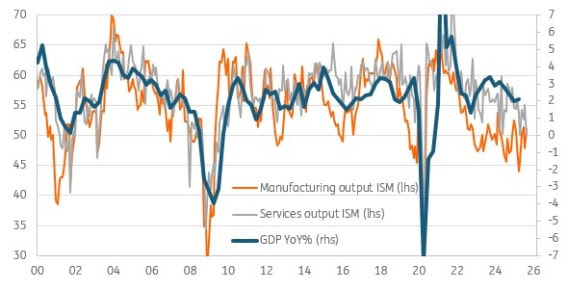
The details show business activity dropping to 49.9 from 55.0. This is the worst outcome since the shutdown period of the pandemic in May 2020, while new orders fell from 56.0 to 50.4. The employment component rose to 47.2 from 46.5, but because it remains below 50, this increase merely means that the pace of job losses slowed last month. The chart below shows the output measures of both the services and manufacturing ISM series versus annual GDP growth, and based on the historical relationship, points to the risk of slowing growth in the coming quarters.

GDP growth (YoY%) versus ISM output metrics advanced 6 months

Source: Macrobond, ING

Source: Macrobond, ING

While we didn’t get the jobs report [Friday], the ADP private payrolls numbers earlier in the week suggest the jobs market continues to cool, while the job openings numbers within the JOLTS report show there are now more unemployed people in America than there are job vacancies.

At the same time, a slowing quits rate – a measure of job turnover – is pointing to wage growth dropping below 3% in early 2026. This combination of sub-trend growth and weakening jobs numbers will, we believe, drive the Fed’s interest rate decisions.

There are lingering concerns about tariffs pushing up prices and inflation, with today’s ISM prices paid series doing nothing to dispel them – it rose to 69.4 from 69.2, so well above the 50 break-even level. However, tariffs have come through more slowly than feared in the key inflation metrics the Fed focuses on, of CPI and the PCE deflator.

As such, the balance of risks to the Fed’s dual mandate of price stability and maximum employment justifies the central bank moving monetary policy closer to neutral with 25bp interest rate cuts at the October and December FOMC meetings expected.

WHAT RESPONDENTS ARE SAYING
  • “We are beginning to see the impact of the tariffs impact our business, particularly for food products from India, China, and Southeast Asia, coffee from South America, and apparel and electronics from Asia. Our year-over-year cost increases are getting progressively greater.” [Accommodation & Food Services]
  • “New residential construction continues to struggle in a tough market. Housing values remain high, and tariffs are beginning to be passed through on materials that are metal based. The pace of housing starts has been stagnant to slightly declining, as we head out of the summer building season.” [Construction]
  • “Pharmacy costs continue to rise, and medical devices are being held at bay mainly due to contracts and continued negotiations where we have two to three sources for a given product.” [Health Care & Social Assistance]
  • “Demand for artificial intelligence (AI) and cloud infrastructure remains very strong. Our primary focus this month was on increasing production throughput to begin clearing the significant order backlog built up over the summer. While new order intake has stabilized at a high level, the overall business outlook remains positive. We are still facing significant supply chain challenges, especially for advanced semiconductors and power components, with lead times remaining extended. Price pressures are still present but have not worsened compared to the previous month.” [Information]
  • “Client demand in professional services remains steady, though decision-making timelines are lengthening due to continued economic uncertainty and interest-rate concerns. We are also seeing modest upward pressure on labor costs, which impacts both our internal resourcing and supplier pricing.” [Professional, Scientific & Technical Services]
  • “The overall housing market remains stagnant, which has forced our company to be hyper-vigilant about costs. However, we are growing and increasing our market share despite the headwinds. Tariffs continue to inject an unnecessary level of uncertainty across the broader economy, and costs are now beginning to increase with the full effect of the tariffs now coming into play.” [Real Estate, Rental & Leasing]
  • Costs overall have stabilized, and we’ve not seen any interruptions in sourcing or shipments.” [Retail Trade]
  • We’ve had more tariff charges last month than in previous months.” [Utilities]
  • “Business conditions continue to soften, even in markets that have historically been more resilient. Demand is simply weak.” [Wholesale Trade]

S&P Global sees GDP growth of 2.5% in Q3 but notes that the index has fallen in the last 2 months of the quarter with sales growth a three-month low, supported by a wholesaler saying “demand is simply weak”.

S&P also notes that “overall costs again rose at an above trend pace”, rising “sharply and to a slightly faster degree than the previous month”, supported by several ISM comments about tariffs increasingly biting.

But S&P also reports that “selling prices increased to the slowest degree since April” because “slower demand growth and competition limited pricing power.”

If ING is right and wage growth drops below 3% in early 2026, one better hopes inflation slows down materially, particularly with employment growth stalling.

image

Then demand could get worse than “simply weak” or profit margins will also become “simply weak”.

(…) Since April, leading retailers have raised prices on 11 of 29 “soft line” products, such as T-shirts and shoes; 12 or 18 “hard lines,” such as bicycles and dishwashers; and five of 16 sporting goods items, according to a sample of imported goods tracked by Telsey Advisory Group, a Wall Street research firm. (…)

imageAshley Furniture, the world’s largest furniture manufacturer, plans to raise prices for the majority of its products by 3.5 to 12 per cent starting on Sunday, according to a notice to customers first reported by Home News Now, an industry publication. “The ongoing tariff situation has created significant challenges with cost impacts across our industry,” said the notice from Todd Wanek, chief executive. (…)

Ashley’s notice came before Trump’s announcement this week of a new 25 per cent on upholstered furniture, to take effect on October 14.

At car parts retailer AutoZone, “there probably will be more” price rises as the full impact of tariffs becomes felt, Philip Daniele, chief executive, told analysts late last month. He said many customers would be willing to pay.

“If the starter breaks, your car is not going to start,” Daniele said. Drivers are faced with a choice: “Either bum a ride or get your car fixed or take an Uber,” he added.

Coffee prices have been surging, in part because of 50 per cent duties on Brazil, the world’s largest coffee exporter. Tariffs on imported tin-plate steel has also driven up the price of food cans. (…)

image

More tariffs to hit:

Invasion of the Killer Ikea Sofas There’s nothing Trump won’t call a ‘national security’ threat to justify a punitive tariff.

The WSJ Editorial Board

(…) The President on Monday announced 10% tariffs on lumber as well as 25% on upholstered wooden furniture, bathroom vanities and kitchen cabinets. This follows last week’s announcement of tariffs on heavy-duty trucks (25%). All of these tariffs are being imposed under Section 232 of the 1962 Trade Expansion Act to—get this—protect national security. (…)

The trouble is that his metal tariffs, which he made even more punitive this year, are hurting U.S. manufacturers of hundreds of products. Furniture manufacturers are having to pay more for imported steel, aluminum, timber and upholstery. Trucking companies are placing fewer orders for new big rigs because of the slowdown in trade. Building permits for new housing units have fallen 11% over the last year, which home builders attribute to tariff uncertainty. That means less demand for kitchen cabinets.

Mr. Trump’s household remedy is always more tariffs to counter the damage from his previous tariffs. So in August he broadened his metal tariffs to include some 400 “derivative” products, including butter knives, spray deodorants and baby strollers.

His Administration has launched sweeping 232 investigations into pharmaceuticals, trucks, timber and lumber, semiconductors, polysilicon and its derivatives, drones, jet engines and more. Mr. Trump’s latest tariffs flow from those investigations. With his trade officials as rubber stamps, there are no imports that Mr. Trump won’t declare a threat to national security.

A Supreme Court decision striking down the IEEPA tariffs is vitally important to the rule of law. But Mr. Trump is showing he will then use Section 232 to damaging effect, much as Joe Biden turned to new authorities to forgive student debt after the Justices blocked his first forgiveness plan. This is another reason for Congress to rein in Section 232.

Bipartisan Senate legislation in 2021 to subject 232 tariffs to Congressional approval had 11 GOP co-sponsors. Republicans in Congress have been reluctant to limit Mr. Trump’s tariff power, or anything else he does for that matter. But they might note that his border taxes are broadly unpopular and could boomerang on the party during the midterm elections.

Software and AI’s contribution would not be enough to keep the economy strong absent a supportive consumer (chart via GaveKal).

image

Tight correlations. Odds?

image

image

Preemptively:

Trump’s Team Hones a New Message Pledging Economic Gains Next Year Advisers work to ease voter anxiety about weak jobs growth and stubborn inflation

Their new mantra: Just wait until next year.

In private conversations with the president, Trump’s advisers, rather than dwell on shaky economic data, have painted a rosy outlook, insisting that data will begin to improve in the first quarter of 2026, according to people familiar with the matter, including senior administration officials. 

(…) advisers told Trump it was up to him how to publicly address the weak jobs data and he could just breeze past the information by pointing to the future, according to a senior administration official. They assured him the economic indicators will show improvements as 2025 comes to a close, the official said. (…)

Public opinion of Trump’s leadership on the economy has turned more negative in recent months. Just 37% of adults polled in September approved of Trump’s handling of the economy, according to an AP-NORC survey, while 62% disapproved. In a recent New York Times survey, 45% of voters said Trump had made the economy worse since taking office, while 32% said he had made it better. (…)

Mid-terms coming rapidly…

The departures coincide with the government shutdown, which could bring another round of cuts.

The trims stem from the Trump administration’s deferred-resignation plan, launched earlier in the year, which allowed staff to leave the government and keep their paychecks and benefits for months. About 154,000 employees took the deal, according to the Office of Personnel Management, and two-thirds were paid through Sept. 30, the end of the fiscal year.

Overall, the administration expects the federal workforce to end the year with hundreds of thousands fewer employees, attributed to a hiring freeze, layoffs and voluntary departures. Trump has also threatened to permanently lay off additional workers in connection with the shutdown, which temporarily furloughs an estimated 750,000 people, according to the nonpartisan Congressional Budget Office. (…)

Though some federal workers in high-demand occupations have gotten jobs quickly, many others face a crowded market and slow searches in a tough white-collar hiring market.

Federal workers’ job applications on Indeed rose 41.2% from January to September, according to the platform. But Frank Grossman, a Philadelphia-based career coach working with federal workers, said many who took the buyout options haven’t looked for jobs in earnest.

“Reality hasn’t hit for a lot of people yet,” he said.

The government shutdown could soon darken the job picture even more. 

Furloughed federal workers may show up as unemployed in the part of the jobs report used to calculate the unemployment rate, Sweet said. Any new layoffs tied to the shutdown combined with the workers who took the deferred resignation program could mean “a hideous employment report could be coming,” he said. (…)

BTW: The nonfarm jobs not report last Friday would not yet have captured those 100k whose last day on the payroll was September 30. The November 7 report (??) would include those 100,000.

BTW #2: Trump last week again floated the idea of sending tariff rebate checks to U.S. Citizens, telling the New York Post that “we’re thinking maybe $1,000 to $2,000 — it would be great.”

Saudi Arabia Takes a Risk in Boosting Oil Production—and Gives Trump a Win Crude prices have fallen this year as Riyadh raises output, but risks abound

Crude prices have fallen this year as a result of what Riyadh has officially cast as routine oil-market management. In reality, strategists say the kingdom is trying to achieve several objectives: claw back market share lost to Brazil, Guyana and U.S. shale producers; rein in members of the cartel it dominates that routinely exceed quotas; and raise cash for massive infrastructure projects now beset by cost overruns and delays.

Whatever Riyadh’s goals, the gambit has benefited the Trump administration. More Saudi crude has helped lower gas prices at the pump, something Trump has repeatedly called for. (…)

Falling oil prices are helping to blunt the inflationary effects of Trump’s tariffs and boost the U.S. economy just as households and businesses grow cautious. Average gas prices were $3.16 a gallon recently, according to AAA, down slightly from a year earlier. (…)

Saudi Arabia can pump crude oil at a cost of less than $10 a barrel, analysts estimate—a huge cost advantage over U.S. shale producers. But the International Monetary Fund estimates the kingdom’s fiscal break-even oil price is $92 a barrel, meaning Saudi Arabia needs to sell oil at that level or higher to bring its fiscal deficit down to zero.

Brent trades around $65 a barrel, down from around $75 at the end of last year, and considerably below the kingdom’s fiscal break-even price. Some think that is still too high. (…)

Despite years of trying to diversify its earnings, the kingdom still derived 53% of revenue from the oil sector in the first half of this year, according to the Saudi Finance Ministry. In the three months through June, total revenue fell 15%, as a 29% plunge in oil revenue wasn’t fully offset by a modest rise in other income.

Riyadh has sold assets and loaded up on debt to ensure it can still fund its spending ambitions. Last year, it sold shares in the crown-jewel oil company, Aramco, and issued $65 billion of debt—up 30% from 2023, according to budget documents. Its Finance Ministry expects public debt to total nearly 32% of gross domestic product by year-end, up from 5.8% a decade earlier.

Bloomberg:

While prices have held up relatively strongly to the supply added so far, there are now signs that the market is starting to shift. Unsold cargoes from the Middle East are accumulating and the futures forward curve is showing signs of near-term weakness. The International Energy Agency anticipates that inventories will pile up rapidly this quarter and that a record surplus will emerge in 2026 as global demand cools and supply across the Americas booms.

Tariffs Threatened to Be a Third Inflation Shock for Europe, But Have Had Little Impact What seemed set to follow Covid-19 and Russia’s invasion of Ukraine as a major inflation shock hasn’t materialized, at least not yet

(…) In a speech in Finland, President Christine Lagarde laid out the ECB’s understanding of what just happened, or didn’t happen. Most importantly, European governments decided not to retaliate when Trump imposed tariffs. If they had, prices of goods imported from the U.S. would have risen, fueling inflation.

The other thing that didn’t happen was a depreciation of the euro. Ahead of their imposition, most economists predicted that the euro would lose ground after tariffs were applied, since the demand for eurozone exports would cool, as would demand for the currency in which they were sold. Instead, the euro has gained significantly since the start of the year.

“All in all, with no retaliation and an appreciating exchange rate, tariffs have had little inflationary impact so far, with their adverse effects mainly limited to growth,” said Lagarde. “Those effects, however, have been relatively moderate thanks to the domestic response.”

Included in that response has been a series of trade deals with economies around the world, most recently with Indonesia. The ECB calculates that deals sealed to date cover 3% of eurozone exports, and those in the pipeline a further 6%. In 2024, 21% of EU exports went to the U.S., and most of those are now subject to higher tariffs.

For Lagarde, EU governments chose not to retaliate against Trump’s tariffs partly because it was more important to them to retain his support for Ukraine in its defense against Russian invasion. And the dollar’s weakness largely reflects doubts about whether the currency “would continue to warrant its status as the ultimate safe-haven currency,” Lagarde said.

In sum, various Trump effects have cancelled each other out as far as inflation in Europe is concerned. (…)

The impact of tariffs on inflation may not be complete.

In particular, Chinese businesses facing high duties in the U.S. could seek new customers in Europe, and lower their prices to acquire them, putting downward pressure on inflation as well as economic growth. At least one ECB rate setter thinks it likely that supply chains will be disrupted, leading to a repeat of the pickup in inflation that accompanied the second year of the Covid-19 pandemic, if on a smaller scale.

But the ECB’s economists reckon either development would have a very modest impact on prices, with inflation in 2027 coming in as high as 2.1% or as low as 1.7%, compared to the 1.9% now forecast.

That is not a rate-changing deviation from the target, and it may take an entirely different shock to really change the outlook for European policy rates.

EARNINGS WATCH

The official Q3 earnings season launches soon but we already have the usual 19 early reporters in:

  • 74% beat rate.
  • +4.6% surprise factor, including +10.6% for the 6 Consumer Discretionary companies. Their surprise was +5.2% in Q2.
  • Earnings up 14.2% on revenues up 7.2%. In Q2: +6.5% and +6.5% respectively.

Ed Yardeni expects Q3 earnings up 10.7% vs consensus at +6.4%.

S&P 500 forward earnings per share for the S&P 500 rose to another new record high during the week of October 2. That puts the forward P/E at 22.7 based on Friday’s close. (The recent downticks in the 2025 and 2026 earnings estimates reflect changes in the constituents of the S&P 500.)

Callum Thomas averages the trailing P/E, forward P/E and the Shiller P/E:

Source:  Topdown Charts Professional

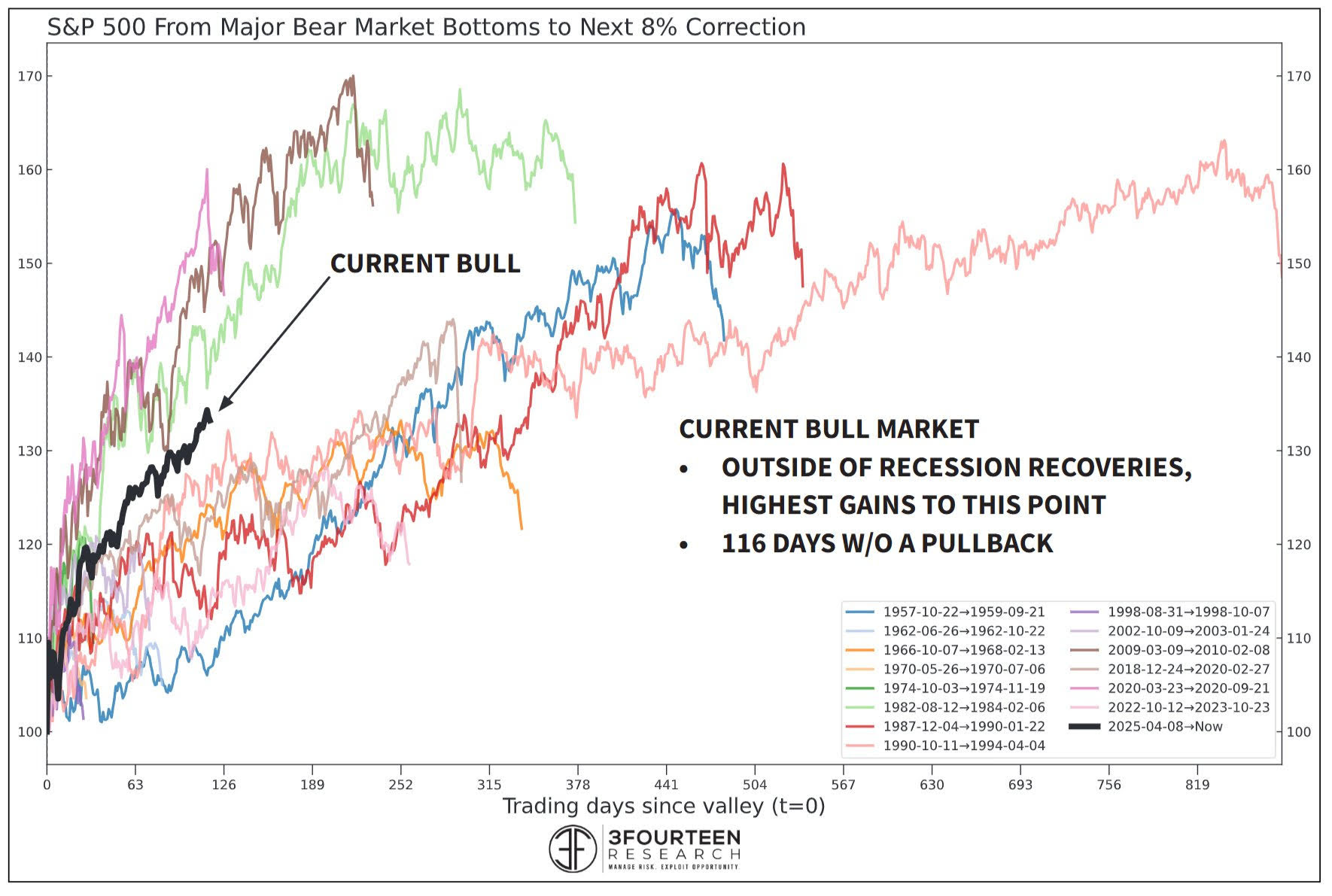
How does the rally compare to history?


Source: @WarrenPies

KKR:

Capital markets in Asia are outperforming, challenging global investors’ assumptions that it’s still all about the U.S.

imageIndeed, after several years of collective performance that has badly lagged that of the S&P 500, Asia markets certainly have perked up in 2025. Korea’s equity markets have appreciated 59%, China is up 38%, and Japan has risen by 22% in total return USD terms. During this period, the S&P 500 has appreciated 14%, marking the first time it has lagged Asia nine months into the year since 2019.

Such strong performance has caught many allocators by surprise, and many are now wondering whether their large overweight to U.S. assets is still the ‘right’ call. (…)

What’s different now is that structural reforms are taking place in cheap markets, such as Japan and Korea, while a falling dollar is occurring amidst a long-tailed Fed easing cycle. Bottom line: most investors are significantly underweight the region, and the earnings growth rate relative to rest of world is compelling.

Bigger picture, Asia is insulating itself more from Western policy, including trading more with itself. All told, intra-Asia trade rose to 58 percent of regional flows in 2021, compared to 46% in 1990. Importantly, we think that this ratio is headed towards 67% in 2029.

For investors, this means that logistics, manufacturing, and consumer sectors tied to local demand are enjoying better momentum than expected. Moreover, Asia’s 822 million millennials, 6x those of Europe and the U.S. combined,care seeking consumption upgrades as their GDP-per capita ratios increase. India and Vietnam represent prime
examples, we believe.

While history does not always repeat itself, Fed easing cycles are particularly constructive for the region’s performance if there is no U.S. recession (which is our base view). Thus far, this cycle has been no different. Asia typically performs quite well when the Fed eases and there is no recession. We also see local currency gains ahead. Importantly, over time, currency appreciation is typically one third of all EM Equity total return, and this easing cycle is occurring when the U.S. dollar is already expensive.

image image

Demographic shifts amidst both young and old are surging. All told, the 65+ age group will be 18% of the Chinese population by 2030; already in Japan 30% of the population is over 65, and in Korea that percentage is 20%.

Not surprisingly, this slowdown in population growth is leading to a surge in productivity-enhancing capex. One can see the surge in software demand in key markets such as Japan. At the other end of the spectrum, our research shows Asia has six times more millennials than the U.S. and Europe combined. For this demographic, consumption upgrades—including savings/brokerage, wellness/healthcare, and leisure—represent major investment themes amid ongoing urbanization. (…)

Within Korea, despite corporate reforms and shareholder activism driving +50% gains so far in 2025, 70% of the market still trades below book value, compared to 40% in Japan and less than seven percent in the U.S (…)

China too is cheap, especially if one compares China AI stories relative to their global counterparts in the U.S. Moreover, the dividend and buyback yield now exceeds the 10-year government bond yield by 1.5-2.0%.

image

Unfortunately, KKR does not relate P/B with ROEs, a must for a complete assessment of value. Paying 2x book value (equity) when the return on equity is 20% is as good as paying 1x BV when ROE is 10%. How much do you pay per unit of ROE?

Fortunately, Aswath Damodaran, Professor of Finance at the Stern School of Business at New York University computes many country ROEs (though his sample may no exactly match others’). Note that Damodaran shows 2 P/B values, one for “complex” organizations and one for “simple” organizations.

  • USA:      15.9%
  • India:     15.5%
  • Europe: 11.3%
  • Japan:      9.9%
  • All EM:     9.7%
  • China:      8.3%

While investors are enamored with the US, the WSJ informs us that “Nearly 70% of people said they believe the American dream—that if you work hard, you will get ahead—no longer holds true or never did, the highest level in nearly 15 years of surveys.”