Note: I am travelling with limited equipment and internet access. Postings will thus be sporadic.
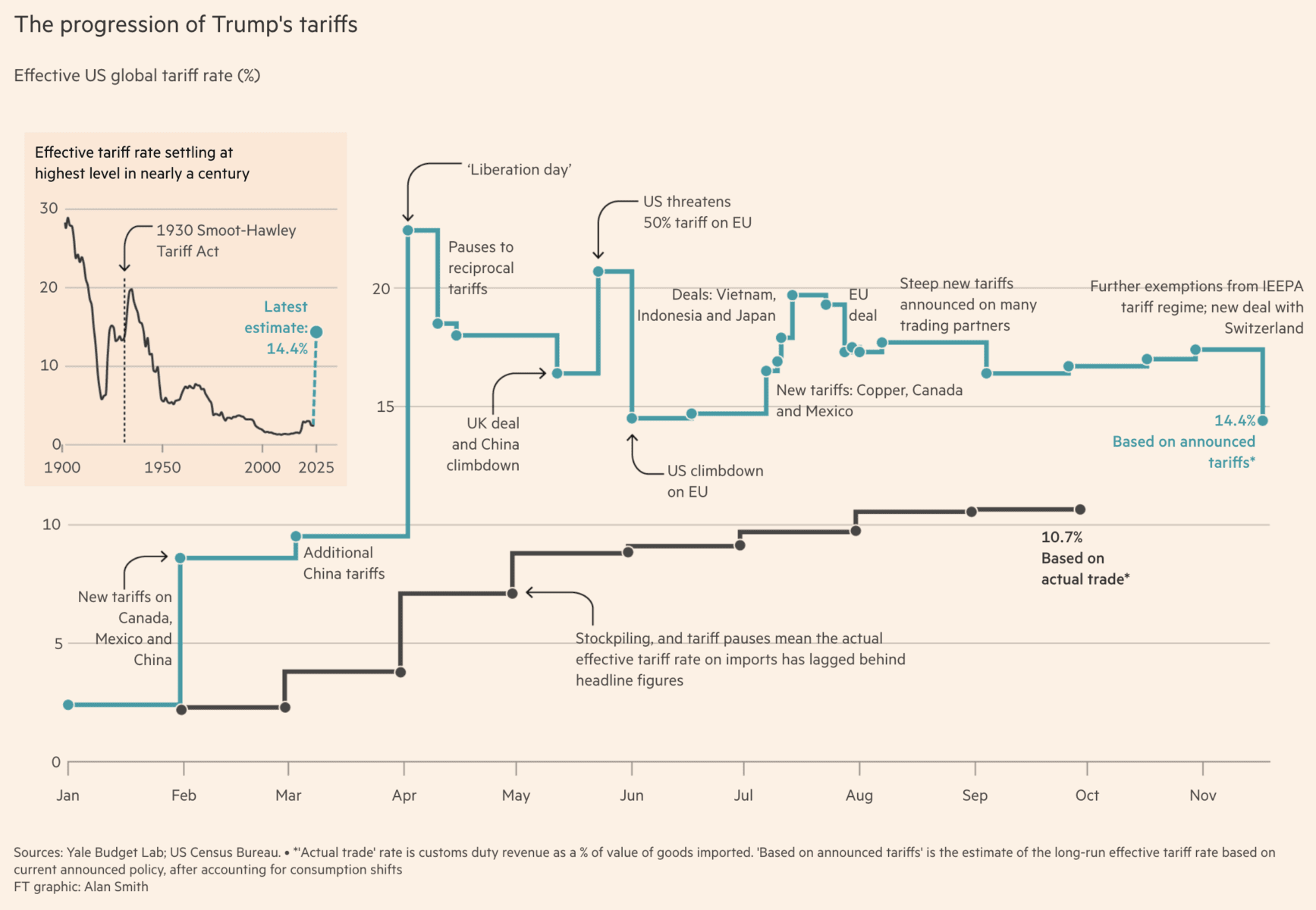
Trump Vows 25% Tariff on Countries Doing Business With Iran
Trump posted on social media on Monday that the new duty would be “effective immediately,” without providing details about the scope or implementation of the charges. The action has the potential to disrupt major US trading relationships across the globe. Iran’s partners include not only neighboring states, but large economies including India, Turkey and China.
“Any Country doing business with the Islamic Republic of Iran will pay a Tariff of 25% on any and all business being done with the United States of America. This Order is final and conclusive,” he said. (…)
An additional 25% tariff hitting products from Beijing risks upsetting the trade truce Trump negotiated with Chinese President Xi Jinping late last year. China is the world’s top buyer of Iranian crude and the nation’s independent refiners were increasing their intake of the oil as of last month. (…)
I’m curious how China will interpret “conclusive”.
Trump Administration Nears Trade Deal With Taiwan The deal would cut tariffs and include a commitment from Taiwanese Semiconductor Manufacturing Corporation, the island’s chip giant, to build more manufacturing plants in the United States.
(…) The deal would reduce the U.S. tariff rate, to 15 percent, for goods from the island, the people said. That rate is in line with imports from Japan and South Korea, Asian allies that struck deals last year.
As part of the deal, TSMC would also commit to building at least five more semiconductor facilities, or fabs, in Arizona, roughly doubling the number of plants it has in the state, one of the people said. The timeline for the investments was not immediately clear. (…)
TSMC, the world’s pre-eminent chipmaker, has completed one plant in Arizona since 2020; is completing a second, which will open in 2028; and has promised to build four more in the coming years. But as part of the U.S.-Taiwanese trade talks, it agreed to add at least five more.
US Small-Business Optimism Edges Higher on Economic Outlook
The National Federation of Independent Business optimism index rose 0.5 point to a four-month high of 99.5, according to figures released Tuesday. Two of the 10 components that make up the gauge increased, while three decreased. Five were unchanged.
A net 24% of owners said they expect business conditions to improve in the next six months, the primary driver of the overall index increase. That was 9 percentage points higher than in November, but just the first increase since July.
Meanwhile, both actual and planned price increases fell in December. The net share of owners raising average selling prices fell 4 points to 30%. Though this remains well above the historical average of a net 13%, it suggests that inflationary pressures eased somewhat.
The National Federation of Independent Business optimism index rose 0.5 point to a four-month high of 99.5, according to figures released Tuesday. Two of the 10 components that make up the gauge increased, while three decreased. Five were unchanged.
A net 24% of owners said they expect business conditions to improve in the next six months, the primary driver of the overall index increase. That was 9 percentage points higher than in November, but just the first increase since July.
Meanwhile, both actual and planned price increases fell in December. The net share of owners raising average selling prices fell 4 points to 30%. Though this remains well above the historical average of a net 13%, it suggests that inflationary pressures eased somewhat. (…)
Lawfare for Dummies, Monetary Edition DOJ’s criminal subpoena to Fed Chair Jerome Powell is a self-defeating fiasco.
(…) In the annals of political lawfare there’s dumb, and then there’s the criminal subpoena federal prosecutors delivered Friday to Federal Reserve Chairman Jerome Powell. President Trump would do himself and the country a big favor by firing those responsible for this fiasco. (…)
Mr. Trump said this weekend he didn’t know about the subpoena, which would be the first time he hasn’t been involved with DOJ decisions regarding his opponents. He has long signaled his dislike for Mr. Powell. This episode smacks of loyal underlings trying to curry favor with the President by doing what they think he would want.
Mr. Trump has made a routine of criticizing Mr. Powell for not cutting interest rates fast enough, despite having cut three times in recent months. Mr. Pulte is an especially eager toady, having led the campaign to unseat Fed Governor Lisa Cook on unproven allegations of mortgage fraud, in hopes of stacking the board with more accommodating members.
This brings to mind the medieval episode of England’s King Henry II idly importuning some knights to rid him of Archbishop Thomas Becket, only to be surprised when they actually did it. That historical episode proved self-defeating for the king (Becket became a saint and Henry lost his fight for supremacy over the church), and this one may not work out better for Mr. Trump.
His saner advisers are worried that Wall Street will view this as an attack on the Fed’s institutional independence, which it is. Markets reacted calmly on Monday, though the dollar fell and bond yields rose as a bet on more inflation. Whatever you think about Mr. Powell or central-bank independence, the way to change the Fed’s legal status is through legislation, not a criminal prosecution of dubious merit.
This ploy may backfire on Mr. Trump’s plans for the Fed. Mr. Powell’s term as chairman ends in May, but his seat on the Board of Governors doesn’t expire until 2028. He issued a defiant statement about the subpoena Sunday night, describing it as a pretextual political assault on the Fed.
Mr. Powell isn’t required to leave the Fed when his chairmanship ends, and Mr. Powell may now feel he needs to stay to avoid the appearance that the White House can bully Fed officials. That would deny Mr. Trump a second appointment to the Fed board.
Mr. Trump also is alienating Senators who will judge his nominees for confirmation. Sen. Thom Tillis (R., N.C.), a member of the Banking Committee, said Sunday he’ll block a Trump nominee for Fed Chair until this legal matter is resolved. Mr. Trump needs to call time on this self-defeating scheme, with a message to Ms. Bondi to halt the legal harassment. Firing Mr. Pulte before he can cause any more embarrassment would also help.
Americans elected Mr. Trump to reduce inflation, and he and Republicans have 10 months until the elections to show progress. Picking a fight with the Fed—and the bond market—over an issue that voters will find confusing and irrelevant is lawfare for dummies.
AI ROADBLOCKS: POWER PLAY
America’s Biggest Power Grid Operator Has an AI Problem—Too Many Data Centers Increasing demand from tech industry threatens to max out generation capacity in 13-state region; rate increases anger consumers
America’s AI boom is pushing the nation’s largest power-grid operator to the brink of a supply crisis.
Sixty-seven million people in a 13-state region stretching from New Jersey to Kentucky get their power from a market operated by nonprofit PJM. So, too, do the many AI data centers springing up in Northern Virginia’s “Data Center Alley,” which have a bottomless appetite for electricity.
Rates are going up for consumers. Older power plants are going out of service faster than new ones can be built. And the grid’s capacity is in danger of maxing out during periods of high demand, which could force PJM to call for rolling blackouts during heat waves or deep freezes to avoid damaging grid infrastructure.
Mark Christie, former chairman of the Federal Energy Regulatory Commission, said that a few years ago he considered the PJM blackout threat to be on the horizon. “Now I’m saying that the reliability risk is across the street,” he said.
PJM expects power demand to grow by 4.8% a year, on average, for the next decade—an astonishing pace for a system that hasn’t had substantial demand growth in years.
Consumers are furious about the rate increases. And tech companies, including Amazon, Alphabet and Microsoft, have fought against proposed rules that would require data centers to build their own power sources or go dark during demand surges.
Potential solutions to PJM’s problems are complex, controversial and nearly impossible to implement quickly. Adding to the challenge: The organization’s longtime chief executive, Manu Asthana, stepped down at the end of 2025 with no successor yet in place. PJM board chairman David Mills will serve as interim CEO until a replacement is chosen.
“The reliability challenges facing the grid are real, but they are not unsolvable,” Mills said in a written statement. PJM is coordinating with policymakers, regulators and industry, he said, to align investments in power generation and transmission with increasing demand. (…)
Other regions of the country are also seeing a surge in power demand tied to data centers. West Texas and the parts of the Southeast and the Southwest are becoming home to massive facilities. Power demand forecasts vary widely, but analysts expect significant growth in the coming years. An analysis by consulting firm ICF forecasts U.S. power demand in 2030 will be 25% higher than it was in 2023, largely because of data center needs. (…)
“One of the fundamental problems that PJM faces is political,” said Christie, the former FERC chairman. “You’ve got 13 different states with 13 very different policies about what kind of generation they want, and about who can build generation.” (…)
In September, PJM released proposals meant to balance data-center needs with those of other customers, including one that would cut power to data centers during times of extreme strain on the grid. That one included possible exceptions for data centers that either arrange for their own power supplies or volunteer to participate in demand response.
Amazon, Google, Microsoft and others said parts of that proposal discriminated against data centers. They opposed almost every facet of it, expressing concern about the prospect of being cut off from the grid, the cost of building power plants and the feasibility of powering down.
Tech companies put forward counterproposals that would make building power plants or going offline strictly voluntary for data centers within PJM.
In November, efforts to establish new rules for data centers stalled when PJM executives, tech companies, power suppliers, utilities and the independent monitor that oversees the market couldn’t agree on a plan. PJM’s board of managers is now working to propose one.
The market monitor, Joseph Bowring, has urged federal regulators to intervene. In a complaint filed with the Federal Energy Regulatory Commission, the monitor said PJM should stop admitting new data centers to the grid unless there are enough power plants and transmission lines to serve them.
Bowring’s firm, Monitoring Analytics, has been sounding the same warning for months.
Unless data centers bring their own power supply, the firm said in a letter to the grid operator in November, “PJM will be in the position of allocating blackouts rather than ensuring reliability.”
(…) “Late Monday, Trump said in a post that he wanted to ensure that “big Technology Companies” don’t leave consumers with higher utility bills as the result of a surge in data center construction linked to the artificial intelligence boom.” (…)
Polling shows that Trump’s approval ratings have declined since he took office. About 40% of voters approve of the way he’s handling the presidency, compared with 54% who disapprove, according to a Quinnipiac University poll released last month. Just over one-third of voters characterized the state of the economy as “excellent” or “good” while 65% described it as “not so good” or “poor.” (…)
It’s not clear if Trump plans to increase his travel to battleground states after Michigan. Ten months out from the midterms, a Republican close to the White House expressed confidence that the party could hold the Senate, but was more skeptical about maintaining a majority in the House. The White House should have been more sensitive to the significance of prices and cost-of-living issues to voters, given that similar frustration over the economy drove voters toward Trump in 2024, the person said.
Microsoft warns that China is winning AI race outside the west DeepSeek’s technology is being rapidly adopted across Africa and beyond, tech group’s research shows
Microsoft has warned that US AI groups are being outpaced by Chinese rivals in the battle for users outside the west, as China combines low-cost “open” models with hefty state subsidies to gain an edge. Brad Smith, Microsoft’s president, told the FT that the rapid adoption of Chinese AI start-up DeepSeek’s technology in emerging markets such as Africa underscores the competition American firms face around the world.
“We have to recognise that right now, unlike a year ago, China has an open-source model, and increasingly more than one, that is competitive,” he said. “They benefit from subsidisation by the Chinese government. They benefit from subsidies that enable [them] to basically undercut American companies based on price.”
In contrast, US tech groups such as OpenAI, Google and Anthropic have instead focused on maintaining full control of their most advanced technology, profiting from it through customer subscriptions or enterprise deals.
Microsoft’s research, which is based on usage data from the tech group’s products, estimated the Chinese group has an 18 per cent share of the AI market in Ethiopia and 17 per cent in Zimbabwe.
Smith said African countries would need broader investment from “international development banks” or “lending facilities” in order to build data centres and subsidise electricity costs. “If we rely on private capital flows alone, I don’t think that will be sufficient to compete with a competitor that is subsidised to the degree that Chinese companies often are, especially in those parts of the world,” he said.
However, Bright Simons, vice-president at the IMANI think-tank in Ghana and an expert on AI, said there was no “scientifically rigorous way” to determine whether DeepSeek was forging ahead in Africa, but that open-source Chinese AI systems offered cheap alternatives.
“Africans can’t afford very expensive solutions apart from open source, so you have to go to [Meta’s] Llama or Chinese options,” he said.
They were also using homegrown small language models, such as Masakhane, a pan-African model, and the South African InkubaLM, he said.
Microsoft’s research also found that in countries where US technology products are limited or restricted, DeepSeek had gained a considerable lead, with a 56 per cent market share in Belarus, 49 per cent in Cuba and 43 per cent in Russia. (…)
Microsoft’s research showed that AI adoption is currently concentrated in developed countries, with nearly a quarter of the global north using AI in the fourth quarter of 2025, compared to 14 per cent of the global south, and 16 per cent globally. (…)
“What we do have is, as American companies, a stronger reputation for trust. We have access to better chips than the Chinese companies do . . . [but] you always have to compete on price,” he added. (…)

Not just a question of price and “subsidies” Mr. Smith. Open source is clearly winning. In this chart OpenAi is the only closed LLM.