Did you miss MIND THE GAAP?
Jim Grant’s recent piece:
Jim Grant Asks When The World Will Realize “That Central Bankers Have Lost Their Marbles”
Oil Isn’t the Only Commodity Threatened by Tesla’s Rise
So What Are the Odds, Really?
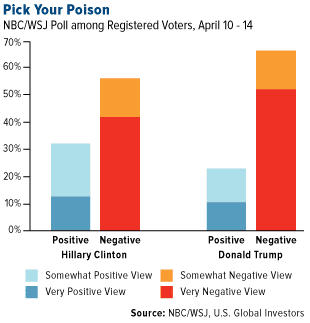
The cards are markedly stacked against Trump when it comes to winning in November. Most national polls show Hillary Clinton beating him in the general election, even though she is nearly as unfavorable to registered voters, according to an NBC/Wall Street Journal survey. Renaissance Macro Research calls Trump’s “net negatives prohibitively high.†And as I shared with you way back in August of last year, Moody’s Analytics forecasts a win for the Democratic nominee, whether that’s Clinton or someone else. Since 1980, Moody’s sophisticated election model has accurately predicted the outcome of every single contest, and in 2012 it even nailed the Electoral College vote.
Trump still has quite a lot of support in the financial industry. A Financial Advisor poll found that, as of today, a little over 50 percent of respondents say Trump will win the White House, while nearly 37 percent say Clinton. Doubleline Capital founder Jeff Gundlach also believes Trump will be the victor, arguing that in the short term, this would be positive for the U.S. economy. The New York billionaire, Gundlach points out, has promised to build up the military and initiate an infrastructure program.
-
How to Trump-proof your portfolio You would be a fool to base your investment choice on free-market theories alone
By Gillian Tett
(…) First of all, do not buy banks; or not if you hope government will boost their share price. Until recently, Mrs Clinton was perceived as being soft on Wall Street; indeed, some financiers hoped that bank-bashing would end in 2016.
But Bernie Sanders, her Democratic rival, has performed so well that Mrs Clinton will face pressure to steal his “socialist†language to appease his supporters, and may well pick an anti-Wall Street figure as her running mate, such as Sherrod Brown, an Ohio senator.
Mr Trump may not be so different. Many Republicans would love to repeal the post-crisis financial reforms, and he has criticised the Dodd-Frank Act. But he also seems instinctively hostile to Wall Street. As a self-appointed hero of angry main street voters, he is unlikely to embrace banks.
Second, do not expect a rally in Treasury bonds; at least, not one driven by debt cuts. A couple of years ago, it was presumed that by this point in the economic cycle policymakers would be discussing how to cut America’s vast debt burden. But Mrs Clinton is no fiscal hawk. On the contrary, she seems to lean towards fiscal stimulus, and may try to appease supporters of Mr Sanders this way.
And, while the Tea Party wing of the Republican party is eager to slash debt, Mr Trump has built a career on exploiting leverage. He has vaguely promised to get rid of America’s $15tn debt in eight years; but he also wants to create jobs, boost growth and protect entitlements. Little wonder that traditional fiscally hawkish Republicans dislike him.
Third, embrace infrastructure stocks — whoever wins. Mr Trump built his brand with construction, and were he to win in November he would be likely to unleash a national infrastructure campaign to create jobs and growth. He likes the idea of being a second Dwight Eisenhower, the man who built America’s Interstate highway system.
But Mrs Clinton may do this too. After all, as Lawrence Summers, the former US Treasury secretary, recently pointed out, the beauty of infrastructure spending is that it could create middle-class jobs and growth at a time when monetary policy has reached its limits — at least, if you do not mind raising debt.
Fourth, expect currency volatility. The most eye-grabbing element of Mr Trump’s campaign so far has been his threats about trade protectionism. But Mrs Clinton has turned more protectionist, too, toning down her support of the Trans-Pacific Partnership. No one knows if her newfound caution will actually change trade flows or supply chains. But sabre-rattling on the global stage could certainly quickly unleash some currency swings.
Finally — and most importantly — investors need to invest in assets with an eye to capricious government intervention. After all, if there is one thing that will make sense of this peculiar election, it is the idea that voters have lost faith in the free-market political centre.
With populism rife, Mrs Clinton may deploy more consumer protection and regulation in response, while Mr Trump ay plump for endless protectionism.
Either way, if you want to invest in pharma, cars, tech or pretty much anything else, you would be a fool to make your choice based on economics or free-market theories alone. Populism matters, in investing and politics alike now — even, or especially, if it makes your head spin.
 Trump’s Comments on U.S. Debt Seen as Non-Starter by Bond Market
Initially,
“I would borrow, knowing that if the economy crashed, you could make a deal,†Trump said in a CNBC interview.
Later, when the inevitable would happen,
(…) Trump, the presumptive Republican nominee for president, said in an interview with CNBC Thursday that if the economy were in a prolonged slump, he might use his business skills to reduce America’s debt burden by pushing creditors to accept write-downs on their government holdings.
Since the founding of the country Treasury secretaries have been unwavering in their commitment to always make good on government obligations, an assurance that’s helped make U.S. debt a haven from risk around the world. A default would put that status in jeopardy, sinking the value of the dollar and sending yields surging, according to David Ader, head of government-bond strategy at CRT Capital Group LLC. Growth could stall as borrowing costs for holders of mortgages and other consumer loans — which are tied to government debt yields, spiked.
“This is stupid and ridiculous and never going to happen,†Ader said from Stamford, Connecticut. “But it’s not impossible that he could be president, and could try all the seemingly ludicrous and impossible things he’s talked about. You can’t just dismiss it when the guys got his finger on the button, so to speak.†(…)
Americans’ Distaste For Both Trump And Clinton Is Record-Breaking
No past candidate comes close to Clinton, and especially Trump, in terms of engendering strong dislike a little more than six months before the election.
