The enemy of knowledge is not ignorance, it’s the illusion of knowledge (Stephen Hawking)

It ain’t what you don’t know that gets you into trouble. It’s what you know for sure that just ain’t so (Mark Twain)

Invest with smart knowledge and objective odds

THE DAILY EDGE: 8 JULY 2020

Coronavirus cases in the U.S. rose 1.8% from a day earlier to 2.96 million, according to data collected by Johns Hopkins University and Bloomberg News. That matched the average daily increase over the past week and marked a fourth day in which new cases topped 50,000. Deaths rose 0.6% to 130,813.

  • Florida had 213,794 cases, up 3.6% from a day earlier, compared with an average increase of 5% in the previous seven days, according to state health officials. Deaths reached 3,841, an increase of 1.7%

  • California reported a 3.4% daily jump in virus hospitalizations, to a record 5,989 patients. San Francisco will delay plans to open indoor dining and outdoor bars as planned July 13

  • Arizona health officials reported 3,653 new cases, bringing that total to 105,094, a 3.6% increase. Deaths rose by a record 117 to 1,927

  • New Jersey’s virus transmission rate rose to 1.05, the highest in about 10 weeks, according to Governor Phil Murphy’s office. Weeks ago, the rate was 0.64

  • Montana cases rose 6.2% to a total 1,327, according to data compiled by Johns Hopkins and Bloomberg News

Coronavirus deaths are ticking up in the new hotspots of Florida, Texas and Arizona, even as they continue to trend down nationally, Axios’ Caitlin Owens writes.

  • Arizona reported a record 117 deaths yesterday, and hospitalizations are skyrocketing there and in other hotspots.

  • Texas reported a record 60 new deaths and 10,000 new cases.

  • Florida reported 63 new deaths.

unnamed (24)

unnamed (3)

PANDENOMICS

Yesterday, I summed up Markit’s Services PMIs with

My take is that in spite of the normal snap back in demand from re-openings, with the  exception of China, we are still not seeing indications of a sustained solid turn in new orders (business demand) that would then solidly lift employment (consumer demand) that would fuel more new orders and create the typical post-recession self-feeding recovery.

Later in the day, Markit posted this chart on global employment, orders and backlogs which are, in my view, the critical series to watch currently.

unnamed (23)

The current situation is also very different from prior global downturns. Although global PMI indicators of new business showed record gains in both manufacturing and services in June, a rebound from enforced closures of non-essential business and household lockdowns was only to be expected as operations restart. Companies have also reported that lockdowns have led to pent-up demand for certain goods and services which is now supporting business activity.

Quite how long this pent-up demand effect will last remain uncertain. Even with the rebound, the latest global new business indicators remain below 50, reflecting a situation where more companies reported a drop in new work than saw an improvement, hinting strongly at subdued underlying demand. Broader indicators of global trade from the manufacturing PMI surveys also showed exports continuing to act as a particular drag on the global economy, leaving many economies reliant on domestic demand to drive growth.

Furthermore, the current demand environment also reflects emergency stimulus measures, both from central banks and government, the latter notably via fiscal support and employment retention schemes, which have helped provide temporary platforms to support demand and consumption.

The big question is therefore whether the demand indicators will continue to improve beyond the initial rebound from the lockdowns, and in particular how employment will hold up when support measures are removed. Encouragingly, the rate of global job losses eased for a second successive month in June. Business expectations for the year ahead have almost recovered to levels seen earlier in the year. Whether these positive trends continue will ultimately depend on central bank and government policy support, and also of course on the absence of a renewed upward trend in COVID-19 infections. Any renewed faltering of the PMIs in coming months will flash warning signs of a W- rather than V-shaped recovery.

Weekly Economic Index The WEI is an index of ten daily and weekly indicators of real economic activity, scaled to align with the four-quarter GDP growth rate.

WEI Chart
Recession Forces Spending Cuts on States, Cities Hit by Coronavirus State and local governments from Georgia to California are cutting money for schools, universities and other services as the coronavirus-induced recession wreaks havoc on their finances.

(…) Widespread job losses and closed businesses have reduced revenue from sales and income taxes, forcing officials to make agonizing choices in budgets for the new fiscal year, which started July 1 in much of the country.

Governments have cut 1.5 million jobs since March, mostly in education, and more reductions are likely barring a quick economic recovery. In Washington state, some state workers will take unpaid furloughs. In Idaho, Boise State University cut its baseball and swim teams in an effort to save $3 million.

Dayton, Ohio, Mayor Nan Whaley says the city may have to cut up to 8% of its general fund budget, which pays for fire, police, roads, water and trash collection. (…)

The National Governors Association says states need another $500 billion in federal aid to make up for lost revenue. The U.S. Conference of Mayors says cities need $250 billion. (…)

Almost all states and local governments require balanced budgets. For now, they have largely avoided raising taxes to plug budget holes, opting instead to cut spending or dip into reserves. (…)

The median state went into the crisis with reserves totaling a record 7.8% of its general fund budget, according to the National Association of State Budget Officers.

California lawmakers used $9 billion of their $16 billion rainy-day fund to help balance the $202 billion budget that Gov. Gavin Newsom, a Democrat, signed June 29. Even so, state employees will have to take up to two unpaid furlough days a month, and public colleges and universities face about $602 million in reductions. (…)

With an uncertain outlook, officials are trying to maintain reserves in anticipation of more lean years.

“You may need to use it in 2022 and beyond,” said Brian Sigritz, director of state fiscal studies at the budget officers’ association. “They’re not expecting this decline to be a one-year or two-year thing.” (…)

States and cities’ aggregate expenditures are 60% larger than the federal government’s. They employ 18.4 million people (13% of the U.S. total employment) compared to 2.9 million for the federal government. So far, employment in states and cities has declined 7.5% from February while total employment dropped 10.2% and federal employment is up 0.6%.

fredgraph (99)

  • United Airlines Holdings Inc. warned employees that a jump in coronavirus infections in parts of the South and West is jeopardizing a nascent recovery for U.S. travel. The shares plunged. The airline has seen a sharp drop in bookings, particularly at its Newark, New Jersey hub, as states in the New York City metro area add new quarantine rules for travelers, United executives told employees Monday in a town hall meeting. Bookings at United’s Newark hub were 16% of 2019 levels as of July 1, or about half of what they were several weeks earlier when travel began reviving, according to the presentation. United is watching for signs of a similar drop at its Chicago hub given restrictions the city imposed last week on travelers arriving from more than a dozen states, said a person familiar with the matter, who asked not to be named because the employee discussions were private.
  • Covid Still Poses Challenges for Financial System, Fed’s Quarles Says Global policy makers responded decisively to the coronavirus outbreak earlier this year but the financial system isn’t out of the woods yet, a top Federal Reserve official said Tuesday.
  • American consumers may not be prepared to return to pre-pandemic spending levels. More than 40% of people who spent money on movies, event tickets or at bars before the pandemic now plan to spend less on those activities, according to a new survey for CreditCards.com. Meanwhile, more than 60% of small businesses say they need spending to return to normal by the end of the year to stay open, according to American Express data.
  • Ascena Retail Group Inc., the owner of mall brands that occupy almost 3,000 stores in the U.S., is preparing to file for bankruptcy and shutter at least 1,200 of those locations, according to people with knowledge of the plan. The company, which owns brands such as Ann Taylor and Lane Bryant, could enter Chapter 11 as soon as this week with a creditor agreement in place that eliminates around $700 million of its $1.1 billion debt load.
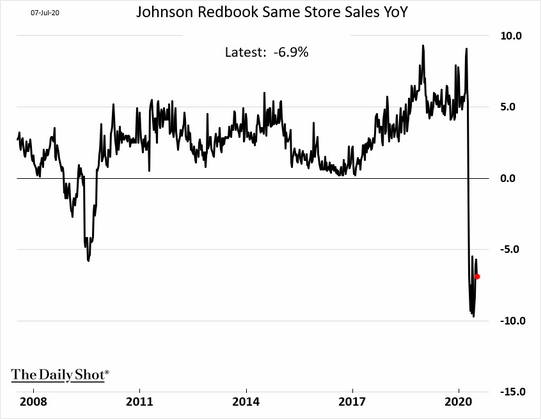
    • The Johnson Redbook index of same-store sales is yet to see a meaningful rebound. (The Daily Shot)
    • Chinese retail sales have been recovering but remain well below previous trend growth.

Source: Gavekal

  • A growing number of Japanese businesses are failing amid the coronavirus pandemic. Some 780 Japanese firms filed for bankruptcy in June, 148% more than the prior month and the most this year, according to Tokyo Shoko Research Ltd. There were 94 pandemic-driven cases last month, bringing the total to 240 in the first half of the year, with sectors such as hotels and restaurants badly hit. Growing distress among businesses is in line with the record jump in bank loans and deposits in June, as companies continued to tap emergency credit facilities and hoard cash.
  • European Union leaders will probably fail to agree at a summit next week on a massive spending plan aimed at reviving their economies, according to Hungarian Prime Minister Viktor Orban. Negotiations will be “very tough” and will likely need to continue throughout the summer, Orban said on Wednesday in an online panel discussion with Slovenian Prime Minister Janez Jansa and Serbian President Aleksandar Vucic.

Pointing up Also posted today: DON’T FIGHT THE FED: Facts and Fiction

Below is the forward P/E ratio for the S&P 500 Consumer Discretionary sector.

Source: @LizAnnSonders, @business

With four months to go, how US equities are trading the 2020 elections. Three different markets suggest three different 2020 election perspectives: (1) Prediction markets suggest a Democratic sweep. Market pricing currently implies the Democrats will control the White House, Senate, and House of Representatives. The current probabilities equal 62%, 61%, and 85%, respectively, compared with 43%, 30% and 61% in late February. (Goldman Sachs)

FYI:
THE DAILY EDGE: 16 APRIL 2020

Virus Update

image

image

A graphic with no description

image

  • The number of cases in Europe doubled within 10 days to 1 million. (…) While there have been “small positive signals” in countries such as Spain, Italy, Germany, France and Switzerland, that’s tempered by sustained or increased levels of incidents in the U.K., Turkey, Ukraine, Belarus and the Russian Federation.
  • Spain confirmed 5,183 new cases, the most in a week, taking the total to 182,816. There were 551 deaths in past 24 hours, for a total of 19,130 since outbreak began.
  • Confirmed infections [in Russia] rose by 3,448 in the past day to 27,938, Russian consumer health watchdog Rospotrebnadzor said. At 14%, the daily growth rate is the lowest since April 11. Moscow reported 1,370 new cases compared with 1,774 the day before, the first daily decline since April 11
  • China reported 46 new coronavirus cases, 34 of them imported, and no new deaths as of midnight on Wednesday. It was the third straight day of slowing growth in imported cases, 16 of which were recorded in the northeastern province of Heilongjiang province. All were in Chinese citizens returning from Russia—the source of half of China’s imported infections since the start of April.
  • Singapore late Wednesday confirmed 447 new cases of Covid-19, the disease caused by the virus, its highest daily count to date. The country’s Ministry of Health reported that most of the infections were among people living in foreign-worker dormitories, a population whose number of cases “has increased significantly.” The ministry added that it has been increasing its testing of these thousands of workers, mostly from South Asia, who have low-skill jobs in industries such as construction and live in close quarters in purpose-built dormitories. There have now been 3,699 cases and 10 deaths in the tightly controlled city-state, earlier lauded for moving quickly to control initial outbreaks.
  • Japan on Wednesday also reported a daily high: 17 new deaths related to Covid-19, bringing the total in the country to 136. Some 8,582 people have been infected. (…) Mr. Abe plans to declare a nationwide state of emergency until at least May 6, Economy Minister Yasutoshi Nishimura said Thursday. It will cover the Golden Week holidays, when many Japanese would normally travel on trains and planes around the country.
  • German Chancellor Angela Merkel on Wednesday announced plans to gradually reopen the nation, as the economics ministry said it expected its recession to last at least through midyear.
  • Two-thirds of people testing positive for the coronavirus without signs of being sick remain symptom-free throughout infection, according to a breakdown published by the Chinese government. Among 6,764 people without symptoms who tested positive for Covid-19, only one-fifth — or 1,297 — later developed symptoms and were reclassified as confirmed cases, a Chinese health official said Wednesday.
  • A trial for remdesivir, an experimental drug developed by Gilead Sciences Inc., in Covid-19 patients with mild or moderate symptoms, has been suspended in China, as no eligible patients could be recruited amid an abating epidemic, according to a Wednesday update on ClinicalTrials.gov. Previously, a trial for remdesivir in severely ill Covid-19 patients was terminated due to a stall in enrollment
  • Abbott Laboratories said on Wednesday that it had launched a test that can detect whether a person has Covid-19 antibodies, regardless of whether they have ever shown symptom  of infection.

Confused smile Counselor to the president Kellyanne Conway appeared on Fox News’ “Fox & Friends” Wednesday morning, attempting to take a shot at the World Health Organization — and has been brutally mocked for her seemingly scientifically inaccurate comment. The White House, however, claims she did not misspeak. “This is COVID-19, not COVID-1, folks,” she declared, “and so you would think the people in charge of the World Health Organization, facts and figures, would be on top of that.”

PANDENOMICS
U.S. Retail Sales Record Plunge

image

Largest Drop In Industrial Production in 75 Years

large image

(…) Xiong’s experience provides a window into the uncertain future facing small-business owners around the globe as they contemplate life after lockdowns. While many hope to pick up where they left off, Wuhan’s cautious emergence shows it likely won’t be that easy. The city, once a bustling hub for steel and auto manufacturing, remains gripped by fear of reinfection. Companies are testing employees before they’re allowed back to work and disinfecting their premises daily. If a customer or worker gets the virus, businesses typically have to shut down again for weeks of quarantine—something even the most painstakingly prepared business plan can’t predict. (…)

Data: CivicScience; Chart: Axios Visuals

This is what it will take to get us back outside How to safely ease social distancing while we wait for a covid-19 drug or vaccine.

The coronavirus issue(…) In recent weeks a consensus has started to build among various groups of experts on what this new normal might look like. Some parts of the strategy will reflect the practices of contact tracing and disease monitoring adopted in the countries that have dealt best with the virus so far, such as South Korea and Singapore. Other parts are starting to emerge, such as regularly testing massive numbers of people and relaxing movement restrictions only on those who have recently tested negative or have already recovered from the virus— if indeed those people are immune, which is assumed but still not certain.

This will entail a considerable degree of surveillance and social control, though there are ways to make it less intrusive than it has been in some countries. (…)

In their report on March 16, the researchers at Imperial College proposed a way of alternating between stricter and looser regimes: impose widespread social distancing measures every time admissions to intensive care units (ICUs) start to spike, and relax them each time admissions fall. (…)

What counts as “social distancing”? The researchers define it as “All households reduce contact outside household, school, or workplace by 75%.” That doesn’t mean you should feel free to go out with your friends once a week instead of four times. It means if everyone does everything they can to minimize social contact, then on average, the number of contacts is expected to fall by 75%.

Under this model, the researchers concluded, both social distancing and school closures need to be in force some two-thirds of the time— roughly two months on and one month off—until a vaccine or cure is available. They noted that the results are “qualitatively similar for the US.”

The researchers also modeled various less stringent policies, but all of them came up short. (…)

Those scenarios, however, assumed that being shut in applies equally to everyone. But not everyone is equally at risk, or risky. The key to getting to normal will be to establish systems for discriminating—legally and fairly—between those who can be allowed to move around freely and those who must stay at home.

Assorted proposals now coming out of bodies such as the American Enterprise Institute, the Center for American Progress, and Harvard University’s Edmond J. Safra Center for Ethics, describe how this might be done. The basic outlines are all similar.

First, keep as many people as possible at home until the rate of infections is well under control. Meanwhile, massively ramp up testing capacity, so that once the country is ready to relax social distancing rules, anybody who asks for a test—and some who don’t—can take one and get the result within hours or, ideally, minutes. This has to include testing both for the virus, in order to detect people who are currently sick even if they don’t have symptoms, and for antibodies, in order to find people who have had the disease and are now immune.

People who test positive for antibodies might be granted “immunity passports,” or certificates to let them move freely; Germany and the UK have already said they plan to issue such documents. People who test negative for the virus would be allowed to move around too, but they would have to get retested regularly and agree to have their cell phone’s location tracked. This way they could be alerted if they come into contact with anyone who has been infected. (…)

The Safra Center, for example, outlines various schemes for “peer-to-peer tracking,” in which an app on your phone swaps encrypted tokens via Bluetooth with any other phones that spend some minimum period of time nearby. If you test positive for the virus, you put that information into the app. Using the tokens your phone has collected in the past few days, it sends alerts to those people to self-isolate or go get tested. Your actual location doesn’t have to be tracked, only the anonymized identities of the people you’ve been near. (…)

There also needs to be nationwide data-gathering and analysis to better understand how the virus is spreading and spot high-risk areas that might need more testing or medical resources, or another quarantine. This strategy has to include serological surveys—random testing for antibodies to find out how widely the virus has already spread. Some other ways to gauge its prevalence without spying on people directly might be to crowdsource the information using sites like covidnearyou.org, infer it from the volume of Google searches for covid-19 symptoms in different places, or even look for the virus in samples of sewage.

It’s also important to make sure people who have tested positive or been exposed are staying in quarantine. This, however, seems hard to do without more direct surveillance. Countries like Singapore and South Korea use various means, such as making people share their location via WhatsApp or download a specialized tracking app. Whether the US or European countries could impose (let alone enforce) that kind of control isn’t clear. Without it, we have to rely on people to be responsible citizens and self-isolate when necessary.

The point is, there are more and less creepy ways of doing all this, and the crisis could catalyze a broader conversation about how to use people’s data for the collective good while protecting the individual.

Regardless of the methods chosen, the goal is the same: after a couple of months of shutdown, to begin selectively easing restrictions on movement for people who can show they’re not a disease risk. With good enough testing capacity, data collection, contact tracing, enforcement of or adherence to quarantines, and coordination between the federal, state, and local governments, local outbreaks might be contained before they spread and force another national shutdown.

Gradually, more and more people would be able to return to some semblance of normality. It would still be a far cry from the packed bars and sports arenas of the past, but it would be a less unbearable way to wait for the discovery of a vaccine or cure. More important, the economy could start ticking back to life.

This depends on a lot of things going right, though. First, the initial shutdown probably needs to be harsher than it currently is in the US. At the time of writing some US states still had no stay-at-home orders, few cities were enforcing those orders, and there were no restrictions on travel between cities or states. (…)

Second, by some estimates, millions of virus tests a day, promptly performed, may be required to properly keep tabs on the pandemic in the US. By April 8 the country was testing around 150,000 people a day, and many results were taking more than a week to come back.

(…) the US in particular has precious little coordinated national strategy. The chaotic management of the crisis by the Trump administration, the separation of powers between the federal government and the states, and the fragmented nature of privatized health care make it unclear how systems for automated contact tracing, quarantine enforcement, or immune certification will emerge.

That means a reopening of the US in June is optimistic, to say the least, and a reopening by April 30, as President Donald Trump was still hoping for in early April, is a fantasy. (…)

Business Leaders Tell Trump Testing Is Inadequate to Reopen Economy In the first meeting of President Trump’s task force to reopen the economy, banking and financial services executives said the administration needed to dramatically increase the availability of coronavirus testing before the public would be confident enough to return to work.

The push for more testing came in the first of four Wednesday phone calls that Mr. Trump held with business executives on his newly formed task force to reopen the economy. (…)

The task force, known formally as the Great American Economic Revival Industry Groups, includes more than 200 business and political leaders, who have been divided into smaller groups based on their industry. (…)

The president said reopening the country would not mean the end of social distancing and that people might have to get used to wearing masks even after businesses reopened, the people said. (…)

EARNINGS WATCH

As of Tuesday night, we had 35 reports in. Half of the 10 Financials beat but Financials’ overall surprise factor was –26.9%. These 35 companies reported earnings down 33.1%. The current blended estimated growth for Q1 is –12.8% with Q2 at –25.2%.

Full year EPS are now seen declining 11.4% to $144.42. If the unemployment rate rises to 10-15% as many predict, profits could end up much worse:

image

Coronavirus latest: Goldman warns stocks have risen ‘too far, too fast’
Don’t Trust the ‘E’ in the Stock Market’s P/E Ratio Analysts have cut earnings forecasts sharply for U.S. companies, but the actual numbers will likely be much worse

For the first quarter, analysts estimate earnings for companies in the S&P 500 will be 12.3% below their year-earlier level, according to I/B/E/S data from Refinitiv. Back at the start of the year, they were looking for a first-quarter gain of 6.3%. In the just-started second quarter, they expect earnings to drop by 23.6%. Third- and fourth-quarter earnings are seen falling by 11.3% and 3.5%, respectively. (…)

Considering what has happened in past recessions, though, the earnings hit will likely be much bigger than they are guessing. (…)

Based on current analyst estimates, the S&P trades at nearly 19 times expected earnings over the next year—roughly where the forward price/earnings ratio was in early February, before coronavirus worries took hold. Whether one finds that reassuring or worrisome, the actual figure is almost certainly much higher. Investors could be in for a rude awakening in the months ahead.

U.K. Earnings Could Halve This Year, Citi Says

The bank warned clients that the pandemic’s economic impact will be greater in the U.K. due to the country’s dependency on its services industry, which is deeply affected by social distancing efforts. While consensus is for a 20% decline in earnings, “we think that this is not low enough,” strategists including Robert Buckland wrote in a note. Citi expects U.K. gross domestic product to drop 7.6% this year versus a 2.3% decline globally.

Biggest Wall Street banks set aside $25bn for loan losses Shares in lenders fall as Goldman chief Solomon warns of recession lasting into 2021

Federal Reserve Bank of Minneapolis President Neel Kashkari says that large U.S. banks should raise $200 billion from private investors and stop paying dividends so they can support the economy.

“The most patriotic thing they could do today would be to stop paying dividends and raise equity capital, to ensure that they can endure a deep economic downturn,” Kashkari writes in a Financial Times op-ed.

Under severe coronavirus scenarios, large banks with assets of more than $100 billion each could together lose hundreds of billions of dollars of equity capital, stress test modeling by the Minneapolis Fed indicates. (…)

If the current crisis “turns out less serious than we fear, banks can return the capital through buybacks and dividends once the crisis passes,” he said.

Earlier this month, former Fed Chairman Ben Bernanke, who led the central bank through the financial crisis, said that while U.S. banks are in much better shape than they were back then, he saw a case for regulators to ask banks to be cautious about paying out dividends or executing share buybacks — provided that could be done without unduly alarming investors about the financial health of the institutions.

13/34–Week EMA Trend

Strange Relationship Between Stocks and Havens Unnerves Investors Safer assets from gold to Treasurys are rising alongside major indexes, a sign that the stock market rebound hasn’t assuaged investors’ fears about the world economy.

The S&P 500 has rebounded 24% from its March 23 multiyear low. At the same time, gold on Tuesday climbed to its highest level in nearly 7½ years, bringing its gains for the year to 15%. Billions of dollars have flowed into gold exchange-traded funds, and sales of physical bars and coins have soared.

Treasurys prices have joined the rally, pushing the yield on the benchmark 10-year U.S. Treasury note down to 0.64% from 1.26% on March 18. The Swiss franc and Japanese yen also have posted gains. (…)

But stocks and havens have risen in tandem since the Federal Reserve slashed interest rates near zero last month and stepped up lending programs and asset purchases. (…)

Stock prices suggest a short recession with a swift rebound in corporate profits, while gains in havens signal worries about a longer downturn. (…) Even within the stock market, many are favoring companies with more cash that can withstand the crisis. (…)

With the Fed flooding the economy with cash to stabilize growth, some analysts think the dollar could weaken, making gold an attractive bet. Low or negative government-bond yields also make it less likely investors will miss out on outsize returns by owning gold instead of bonds. (…)

Asset correlations are upset by central banks’ interventions just about all over the place.

Huawei chip unit orders up more domestic production as U.S. restrictions loom: sources

Huawei Technologies Co Ltd is gradually shifting production of chips designed in-house away from Taiwan Semiconductor Manufacturing Co Ltd (TSMC) and towards a mainland Chinese firm in preparation for more U.S. restrictions, sources familiar with the matter said.

The move towards Shanghai-based Semiconductor Manufacturing International Corp (SMIC) comes as Washington readies new rules which would require foreign companies using U.S. chipmaking equipment to obtain a license before supplying chips to Huawei – rules that would directly affect TSMC.

It also highlights how U.S. restrictions against Huawei can act as an impetus for Chinese companies to accelerate the development of homegrown technology. (…)