CONSUMER PRICE INDEX – FEBRUARY 2019
The Consumer Price Index for All Urban Consumers (CPI-U) increased 0.2 percent in February on a seasonally adjusted basis after being unchanged in January, the U.S. Bureau of Labor Statistics reported today. Over the last 12 months, the all items index increased 1.5 percent before seasonal adjustment.
The food index rose 0.4 percent, its largest monthly increase since May 2014, as both the food at home and food away from home indexes increased. The gasoline index rose 1.5 percent in February, following three consecutive monthly declines, resulting in the energy index rising 0.4 percent despite declines in the electricity and natural gas indexes.
The index for all items less food and energy increased 0.1 percent in February after rising 0.2 percent in January. The index for all items less food and energy rose 2.1 percent over the last 12 months, a slightly smaller figure than the 2.2-percent increase for the period ending January. The food index rose 2.0 percent over the past year, its largest 12-month increase since the period ending April 2015. In contrast, the energy index declined 5.0 percent over the last 12 months.
Retail Sales Rose in January, but Didn’t Make Up for Lost December Spending Consumer spending recovered only modestly, but data signal decline may not be sustained
Retail sales, a gauge of spending at restaurants, bricks-and-mortar establishments, and online stores, rose a seasonally adjusted 0.2% in January from a month earlier to $504.4 billion, the Commerce Department said Monday. (…) December’s spending report initially showed consumers unexpectedly pulled back spending in almost every category, which rattled markets. Monday’s report showed December sales were revised even lower to a 1.6% drop, from an initially published 1.2% decline. Though January’s sales gain didn’t make up for December’s loss, the data signal that the consumer-spending decline may not be sustained. (…)
Many were expecting December’s very weak –1.2% drop to be revised. It sure was…to –1.6%! The worst month (a December!) on a MoM basis since the end of the Great Financial Crisis.
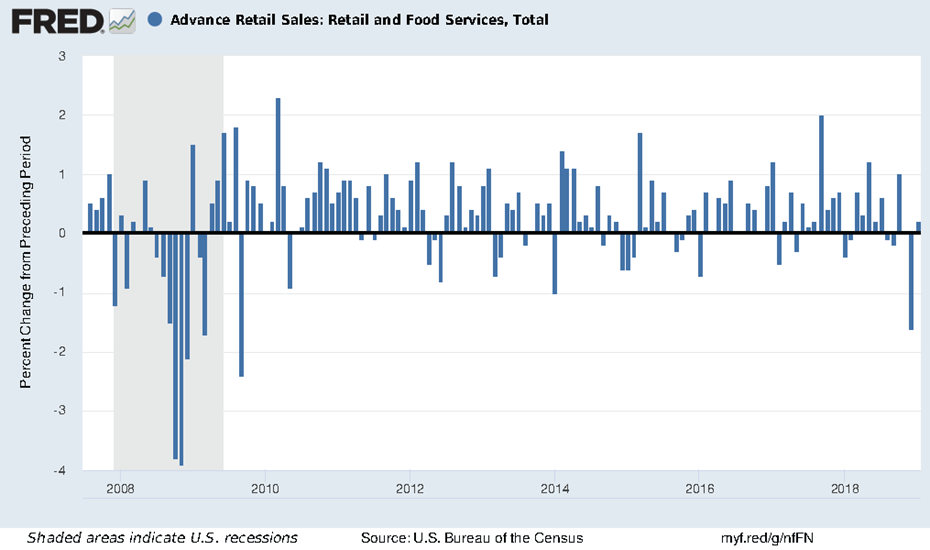
So many ways to skin a cat:

The “control group” which excludes food services, autos, building materials, and gasoline is what goes into GDP:


Many continue to doubt December data. I have a kind of monetarist approach with North American consumers: money in the pocket is money to be spent. The blue line below is aggregate weekly payrolls of private employees (employment x hours x wages). The red line is nominal expenditures and the black line retail sales. If all these numbers are good, Americans have boosted their savings in recent months. They better spend again soon because the U.S., and the world economy sure needs them shopping. Last 3 months U.S. retail sales annualized: –5.7%!!!! And yet, business people are not complaining of a consumer strike even after such a weak Christmas.

Not complaining but not cheerful:
Optimism Stabilizes Among Small Business Owners


GLOBAL COPPER USERS PMI NEAR 10-YEAR LOW
The seasonally adjusted Global Copper Users Purchasing Managers Index™ (PMI) – a composite indicator designed to give an accurate overview of operating conditions at manufacturers identified as heavy users of copper – fell from 47.9 in January to 47.0 in February, to signal a solid deterioration in business conditions. In addition, the rate of decline was the sharpest since May 2009.
Output at global copper users declined sharply in February, with the rate of decrease accelerating from January to the fastest in nearly ten years. As has been the case in recent months, Asian users saw the most marked downturn in activity, while European users reported a solid drop. Meanwhile, US users saw output growth improve since the start of the year.
Contributing to the downturn worldwide was a fall in new orders for the third month in a row. Moreover, the latest decline was the sharpest since April 2009. Similarly, new export orders dropped at the quickest rate in over six years. Panellists that reported lower sales related this to weaker global economic activity, particularly in China. European copper users noted a lack of demand from the automotive industry and uncertainty over the Brexit negotiations.
As demand fell, global copper users reduced purchases of inputs at a sharp rate in February. This marked the third successive fall in input buying and the strongest since September 2012. Stock levels also declined, albeit moderately. (…)
Business conditions at copper users worldwide are deteriorating at a rate not seen since the financial crisis. For any industry, that is worrying news, but copper has a historical trend of correlating impressively with global output. Subsequently, current PMI figures point to a marked weakening of GDP growth in the first quarter of 2019.
One factor is the decline of the automotive sector, a key purchaser of copper end-use goods. New emissions standards have kick-started a transition process in the industry, which so far has curtailed production levels. This could continue during 2019 as car-makers reassess their businesses and prepare for further regulation changes.

Same trend for aluminum users:

Speaking of autos, Markit has this:
Autos & parts sector posts series-record drop in output in February
Global output of automobiles & auto parts fell for the fifth month running in February. Moreover, the rate of contraction was the strongest since global sector PMI data were first available in October 2009. New orders in the sector fell at the fastest pace in over six years.

It sure looks like we should not expect green shoots anytime soon from China nor autos.
Momentum Slips for Auto Import Tariffs President Trump’s threat to impose tariffs on car imports is facing headwinds amid congressional opposition, legal challenges and the prospect of consumer opposition.
Three weeks after the Commerce Department submitted a report on possible auto tariffs, the administration has yet to address the issue publicly—an uncharacteristically quiet approach that has trade experts concluding the White House isn’t eager to launch another grueling trade battle that could rattle markets as the 2020 election campaign gets under way. (…)
“They don’t engage too much” on the issue, one European official said. A second said the White House has signaled it plans to take no action on auto tariffs in the near term. (…)
Sen. Chuck Grassley, the influential Republican chairman of the Finance Committee, said last week he will work with Democrats and Republicans “to find a bill that we can get massive amount of support, so if we have to [we can] override the veto” expected from Mr. Trump. (…)
More broadly, lawmakers are questioning the Trump administration’s use of national-security arguments to set economic policy. (…)
China asks private sector to beef up investment in basic science
(…) “China will invest more in basic research,” said Science and Technology Minister Wang Zhigang during the ongoing National People’s Congress in Beijing on Monday, adding that his ministry will seek to motivate local governments, enterprises and industries to boost their investment in this area.
Regarded by Wang as “the source of all technological innovation” and currently a “weakness of China’s science and technology sector”, basic research has now become a priority as the nation seeks to catch up as a technology leader. Basic research aims to improve scientific theories — which can then be used to improve applied technologies and techniques. (…)
The China percentage translates into a sum of 1.96 trillion yuan (US$291.6 billion) on research and development in 2018 – a large number given the sheer size of the country’s economy. However, only about 5 per cent of China’s overall research and development spending goes on basic research, lagging a figure of 15 per cent in the US. (…)
U.S. Warns Germany to Drop Huawei or Lose Intel Access
(…) In a letter to the country’s economics minister, U.S. Ambassador to Germany Richard A. Grenell wrote allowing the participation of Huawei or other Chinese equipment vendors in the 5G project would mean the U.S. won’t be able to maintain the same level of cooperation with German security agencies. (…)
Among other things, European security agencies have relied heavily on U.S. intelligence in the fight against terrorism. U.S. officials declined to say whether other countries have received or would receive similar warnings. (…)
Here’s the rub from the WSJ:
-
Where China Dominates in 5G Technology Chinese companies are leaders in 5G patents and standards proposals
Huawei, and its crosstown rival ZTE Corp. ZTCOY 1.97% , have put forth vastly more proposals—and are among the biggest owners of key patents—underpinning the coming wave of 5G technology. That is in contrast to Western firms, which played a comparatively smaller role in the blueprint and design of 5G than in previous generations of wireless technology.
Huawei’s clout in the design of 5G stems from its massive research and development budget, and from its aggressive contributions to the round-the-world meetings where engineers cobbled together the underlying architecture of 5G.
As a result, the Chinese tech juggernaut as of early February owned 1,529 “standard-essential” 5G patents, the most of any company. Together with patents owned by ZTE, the state-owned China Academy of Telecommunications Technology, and Guangdong Oppo Mobile Telecommunications Corp., companies from China own 36% of all 5G standard-essential patents, more than double their share of comparable 4G patents, according to data-analytics firm IPlytics.
The Chinese 5G patents cover technology associated with everything from 5G handset componentry to base stations and driverless-car technology. And telecom companies around the world—including those operating in places where Huawei gear might be off-limits—will have to pay royalties to Huawei to license that technology when it comes time to put 5G networks on the ground, experts say.
U.S. firms, by contrast, including Qualcomm Inc. QCOM 1.53% and Intel Corp. INTC 1.66% , hold just 14% of critical 5G patents, according to IPlytics. Huawei’s clout in 5G sets it apart from previous generations of wireless networks, which saw significantly fewer contributions from Chinese mobile companies compared with U.S. and European firms. (…)
Huawei’s prowess in next-generation technology stems partly from the fact that it now regularly outspends its rivals in research and development, a fact that has alarmed some policy makers in Washington. In 2017, the company spent $13 billion on R&D, more than any other Chinese tech company, and more than its chief rivals, Ericsson ERIC 1.41% and Nokia Corp. NOK 1.15% , combined. (…)
Some of Huawei’s proposals are now fundamental building blocks of 5G. They include one highly prized technique called “polar coding,” a method for correcting errors in data transmission. Huawei poured resources into developing it, and polar coding became a rallying cry for Huawei and its Chinese peers at standards meetings. After it was partially adopted as an official 5G standard at a critical meeting in 2016, Huawei founder Ren Zhengfei threw an opulent ceremony at the company’s Shenzhen headquarters to celebrate. (…)

 .)
.)