The enemy of knowledge is not ignorance, it’s the illusion of knowledge (Stephen Hawking)

It ain’t what you don’t know that gets you into trouble. It’s what you know for sure that just ain’t so (Mark Twain)

Invest with smart knowledge and objective odds

THE DAILY EDGE: 15 FEBRUARY 2019

Weak Retail Sales Stoke Worries U.S. retailers registered a far worse December holiday selling season than many analysts had realized, sending stocks lower and raising questions about the economy.

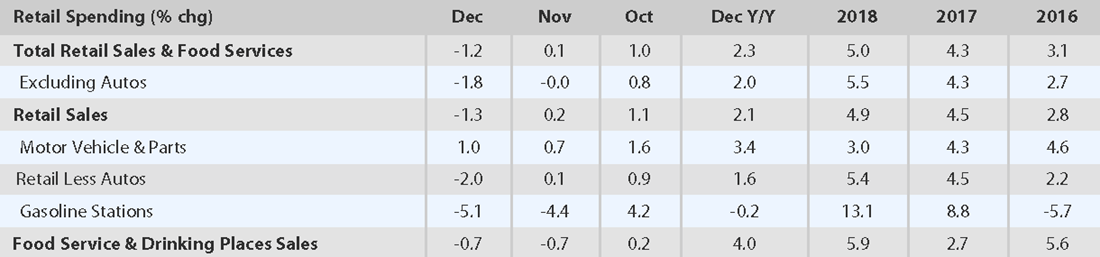
Sales at stores, restaurants and online fell a seasonally adjusted 1.2% in December from November, the retail sales report said, the biggest monthly drop since September 2009. The performance was so poor that some analysts questioned the report’s accuracy. (…)

Everybody was happy to finally get a fix on consumer spending post-shutdown. Now nobody is happy with this Retail Sales report which is too weak to be believable (table from Haver Analytics)
image

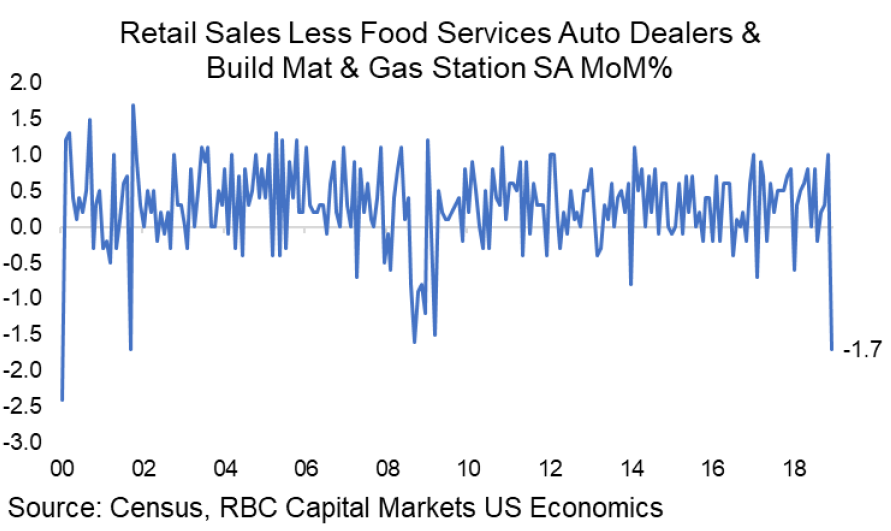
Two relevant charts from RBC Capital Markets:
image

image

So we and our data-dependant Fed will remain in the dark for 2 more weeks as the BEA will only release Personal Income and Outlays for December 2018 and Personal Income for January 2019 on March 1.

In the meantime, the bears will use this report to boost recession odds which truly go up if this is a correct reflection of the mood of American consumers. The hopefuls will feed question marks like those from the WSJ article:

Economists were puzzled by the decline because reports from individual retailers in recent weeks, though soft, hadn’t suggested such a disappointing holiday season. Other reports on holiday shopping, such as from Mastercard, suggested solid gains. (…)

The government’s report on the performance of online retailers, such as Amazon.com Inc., was especially stunning. It said online sales fell 3.9% from November, the biggest monthly decline since November 2008, and were up just 3.7% from a year earlier. (…)

Amazon reported last month its fourth-quarter revenue was up 20% from a year earlier.

“They indicated they saw minimal impact from any consumer slowdown,” Colin Sebastian, an analyst at Robert W. Baird & Co., said of Amazon. He and other analysts said some shopping might have shifted to November, tied to promotions.

(…) department stores were down 3.3% from a month earlier, according to the government.

The department stores themselves have reported mixed though generally positive results so far. Macy’s Inc. sales for the November-December period grew 1.1% from a year earlier, while Kohl’s Corp. sales rose 1.2%, less than analysts had expected. J.C. Penney Co.’s sales fell 5.4%. Target Corp. , meantime, saw its sales grow 5.7%. (…)

A Bank of America Merrill Lynch report released this week said its credit- and debit-card data showed month-over-month retail sales, excluding autos, were flat in December and slid in January. (…)

U.S. Producer Prices Decline; Core PPI Rises

The headline Final Demand Producer Price Index edged down 0.1% for the second consecutive month in January (+2.0% year-on-year). December’s reading was revised up from -0.2%. The Action Economics Forecast Survey expected an increase of 0.1%. Producer prices excluding food & energy increased a greater-than-expected 0.3% (2.6% y/y) after an unchanged reading (was -0.1%). A 0.2% gain had been anticipated. The PPI excluding food, beverages and trade services, another measure of underlying price inflation, rose 0.2% (2.5% y/y) following a flat December. (…)

Service prices rose 0.3% (2.8% y/y) after an unchanged reading in December (was -0.1%). The cost of trade services jumped 0.8% (3.2% y/y) while transportation & warehousing costs rose 0.5% (7.0% y/y). Prices for final demand services excluding trade, transportation & warehousing was unchanged for the second consecutive month (2.0% y/y).

Goods prices fell -0.8% (+0.4% y/y), the third monthly decline. Goods prices excluding food & energy rose 0.3% (2.4% y/y) after a 0.1% reading. Core consumer goods prices increased 0.4% (2.8% y/y), while capital equipment grew 0.6% (2.8% y/y). (…) Prices for intermediate demand processed goods fell 1.4% (+0.9% y/y), the third consecutive monthly decline.

image
large image
China’s Muted Inflation Likely to Spur Policy Easing

The producer-price index, a gauge of prices at the factory gate, edged up 0.1% in January, slowing from a 0.9% gain in December, the National Bureau of Statistics said. The consumer-price index rose 1.7% in January from a year earlier, compared with a 1.9% increase in December, the bureau said. (…)

January’s 0.1% rise in producer inflation was the seventh straight month of deceleration and was the slowest increase since September 2016.

Though prices of raw materials and unfinished products edged down 0.1% last month, finished products climbed 0.6%, slowing a tick from December’s 0.7% growth, said Dong Yaxiu, an analyst with the statistics bureau, in a statement. (…)

  
Chinese, U.S. Trade Negotiators Inch Toward an Agreement Negotiators made progress on a memorandum of understanding that could serve as the basis for a deal that President Trump and Chinese leader Xi Jinping could later finalize.

The agreement would be in the form of a memorandum of understanding and could serve as the framework for a deal that President Trump and Chinese leader Xi Jinping could later finalize at a summit, the people said. Negotiators on both sides have agreed to continue the talks next week in Washington, according to the people.

During negotiations this week in Beijing, officials on both sides have been seeking to narrow the still-substantial gap between the concessions China is willing to offer and what the Trump administration will accept.

The memorandum in the works is expected to cover issues related to Beijing’s offers to purchase more American goods and services, accelerating China’s market-opening efforts in sectors such as financial services and manufacturing, as well as improving its protection of U.S. intellectual-property rights.

Thornier issues like how to enforce a trade deal are also expected to be included in the memorandum, the people said. (…)

Throughout the talks, sharp divisions remained on items such as how Beijing can address U.S. complaints that China pressures U.S. companies to share technology and that its policies favor state-owned companies at the expense of U.S. competitors.

The memorandum likely will mention those topics as well, but so far scant progress has been made toward narrowing those differences. (…)

(…) Xi said he values the “good working relationship” with President Donald Trump very much, and is willing to keep in touch with him in various ways. He added that China was “willing to solve the bilateral economic disputes and frictions through cooperation, and push for an agreement that both sides can accept. But cooperation has principles.”

The U.S. echoed the sentiment, saying there had been progress reached, but that work remained, according to an emailed statement from the White House. (…)

“We feel we have made headway on very, very important and difficult issues,” Lighthizer said, according to the Associated Press. “We have additional work we have to do but we are hopeful.” (…)

We shall see if President Trump has principles.

Purchases With Plastic Get Costlier for Merchants—and Consumers Visa and Mastercard are hiking a range of fees that U.S. merchants will pay to process transactions starting in April, a move likely to inflame already fractious relations between many businesses and card networks.
EARNINGS WATCH

386 companies in, 70% beat rate and a lower +3.1% surprise factor. Blended estimates for Q4’18 are now +16.2%, from +16.6% yesterday.

Q1’19 estimates still at –0.3% (+0.3% ex-Energy).

Trailing EPS: $162.85.

WHO WANTS TO BE A PRESIDENT?
First 2 Primary Debates Could Have Up to 20 Presidential Contenders As many as 20 Democratic presidential contenders could qualify for the first two televised primary debates beginning in June, the party announced Thursday.

THE DAILY EDGE: 16 JANUARY 2019

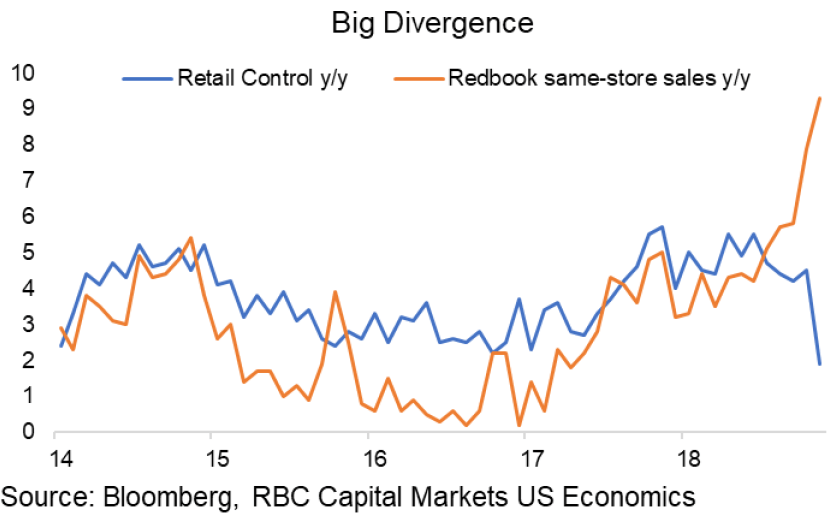
Today’s retail sales data for December will not be available because of the government shutdown, but based on the Redbook same-store index, holiday sales were relatively healthy. (The Daily Shot)

Source: Pantheon Macroeconomics

U.S. Producer Prices Decline Led by Lower Energy Costs

The headline Final Demand Producer Price Index using new methodology fell 0.2% during December following a 0.1% uptick in November. A 0.1% decline had been expected in the Action Economics Forecast Survey. From December-to-December, the index rose 2.5%, the same as during 2017. Producer prices excluding food & energy eased 0.1% after a 0.3% increase. A 0.2% gain had been anticipated. For the year, the core PPI rose 2.7% after rising 2.2% in 2017. The PPI excluding food, beverages and trade services is another measure of underlying price inflation. It held steady last month (2.8% y/y) following a 0.3% increase. It’s 2017 rise was 2.3%.

The PPI using the old methodology fell 0.3% during December (+1.4% y/y) following a 0.8% November decline. Prices excluding food & energy improved 0.1% last month (2.5% y/y) after rising 0.3% in November. (…)

image

Core PPI rose 2.0% annualized in Q4 with a weak finish. Core Goods prices are up 1.6% a.r. in Q4, also with a weak finish.

image

Empire State Manufacturing Activity Weakens Sharply

The Empire State Manufacturing Index of General Business Conditions declined to 3.9 in January, the lowest level since May 2017. The Action Economics Forecast Survey expected a reading of 12.0 for January. Data back through 2017 were revised. The Empire State data, reported by the Federal Reserve Bank of New York, reflect business conditions in New York, northern New Jersey and southern Connecticut.

Haver Analytics calculates a seasonally adjusted index that is comparable to the ISM series. The calculated figure fell sharply to 51.9 from 56.2. It was the lowest level in two years. During the last ten years, the index has had a 66% correlation with the quarter-to-quarter change in real GDP.

Deterioration in the component series was broad-based last month and led by much lower orders, delivery times and inventories indexes. The shipments and unfilled orders indexes also fell sharply.

The employment index fell significantly during January after showing strong hiring in December. A lessened 15% of respondents reported increased employment, while a steady eight percent showed a decrease. The series dates back to 2001. During the last ten years, there has been a 77% correlation between the employment index and the month-to-month change in factory sector payrolls. The employee workweek reading was little changed.

The prices paid index weakened to the lowest level since December 2017. Forty-one percent of respondents indicated increased prices this month, while a higher six percent reported a decrease. Prices received held steady at the lowest level since December 2017.

The series measuring expectations for business conditions in six months fell sharply to the lowest level in nearly three years due to declines in most categories.

 large image large image

Banks Flash Warning on Economy The latest signs of weakness in the U.S. economy come from big banks JPMorgan Chase and Wells Fargo

(…) JPMorgan reported growth of 1% from a year earlier in commercial and industrial loans, down from 4% in the prior quarter, which Chief Financial Officer Marianne Lake said was partly because the bank had pulled back from lending in particular areas and partly because of a general slowdown in the economy.

The bank also increased loan-loss reserves in its commercial-banking book moderately. On a conference call, Ms. Lake characterized the reserve build as being in “a handful of names in a handful of sectors, nothing that points to a systematic deterioration in a particular sector.” (…)

Meanwhile, at Wells Fargo there was a 5% jump in commercial and industrial loans, which was an encouraging sign after relatively weak momentum in this business for the past few quarters. But total loans outstanding at the end of the year were still down slightly from a year earlier. Notably for the biggest mortgage lender in the country, mortgage originations fell by 28% from a year earlier, the latest signal of weakness in the U.S. housing sector.

High five Fact is that bank lending has been pretty good lately. It’s off a weak base but Q4 lending is up 8.0% YoY and December up 9.7%.

image

BTW: JPMorgan CEO James Dimon said on a conference call with reporters that if the government shutdown lasts through the first three months of 2019, that could send U.S. economic growth to zero. (…)

Source: @GregDaco, @OxfordEconomics (via The Daily Shot)

(…) In addition to those 800,000 workers, a much larger number of government contractors is going without pay. The shutdown is reducing payments to contractors by about $245 million a day, or about 0.4 percent of daily gross domestic product. Some estimates put the number of workers who will be affected at more than 4 million — and unlike government employees, contractors won’t receive backpay once the shutdown ends.

Together, those 4 million contractors and the 800,000 furloughed employees constitute about 3 percent of the country’s labor force. That number is heading into territory that could have macroeconomic implications — for comparison, the increase in unemployment in the typical recession is usually about 2 percent to 4 percent. Furloughed workers and unpaid contractors are not quite the same as unemployment, but the macroeconomic spillovers might be comparable. (…)

Companies might delay investment due to regulatory disruptions — already there are ominous signs. Thanks to the lack of government workers to grant regulatory approval, new products from aircraft to beer to trucks can’t be released. That uncertainty will almost certainly give companies pause about investing. If anxieties about the decline in demand due to the shutdown make companies even more reluctant to invest, the result could be that many businesses stampede for the exits. And since many businesses serve other businesses, a lack of investment could quickly ripple through the supply chain. A general slowdown in business activity would result, with the attendant layoffs, pay freezes and cuts — in other words, a recession. (…)

U.S. Home Sales Plunged in December, Price Growth at 6-Year Low Previously hot metropolitan areas are cooling fast.

The median home price rose to $289,800 in December, a gain of 1.2 percent, the slowest monthly pace since March 2012. Sales dropped by almost 11 percent, the biggest decline for any month since 2016, Redfin said. Previously hot metropolitan areas are cooling fast. Prices dropped 7.3 percent in San Jose, California. (…)

Redfin’s data, which covers many large metropolitan areas, represents closed sales. Buyers likely signed contracts in November for most December sales. While rates for 30-year mortgages peaked at 4.94 percent in November, climbing a percentage point since the start of 2018, they’ve since fallen to 4.45 percent.

Goldman Says Rich People Will Drag Down the U.S. Economy The stock market sell-off means they’ll be spending less.

(…) Lower equity prices could take half a percentage point off U.S. gross-domestic product growth in 2019, with overall tighter financial conditions restricting expansion by around 1 percentage point, Goldman economist Daan Struyven wrote in a note Tuesday. (…)

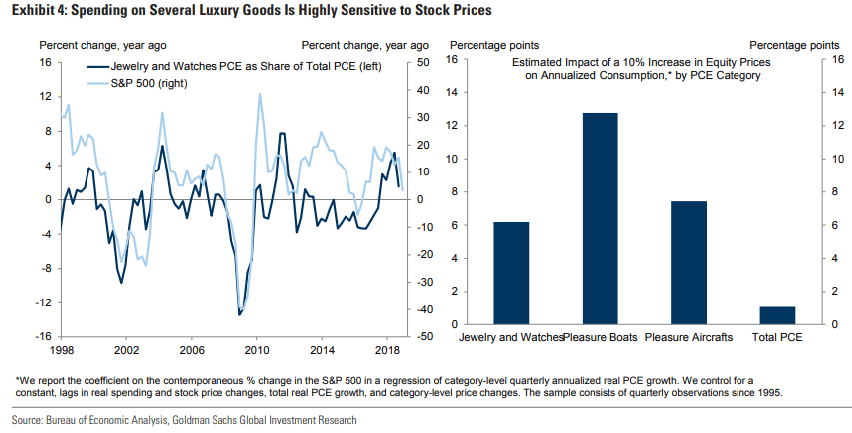
Struyven argued against the idea that the wealth effect from the stock market might be limited due to a higher concentration of stock ownership than in previous decades, and a lower propensity to spend among rich households. To prove that this thesis doesn’t hold up, he cited increases in equity holdings, as well as a high sensitivity of luxury-goods spending to stock-market fortunes, as evidence.

That’s at odds with a paper from the National Bureau of Economic Research in 2013 that finds “at best weak evidence of a link between stock-market wealth and consumption,” and asserts that the housing market has much more of a wealth effect.

The share of personal consumption expenditures spent on jewelry is “highly correlated with moves in the stock market,” Struyven wrote in the Jan. 15 report. (…)

image

China injects record $84bn to boost economy Central bank acts on growth fears and higher lunar new year cash demand

(…) The finance ministry also issued new quotas for local government bond sales earlier than normal this year to ensure that infrastructure projects are adequately funded.  A senior finance ministry official on Tuesday provided details on new tax cuts designed to support small businesses, manufacturers and exporters.

Trade War Tops Global Risks for Business Leaders

(…) “We simply do not have the gunpowder to deal with the kind of slowdown that current dynamics might lead us towards,” said Børge Brende, president of the World Economic Forum.

Economic policy, once a way for rivals to mutually benefit in trading relationships, is now “frequently seen as a tool of strategic competition,” the report said. (…)

“The biggest risk is the lack of willingness to collaborate—we are not mitigating that risk,” the group’s chief said. (…)

EARNINGS WATCH
Earnings: First, the Good News Corporate results are likely to be a lot better than analysts expect in the fourth quarter

(…) For one thing, despite Apple, earnings warnings have been muted. By Refinitiv’s count, the ratio of companies with negative earnings pre-announcements to those with positive pre-announcements is 1.5—well below the long-term average of 2.8. In the third quarter, the negative-to-positive ratio was 1.4, and eventual earnings growth ended up at 28.4%, versus the 21.6% analysts expected at quarter end.

Another plus: Among the admittedly small number of companies that already have reported results, some 85.2% have topped estimates. That compares with 64.5% historically and 78% over the past four very strong quarters. (…)

The first quarter could be a different matter, though. The effects of the government shutdown and ongoing trade disputes are expected to weigh on the economy and the boost to earnings growth from the tax cut is going away.

While they are unveiling good numbers, companies will be discussing all this on their earnings calls—so don’t relax too much.

It’s been a while I had not seen a positive spin on earnings. The most recent facts:

As of yesterday, we have had 27 earnings reports boasting an 85% beat rate. Financials are 50% with only 4 reports in but the two misses were enough to bring the surprise factor down from +3.3% to zero.

Q4 earnings are seen up 14.0%, down from 15.8% on Jan. 1.

Trailing EPS are now $162.05, slightly above the full year estimate of $161.65.

Q1’19 earnings are now seen up 3.3%, down from 5.3% on Jan. 1 while Q2’19 earnings are expected up 5.1% (6.5%).

U.S. middle-market private companies enjoyed the strongest earnings growth in years, propelled by high demand for products and services, according to a report released Friday by Golub Capital, a lender to these firms.

Closely held smaller companies reported that earnings rose 13.4% in the first two months of the fourth quarter compared with the same period in 2017, the fastest such increase since at least 2012. Revenue rose by 10.6% during the first two months of the fourth quarter, the report said.

“Unless you are a business that’s driven by commodity prices, you are doing great,” said Lawrence Golub, chief executive of Golub Capital. “There is a lot of momentum going to 2019; it looks as if nothing could derail that.” (…)

Some sectors analyzed by Golub Capital, such as manufacturers, feel the pressure of higher steel prices. “We see margin compression in the industrial sector,” Mr. Golub said. “This sector is most sensitive to cost increases coming from trade issues.”

The report is based on the Golub Capital Altman Index, which assesses the median revenue and earnings growth of more than 150 closely held companies across the U.S. that Golub Capital lends to. The index, which was created in 2012, focuses on financial performance during the first two months of each quarter and measures earnings before interest, tax, depreciation and amortization. (…)