The enemy of knowledge is not ignorance, it’s the illusion of knowledge (Stephen Hawking)

It ain’t what you don’t know that gets you into trouble. It’s what you know for sure that just ain’t so (Mark Twain)

Invest with smart knowledge and objective odds

THE DAILY EDGE (16 February 2017)

Data Signal Solid Momentum for U.S. Economy Stronger consumer spending, rising factory production and firming inflation are pointing to solid momentum for the U.S. economy and another interest-rate increase by the Federal Reserve, potentially as soon as next month.

(…) Ms. Yellen told lawmakers it “would be unwise” to wait too long to raise rates, because it could force the Fed to tighten policy more quickly down the road and potentially cause a new recession in the process. (…)

Forecasting firm Macroeconomic Advisers on Wednesday projected first-quarter gross-domestic-product growth at a 2.0% pace, and the Federal Reserve Bank of Atlanta’s GDPNow model estimated GDP growth at 2.2% in the first quarter. In the fourth quarter, GDP grew at a 1.9% annual rate, near its average since the recession ended in mid-2009. (…)

U.S. Retail Sales Slow with Lower Auto Sales; Other Spending Firms

Total retail sales and spending at restaurants increased 0.4% (4.9% y/y) in January following a 1.0% December rise, which was revised from 0.6%. A more modest 0.1% increase had been expected in the Action Economics Forecast Survey.

Sales at motor vehicles & parts dealers accounted for the January slowdown in the total; these fell 1.4% (5.8% y/y), after their sizable 3.2% gain in December. The decline compared to a 4.4% decrease in unit sales of light vehicles. Excluding autos, retail sales increased 0.8% (4.7% y/y). clearly more than December’s a 0.4% rise. A 0.4% increase had been expected. Sales at gasoline service stations again lifted retail spending last month, as they went up 2.3% (13.9% y/y); December’s gas stations sales increase was revised from 2.0% to 3.2%. In the CPI array for January, gasoline prices are seen to have risen 7.8% in the month. Retail sales excluding both auto dealers & gas stations rose 0.7% (3.8% y/y) in January following a 0.1% rise.

image

Surprised smile Non-auto less gas up at a 4.5% annualized rate in the last 3 months!

U.S. CPI Strengthens With Higher Energy Prices

The Consumer Price Index jumped 0.6% during January following a 0.3% December gain. It was the strongest rise since February 2013 and lifted y/y growth to 2.5%. Expectations had been for a 0.3% gain in the Action Economic Forecast Survey. Prices excluding food & energy rose 0.3% following two months of 0.2% gain. [Core prices were up 2.3% on the year]. It was the firmest rise since August. A 0.2% increase had been expected.

Higher energy prices led the pick-up in inflation with a 4.0% jump (10.8% y/y). Gasoline prices surged 7.8% (20.3% y/y) to the highest level since July 2015. Fuel oil prices increased 3.5% (NSA, 24.8% y/y) after a 6.0% jump. Natural gas prices improved 1.5% (10.1% y/y) while electricity costs were little changed (1.0 % y/y.

Goods prices excluding food & energy increased 0.4% (-0.2% y/y) following steadiness or decline in the prior four months. (…)

Prices for services less energy provided further strength with a 0.3% increase (3.1% y/y) for the third month in a row. (…) Medical care services prices rose 0.2% (3.6% y/y) for the third straight month. Shelter costs also rose 0.2% (3.5% y/y) following five straight months of 0.3% increase. Owners’ equivalent rent of primary residences gained 0.2% (3.5% y/y), while primary residence rents gained 0.2% (3.9% y/y).

 large image large image

  • According to the Federal Reserve Bank of Cleveland, the median Consumer Price Index rose 0.3% (3.3% annualized rate) in January. The 16% trimmed-mean Consumer Price Index also rose 0.3% (3.7% annualized rate) during the month. The median CPI and 16% trimmed-mean CPI are measures of core inflation calculated by the Federal Reserve Bank of Cleveland based on data released in the Bureau of Labor Statistics’ (BLS) monthly CPI report.
  • Over the last 12 months, the median CPI rose 2.5%, the trimmed-mean CPI rose 2.2%, the CPI rose 2.5%, and the CPI less food and energy rose 2.3%.
  • The Federal Reserve Bank of Cleveland provides daily “nowcasts” of inflation for two popular price indexes, the price index for personal consumption expenditures (PCE) and the consumer price index (CPI). “Nowcasts” are estimates or forecasts of the present. The Cleveland Fed produces nowcasts of the current period’s rate of inflation—inflation in a given month or quarter—before the official CPI or PCE inflation data are released. These forecasts can help to give a sense of where inflation is now and where it is likely to be in the future.

image

  • The jump in the core CPI over the past three months was the largest since 2011. (The Daily Shot)

Source: @jbjakobsen, @josephncohen

  • it’s clear that the core CPI increases have been broader than just medical and housing inflation. (The Daily Shot)

Source: @boes_, @josephncohen

U.S. Producer Prices Strengthen Broadly

The headline Final Demand Producer Price Index increased 0.6% during January (1.6% y/y) after a 0.2% December gain, revised from 0.3%. The rise was the largest since September 2012 and exceeded expectations for a 0.3% increase in the Action Economics Forecast Survey. The PPI excluding food and energy rose 0.4% (1.2% y/y) following a 0.1% uptick, revised from 0.2%. It was the largest gain since June 2015. A 0.2% rise had been expected.

An updated measure of “core” PPI inflation, final demand prices excluding food, energy, and trade services prices, increased 0.2% (1.6% y/y) following a 0.1% December rise. 

Final demand goods prices jumped 1.0% (3.1% y/y), the strongest rise since May 2015. It reflected a 4.7% increase (14.0% y/y) in energy prices which followed 1.8% gain. This rise was accompanied by no change (-2.2 % y/y) in food prices, which followed two months of 0.5% increase.

Nondurable goods prices excluding food & energy strengthened 0.5% (3.3% y/y) following a 0.1% rise.

large image

Interestingly, PPI Goods ex-food, ex-energy rose 0.4% in January after +0.3% and +0.2% in December and November respectively. PPI core goods is thus up 2.1% YoY but it has increased at a 3.6% annualized rate in the last 3 months. Goods prices have been very weak in 2016 partly owing to the strong dollar.

Empire State Business Conditions Survey Strengthens; Prices Surge

The Empire State Manufacturing Index of General Business Conditions for February jumped to 18.7 from 6.5 in January. It was the highest level since September 2014. The Action Economics Forecast Survey expected 7.0. These data, reported by the Federal Reserve Bank of New York, reflect business conditions in New York, northern New Jersey and southern Connecticut.

Each of the index components increased this month, notably new orders, shipments and the average workweek. Inventories, unfilled orders and delivery times also rose. The employment index jumped to 2.0, its first positive reading since May. During the last ten years, there has been a 69% correlation between the employment index and the m/m change in factory sector payrolls.

The prices paid series increased to 37.8, the highest level since April 2012. A fairly stable 40.8% of respondents reported paying higher prices, while a lessened 3.1% reported them lower. The prices received index similarly rose to 19.4, its highest point since May 2011.

Confused smile Expectations of business conditions six months ahead, in contrast, fell to 41.7, its lowest point in three months.

 large image large image

Global Risks Begin to Recede It isn’t only in the U.S. that economic spirits are looking up, Greg Ip writes. Around the world, confidence is on the rise.

(…) the upswing is global: In Europe, Japan, China and elsewhere, business surveys and markets have turned markedly more optimistic. (…)

Stronger Growth Could Set Fed Against Trump

(…) Higher interest rates will hit stock and bond valuations, and a rapid rise could spark a serious sell-off.

The new economic data highlights the tense relationship that could develop between the Fed and the administration. With the economy humming, a tax cut or infrastructure-led stimulus could boost the economy further, leading the Fed to tighten more rapidly. That could take the air out of growth and make it harder for Mr. Trump to reach his promised 4% growth. No doubt there would be angry tweets. (…)

So, from all the above:

(…) “It is my view that it will likely be appropriate to raise short-term interest rates at least as quickly as suggested by the Fed’s current…median forecast, and possibly even a bit more rapidly than that forecast,” Rosengren said in a speech prepared for delivery to the New York Association for Business Economics.

The Boston Fed president said the economy is very close to hitting the natural rate of unemployment.

Inflation is now close enough to the Fed’s 2% target that it is possible that the target will be reached as soon as the end of the year, he said. (…)

But, there is this new problem:


And that one:

(…) The percentage of Americans who moved in the previous year dropped to a record low of 11.2% in 2016, according to the Census Bureau. Much of that is due to millennials staying put. Only 20% of young Americans between ages 25 and 35 said they changed addresses last year, lower than the mobility of the prior four generations when they were in that age range, according to the Pew Research Center.

Meanwhile, older people who already have locked in historically low mortgage rates will be more reluctant to move now that rates are rising. A new house could come with a far higher rate.

The average 30-year fixed-mortgage rate was 4.24%, up more than half a percentage point since the election, according to Mortgage News Daily. And the case for the Federal Reserve raising interest rates faster than anticipated only appears to be getting stronger. (…)

GLOBAL REFLATION…

Even the dogs are now reflating:


These Charts Show Why Something Has to Give in the Oil Market
EARNINGS WATCH
  • 388 companies (86.4% of the S&P 500’s market cap) have reported. Earnings are beating by 2.1% while revenues are surprising by 0.3%. Excluding AIG’s unexpected reserve charge, earnings are exceeding expectations by 3.8%.
  • Expectations are for revenue, earnings, and EPS growth of 4.3%, 5.5%, and 7.2%, respectively.
  • EPS is on pace for 7.5%, assuming the current beat rate for the remainder of the season.
Trump Tax Cuts Could Boost Profit $12 Billion at Big U.S. Banks

The six largest U.S. banks could see annual profit jump by an average of 14 percent if President Donald Trump delivers on his promise to cut corporate taxes.

The lenders, which stand to benefit more than other industries because they typically have fewer deductions, could save a combined $12 billion a year, according to data compiled by Bloomberg. Trump has called for cutting the corporate tax rate to 15 percent from 35 percent. (…)

The effective federal tax rate for the biggest banks averaged 28 percent for the three years ending in 2015, data compiled by Bloomberg show, twice the 14 percent rate paid by all large companies. (…)

For some large banks, a rate cut would mean a one-time loss because of a reduction in the value of their deferred-tax assets. Those are benefits that build up because losses are recognized earlier in public company accounting than they can be in tax returns. Citigroup and Bank of America, which had the largest losses in the financial crisis, still have large amounts of such benefits that they can’t fully use in a lower tax-rate environment.

Citigroup has estimated its hit would be about $12 billion. KBW’s estimate for Bank of America’s upfront loss is $4 billion, and about $1 billion each for Goldman Sachs and Morgan Stanley. 

While those writedowns could wipe out the potential benefit from a lower tax rate, the elimination of deferred-tax assets would bring reported profits for some banks closer to what analysts and investors already look at, according to KBW’s Cannon. They generally ignore the impact of deferred-tax assets on earnings, adjusting reported figures to understand the true nature of a firm’s profitability. Writedowns on deferred-tax assets would be considered cosmetic, while the benefit from lower tax bills will be seen as concrete and permanent.

THE DAILY EDGE (16 January 2017): Earnings Watch

Car Buyers, Online Shoppers Lifted U.S. Retail Sales in December Americans splurged on cars and online shopping during the holidays, but not much else. Sales at U.S. retailers and restaurants rose 0.6% in December from a month earlier.

Retail sales rose 3.3% in all of 2016, faster than the prior year’s gain of 2.3% and similar to the underlying trend during the expansion. (…) A separate report Friday from the National Retail Federation, an industry trade group, showed holiday sales rose 4% in November and December, compared with the same period a year earlier. The government data showed a roughly 4% gain in sales in the final three months of last year over the fourth quarter of 2015. (…)

Car sales helped drive holiday spending, as Americans took advantage of big discounts offered by the auto industry. Sales had moderated earlier in the fall, and car makers offered incentives over the holidays to encourage sales of passenger cars. The strategy largely worked, with the late-year surge lifting auto sales to another annual record. (…)

Haver Analytics provide more granularity:

During Q4’16, retail sales grew at a 6.8% annual rate, the quickest rise since Q2’14.

Total retail sales & spending at restaurants increased 0.6% (4.4% y/y) during December following a 0.2% November rise, revised from 0.1%. October’s increase also was revised higher to 0.7% from 0.6%.

A 2.4% rise (7.4% y/y) in purchases of motor vehicles & parts followed a 0.2% decline in November. The gain compared to a 3.1% increase in unit sales of light vehicles. Excluding autos, retail sales increased 0.2% (3.8% y/y) following a 0.3% rise. A 0.5% increase had been expected. Sales at gasoline service stations also lifted retail spending last month. The 2.0% increase raised sales 7.4% y/y, but that followed little-change in November. Retail sales excluding both autos & gasoline remained steady (3.5% y/y) following a 0.3% rise.

image

And Doug short has the best charts:

Retail Sales YoY

Core Retail Sales YoY

Control sales exclude Motor Vehicles & Parts, Gasoline, Building Materials as well as Food Services & Drinking Places. It is what gets into GDP calculations:

Control Sales YoY

U.S. Producer Prices Increase An Expected 0.3%

The headline Final Demand Producer Price Index increased 0.3% (1.6% y/y) during December after an unrevised 0.4% November rise. (…) The PPI excluding food and energy prices rose 0.2% m/m (1.6% y/y) in December, also as expected.

An updated measure of “core” PPI inflation has evolved, known as final demand prices excluding food, energy, and trade services prices. It is available only back to 2014. This measure rose a minimal 0.1% (1.7% y/y) in December following a 0.2% November rise. During all of last year, however, the 1.2% rate of increase was double the 2015 increase. Prices of trade services improved 0.2% (1.0% y/y) following a 1.3% jump. (…)

large image

Inflation on goods has been tame but it has accelerated lately even against a strong dollar.

image

SYNCHRONIZED ACCELERATION
  • According to Citi, we’ve had the most synchronized economic upturn in advanced economies in years.

Source: Citi, @NickatFP, @joshdigga

Sample

  • Euro area consumers are feeling significantly better about their financial situation. (The Daily Shot)

Source: Morgan Stanley, @NickatFP, @joshdigga

So, lots of upside surprises and yet:

 
  • From the Atlanta and NY Fed after Friday’s retail sales:

image
image
image
  • Central Banks Drop Their Bazookas A range of forces—including political blowback, whiffs of inflation, stirrings of fiscal stimulus and worries that the policies themselves may backfire—are pressing central-bank chiefs to push short-term interest rates no lower.

Did you miss The Lady and the Trump?

BORDERING ON…

(…) A border tax will apply “when a company that’s in the U.S. moves to a place, whether it’s Canada or Mexico or any other country seeking to put U.S. workers at a disadvantage,” Sean Spicer, a spokesman for president-elect Donald Trump, said during a conference call with reporters Friday, Bloomberg News reported.

Until Friday, the name Canada had not arisen specifically in comments by the administration on auto exports or in the tweets Mr. Trump has sent out threatening to impose a “big border tax” on General Motors Co. and Toyota Motor Corp. for importing vehicles to the United States from Mexico. (…)

The five auto makers that assemble vehicles in Canada exported about $60-billion worth of cars, crossovers and minivans to the United States last year.

In the past four months, four of them have announced investments totalling more than $2-billion at their Canadian plants, including a $400-million investment announced Monday by Honda Motor Co. Ltd., at its assembly plant in Alliston, Ont. (…)

While Canada has a trade surplus with the U.S. on finished vehicles, it runs a deficit of about $11-billion on parts because of the high value of parts that auto makers in Canada import from U.S. suppliers. (…)

Mexico also imports billions of dollars’ worth of U.S. parts for cars assembled there, Mr. Wildeboer said. (…)

United States President-elect Donald Trump warned German car companies he would impose a border tax of 35 percent on vehicles imported to the U.S. market, a plan that drew sharp rebukes from Berlin and hit automakers’ shares .

In an interview with German newspaper Bild, published on Monday, Trump criticized the German carmakers for failing to produce more cars on U.S. soil.

“If you want to build cars in the world, then I wish you all the best. You can build cars for the United States, but for every car that comes to the USA, you will pay 35 percent tax,” Trump said in remarks translated into German.

“I would tell BMW that if you are building a factory in Mexico and plan to sell cars to the USA, without a 35 percent tax, then you can forget that,” Trump said. (…)

All three German carmakers have invested heavily in factories in Mexico, with an eye to exporting smaller vehicles to the U.S. market.

At the same time, German carmakers have quadrupled light vehicle production in the United States over the past seven years to 850,000 units, more than half of which are exported from there, the German VDA automotive industry association said. (…)

Around 65 percent of BMW’s production from its factory in Spartanburg, South Carolina is exported overseas. BMW builds the X3, X4, X5 and X6 models in the United States. (…)

Trump called Germany a great car producer, noting that Mercedes-Benz cars were a frequent sight in New York, but claimed there was not enough reciprocity.

Germans were not buying Chevrolets at the same rate, he said, calling the business relationship an unfair one-way street.  (…)

Donald Trump has taken his strongest swipe yet at the EU, labelling it “a vehicle for Germany” and predicting that other countries will follow Britain in leaving the bloc. The president-elect also warned that his trust for Angela Merkel “may not last long at all”, ranking the German chancellor alongside Vladimir Putin as a potentially problematic ally. (…)

Charles Grant, director of the Centre for European Reform think-tank, said: “These comments reinforce the view that transatlantic relations are heading for their rockiest period since world war two. “His views on Israel, Iran, climate etc are bound to create a chasm across the Atlantic and the UK will be left trying to straddle the divide — and perhaps falling in.”

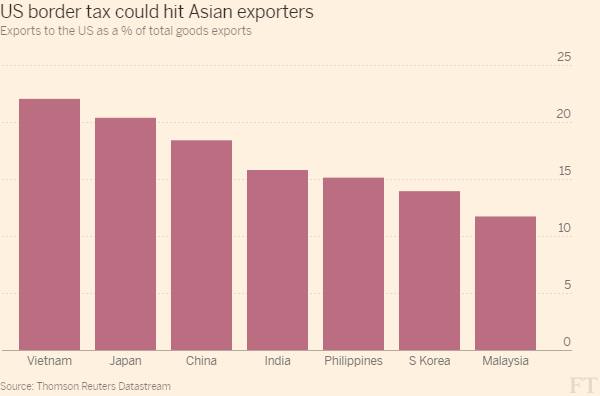
(…) President-elect Donald Trump heightened concerns in December, when he raised the prospect of levying duties of up to 45 per cent on Chinese goods to level the playing field for US manufacturers. Such tariffs could hurt not just Chinese companies, but also the multinational players such as Qualcomm, Intel and Samsung that have set up shop in China, through joint ventures or partnerships. (…)

(…) Although most other countries already operate “territorial” systems, the Republican plan includes other features that would make the new tax regime operate like a tariff on imports into the US, combined with a subsidy on many exports from the US, a combination that would have profound international economic consequences.

This is not just an obscure change to the details of America’s corporate tax code. It would be seen by trading partners as a protectionist measure that could disrupt world trade. (…)

TRUMP TO THE WSJ:

  • “Everything is under negotiation, including One-China.”

CHINA TO TRUMP:

U.S. Shale’s Great Reawakening

(…) Separate weekly EIA data published on Wednesday showed a 176,000 barrel-a-day jump in U.S. production from the previous week, the biggest increase since May 2015. A large part of that increase came from a revision of fourth-quarter output figures, with U.S. production raised by 100,000 barrels a day from the previous estimate — this isn’t an example of shale responding quickly to higher prices. (…)

The EIA now sees U.S. production reaching 9.22 million barrels a day by December, an increase of 320,000 barrels over the year. But this could quickly start to look like a conservative forecast. (…)

EARNINGS WATCH

Very early in the season but so far, so good:

Factset:

Over the past five years on average, actual earnings reported by S&P 500 companies have exceeded estimated earnings by 4.5%. During this same time frame, 67% of companies in the S&P 500 have reported actual EPS above the mean EPS estimates on average. As a result, from the end of the quarter through the end of the earnings season, the earnings growth rate has typically increased by 3.1 percentage points on average (over the past 5 years) due to the number and magnitude of upside earnings surprises.

If this average increase is applied to the estimated earnings growth rate at the end of Q4 (December 31) of 3.0%, the actual earnings growth rate for the quarter would be 6.1%.

image

Overall, 6% of the companies in the S&P 500 have reported earnings to date for the fourth quarter. Of these companies, 70% have reported actual EPS above the mean EPS estimate, 7% have reported actual EPS equal to the mean EPS estimate, and 23% have reported actual EPS below the mean EPS estimate.

In aggregate, companies are reporting earnings that are 5.9% above expectations. This surprise percentage is above the 1-year (+5.0%) average and above the 5-year (+4.5%) average.

The blended earnings growth rate for the fourth quarter is 3.2% this week, which is slightly higher than the earnings growth rate of 2.8% last week. Upside earnings surprises reported by companies in the Financials sector were mainly responsible for the small increase in the overall earnings growth rate for the index during the past week.

At this point in time, 7 companies in the index have issued EPS guidance for Q1 2017. Of these 7 companies, 3 have issued negative EPS guidance and 4 have issued positive EPS guidance. The percentage of companies issuing negative EPS guidance is 43% (3 out of 7), which is below the 5-year average of 74%.

Big Banks’ Results Show Strength

The fourth-quarter performance of J.P. Morgan Chase & Co., Bank of America Corp. and Wells Fargo & Co. was largely in line with what Wall Street had expected: Trading revenue was upbeat thanks to increased market activity and volatility following the election; expenses remain in intense focus; credit quality continues to improve; and a recent upward move in interest rates should eventually produce gains in banks’ income. (…)

  • J.P. Morgan, the country’s biggest bank by assets and the world’s largest by market value, was the standout performer in Friday’s earnings parade. Its quarterly profit of $1.71 a share handily outpaced analyst expectations, largely due to strong trading results.
  • Bank of America’s earnings per share of 40 cents beat analyst expectations as the bank cut enough expenses to offset lower-than-expected revenue.
  • Wells Fargo reported lower fourth-quarter earnings and revenue, at 96 cents a share and $21.58 billion, that both missed analysts’ expectations. The bank’s shares rose after it repeatedly referenced a charge related to interest-rate moves as the reason for coming in below estimates.

Big-bank earnings continue this coming week with Morgan Stanley reporting on Tuesday and Citigroup Inc. and Goldman Sachs Group Inc. following on Wednesday. (…)

In the fourth quarter, J.P. Morgan’s trading revenue climbed 24%, and Bank of America’s rose 11%. Wells Fargo’s relatively small presence in trading has sometimes been an advantage in recent years but has been a handicap of late. (…)

Consumer banking was less buoyant. Revenue was down at J.P. Morgan and Wells Fargo versus the prior year, and flat at Bank of America. Mortgage-banking revenue was also challenged due to the rise in interest rates and looks set to continue falling this year.

Reflecting a persistent emphasis on cost controls, executives held the line on pay for traders and investment bankers. Compensation expenses in J.P. Morgan’s corporate and investment bank was 20% of revenue in the fourth quarter, down from 27% in the third period.

The cost-cutting drive continued in other parts of banks. Bank of America CEO Brian Moynihan has made expense savings a key part of his business strategy, and the company cut annual expenses nearly 5%, to $54.95 billion. Mr. Moynihan promised this past summer to reduce annual expenses to about $53 billion by 2018.

On the plus side, all three banks released reserves they had set aside for loan losses, in part due to improvement in credit quality. Such reserve releases bolster profit. (…)

RBC Capital on banks results:

  • JPM: core EPS came in at $1.53 [from $1.24 last year], above our $1.47 estimate and consensus estimate of $1.42. 4Q16 performance came in stronger than expected driven by stronger FICC and investment banking revenues, improving energy related credits, stronger investment management revenues, and a lower loss in the Corporate segment, partially offset by lower noninterest income and higher noninterest expense in the CCB unit. Overall the outlook is strong for the company. Our 2017 and 2018 EPS estimates remain unchanged at $6.81 and $7.78. Our estimates incorporate 2-3 Fed Fund rate increases in each 2017 and 2018. A change in corporate tax rates over the next 12 months would lead us to increase our estimates to reflect the lower corporate tax rates.
  • BAC: core EPS came in at $0.36 [from $0.28 last year], below our $0.37 estimate and consensus of $0.38. The downside to our estimates primarily came from
    lower revenues, particularly in the Global Markets business segment where net income was 13.3% below our estimate. We maintain our 2017 and 2018 EPS estimates of
    $1.74 and $2.24, respectively.
  • WFC: core EPS were $1.00 [from $1.01 last year], above our estimate of $0.99 and in-line with consensus. 4Q16 performance came in generally in-line, with better net
    interest income, improving energy related credits, and modestly lower than expected expenses offsetting softer core fee income trends. We decreased our 2017 EPS estimate to $4.31 from $4.36 while maintaining our 2018 EPS estimate at $4.85.
SENTIMENT WATCH
Goldman Is Concerned: “The S&P Has Surged 6% Since The Election But 2017 EPS Forecasts Haven’t Budged”

(…) Since 1984, there have been just six years with materially positive EPS revisions: 1988, 1995, 2004-06, and 2011.” (…)

Pimco hoards cash to fend off dangers after Trump surge Big US fund manager prepares for turbulence as it predicts market euphoria will fade

(…) “Given the uncertainty, it’s better to be careful,” said Dan Ivascyn, group chief investment officer at Pimco. (…)