The enemy of knowledge is not ignorance, it’s the illusion of knowledge (Stephen Hawking)

It ain’t what you don’t know that gets you into trouble. It’s what you know for sure that just ain’t so (Mark Twain)

Invest with smart knowledge and objective odds

THE DAILY EDGE (16 November 2016): Strong Retail Sales; Ray Dalio’s Note

U.S. Retail Sales Rose Briskly in October Americans spent briskly at retailers in recent months, supporting hopes for a strong holiday shopping season and giving the economy momentum.

Retail sales—measuring spending at restaurants, clothiers, online stores and other shops—rose 0.8% in October from the prior month, the Commerce Department said Tuesday. Sales grew 1% in September, revised figures showed, up from a previously reported 0.6% increase.

Those gains marked the best two-month stretch of sales in at least two years. (…)

Tuesday’s report showed that strong car sales accounted for much of the bounce in retail sales last month, as well as higher gasoline prices that drove up spending at service stations. But spending grew across a range of items, including construction materials, groceries and health care products. Excluding car purchases, sales rose 0.8%.

Meanwhile, Americans cut spending at furniture stores, department stores and restaurants. (…)

Retail sales have picked up more broadly—they rose 4.3% in the past 12 months, the best annual gain in almost two years—due to many factors lifting Americans’ confidence and discretionary income. (…)

Unseasonably warm weather also likely boosted retail traffic in October.

Two very strong months, across the board, following a weak August (table from Haver Analytics)

image

This will help that:

U.S. Business Inventories Inch Higher

Total business inventories increased 0.1% during September (0.6% y/y) following an unrevised 0.2% August gain. Total business sales improved 0.7%, and were up 0.8% y/y. The inventory-to-sales ratio eased to 1.38, down sharply from 1.41 during Q1.

New data in this report showed that retail inventories rose 0.2% (3.9% y/y) following a 0.6% increase, revised from a 0.7%. The gain was powered by a 0.7% surge (9.0% y/y) in motor vehicle inventories. Excluding autos, retail inventories were little changed (1.4% y/y).

 large image large image

California Ports See Delayed Import Surge as Hanjin Unwinds

(…) Container import volume at the ports of Los Angeles and Long Beach, which together handle the largest share of U.S. inbound trade in goods, expanded 7.1% and exports jumped 11.4%, according to the figures released by the port authorities.

The shipping volume marked a turnaround from a September in which the California ports reported fading import volume, including a 15% decline at Long Beach, as several Hanjin container ships sat offshore because the South Korean shipping line feared they would be seized by creditors after the company went into Korea’s version of bankruptcy protection in late August. (…)

O’Connell said that for September and October combined, the two ports handled nearly 1.4 million twenty-foot equivalent units, or TEUs, a common measure of shipping volume, just 0.6% ahead of the volume they saw in the same two-month period in 2015. (…)

Fed’s Bullard: Would be surprise if Fed didn’t hike rates in December

Most people would be.

U.S. Import prices resume decline

Inflation expectations have surged over the past week on the hope of massive fiscal stimulus in the United States. We believe that things have gone a little bit too far. For one, infrastructure spending is unlikely to be deployed before 2018. For another, the USD surged by the most in five years last week and is now virtually back to its cyclical peak on a trade-weighted basis. That will certainly have an impact on the short-term inflation outlook by depressing import prices.

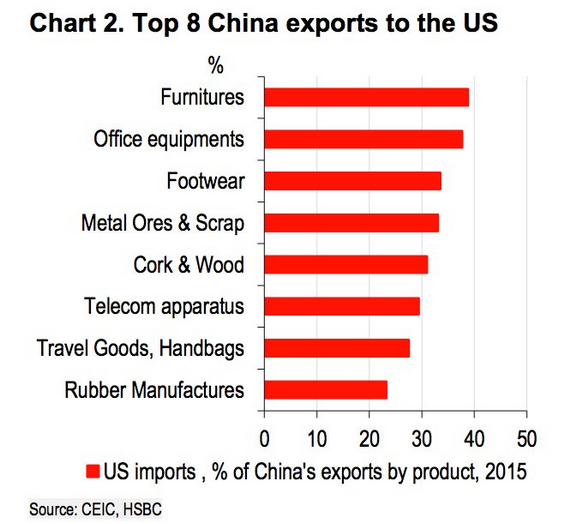
Data released earlier today showed non-fuel import prices (91.7% of U.S. merchandise imports) falling for the second consecutive month in October, the first such occurrence in eight months. Import price deflation is not over. As today’s Hot Chart shows, USDCNY fell to a new multi-year low this morning, a development that will continue to depress prices originating from the U.S. largest import trade partner (China accounts for 21.5% of total U.S. imports). So far this quarter, the CNY is already down more than 6% y/y vs. the USD, the biggest decline since China joined the World Trade Organization in 2001. (NBF)

image

From The Daily Shot:

What Surging Interest Rates Mean for Your Student and Auto Loans Mortgage rates have increased since Donald Trump was elected president—but that doesn’t mean consumers will immediately pay more for credit cards and other loans.

(…) Student and auto loans are more reliant on shorter-term measures, typically based on the London interbank offered rate, or Libor, or Treasury yields. The one-month Libor has barely budged since the election, while the three-month Libor is only up about 0.03 percentage point. So the costs of loans based on that shouldn’t jump in the same way as mortgages, which have now risen to slightly more than 4% on average for a 30-year, fixed-rate conforming loan.

And some consumer borrowing rates, say for credit cards and home-equity lines of credit, are influenced by the prime rate rather than instruments that trade daily. That rate is based on the Federal Reserve’s target for short-term rates. That currently stands at a range of 0.25% to 0.50%.

The bottom line for consumers: Interest rates for most loans aside from mortgages shouldn’t show big, immediate increases. Plus, these rates remain low by historical standards. (…)

It is true that Libor has barely bulged since the elections but it has been rising steadily throughout 2016. As to the prime rate, we shall hear about that in a month.

image

Meanwhile, mortgage apps to purchase are rolling over (CalculatedRisk):

Empire State Factory Sector Index Turns Positive

The Empire State Factory Index of General Business Conditions for November posted its first reading above zero since July. It rose to 1.5 from -6.8 in October. (…)

The new orders as well as the shipments readings both returned to positive territory following a few months of negative readings. Delivery times also slowed, but inventories fell more rapidly. The employment index declined. During the last ten years, there has been a 70% correlation between the index and the m/m change in factory sector payrolls. The average workweek figure was fairly stable m/m, but down sharply over the last three.

The prices paid index reversed improvement during the prior two months. Eighteen percent of respondents reported paying higher prices while three percent paid less. The index of prices received eased to 2.7. (…)

 large image large image

The Atlanta Fed’s GDP Now model finds itself way above the pack at +3.3% in Q4:

German economic growth halves in third quarter as exports decline

The German economy expanded 0.2% in the three months to September, according to results from official statistics body Destatis, indicating that growth has slowed markedly so far this year. In contrast, the economy grew 0.4% and 0.7% in the second and first quarters respectively. Moreover, the 0.2% growth rate was slightly below expectations of a 0.3% expansion and the weakest in a year. However, business surveys suggest growth is picking up again.

German economic growth and the PMI

Although no details were revealed, Destatis reported that the domestic market remained the mainstay of the German economy, with final consumption expenditure of both households and government continuing to increase and boost gross domestic product, while negative impulses came from trade.

The weakness in the GDP report had already been hinted at by business survey data, with the German PMI dropping to a 16-month low in September.

That said, the outlook for the fourth quarter looks positive, with business survey data such as the PMI and Ifo pointing to an acceleration in economic growth. (…)

Exports declined in the latest three-month period, while imports rose. Meanwhile, industry is likely to have had a mildly positive impact on economic growth. Industrial production expanded 0.2% in the three months to September, up substantially from a 0.8% decline in the second quarter.

In a separate report published last week, Destatis reported that Germany’s trade balance narrowed in September as exports fell 0.7%. Moreover, Germany’s economic ministry warnedthat German exporters are struggling amid global economic uncertainties stemming in part from the UK’s decision to leave the European Union and the surprise U.S. presidential election result.

The recent slump in the pound has made German goods and services less competitive in the UK (Germany’s second-largest single country trading partner) and it is therefore likely that the Brexit vote has had some negative impact on Germany’s trade balance in the third quarter. That said, the Manufacturing PMI New Export Orders Index reached its highest level since the beginning of 2014 in September and was little-changed in October, thereby suggesting that the weakness in the official data was only a temporary blip. (…)

The latest business survey results point to stronger economic growth at the start of the fourth quarter. The PMI recovered and reached its second-highest level this year so far in October, while Ifo’s Business Climate Index climbed to a two-and-a-half year high. Both IHS Markit and the German government expect GDP growth of 1.8% for 2016, which would be the strongest in five years.

Another Financial Warning Sign Is Flashing in China

The adjusted loan-to-deposit ratio, which includes a range of off-balance sheet items and is an indicator of the banking system’s ability to weather stress, climbed to 80 percent as of June 30, according to S&P Global Ratings. For some smaller lenders, the ratio has already topped 100 percent, S&P estimates.

S&P’s adjusted measure is rising much faster than the official loan-to-deposit ratio as banks pile into off-balance sheet lending, sidestepping government efforts to rein in credit. At the current pace, overall credit could surpass deposits on an adjusted basis within a few years — a level that would give China little leeway to stave off financial turmoil, S&P says.

“The next two to three years is a crucial window for China to rein in the ratio, or we will be in serious trouble,” said S&P’s Beijing-based director Liao Qiang. “Reaching 100 percent doesn’t mean a crisis will ensue immediately, but it shows China’s entire deposit base is used up and any loss of confidence from savers will severely destabilize the banking system.”

Even after S&P’s adjustments, the ratio in China remains lower than in many other countries. Yet the country’s rapid loan growth, diminishing return on credit and rising bad debts combine to make deposits a particularly important buffer against future financial distress, according to Liao. (…)

OPEC, Russia Expand Diplomatic Push to Secure Oil-Cuts Deal

Pointing up Please, read this note from Ray Dalio (the entire piece is even better):

Reflections on the Trump Presidency, One Week after the Election

(…) we chose not to bet on whether or not he would be elected and/or whether or not he would be prudent because we didn’t have an edge in predicting these things. We try to improve our odds of being right by knowing when not to bet, which was the case.

Having said that, we want to be clear that we think that the man’s policies will have a big impact on the world.(…) What follows are simply our preliminary impressions from these. (…)

Donald Trump is moving forcefully to policies that put the stimulation of traditional domestic manufacturing above all else, that are far more pro-business, that are much more protectionist, etc.  (…)  As a result, whereas the previous period was characterized by 1) increasing globalization, free trade, and global connectedness, 2) relatively innocuous fiscal policies, and 3) sluggish domestic growth, low inflation, and falling bond yields, the new period is more likely to be characterized by 1) decreasing globalization, free trade, and global connectedness, 2) aggressively stimulative fiscal policies, and 3) increased US growth, higher inflation, and rising bond yields. 

(…) the main point we’re trying to convey is that there is a good chance that we are at one of those major reversals that last a decade (like the 1970-71 shift from the 1960s period of non-inflationary growth to the 1970s decade of stagflation, or the 1980s shift to disinflationary strong growth). To be clear, we are not saying that the future will be like any of these mentioned prior periods; we are just saying that there’s a good chance that the economy/market will shift from what we have gotten used to and what we will experience over the next many years will be very different from that.

To give you a sense of this, the table below shows that a) these economic environments tend to go on for about a decade or so before reversing, b) market moves reflect these environments, and c) extended periods of movements in one direction (which lead to confidence and complacency) tend to lead to big moves in the opposite direction.

As for the effects of this particular ideological/environmental shift, we think that there’s a significant likelihood that we have made the 30-year top in bond prices. We probably have made both the secular low in inflation and the secular low in bond yields relative to inflation. (…)

Because the effective durations of bonds have lengthened, price movements will be big. Also, it’s likely that the Fed (and possibly other central banks) will increasingly tighten and that fiscal and monetary policy will come into conflict down the road. Relatively stronger US growth and relative tightening of US policy versus the rest of world is dollar-bullish.  All this, plus fiscal stimulus that will translate to additional economic growth, corporate tax changes, and less regulation will on the margin be good for profitability and stocks, though for domestically oriented stocks more than multinationals, etc. 

The question will be when will this move short-circuit itself—i.e., when will the rise in nominal (and, more importantly, real) bond yields and risk premiums start hurting other asset prices. That will depend on a number of things, most importantly how the rise in inflation and growth will be accommodated, that we don’t want to delve into now as that would take us off track. (…)

Our very preliminary assessment is that on the economic front, the developments are broadly positive—the straws in the wind suggest that many of the people under consideration have a sufficient understanding of how the economic machine works to run reasonable calculations on the implications of their shifts so that they probably won’t recklessly and stupidly drive the economy into a ditch.  To repeat, that is our very preliminary read of the situation, which is too premature to take to the bank. Of course, we should expect big bumps resulting from big shifts regardless of who is engineering this big ideological shift. 

So, what are we trying to say? The headline is that the ideological/environmental shifts are clear, their magnitudes will be large, and there’s a good chance that the “craziness” factor will be smaller and play a lesser role in driving outcomes than many had feared. In fact, it is possible that we might have very capable policy makers of the previously mentioned ideological persuasion in control. As always, we will keep you posted of our thinking as it will certainly change as we learn more.

THE DAILY EDGE (11 November 2016):

Rising Wages, Tighter Inventory Spark Retail Holiday Optimism With just two weeks until Black Friday, executives at the nation’s biggest department stores said they are seeing signs that consumers are turning their attention from voting to shopping.

(…) Macy’s Inc. and Kohl’s Corp. cited improving sales trends and gave upbeat outlooks for the key holiday season, despite posting another quarter of declining sales as the chains struggle with changing shopping habits and competition from discounters.

Nordstrom Inc., meanwhile, reported a sales increase and lifted its financial targets for the year.

“We have momentum coming out of October,” Kohl’s Chief Executive Kevin Mansell said. “We feel we’re very well positioned for the upcoming holiday season.” (…)

Perhaps even more important than the impact of the election on retail sales is the unseasonably warm weather across much of the country.

Inventory levels are in good shape compared with a year ago but that could change if cold weather doesn’t materialize, leading to “another over-inventoried, heavily-promotional holiday season,” Citi analyst Kate McShane wrote in a note to clients. (…)

Macy’s, Kohl’s and Saks Fifth Avenue, which is owned by Hudson’s Bay Co., on Thursday all reported lower sales at existing stores for the latest quarter. However, the chains reduced inventories, putting the companies on stronger footing heading into the holidays than last year.

Nordstrom executives said lower inventory levels at their stores, and throughout the industry, are resulting in fewer discounts and more stable margins. Several of the department stores had to resort to heavy discounting to clear unsold goods that piled up during the 2015 holiday season. (…)

Overall, Macy’s reported a third-quarter profit of $17 million, down from $118 million a year earlier, hurt by restructuring costs. Sales fell 4.2% to $5.63 billion.

Kohl’s profit rose 22% to $146 million, while revenue fell 2.3% to $4.33 billion.

  • J.C. Penney’s quarterly comparable sales fall 0.8 percent J.C. Penney Co Inc reported a 0.8 percent fall in quarterly comparable store sales on Friday, reflecting weak store traffic, increased price competition from online and off-price retailers and a general shift away from spending on apparel.

From Merrill Lynch via CalculatedRisk:

Consumer spending accelerated in October, according to internal aggregated BAC credit and debit card data. Using the BAC card data, retail sales ex-autos climbed by 0.8% mom seasonally adjusted in October. This follows the 0.5% mom gain in September, leaving an improving trend. … This is indicative of a solid pace of consumer spending. Indeed … the consumer has strong support from wealth gains and income creation, but has restrained spending somewhat, given the propensity for greater savings and deleveraging.

Pointing up Moody’s: US Election Outcome: Trump’s Victory to Shift Ground on Trade, Financial Regulation, Healthcare
Trump’s economic policy explained: the era of fiscal restraint is over

(…) Yet as bond markets have been recognising over the past 48 hours, by prioritising tax cuts and an infrastructure package for the first 100 days of the Trump administration, his team appears to be envisaging a stimulus programme that comes at a time when the US is already close to full employment. That could mean not only higher growth, but quicker inflation. (…)

“From a Fed perspective if fiscal policy is coming back the corollary to that is monetary policy will have to do less easing.” (…)

While Republicans have tended to brand themselves as the party of fiscal conservatism, their new president may lead them down the path of stimulus. (…)

Trump’s Transition Team Pledges to Dismantle Dodd-Frank Act

The Dodd-Frank Act (DFA) has featured as a target in President-elect Donald Trump’s campaign statements, but most aspects of DFA have been implemented, and it is unclear whether a wholesale repeal could pass or what a partial repeal may encompass. (…)

Notably, there has been little specific discussion of peeling back the Volcker Rule or Resolution Authority, some of the more costly aspects of the DFA. Fitch notes that the reduction in proprietary trading activity linked to Volcker has been largely positive for banks, while the resolution process has been largely positive for banks’ governance.

Anti-Wall Street sentiment has been a recurring theme in the presidential campaign for both candidates, so it remains an open question as to the likelihood or urgency of any proposed financial sector regulatory reform or repeal. (…)

It is also important to note that capital and liquidity requirements have not historically been dictated by the Legislature but through banking regulators in the US. The US has adopted Basel III and those requirements will continue to be implemented, regardless of the administration. Therefore, while aspects of the DFA may be peeled back, core banking regulation is unlikely to change. (…)

Trump Outlines Health Plan, From Obamacare Repeal to Abortion
Trump Reveals Policy Goals: “Building That Wall”, End “War On Coal”, Repeal Obamacare, Dismantle Dodd-Frank

On his transition website GreatAgain.gov, the Trump team has laid out the framework of his initial policies with policies focused i) on American Security, ii) Getting America Back to Work Again and iii) Government for the people including Healthcare Reform (Obamacare).

FITCH: Trump Policies Would Be Negative For US Public Finances

(…) The fiscal impact of the Trump plan would be negative for US sovereign creditworthiness over the medium term, as tax cuts alone cannot generate enough growth to make up for the loss in revenue. (…)

Government debt/GDP would rise dramatically were the tax cuts to be implemented in full. The net loss of revenue stemming from the planned cuts to individual and corporate income tax rates has been estimated by the Urban-Brookings Tax Policy Center at USD6.2trn (a third of 2016 GDP) over a 10-year horizon compared with the current baseline scenario published by the Congressional Budget Office, which already forecasts federal debt/GDP to rise by 9pp of GDP by 2025. A rapid move into substantial fiscal deficit by the US could push up borrowing costs.

Trump Effect Routs Emerging Markets 
Your Taxes Are About to Change—Perhaps Not the Way You Think

(…) Here are highlights of proposals in play:​

Income-tax rates: Both Messrs. Trump’s and Ryan’s plans would consolidate the current rates on “ordinary” income such as wages and interest from seven brackets to just three—12%, 25% and 33%. It would also make changes to the calculation of “taxable income.”

The top rate of 33% would take effect at about $225,000 of taxable income for married couples; currently the top rate of 39.6% kicks in at $467,000 for couples. The top rate for singles under Mr. Trump’s plan would take effect at about $113,000, compared with $415,000 now, according to the Tax Policy Center in Washington.

In 2016 the 33% rate takes effect at about $231,000 of taxable income for married couples and $190,000 for singles.

The upshot is that while most people would have lower tax bills, higher earners would save much more. According to the Tax Policy Center, nearly half the benefits from the Trump plan would go to the top 1% of households—those earning more than about $700,000. It could also increase taxes on many single parents and two-parent families with more than two children, although the Trump campaign said it would make sure this didn’t happen. (…)

Capital gains and qualified dividends: Mr. Trump’s plan would leave the current rate structure of 0%, 15% and 20% in place.

Mr. Ryan’s plan would revert to an older code provision that taxes capital gains, dividends and interest as ordinary income—after excluding 50% of it. Thus lower earners would see their rate rise from 0% to 6%, those in the middle would owe 12.5%, and the rate for top earners would fall to 16.5% from top 20%. (…)

Estate and gift taxes: Mr. Ryan’s plan would eliminate all gift and estate taxes. Mr. Trump’s plan would also eliminate these levies, but it would impose income taxes on the capital gains of assets held at death—beyond an exemption of about $5 million per person or $10 million per couple.

Revenue effects: These sweeping changes don’t come cheap. The changes to individuals’ taxes in Mr. Trump’s plan would reduce federal revenue by an estimated $3.5 trillion over 10 years, while Mr. Ryan’s plan reduced it by an estimated $2.2 trillion. (…)

Surprised smile The 30yr Treasury yield has gone vertical as investors expect fiscal stimulus and higher inflation from the Trump administration.

Surprised smile US market-based inflation expectations continue to rise.

OPEC points to even bigger 2017 oil surplus as its output jumps

The Organization of the Petroleum Exporting Countries pumped 33.64 million barrels per day (bpd) last month, according to figures OPEC collects from secondary sources, up 240,000 bpd from September, OPEC said in a monthly report. (…)

According to OPEC’s report, October’s supply boost mostly came from Libya, Nigeria and Iraq – members that have sought to be exempt from cuts due to conflict. Iran, seeking an exemption as output was held back by Western sanctions, also pumped more. (…)

With demand for OPEC crude in 2017 expected to average 32.69 million bpd, the report indicates there will now be an average surplus of 950,000 bpd if OPEC keeps output steady. Last month’s report pointed to an 800,000 bpd surplus.

The 2017 surplus implied by the IEA in its latest report on Thursday is closer to 500,000 bpd.

The Trump era (The Economist)

(…) Start with the observation that America has voted not for a change of party so much as a change of regime. Mr Trump was carried to office on a tide of popular rage (see article). This is powered partly by the fact that ordinary Americans have not shared in their country’s prosperity. In real terms median male earnings are still lower than they were in the 1970s. In the past 50 years, barring the expansion of the 1990s, middle-ranking households have taken longer to claw back lost income with each recession. Social mobility is too low to hold out the promise of something better. The resulting loss of self-respect is not neutralised by a few quarters of rising wages.

Anger has sown hatred in America. Feeling themselves victims of an unfair economic system, ordinary Americans blame the elites in Washington for being too spineless and too stupid to stand up to foreigners and big business; or, worse, they believe that the elites themselves are part of the conspiracy. They repudiate the media—including this newspaper—for being patronising, partisan and as out of touch and elitist as the politicians. Many working-class white voters feel threatened by economic and demographic decline. Some of them think racial minorities are bought off by the Democratic machine. Rural Americans detest the socially liberal values that urban compatriots foist upon them by supposedly manipulating the machinery in Washington (see article). Republicans have behaved as if working with Democrats is treachery.

Mr Trump harnessed this popular anger brilliantly. (…) For some [voters], his flaws are insignificant next to the One Big Truth: that America needs fixing. For others the willingness to break taboos was proof that he is an outsider. As commentators have put it, his voters took Mr Trump seriously but not literally, even as his critics took him literally but not seriously. The hapless Hillary Clinton might have won the popular vote, but she stood for everything angry voters despise.

The hope is that this election will prove cathartic. Perhaps, in office, Mr Trump will be pragmatic and magnanimous—as he was in his acceptance speech. Perhaps he will be King Donald, a figurehead and tweeter-in-chief who presides over an executive vice-president and a cabinet of competent, reasonable people. When he decides against building a wall against Mexico after all or concludes that a trade war with China is not a wise idea, his voters may not mind too much—because they only expected him to make them feel proud and to put conservative justices in the Supreme Court. Indeed, you can just about imagine a future in which extra infrastructure spending, combined with deregulation, tax cuts, a stronger dollar and the repatriation of corporate profits, boosts the American economy for long enough to pacify the anger. This more emollient Trump might even model himself on Ronald Reagan, a conservative hero who was mocked and underestimated, too.

Nothing would make us happier than to see Mr Trump succeed in this way. But whereas Reagan was an optimist, Mr Trump rails against the loss of an imagined past. We are deeply sceptical that he will make a good president—because of his policies, his temperament and the demands of political office.

Take his policies first. After the sugar rush, populist policies eventually collapse under their own contradictions. Mr Trump has pledged to scrap the hated Obamacare. But that threatens to deprive over 20m hard-up Americans of health insurance. His tax cuts would chiefly benefit the rich and they would be financed by deficits that would increase debt-to-GDP by 25 percentage points by 2026. Even if he does not actually deport illegal immigrants, he will foment the divisive politics of race. Mr Trump has demanded trade concessions from China, Mexico and Canada on threat of tariffs and the scrapping of the North American Free Trade Agreement. His protectionism would further impoverish poor Americans, who gain more as consumers from cheap imports than they would as producers from suppressed competition. If he caused a trade war, the fragile global economy could tip into a recession. With interest rates near zero, policymakers would struggle to respond. (…)

The second reason to be wary is temperament. During the campaign Mr Trump was narcissistic, thin-skinned and ill-disciplined. Yet the job of the most powerful man in the world constantly entails daily humiliations at home and abroad. (…) If Mr Trump fails to master his resentments, his presidency will soon become bogged down in a morass of petty conflicts.

The third reason to be wary is the demands of office. No problem comes to the president unless it is fiendishly complicated. Yet Mr Trump has shown no evidence that he has the mastery of detail or sustained concentration that the Oval Office demands. He could delegate (as Reagan famously did), but his campaign team depended to an unusual degree on his family and on political misfits. He has thrived on the idea that his experience in business will make him a master negotiator in politics. Yet if a deal falls apart there is always another skyscraper to buy or another golf course to build; by contrast, a failure to agree with Vladimir Putin about Russia’s actions leaves nobody to turn to. Nowhere will judgment and experience be more exposed than over the control of America’s nuclear arsenal—which, in a crisis, falls to him and him alone.

(…) The danger with popular anger, though, is that disillusion with Mr Trump will only add to the discontent that put him there in the first place. If so, his failure would pave the way for someone even more bent on breaking the system.

The election of Mr Trump is a rebuff to all liberals, including this newspaper. The open markets and classically liberal democracy that we defend, and which had seemed to be affirmed in 1989, have been rejected by the electorate first in Britain and now in America. France, Italy and other European countries may well follow. It is clear that popular support for the Western order depended more on rapid growth and the galvanising effect of the Soviet threat than on intellectual conviction. Recently Western democracies have done too little to spread the benefits of prosperity. Politicians and pundits took the acquiescence of the disillusioned for granted. As Mr Trump prepares to enter the White House, the long, hard job of winning the argument for liberal internationalism begins anew.

Red heart OBITUARY  Leonard Cohen (1934-2016) Leonard Cohen, the gravelly voiced Canadian singer-songwriter of “Hallelujah,” ‘‘Suzanne” and “Bird on a Wire,” has died at age 82.