The enemy of knowledge is not ignorance, it’s the illusion of knowledge (Stephen Hawking)

It ain’t what you don’t know that gets you into trouble. It’s what you know for sure that just ain’t so (Mark Twain)

Invest with smart knowledge and objective odds

THE DAILY EDGE (25 November 2016): It’s a wonderful world, suddenly.

U.S. New Home Sales and Prices Backpedal

Sales of new single-family homes during October declined 1.9% (+17.8% y/y) to 563,000 (AR) from 574,000 sales in September, revised from 593,000. (…)

large image
Durable Goods Orders Surge in October, Mostly Civilian Aircraft

Led by a 12.0% m/m jump in orders for transportation equipment, U.S. durable goods orders surged a much larger-than-expected 4.8% m/m (2.1% y/y) in October. The Action Economics Forecast Survey had looked for a 1.0% m/m increase. And the initially reported 0.3% m/m decline for September was revised up to a 0.4% m/m rise. The rise in transportation orders was due almost completely to a 94% m/m explosion of nondefense (civilian) aircraft orders. Nondefense aircraft orders rose $10.6 billion (SA) in October while total orders were up $11 billion (SA).

Excluding defense and aircraft, orders edged up 0.3% m/m (0.6% y/y). While the October rise was modest, it was the fifth consecutive monthly increase for this key private-sector indicator, the longest string of monthly increases since the first five months of the recovery in 2009. Excluding transportation, orders rose 1.0% m/m in October (0.3% y/y, the first y/y increase since December 2014).

Core capital goods orders (nondefense capital goods orders excluding aircraft) rose 0.4% m/m (-4.0% y/y). After falling consistently during 2015, these orders appear to have bottomed during 2016, but nonetheless, remain lackluster, underscoring the general weakness exhibited by business investment spending in the national accounts. Core capital goods shipments, an accurate measure of the near-term course for business investment spending, edged up 0.2% m/m in October (-4.9% y/y) for its third consecutive monthly increase. Core capital goods shipments in October were 0.5% above the third quarter average–this indicator has declined in each of the preceding four quarters.

image

Doug Short has the best chart on that:

Durable Goods Components
U.S. ECONOMY GROWING AT 2% IN Q4

Although only covering around 10% of the economy, the manufacturing PMI acts as a good barometer of GDP. This is in part due to the sector influencing business trends in other related sectors, notably transportation.

Since mid-2007, the correlation between Markit’s PMI and official GDP growth has been 82%, rising to 91% if official data are smoothed using a moving average to remove volatility in the GDP series. These correlations are marginally higher than equivalent ISM comparisons of 81% and 87% respectively.

With the average Markit Manufacturing PMI reading for the first two months of the fourth quarter running at 53.6, it is broadly indicative of 0.5% (2% annualised) GDP growth in the closing quarter of 2016.

EUROZONE ECONOMY GROWING AT 1.6% IN Q4.

The PMI readings so far for the fourth quarter point to GDP expanding 0.4%, led by a rebound in German growth to 0.5%. France is also seen to be enjoying its best spell since the start of the year, with the PMIs signalling GDP growth of 0.2-0.3% in the fourth quarter.

How an Illegal-Immigrant Crackdown Could Hit U.S. Economic Growth A new study puts the economic contribution of the U.S.’s illegal workers at 3% of private-sector GDP.

(…) California’s private-sector economy would shrink by almost 7% if its unauthorized workers, which make up 10% of its workforce, were removed, the study found. (…)

Unauthorized workers in the U.S. earned $580 a week on average across all industries, more than 40% less than U.S.-born workers. In finance and information sectors, though, where they still made up 2% of employment, they almost earned the same, around $1,300 a week.

The output of the construction, agriculture and hospitality sectors, whose workforces are made up of between 10% and 18% unauthorized workers, would fall by up to 10%, the research suggests. (…)

  • Small-Business Lament: Too Few Mexicans in U.S. As the U.S. labor market tightens and the population of undocumented immigrants shrinks, employers in industries such as hospitality, construction and agriculture are scrambling to fill jobs they say Americans don’t want.
Taxing Times for the Market’s Global Elite Likely tax changes, promised fiscal boost, strong dollar benefit smaller, domestic-focused companies

Winners since the election are the archetype of middle America: shares of smaller companies, with higher tax rates, which focus on domestic customers. Losers since the election are the globe-trotting elite of the corporate world, behemoths that pay little tax and sell a lot overseas.

At least three factors are working together to help small stocks. First up is corporate taxes, about which President-elect Trump has rare cross-party agreement that Something Must Be Done. That something is likely to mean a big cut to the headline corporate-tax rate, which currently comes in at 39% when state taxes are included, the highest of major countries.

Next is Mr. Trump’s promise of a fiscal boost to the economy from wider tax cuts and infrastructure spending, making domestic sales more attractive than the foreign earnings of the multinationals.

Finally there is the strength of the dollar, boosted by many factors but quite literally meaning that foreign earnings are devalued when brought back to the U.S. (…)

The Russell 2000 index of small stocks has leapt more than 12% since the election, beating the S&P 500 by 9.25 percentage points. (…)

Michael Zezas, fixed-income strategist atMorgan Stanley, says the obvious winners from a big tax package are domestically oriented companies with high tax rates. He estimates that cutting the corporate tax to 15%, as Mr. Trump proposes, would mean a 30% increase in profit, justifying much higher prices. A score of companies his team picked as likely winners are up an average 6% since the election, led by Charles Schwab and Aetna with double-digit gains. (…)

At the heart of the fight is a Republican plan in Congress that would impose corporate taxes on imports while eliminating them from exports, a move that would upend decades of tax policy.

The proposed shift in effect would curtail existing incentives for U.S. companies to move profits and operations abroad, but it would also pose new challenges for some global businesses. Retailers selling imported products and refiners using imported oil could be hardest hit, while some exporters could see their tax bills vanish. (…)

And the changes to the tax system could be quite complex for those with global supply chains that import and export components and products, such as auto manufacturers and Apple Inc.

Still, the plan’s path forward is uncertain. While it has support from House Republicans, senators and Mr. Trump haven’t weighed in.

China Struggles to Steady Yuan’s Decline China is facing an uphill battle to maintain an orderly depreciation of the yuan as investors pile up bearish bets against the currency outside the mainland.

(…) The pace of depreciation has quickened sinceDonald Trump’s surprise U.S. presidential-election win sent the greenback soaring and emerging-market currencies tumbling. The yuan is down 6.2% against the dollar this year in onshore markets, reaching 6.9152 against the dollar on Thursday, with more than a third of the drop in the past two weeks. (…)

SENTIMENT WATCH

“It’s a wonderful world!”, suddenly.

  • Several recent investor surveys have turned decidedly optimistic. Bullish sentiment in the American Association of Individual Investors’ poll last week had its biggest surge since July 2010. The bull/bear spread widened to +20.1 to its widest level since November 2015. (Chart from Horan Capital Advisors)

  • And the big guns are of the same view: more than 80% of 650 institutional investors polled by Strategas Research Partners said the election outcome made them more bullish on stocks.
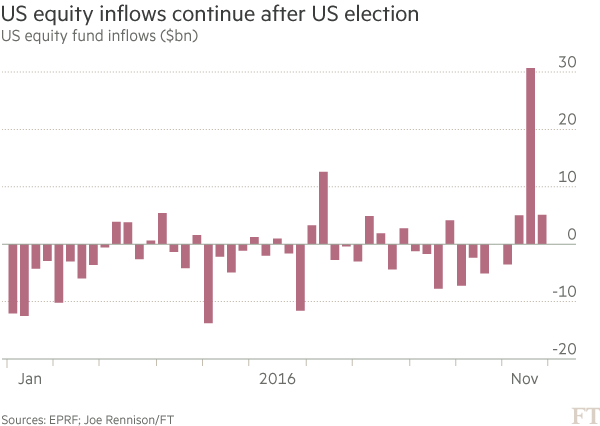
  • More than $5.1bn flows into US stock funds Cash pulled in as Trump’s rhetoric on economy shows no sign of abating
  • (…) Globally, bond funds lost $8.6bn, with $2.5bn coming from the US, as yields, which move inversely to price, have risen sharply since the election victory. Emerging market bond and equity funds also continued to shed money, with investors pulling out $2.9bn and $1.9bn, respectively. (…)
The man on the street is also upbeat all of a sudden:

The University of Michigan said Wednesday its final reading of consumer sentiment rose to 93.8 this month from a preliminary November reading of 91.6 and a final October reading of 87.2. (…)

The post-election rise in optimism was widespread across different regions of the country, income and age groups. (…)

The Michigan index had matched a two-year low in October, just as outcome of the bare-knuckles campaign appeared relatively uncertain.

The turnaround was also apparent in subindexes. The survey’s reading of current economic conditions jumped to 107.3 from October’s final reading of 103.2. The gauge of future expectations climbed to 85.2 from 76.8.

(…) And ‘optimistic’ might be an understatement. According to the latest report, in some cases, Americans are the most hopeful they have been in more than a decade. For the first time since 2006, 37 percent of households said they expect their personal finances to improve in 2017. Also hitting decade highs: real income expectations, as wage growth continues to gain strength in a broadening swath of the economy. 

It’s not just on the personal finance front either. The index tracking households’ expectations for changes in business conditions over the next year rebounded strongly after tumbling in October, with the share calling for an improvement in this area registering its biggest one-month gain last exceeded in 2008. (…)

46 percent of respondents surveyed agreed the U.S. will have “continuous good times” over the next year, up a whopping 11 percentage points from October, while the share who expected “bad times” ahead fell by 7 percentage points to 37 percent. (…)

Consexp

THE DAILY EDGE (22 November 2016)

CFNAI Diffusion Index Weakens in October

The CFNAI Diffusion Index weakened in October, declining to -0.35 from September’s -0.16, according to the Federal Reserve Bank of Chicago. The components of the index all show weakness relative to trend except for the employment complex where the reading is neutral (pointing to trend growth). The index and all components were negative in September and all but one (sales orders and inventories) were negative in August as well.

Over three months, there is deterioration in the diffusion index and its activity reading as well as for three of the four components. Over three months, the consumption/housing complex has improved slightly as have sales/orders/inventories. Over six months, there are declines in the diffusion index, the activity index and in two of four of the components. The consumption/housing complex indicates weakening along with production/income. Strengthening slightly is the employment complex and sales/orders/inventories. Over 12 months, the overall diffusion index is weaker, but the weighed activity index change is positive signaling improving growth. Only one component (the employment complex) signals weakening growth compared to 12-months ago. (…)

large image
Auto Forecast November U.S. Light-Vehicle Sales Leave Potential for Record Year

U.S. light-vehicle sales results are expected to track above the year-to-date pace for the third straight month in November, leaving open the possibility that 2016 still could finish with record volume.

With an upward bias, November sales are forecast to end at a 17.7 million-unit seasonally adjusted annual rate, the third consecutive month the SAAR finished above the year-to-date total, which stands at 17.3 million through October.

The forecast SAAR is below like-2015’s 18.1 million and October’s 17.9 million.

However, because there are two extra selling days (25) in November compared with last year, the forecast volume of 1.367 million units is 3.3% above same-month 2015’s 1.323 million. If November’s outlook holds firm, year-to-date volume will total 15.8 million units, a smidgeon above 11-month 2015’s 15.7 million, but keeping the prospect alive that 2016 could end as a record year.

Regardless of whether 2016 posts a new high, the signs still point to a plateauing in demand, with the likelihood of a decline next year – albeit a mild downturn, based on WardsAuto forecast of 17.2 million units in 2017.

The month’s forecasted daily selling rate of 54,696 is 4.9% below November 2015, and the third decline in the past four months. Also, November’s forecasted SAAR will be the fourth straight year-over-year decline.

November’s results largely will be determined by how much Thanksgiving promotions juice volume from the holiday weekend through the end of the month. (…)

A potential dampener to the month is fleet deliveries. Estimated raw volume has declined for two consecutive months and could drop again in November, as more automakers show signs of pulling back from using fleet sales as a way to maintain market share. (…)

Donald Trump Poised to Pressure Mexico on Trade Rather than kill Nafta, Trump and his advisers appear set for to push for substantial changes to the rules governing trade with Mexico and Canada.

(…)  Among the likeliest would be special tariffs or other barriers to reduce the U.S. trade deficit with Mexico and new taxes that would hit U.S. firms that moved production there, according to Trump advisers. His team says it may also seek to remove a Nafta provision that allows Mexican and Canadian companies to challenge U.S. regulations outside the court system. (…)

The U.S. imported and exported $1.1 trillion in merchandise to and from Canada and Mexico last year, compared with about $700 billion with the European Union and $600 billion with China.

The U.S., Canada and Mexico are intertwined in a complex system of supply chains, with some components crossing borders more than once before final products are sold to consumers. (…)

Mexican officials say they are willing to update the 22-year-old treaty, including adding new chapters on e-commerce and other aspects that didn’t exist in the mid-1990s.

But Mexican officials are wary of revisiting tariffs and export quotas. “We can’t get lost in an old debate about traditional tariffs…that’s a debate from the last century,” Economy Minister Ildefonso Guajardo told a business conference earlier this month. Reopening the treaty would create “a long line” of special interests in all three countries trying to get protection, he said. (…)

If Mr. Trump doesn’t get what he wants in the talks, as president he has the authority to pull the U.S. out of Nafta in a matter of months and could do so, perhaps warning about such a move in his first days in office, lawyers say. If the U.S. leaves Nafta, then the two-decade-old agreement could be replaced with bilateral trade agreements, which Trump advisers say they prefer to multilateral tie-ups.

BTW:

U.S. goods exports to Canada and Mexico have quadrupled since Nafta took effect in 1994, rising to about $550 billion last year. (…)

While critics have decried Nafta and other free-trade agreements for opening U.S. markets to foreign products, the deal actually lowered tariffs in Canada and Mexico even more than in the U.S. The American government applied an average tariff of just 4.3 percent to imports from Mexico and 5.1 percent to those from Canada before Nafta, while Canada had a 9.7 percent tax on imports from the U.S. and Mexico’s tax was 12.4 percent, according to a study last year led by Gary Hufbauer, an analyst at the Peterson Institute for International Economics. (…)

  • Weighing exports and imports is too simplistic. For example, a car made in Canada or Mexico and shipped to the U.S. is counted as an export, but includes many parts and inputs from the U.S.
  • Under the trade agreement, Canada is prohibited from cutting off oil exports to the United States if there is a worldwide shortage or supply disruption unless supplies are also rationed to Canadian consumers by the same amount.

Also BTW, back in 2008:

During a nationally televised debate in Cleveland, the two Democratic presidential candidates suggested Canada and Mexico would be given just six months to make compromises on the deal in order to satisfy the U.S. government.

“I will say we will opt out of NAFTA unless we renegotiate,” Mrs. Clinton said. “I have said we will renegotiate NAFTA (and) you would have to say to Canada and Mexico, ‘That’s what we are going to do’.”

Said Mr. Obama: “We should use the hammer of a potential opt-out” to force Canada and Mexico to reopen trade talks.

A final BTW from The Daily Shot:

Mexico’s manufacturing boom has been brutal on Canada’s trade. Some in Canada are excited about Trump’s anti-NAFTA rhetoric.

The Darker Side of the Dollar’s Rise

(…) A stronger dollar means weaker currencies for some struggling regions, notably Europe and Japan. But tightening elsewhere could offset any gains these regions would get from rising exports driven by their weaker currencies. (…)

Already in some emerging markets, currencies have fallen and yields have risen more rapidly than they did during the [2013] tantrum. (…)

image

  • The biggest dollar-denominated emerging markets bond fund is seeing significant outflows which started immediately after Trump’s victory.
European Firms Take ECB’s Cheap Cash, but Don’t Spend It The European Central Bank began buying billions of euros worth of corporate bonds earlier this year in a high-profile experiment aimed at spurring private investment. So far, the spending hasn’t materialized.

(…) “We just don’t see much evidence that the behavior of corporates has changed as a result of the” corporate bond-buying program, said Hans Lorenzen, head of European credit strategy at Citigroup Inc. “On the whole, corporates in Europe remain very cautious.” (…)

Unlike in the U.S., European companies have barely taken advantage of cheap debt to buy back stock and boost their share price. According to Goldman Sachs, a quarter of cash held by S&P 500 companies is spent on buybacks, compared with 5% for Stoxx Europe 600 companies. (…)

The average yield on eurozone senior debt of nonfinancial companies is 1.1%, down from around 1.4% before the ECB announced its buying plans in March, according to IHS Markit’s iBoxx index. (…)

Global Competition to Cut Corporate Taxes Heats Up

U.K. Prime Minister Theresa May on Monday officially endorsed a move by Britain’s previous Conservative government to lower the main corporate rate there to 17% by 2020, from today’s 20%. (…)

The new attention being paid to corporate tax in both places follows close on the heels of recent moves in Japan, Canada, Italy and France to attract investment with lower rates of their own. (…)

SENTIMENT WATCH
Deutsche Bank: Trump Could Push the U.S. Economy and Stock Markets to New Records

It’s looking more likely that President-elect Donald Trump will preside over a continuing U.S. expansion that could take its place as the longest among American business cycles, according to Deutsche Bank AG. And Chief U.S. Equity Strategist David Bianco predicts that by the time the real estate mogul takes office in January, the S&P 500 Index will eclipse 2,250.

Investors are under-appreciating the “much higher chance now of a long lasting economic expansion that rivals the 10 year U.S. record,” the strategist writes “We’re more confident now that the S&P will reach 2,500 in 2018 before suffering its next bear market.” (…)

While Bianco doesn’t discount the risks to Corporate America’s bottom line posed by a rising U.S. dollar, potential protectionist trade policies under a Trump administration, and the rise in Treasury yields, he thinks the more important things for investors to focus on are lower taxes and the increase in bank profitability.

Deutsche Bank estimates that the U.S. corporate tax rate will be cut to about 25 percent — which would bring it in line with the Organisation for Economic Co-operation and Development (OECD) average — and suggests that every 5 percentage point cut lifts the earnings per share of S&P 500 companies by a cumulative $5.00.

Source: Deutsche Bank

As such, Bianco upped his earnings per share target for the S&P 500 to “at least” $130 for 2017, which would constitute annual growth of over 9 percent (assuming his 2016 estimate of $119 is on the mark). “We’re unsure how much the U.S. corporate tax rate will be cut, but we think a significant cut is likely,” the strategist writes. (…)

Meanwhile, bonds won’t become attractive enough of an alternative to crimp stock valuations or cause companies to face higher interest expenses. The continuation of the Fed’s tightening cycle will keep the labor market from overheating and put a cap on the longer end of the U.S. Treasury yield curve, he added. As such, Bianco recommends that investors in need of income should turn to utilities stocks, which have been battered since the election.

“Utilities benefit from: 1) a lower U.S. corp tax rate given nearly 100 percent U.S. profits and thus no foreign exchange risk, 2) likely continued 15 percent tax rate on dividends versus income tax rates for interest income and the 3.8 percent Affordable Care Act tax is likely dropped, 3) more Federal infrastructure grants and loans for transmission upgrades, 4) a safe haven for retirees and institutions looking to reduce fixed income exposure,” he concludes.