Equity markets got spooked in mid-October after realizing that Europe is still Europe, Russia is still Russia, and that China is no longer China. How about America?
No worry, America is still America. America needs no outside help for growth. And if you doubt it, economists and strategists are unanimous: U.S. exports of goods and services “only†account for 13.6% of GDP. Personal consumption is 68% of the economy and looking good given the recovery in employment and the decline in commodity prices, thanks to Europe, Russia and China.
Housing remains weak, but it only accounts for 3.2% of GDP. And mortgage rates are coming back down, thanks to Europe, Russia and China.
America is indeed the promised land: it benefits when the ROW is strong through rising exports and its powerful multinational companies. It seems to benefit just as much when the ROW is weak through lower commodity prices and interest rates. It also possesses a dependable central bank, always there to backstop if and when necessary, while the ECB, so European, is all words but little action, China’s central bank is political and closed while the BOJ is boldly unpredictable.
“America! America! God shed His grace on theeâ€.
This rich lonesome cowboy sure knows how to master the bull. It is the only game in investment town.
François Trahan, Cornerstone Macro’s investment strategist, has been the number one ranked strategist on Wall Street by Institutional Investor magazine for eight of the last ten years. He is brilliant and very well articulated. He recently gave an interview to Consuelo Mack, painting the bright outlook for the U.S.A., the lonesome cowboy. Half an hour of bullishness:
And here’s Trahan’s partner, economist Nancy Lazar. Backing Trahan, Nancy discusses her optimism on the U.S. economy. My long time readers will notice that the themes she mentions have been part of my own storyline for many years: the American manufacturing renaissance, the energy revolution and, recently, stronger capex and, lately, my views that housing is beginning a more sustainable recovery.
Cornerstone Macro’s view is that the U.S. economy can grown 3.0-3.5% annually for several years even with a weak Europe and a severely slowing China. The story is very appealing: the ROW being weak, the U.S. will benefit from low commodity prices and interest rates which will boost consumer expenditures and revive the housing market. In the background, the American manufacturing renaissance and the U.S. energy revolution, coupled with a strengthening dollar, will boost capex and employment while low inflation rates will restrain wage growth.
For equity markets, the only fly in the ointment is the 33% in foreign revenues for S&P 500 companies. Converted into stronger dollars, these weaker foreign earnings will slow the rate of growth in total S&P 500 earnings. Nevertheless, investors can reap hefty gains by focusing on America-centric companies. These will benefit from relatively stronger revenue growth rates, elevated margins and, importantly, rising P/E ratios given that “P/E ratios rise when the dollar is strongâ€.
This is, indeed, a great story, credibly narrated by smart and renowned professionals.
There are however a few side stories that need being aired:
-
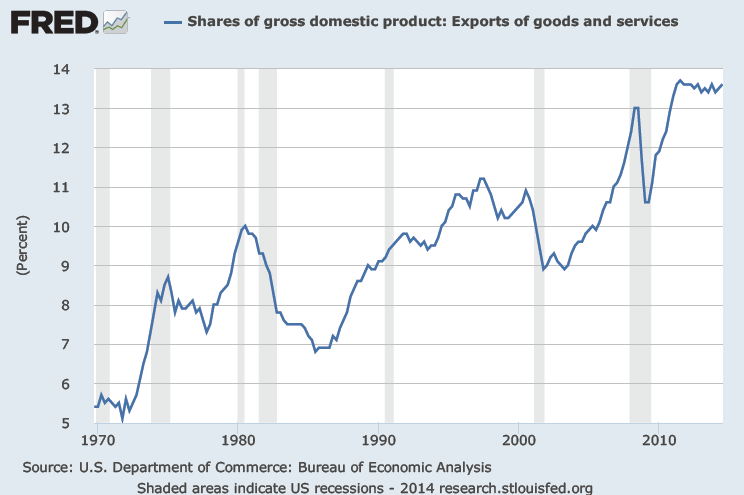
 Exports “only†account for 14% of the economy. In reality, exports have been a pretty consistent contributor to U.S. GDP growth since 1970 when they “only†accounted for 5% of GDP. Fourteen percent of the economy declining by 13-14% like in 2001 and 2008 would cut U.S. GDP growth by nearly 2.0%. If exports decline only 5%, that would shave 0.7% off real GDP. Not so bad when the base growth rate for the economy is 4.0-5.0%, but U.S. GDP growth only averaged 2.2% since 2010, even with real exports growing 5.9% annually. Growth in real final sales to domestic purchasers averaged only 1.8% since 2010 (+2.2% in last 4 quarters).
-
The problems in Europe, Russia and China are not trivial. Things could even get worse. Europe is flirting with another recession and with deflation, Russia is likely in recession now, in stagflation at best, while China might be slowing a lot more than what official figures suggest while two of its principal export markets are tumbling.
-
How low will commodity prices go? What if oil prices drop to $60-70. What happens to Canada, Russia, the U.K., Brazil, the Middle East? Obviously nothing pretty. Globalization has magnified and speeded up the communicating vases. Sharply lower oil prices surely benefit consuming countries and global GDP but producing countries are not an isolated bunch suffering in silence in their corner, patiently waiting for the crisis to pass. Remember the eurocrisis?
-
How high the dollar? How low the yen? How will other countries react, especially China and Korea? Currency wars and protectionism are not market friendly. Central banks are experimenting novel measures with many unknown consequences. To be sure, the sharply increased volatility in foreign exchange markets is a significant new variable; no economist can predict how it will end. BTW, MNI headlined two Fridays ago: FED HAS NOTICED EUR SLIDE AND ECB MUST NOT PUSH TOO FAR: MNI. I wonder how the Fed translated that for the BOJ the following week. Never mind the PBoC.
-
How about another LTCM, or euro bank crisis, or a China banking crisis? These unknown unknowns often pop up when major economic shocks occur.
The truth is that economic scenarios are generally much smoother on paper than they end up being in the real world.
But my main interest is less in the “Lonesome Cowboy†narrative than on what it might actually be worth. Trahan admits that equities are not currently cheap but he asserts that multiples will rise along with the U.S. dollar.
I plot that relationship in the following chart going back 40 years to 1973. For the whole period, Trahan is wrong, as the correlation coefficient is -0.22. However, he seems to have only considered the last 25 years (1991), a period during which the correlation suddenly jumps to +0.80 (click to enlarge).
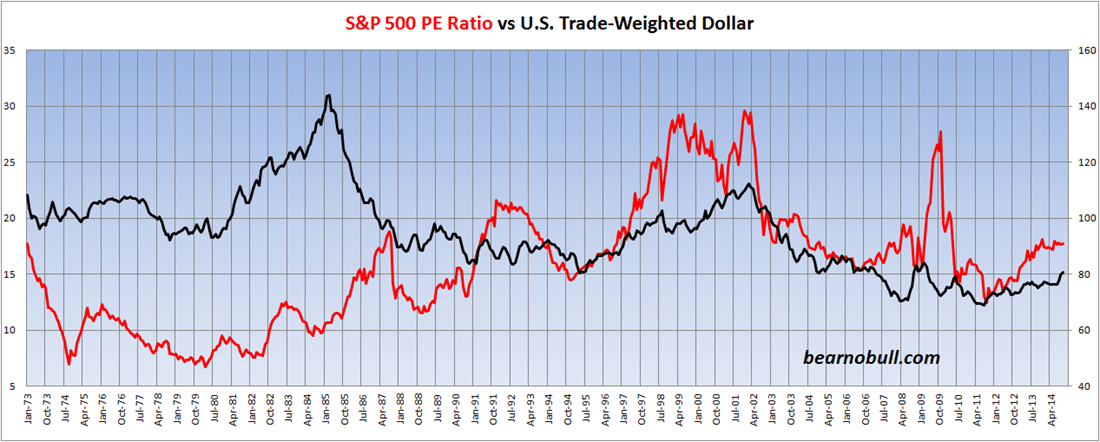
Hmmm… That’s fishy! Even more so after calculating that the correlation between the U.S. dollar and 10-Yr Treasury yields is +0.70 since 1973 (+0.50 since 1991).
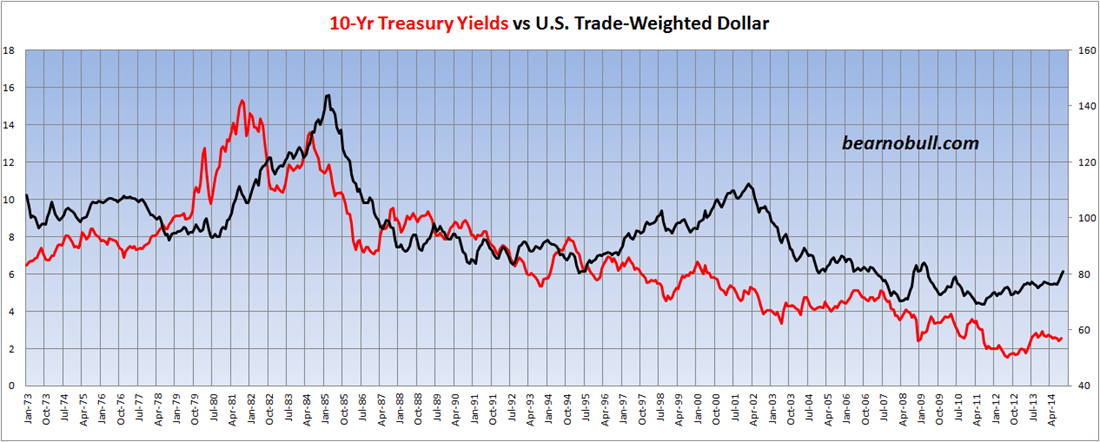
Why fishy? Not because the dollar would rise along with interest rates. That is understandable and right in Trahan’s alley given the continuing weakness in European and Japanese economies. It’s fishy because P/E ratios are not supposed to rise with interest rates, generally the opposite in fact. So Trahan is right based on correlations since 1991 (+0.80) but these correlations between the dollar and P/E ratios were likely strongly influenced by the internet mania and its demise between 1995 and 2004. In effect, the correlation between the dollar and P/E ratios drops to -0.25 between 1973 and 1994 and to +0.22 since 2004.
Trahan is thus statistically right, but really because of the period he used (others have done the same mistake). He is fundamentally wrong however. His forecast that a strong U.S. dollar will push P/E ratios up during the next 4 years is not supported by long-term statistics nor by fundamentals.
Incidentally, François’ January 2014 strategy presentation included a section titled “What Drives P/Es?†in which the only mention of the dollar was to show that a strong dollar tends to boost consumer discretionary spending through lower commodity prices. His February 2007 ISI presentation also supported a P/E expansion thesis essentially based on a stronger economy with tame core inflation and lower oil prices.
This time, he again expects a multiple expansion but links it mainly to his forecast of a strong dollar: “A rising dollar means rising P/Esâ€, which actually only verified during the internet mania of the late 1990s…
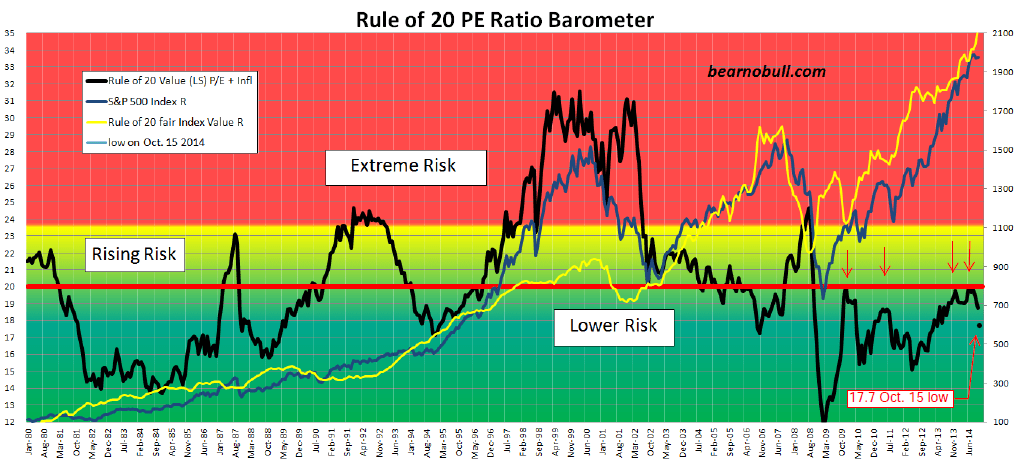
I am old enough to have learned not to forecast equity markets. Rather, it is best to assess the probability that equities rise against the probability of a decline, using essentially trailing data. The Rule of 20 has been meaningfully and consistently helpful for that. The Rule of 20 simply says that the “fair P/E ratio†for the S&P 500 Index is 20 minus inflation. When the Rule of 20 P/E diverges from its “20†fair value, probabilities get skewed one way or the the other, triggering investment or divestment opportunities. We must then assess whether the economic and financial outlook (the story) will be conducive to realizing these opportunities.
U.S. inflation is currently 1.5%. Fair P/E is thus 18.5x trailing EPS of $114.75 on the S&P 500 Index after Q3. Fair Index value is thus 2120, some 4% above current levels (2040). Based on current forecasts for Q4 EPS ($31.10), trailing EPS will rise 2.5% to $117.60 after Q4 earnings are fully released by mid-February 2015. If inflation is unchanged, fair value would rise to 2175, 6.6% above current levels.
Current downside risk? The mid-October scare brought the Rule of 20 P/E from 20 to 17.7x, (16.2x on the actual P/E) implying a downside to 1860, using trailing EPS after Q3. That’s a 9% setback, shaved to 6-7% after Q4 results, making the odds only mildly unfavourable. But the other two recent scare episodes (2010 and 2012) brought the Rule of 20 P/E down to the 16.5 area, implying an additional 7% potential downside.
Trahan says that conditions are ripe for a repeat of the 1996-2000 P/E expansion. The P/E expansion during the internet mania was unprecedented. The problem with a meaningful multiple expansion scenario from current levels is that it defies history: while not impossible, it is rather unlikely. In any event, this is clearly not a “buy low†story.
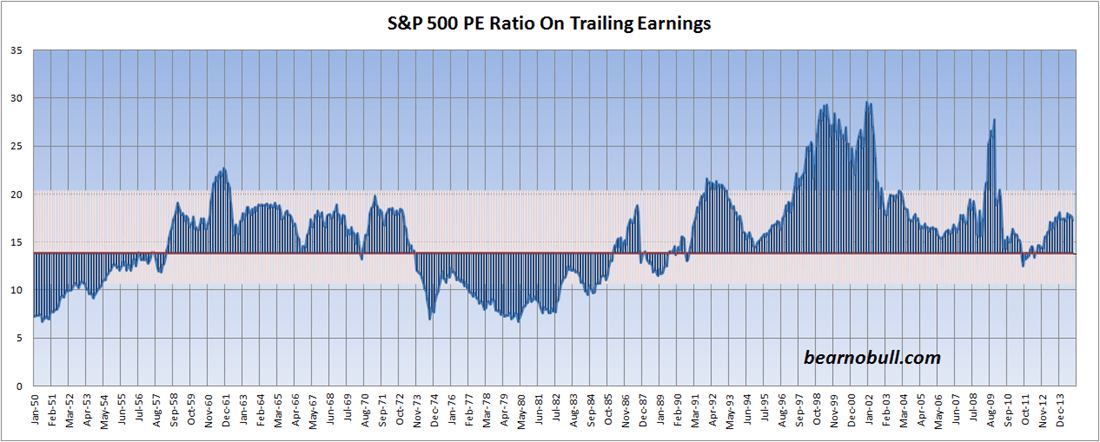
The case for higher P/Es really rests on inflation. But even there, one must be cautious. The case for lower inflation is not bad at all. However, lower inflation necessarily means lower revenue growth at a time when wage growth is being pulled upwards by rising employment. While net profit margins are at all-time highs, operating margins (EBIT) have flattened in recent years. The benefits from lower interest costs and taxes as a percent of sales is likely exhausted at this point. The risk is now tilted towards lower margins.
Deflation risk is also likely to resurface from time to time in America, keeping investors edgy.
Finally, a rising dollar negatively impacts multinationals’ profits. Trahan advises investors to avoid multinationals but the S&P 500 Index can’t avoid them. This should act as another deterrent to rising multiples on the major indices. Can P/Es of small caps and/or domestically-centric companies expand in such a scenario? After all, as Trahan suggests, they will get all the benefits of a slowing world economy while absorbing none of the drawbacks.
Small and Mid Cap stocks are trading near the high end of their recent P/E range, as this chart from Ed Yardeni illustrates. I would not bet much on a major rerating of small cap stocks vs larger caps. Small caps volatility tends to restrain exuberance and foreign money is not naturally drawn to smaller cap equities.
In THREE-STARRED EQUITIES last August, I argued that equities would not get into overvalued territory like they have always done during previous bull markets and that equity markets were in fact fully valued rather than fairly valued at 20x under the Rule of 20:
(…) Large traditional media no longer control the financial news and opinions landscape, a clear win for investors, in as much as they maintain an adequate balance in their info sources.
But in this world where people have become accustomed to rely on user ratings for just about everything, it may be impossible for equity markets to receive much more than a 3-star rating given the number and diversity of the raters. That is unless the bull stays for so long that everything bearish eventually gets thumbed down, a scenario so far challenged by Zerohedge which continues to attract a wide following despite its continuing clear bias toward everything ursid.
Another impediment is the general lack of trust people have on just about everybody and everything associated with the one-percenters, a sentiment that many media are prone to fuel. The perception is strong that this is but a rigged game, led and manipulated by selfish bankers and hedgers, supported by leaders clueless of everything economic and financial other than where the party donations originate. (…)
If so, U.S. equities are in fact fully valued rather than fairly valued under the Rule of 20. The Rule says that fair P/E is 20 minus inflation and that the Rule of 20 P/E (actual P/E + inflation) fluctuates between 15 and 25, which it has usually done during the last 90 years. If we now believe that equities will not venture much into the 20-25 Rule of 20 P/E area, it necessarily follows that 20 is “fully valuedâ€.â€
That’s what we saw in October. For the fourth time this cycle, equities balked at 20 and staged a set back when the environment showed signs of deteriorating.
After the October growth scare, equity markets quickly returned to a positive mood. Reassuring words from the FOMC, continued hopes of eventual ECB stimulus and the recent BOJ QQE program, combined with an upbeat earnings season to quickly remove anxiety. But even the domestic U.S. economy is at risk of a swoon:
- Nominal consumer expenditures rose only 0.4% (1.6% annualized) in the three months to September, a sharp setback from +0.9% to +1.4% (+3.6% to +5.7% annualized) since March 2014. July was unchanged, August rose 0.5% and September declined 0.2%, the only monthly drop in nominal spending since 2009 other than the weather-induced 0.2% decline of January 2014.
- Car sales have flattened since April.
- Weekly chain store sales have been weak since August.
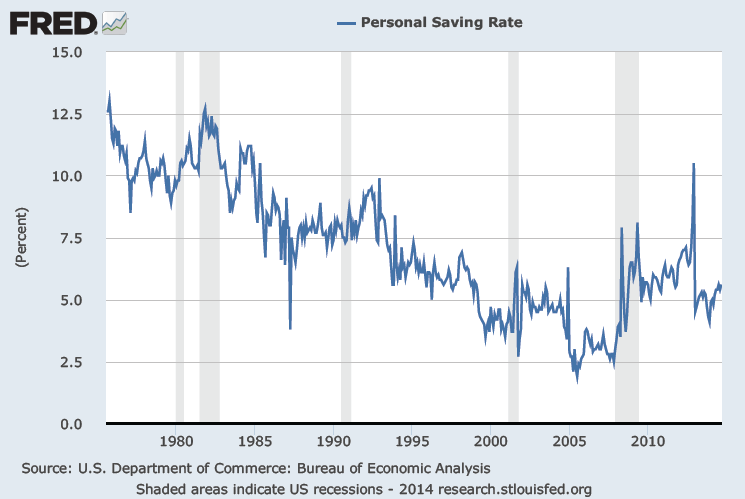
The “oil tax cut†is well documented as U.S. gasoline prices have dropped more than 20% since June. However, retailers have not benefitted much so far. The surprise here could be a rise in the savings rate rather than in expenditures. The elusive savings rate could be on a rising trend if consumers elect to continue deleveraging. The aging of the population also contributes to a secular rise in the savings rate. This would restrain consumers’ contribution to GDP growth. It will be interesting to see how consumers spend the “oil tax cut†during the coming important Holidays season.
Admittedly, economics have not worked in their most traditional ways in this recovery. Low labor participation rates continue to puzzle everybody while demand for housing is not behaving “naturallyâ€. It would appear that lots of things have changed in the last decade, starting with an aging population and ending with a younger generation displaying much different habits and values than preceding ones.
Hence the need to take into account the new unknown knowns, if you can follow me. Normally, accelerating employment and nominal wages combined with low inflation, declining gas prices, historically low interest rates and almost record high consumer confidence would have translated into a swift spending response from consumers. Not to mention a roaring stock market!
During the last 6 months, real consumer expenditures have risen at a paltry 1.2% annualized rate, car sales have flattened and single-family housing starts have remained very depressed. I don’t really know what “new normal†is but I sure see this as abnormal behaviours given the overall economic and financial environment.
Remarkably, this unpredictable consumer is now said to be the only solid basis for the U.S. economy…So much for rising P/Es from already elevated levels.
How about profits?
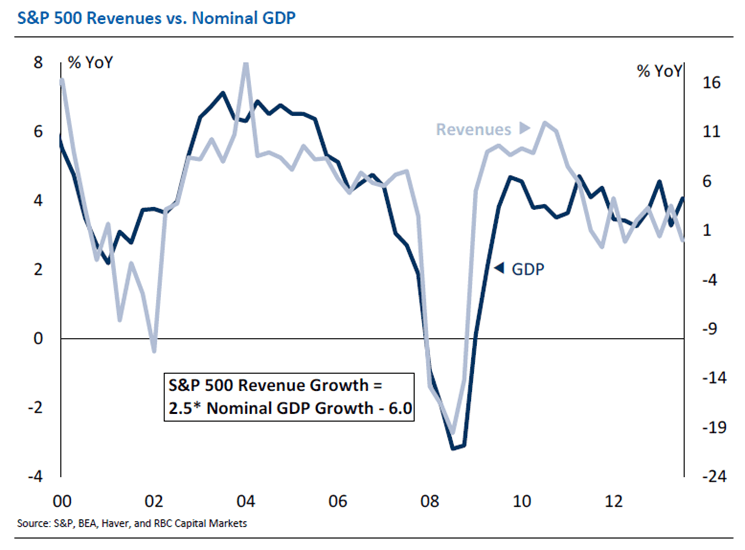 RBC Capital calculates that revenue growth for the S&P 500 Index is (2.5 x Nominal GDP Growth) – 6.0). Nominal GDP growth was 3.9% last quarter, the average since 2011. If we assume the same for the next year, revenues should grow 3.7%. Coincidentally, revenues have grown 3.9% on average in the past 3 years and in the last 12 months with +4.0% estimated for Q3.
Meanwhile the GDP deflator has deflated from the +2.0% range in 2011 to +1.5% in the last 6 months. Nothing really suggests any acceleration over the foreseeable future, meaning that the inflation backwind will ease a little in coming quarters, making the 3.9% revenue growth forecast on the high side.
Labor costs are on an accelerating path: on a trailing 4-quarter basis, the Employment Cost Index is up from +1.4% YoY in early 2010 to +1.9% recently and +2.2% YoY in Q3. With private employment now growing by more than 2% YoY, the corporate wage bill is growing by 4%+ which will make it very challenging for U.S. corporations to increase operating margins in the next year if revenues grow less than 4%.
In this vein, growth in corporate profits should theoretically not exceed 4% in 2015, a far cry from the current 14% growth expected by sell-side analysts.
This lonesome cowboy will more than likely remain reasonably healthy but, given its sick trading partners, the fragility of its well-being has increased. Its financial outlook is more vulnerable in this highly uncertain and volatile world with many known unknowns and swelling unknown unknowns. Overall, the environment does not strike me as being conducive to higher earnings multiples.
Accordingly, the likely ebb and flow in investors confidence and expectations will result in ups and downs in P/E multiples with the 20 in the Rule of 20 P/E acting as the top of the range and 16.0-16.5 being the low end, much like what we experienced since 2010. The current upside is thus around 2175, up 6.6% from current levels. Downside is around 1700 (16.0 – 1.5 inflation x 117), 16.7% lower.
The risk/reward ratio is not equitable to investors. It is therefore better to play safe and wait for either a better risk/reward ratio or an improved narrative. Discipline and patience are true virtues in what will likely be a volatile environment.