Markit sees “weaker new business growth” while the ISM survey’s “New Orders Index registered 65.8 percent, an increase of 5.8 percentage points from the 60 percent reading in September.” It seems that Markit’s survey covers more small and mid-size companies than the ISM.
October data highlighted a slowdown in the ongoing U.S. manufacturing sector recovery, with output and new business growth both moderating during the latest survey period. Manufacturers pointed to a weaker contribution from export sales in October, but job creation remained resilient. Meanwhile, input cost inflation was the weakest since April and factory gate charges rose at a slower pace.
The seasonally adjusted final Markit U.S. Manufacturing PMI posted 55.9 in October, to remain well above the neutral 50.0 threshold. However, the headline index dropped from 57.5 in September and signalled the slowest overall improvement in business conditions for three months.
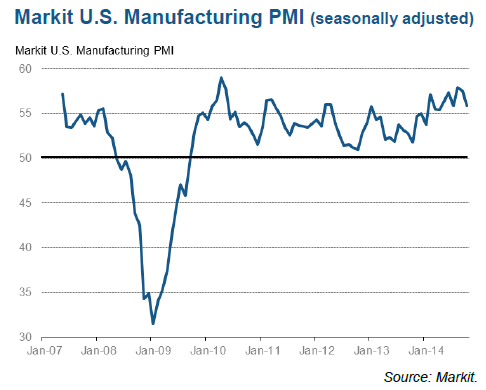
Weaker new business growth was the main factor weighing on the headline PMI in October. Although still strong in the context of the survey history, the latest expansion of new orders was the least marked since January (when sales were suppressed by adverse weather conditions). Softer new business growth in part reflected a subdued contribution from export sales. Latest data highlighted only a marginal rise in new work from abroad, and the rate of expansion was the slowest for three months.
Output growth moderated to a seven-month low in October, but was still stronger than the post-crisis trend. Weaker new business gains also contributed to the slowest increase in backlogs of work across the manufacturing sector since January.
Robust job creation continued in October, with the rate of employment growth remaining close to September’s recent peak. Survey respondents generally linked staff hiring to rising business investment, confidence towards the economic outlook and the launch of new products at their units.
Some manufacturers responded to weaker new business gains by adopting more cautious input buying policies in October. The latest rise in purchasing activity was the least marked since March, but pre-production inventories continued to increase at a solid pace.
Latest data highlighted a sharp moderation in input cost inflation, which some firms linked to lower commodity prices on world markets. Meanwhile, factory gate charges rose at the slowest rate for four months in October.
October data highlighted that large manufacturers (500+ employees) experienced the fastest overall improvement in business conditions, supported by the strongest rise in new orders since March. However, large manufactures indicated a moderation in job creation during the latest survey period, which contrasted with sharper payroll growth among small and medium sized manufacturers.
Consumer goods producers registered the most marked upturn in overall business conditions in October, and this market group bucked the overall slowdown in growth over the month. Meanwhile, investment goods producers were saw the weakest gains in new business and output volumes in October.
THE ISM:
The October PMI® registered 59 percent, an increase of 2.4 percentage points from September’s reading of 56.6 percent, indicating continued expansion in manufacturing. The New Orders Index registered 65.8 percent, an increase of 5.8 percentage points from the 60 percent reading in September, indicating growth in new orders for the 17th consecutive month. The Production Index registered 64.8 percent, 0.2 percentage point above the September reading of 64.6 percent. The Employment Index grew for the 16th consecutive month, registering 55.5 percent, an increase of 0.9 percentage point above the September reading of 54.6 percent. Inventories of raw materials registered 52.5 percent, an increase of 1 percentage point from the September reading of 51.5 percent, indicating growth in inventories for the third consecutive month. Comments from the panel generally cite positive business conditions, with growth in demand and production volumes.
Of the 18 manufacturing industries, 16 are reporting growth in October in the following order: Plastics & Rubber Products; Textile Mills; Fabricated Metal Products; Miscellaneous Manufacturing; Primary Metals; Electrical Equipment, Appliances & Components; Nonmetallic Mineral Products; Food, Beverage & Tobacco Products; Chemical Products; Apparel, Leather & Allied Products; Printing & Related Support Activities; Transportation Equipment; Furniture & Related Products; Paper Products; Machinery; and Computer & Electronic Products. The only industry reporting contraction in October is Petroleum & Coal Products.