Today: Slack no more? China slacking. Europe slacked.
Big Slack Attack
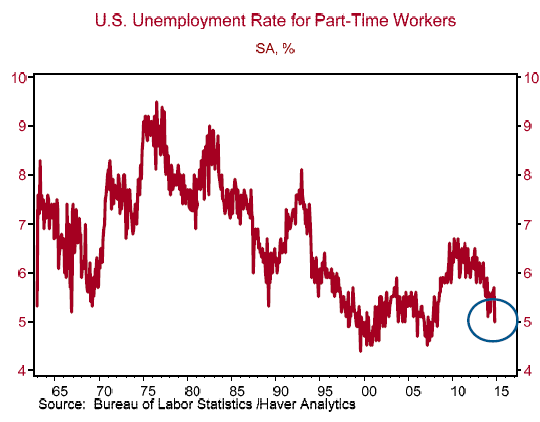
Given rapid job gains this year (2¼ million), the Fed no longer thinks there is significant slack in labour markets. Two points of evidence: The unemployment rate for fulltime workers (5.9% in October) has now slipped below its long-run average (6.0%). Moreover, the jobless rate for part-time workers has dipped to 5.0%, well below its long-run norm (6.6%). Not only are more people finding work, but more are getting full-time hours. That’s good news for income/spending, but it also means the labour market is losing an important source of inflation-dampening slack. (BMO Capital)
Meanwhile, the Fed is working on its communications:
- Fed’s Fisher Says Delay in Raising U.S. Interest Rates Could Cause Recession
- Rosengren: Fed Should Remain ‘Patient’ on Rates Until Inflation Begins to Rise
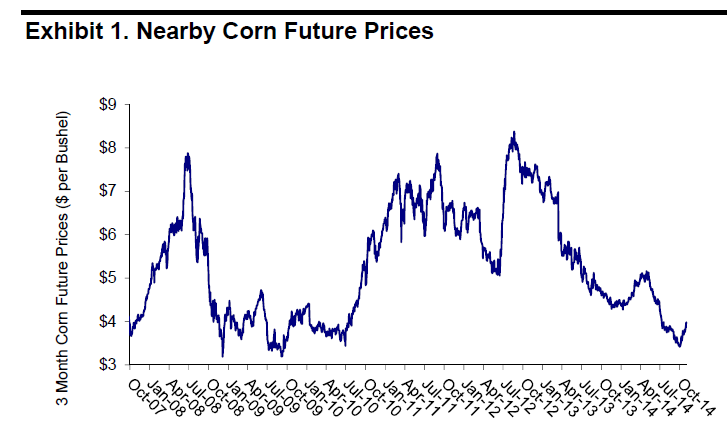
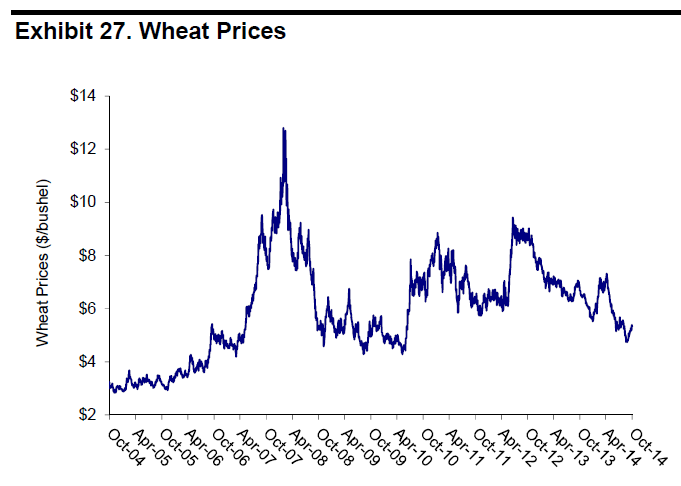
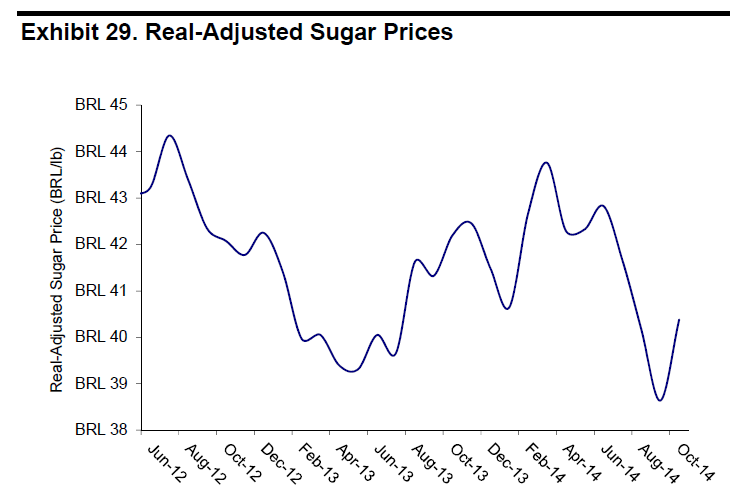
U.S. inflation not about to come from energy, nor food (charts from BMO Capital)
Three Signals China’s Policy Makers Will Keep Stimulus Limited
Will weak growth force China to accelerate easing or are policy makers determined to hold the line with limited stimulus? Three recent signs from Beijing suggest the latter.
First, speaking at the APEC summit over the weekend, President Xi Jinping hinted at readiness to accept slower GDP growth as preferable to overblown stimulus. Xi said that 7 percent growth would still place China among the world’s fastest-growing economies.
(…) the PBOC’s third-quarter monetary policy report, published last week, emphasizes that M2 growth and stock still remain high. M2 growth was 4.4 percentage points higher than growth in nominal GDP in the first three quarters in 2014, while stock reached about 200 percent of GDP.
Concern about rapid growth in M2 implies that the central bank doesn’t plan to introduce broad-based monetary easing. It also signals that the PBOC may
continue to curb shadow-bank lending. (…)
SENTIMENT WATCH
The WSJ’s Paul Vigna has the narrative of the season in today’s Breakfast Briefing:
The U.S. stocks have righted themselves after a shaky October. The slow growth afflicting major economies around the globe hasn’t gone away. But it is no longer weighing on U.S. markets as it was in October.
In the U.S., there is economic growth, and there is profit growth. The slow growth in the rest of the world is now seen as a positive for the U.S. by some investors. That picture may change dramatically once the Fed starts raising rates, but for now there’s no question any more about which house is the best in the neighborhood. (…)
In China, growth is slower than projected. Japan is attempting a massive reflation that may or may not work. Germany is watching the rest of Europe slide into a third recession, and France “is quickly becoming a basket case in economic terms,” Mr. Kotok said. This leaves the U.S. to shoulder the growth mantle, as well support as the speculator set.
“All this means inflows into the U.S. in both stocks and bonds,” he wrote. The dollar will continue to strengthen, and other assets will rally as well. “Just add to that a possible repatriation-tax-code change, and the U.S. markets could soar.”
Randy Frederick, managing director of trading and derivatives at the Schwab Center for Financial Research, echoed that sentiment. “With the usual very low expectations for the lame duck session in place for the rest of 2014 and no threat of higher interest rates for at least four or five months, the U.S. should be able to remain decoupled from the problems in Europe and remain the investing location of choice for at least the next couple of months,” he wrote.
The last two weeks have seen more pouring into domestic equity funds (though ETFs far outpace mutual funds), according to Lipper. “The recent rally in stocks has been accompanied by surging flows into U.S. stock funds,” Russ Koesterick, BlackRock’s global chief investment strategist, pointed out. He doesn’t see that changing. “For now, we continue to expect both stocks and the dollar to continue their rise.”
 Wait, wait! This may not be a stock market, rather a market of stocks:
October jitters are just a taste of things to come
(…) Equity markets have also been difficult for stock pickers to call correctly, despite record levels. Many hedge funds are suffering. Omega Advisers, among the underperformers, pointed out in a letter to its investors that one problem was that “very few sectors and an unusually small number of individual stocks have accounted for the bulk of the S&P 500’s return”.
The letter added that the 10 biggest contributors to that return, with just over 14 per cent of the index, generated more than 44 per cent of the total return for the first 9 months of the year. (The top five included Apple, Gilead, Microsoft, Berkshire and Johnson & Johnson.) Cyclical stocks underperformed relative to defensive blue-chips, the letter added. This does not sound like a market anticipating a broad recovery. (…)
 Meanwhile:
Germany Says Ukraine Risks Return to Conflict With Rebels Ukraine risks sliding back into fighting between government troops and separatist rebels, German Foreign Minister Frank-Walter Steinmeier warned.
GOOD STUFF:
International Investment in Europe May Be a Canary in the Coal Mine
Another good article in today’s BloombergBriefs. This one is from Michael Gestrin, a senior economist in the investment division of the Organisation for Economic Cooperation and Development.
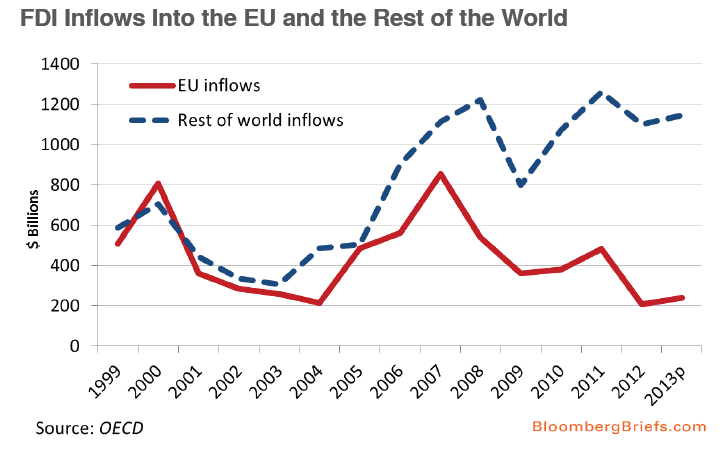
The FDI crisis in Europe has been broad based, with the bulk of the declines in FDI flows concentrated in the largest economies. France, Germany and the U.K. accounted for 50 percent of the $600 billion decline in FDI inflows between 2007 and 2013. (…) With respect to outflows, France, Germany and the U.K. accounted for 59 percent of the $1 trillion decline between 2007 and 2013. (…)
The decline in Europe’s international investment performance started well before the crisis and continued even as international investment in the rest of the world began to recover. In an imaginary world without the EU, global investment flows had fully recovered and were setting new records already in 2010. (…)
Europe seems to be confronting a competitiveness puzzle in which declining competitiveness is discouraging investment, and declining investment is in turn undermining competitiveness. This cycle can only be broken through structural reforms, including policies to ease excessive product-market regulation. (…)
 How Do You Recognize Revenue on a Magic Wand?
It may be bad for a mobile-game maker’s business if players don’t stick with its games for long, but, because of accounting rules for virtual goods, it can drive revenue higher in the short term, CFO Journal reports. Anticipating when players will lose interest is an essential part of recording revenue in the industry, where the sale of “virtual durable goods,” such as cows and tractors in “FarmVille” or cannons and dark barracks in “Clash of Clans,” is a major source of income. (Just ask thisSlate columnist, who was shocked to find himself spending “real money” in one.)
When game companies like Zynga Inc. or King Digital Entertainment PLC change their assumptions, it can skew their short-term results. Some virtual goods, like potions or spells, are good for a single use so accounted for as a one-time sale, but virtual durable goods that are continuously available to a player, like a tractor, are accounted for like services or club memberships. Companies book part of the payment upfront, but defer the rest until the average period in which the item will be used.
The Securities and Exchange Commission has sent more than two dozen letters to the companies since 2010, asking them to explain how they come up with their estimates on length of use of the virtual durable goods. Game makers say they base their estimates on historical data, but that the playing periods can change substantially each year. That could make for some roller-coaster accounting—and revenue shifts to go with it.