Today: China slows down some more. U.S. energy production does not. Record S&P 500 Masks 47% of Nasdaq Mired in Bear Market. Earnings. Sentiment, sentiment!
China Industrial Production Growth Slumps to Six-Year Low
Value-added industrial output grew by 6.9% in August year-over-year, down from the 9.0% level in July, the National Bureau of Statistics said Saturday. It is the weakest growth seen since December 2008.
Fixed-asset investment in nonrural China rose 16.5% year-over-year in the January-August period, slower than the 17.0% increase recorded during January-July.
Retail sales expanded 11.9% year-over-year last month, down from the 12.2% year-over-year level in July.
And the real-estate industry continued to slump despite moves by more than 30 cities to relax purchase restrictions, with housing sales declining during the first eight months of 2014 by 10.9% to 3.43 trillion yuan ($559 billion) as developers fought bulging inventories, reluctant lenders and fickle buyers.
BTW, August Electricity output fell 2.2 percent, the first decline since May 2009 excluding January and February data.
Li’s Options Narrow as China Growth Slowdown Deepens
(…) The slowdown in August economic data that included a second straight decline in imports and a 40 percent drop in the broadest measure of new credit will test Li’s resolve to avoid stronger monetary stimulus to meet his 7.5 percent goal. (…)
A central bank report last week showed aggregate financing fell to 957.4 billion yuan ($156 billion) in August from 1.58 trillion yuan a year earlier. (…)
In a speech at the World Economic Forum in the northern Chinese city of Tianjin last week, Li said the government won’t be distracted by short-term fluctuations in individual economic indicators and will maintain its focus on structural adjustments and dealing with long-term issues.
Growth slightly higher or lower than the 2014 target of 7.5 percent is acceptable as long as employment, incomes and environmental protection improve, he said. (…)
Fracking Gives U.S. Energy Boom Plenty of Room to Run Current Top Gas Well Produces Five Times as Much as Record Setter a Decade Ago
Skeptics of the U.S. energy boom say it can’t last much longer because it requires drilling an ever-increasing number of wells.
But the boom already has lasted longer than anyone would have imagined just a decade ago and has more room to run. That’s because oil and natural-gas wells have become more productive—an unrecognized but potent trend that should keep the fuels flowing. (…)

The U.S. oil-and-gas industry no longer spends its time trying to find new shale formations to tap. Instead, it focuses on finding ways to get more out of the formations it has found. And it is succeeding. (…)
Of course, bigger and better wells come with bigger price tags, leaving drillers more vulnerable to falling energy prices.(…)
Lynn Westfall, the EIA’s director of energy markets and financial analysis, points out that the rig count in South Texas’ Eagle Ford Shale “has not changed since 2012, but the production per new well has doubled.”
Innovation makes the difference. The federal government recently predicted that oil production would rise through 2019 and then flatten off. But a second scenario in the report assumed that extraction technology would continue to improve, leading crude output to rise through 2040, if not longer.
The recent history of oil wells productivity is similar to that of gas wells. (…)
Europe Braces for Energy Shortages
Austria’s energy regulator E-Control and oil and gas company OMV AG OMV.VI -1.11%both said on Friday that gas shipments from Russia were down 15% from previously ordered volumes.
The decline in supplies to Austria began Thursday and was expected to continue through Friday, said Robert Lechner, of OMV’s press office.
“Until now we are not aware of the specific reasons for this,” Mr. Lechner said. (…)
Russia’s state-owned gas company Gazprom GAZP.RS -1.67% said on Wednesday it was supplying the amounts of gas that was available while pumping gas into storage facilities in Russia.
Russia supplies around 30% of the continent’s gas needs, half of which transits via Ukraine.
Several Eastern European countries depend heavily on Russian gas. Russia supplies 80% of Hungary’s gas needs, 89% of Bulgaria’s and 100% of requirements in Finland and Baltic states Lithuania, Latvia and Estonia, for example, according to gas industry group Eurogas. (…)
US targets Gazprom in new sanctions
(…) The latest measures targeting energy, financial services and defence industries also included Lukoil, the privately owned oil group, and Sberbank, Russia’s largest bank.
The new sanctions go much further than previous moves to punish Russia for its role in the eastern Ukraine insurgency by widening the number of companies targeted. In addition to blocking most major state-owned groups from western capital markets, the US has also tightened restrictions on some of Russia’s largest energy projects, a key engine of its future economic growth. (…)
 OECD Cuts Growth Forecasts The Organization for Economic Cooperation and Development lowered its growth forecasts for the U.S. and other large developed economies, and said the continued weakness of the recovery demonstrated the need for significant changes in economic policy.
SENTIMENT WATCH
Resurgent U.S. Dollar Fuels Rally The dollar has logged its longest winning streak in 17 years, bolstering global demand for U.S. stocks and bonds.
The dollar has logged its longest winning streak in more than 17 years, rising against a broad basket of currencies for nine straight weeks, according to the ICE U.S. Dollar Index.
The gains reflect investor expectations that the Federal Reserve next year will raise its fed-funds rate for the first time since 2006, while central bankers in Europe and Japan will seek to spur stagnant economies by holding down interest rates and adopting other easy-money policies. (…)
A rising dollar often creates a virtuous circle for the U.S. economy. Dollar gains signal a perception of economic health. Also, by making imports including oil cheaper, they can boost U.S. growth by increasing consumer spending power. (…)
A stronger dollar isn’t a pana cea. It makes U.S. goods more expensive abroad, likely slowing the growth of U.S. exports such as automobiles, car parts and capital goods, and putting pressure on the trade deficit. A smaller trade deficit generally helps the economy over the long term because it means a growing share of money in the U.S. is being spent on goods and services domestically rather than abroad. (…)
What “bolstering global demand for U.S. stocks”? In fact, U.S. equities keep being swapped for global equities as these ISI charts show:
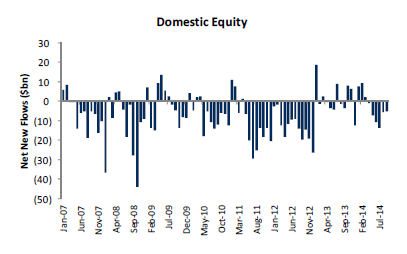
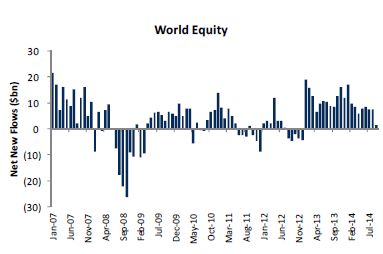
And these forecasts:
-
 Bank of America, J.P. Morgan Move Forward Fed Forecasts Two major banks said Friday that they now believe the Federal Reserve is likely to increase short-term interest rates sooner than they had previously expected.
 -
Fewer Economists See Fed Rate Hikes Starting Before Next Summer Fewer economists expect the Federal Reserve will begin raising interest rates early next year, according to a survey by The Wall Street Journal in recent days, after the Labor Department released a disappointing August employment report.
Stock-Market Bears Turn Docile
(…) For some investors, the disappearance of negative views is cause for concern. They worry that with bulls so dominant, whenever any shocks do hit, the damage could be much worse than if there were more skeptical investors around.
But a healthier U.S. economy, solid corporate profits and low interest rates have persuaded many bearish analysts that a major pullback for stocks isn’t in the cards at least well into next year. (…)
A Scary World, but Investors Trust the Fed The world is a scary place for investors amid global turmoil. But Investors widely believe the Federal Reserve and other central banks will do what it takes to keep economies and financial markets healthy.
(…) The most common explanation is that, five years into the economic recovery, money managers have come to rely on the Federal Reserve and other central banks to keep financial conditions favorable.
“Policy makers globally are still providing substantial support to financial markets,” noted Krishna Memani, chief investment officer at OppenheimerFunds Inc., which oversees $251 billion in New York. (…)
Still, Mr. Trennert, too, said he expects stocks to move higher, “simply because there is a paucity of other alternatives.” British Prime Minister Margaret Thatcher defended free markets by saying, “there is no alternative.” Mr. Trennert says the same “Tina” rule applies to the stock market today. (…)
The “TINA” rule? Beware! When Tina is the only reason you buy…
 Record S&P 500 Masks 47% of Nasdaq Mired in Bear Market
About 47 percent of stocks in the Nasdaq Composite (CCMP) Index are down at least 20 percent from their peak in the last 12 months while more than 40 percent have fallen that much in the Russell 2000 Index and the Bloomberg IPO Index. That contrasts with the Standard & Poor’s 500 Index (SPX), which has closed at new highs 33 times in 2014 and where less than 6 percent of companies are in bear markets, data compiled by Bloomberg show. (…)
The proportion of technology companies, small-caps and newly listed stocks stuck in their own personal bear markets has risen from 30 percent in March 2013, when the overall equity market surpassed its 2007 record. S&P 500 stocks with at least 20 percent losses have fallen since then, the data show. (…)
 Please, read this:
Venture Capitalist Sounds Alarm on Startup Investing Silicon Valley Has Taken on Too Much Risk, Gurley Says
“I think that Silicon Valley as a whole, or that the venture-capital community or startup community, is taking on an excessive amount of risk right now—unprecedented since ’99,” said Bill Gurley, a partner at Benchmark, referring to the last tech bubble. (…)
Do people discount risk? Right now you’ve got private companies raising $200, $400, $500 million. If you’re in a competitive ecosystem and you raise that amount of money, the only way you use it—because these companies are all human-based, they’re not like building stores—is to take your burn up.
And I guarantee you two things: One, the average burn rate at the average venture-backed company in Silicon Valley is at an all-time high since ’99 and maybe in many industries higher than in ’99. And two, more humans in Silicon Valley are working for money-losing companies than have been in 15 years, and that’s a form of discounted risk.
In ’01 or ’09, you just wouldn’t go take a job at a company that’s burning $4 million a month. Today everyone does it without thinking.
(…) you just slowly forget, and half of the entrepreneurs today, or maybe more—60% or 70%—weren’t around in ’99, so they have no muscle memory whatsoever.
So risk just keeps going higher, higher and higher. The problem is that because you get there slowly the correcting is really hard and catastrophic. Right now, the cost of capital is super low here. If the environment were to change dramatically, the types of gymnastics that it would require companies to readjust their spend is massive. So I worry about it constantly. (…)
In the software-as-a-service world, where the risk is potentially among the highest, Wall Street has said it’s OK to lose tons of money as a public company. So what happens in the board rooms of all the private companies is they say, “Did you see that? Did you see they went out and they’re losing tons of money and they’re worth a billion. We should spend more money.” And there are people knocking on their door saying, “Do you want more money, do you want more money?” (…)
Scott Grannis tracks the decline in risk aversion
Risk aversion is still to be found (e.g., huge increases in bank savings deposits, zero yields on 3-mo. T-bills), but it is declining. Confidence, the flip side of risk aversion, is slowly rebuilding, but it is still relatively low.

The graph above speaks directly to the existence of declining risk aversion. It shows the price of gold and the inverse of the real yield on 5-yr TIPS (a proxy for the price of TIPS). Both gold and TIPS are refuges for those who worry about inflation and end-of-the-world scenarios, so their prices reflect the intensity of the world’s demand for safety. Gold prices maxed out at $1900/oz. a few years ago, which was roughly triple the average inflation-adjusted value of gold over the past century (now THAT’s what I call paying a premium). TIPS prices maxed out at a negative real yield of almost 2% early last year, which meant that investors were willing to give up almost 2% of their annual purchasing power in order to capture the U.S. government-guaranteed, inflation-hedging properties of TIPS. In short, people were paying ridiculous prices to minimize risk. But that’s changing.

It sure is changing. Here’s what is to be read in Barron’s web site front page this week:
-
The New American Express As AmEx expands its credit-card franchise, profits could rise at a double-digit rate, lifting the stock nearly 30%.
-
Jackpot for Alibaba Alibaba could be the hottest deal of the year when the company comes public this week. Shares could pop 20% and rise from there.
-
Lam Research Could Return 20% in a Year Lam is gaining share in semiconductor equipment at a time when chip makers must invest to stay competitive.
-
Ventas Shares Deserve an Upgrade An aging population and savvy deals helped turn Ventas into one of the nation’s largest senior health-care REITs. Plus, the stock has 25% upside.
You’ve got to give it to Barron’s. With these 5 stocks, you can almost end up with a reasonably well diversified portfolio: a financial, a consumer e-commerce with a China slant, a tech, a health-care REIT and a global consumer stock for timing (sorry). Pity however for all these other stocks likely to return a lousy 5-10%!
FYI, trailing 12-m EPS for the 500 S&P stocks are up only 12.7% Y/Y. One year ago, the gain was +0.7%.
EARNINGS WATCH
Oh yes! There’s this thing called profits:
S&P says earnings should reach $30.33 in Q3, up $0.20 from two weeks ago and +12.7% Y/Y and $32.34, up $0.05 and +14.4% Y/Y. If so, trailing 12-m EPS will rise 3% after Q3 and another 3.5% after Q4.
However, It seems that S&P is a little behind the ball on earnings revisions as Factset found that
The estimated earnings growth rate for Q3 2014 of 6.2% is below the estimate of 8.9% at the start of the quarter (June 30). Nine of the ten sectors have recorded a decline in expected earnings growth since the beginning of the quarter due to downward revisions to earnings estimates, led by the Energy and Consumer Discretionary sectors. The only sector that has recorded an increase in expected earnings growth since the start of the quarter is the Health Care sector.
The Energy sector has witnessed the largest dip in expected earnings growth (to 4.2% from 11.7%) since the start of the quarter.
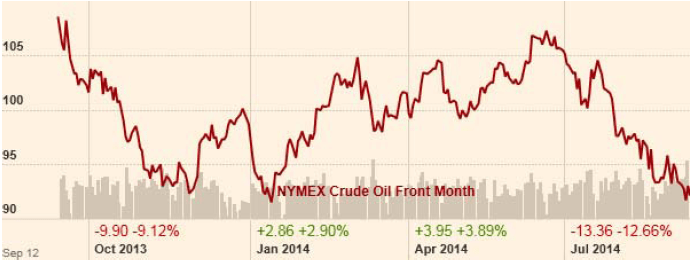
The percentage decline in the Q3 bottom-up EPS estimate (which is an aggregation of the earnings estimates for all 500 companies in the index and can be used as a proxy for the earnings for the index) was 2.3% over the first two months of the quarter. This decline in the EPS estimate was equal to the trailing 1-year average (-2.3%), above the trailing 5-year average (-1.4%), but below the trailing 10- year (-3.1%) average for the first two months of a quarter.
At this point in time, 103 companies in the index have issued EPS guidance for the third quarter. Of these 103 companies, 77 have issued negative EPS guidance and 26 have issued positive EPS guidance. Thus, the percentage of companies issuing negative EPS guidance to date for the third quarter is 75%. This percentage is above than the 5-year average of 66%.
Note that this percentage is roughly in line with that of the previous quarter at the same time and substantially lower than that of the 2013-14 period.
 (Tks for that Gary)
Words of wisdom from Howard Marks:
Today I feel it’s important to pay more attention to loss prevention than to the pursuit of gain. Although I have no idea what could make the day of reckoning come sooner rather than later, I don’t think it’s too early to take today’s carefree market conditions into consideration. What I do know is that those conditions are creating a degree of risk for which there is no commensurate risk premium