Today: IP weakening. Retail sales weakish. China weaker.
Industrial Production Slips 0.1% U.S. industrial production slipped in October, a sign domestic economic growth could slow further in the final months of 2014.
It followed a downwardly revised gain of 0.8% in September, which had initially been reported as a 1% increase.
Capacity utilization, a measure of slack in the industrial sector, decreased to 78.9% in October from September’s revised reading of 79.2%.
Manufacturing output, the largest component of the overall production figure, advanced 0.2% in October. September’s gain was revised down to a 0.2% advance, from previously reported 0.5% increase. The gains come after an August decline.
Auto production was a major factor. The index for motor vehicles and parts manufacturing fell 1.2% last month, the third straight monthly decline. But output of machinery, chemicals and plastics all increased in October.
I had warned on auto production which will decline throughout Q4. IP rose 0.5% in the last 3 months but really only because of utility output rising 4.2% in September. Last 3 months at annualized rates:
- Manufacturing: –0.4%
- Consumer Goods: –3.2%
- Business Equipment: –0.4%
- Construction Supplies: +2.4%
This Could Be The Biggest Holiday Shopping Season America Has Ever Seen
Deutsche Bank’s Torsten Slok thinks this could be the best ever holiday season for retail sales.
Sloks points to recent labor market data. Because hiring for the holiday season is generally done in October, it can be a good way to predict how retailers are feeling about sales for the final quarter of the year.
This particular chart, sent out in a research note this morning, comes from adding together employment growth in eight different retail sectors: furniture, electronics, personal care, clothing, sporting goods, general merchandise stores, miscellaneous store retailers (e.g., florists, office supply stores, gift shops, and pet shops), and non-store retailers (e.g., online shopping and mail-order houses, vending machine operators, and direct store establishments).
Last year, retail sales rose 2.7% over 2012 numbers.

 If not, it will be the worst Christmas for retail margins…FYI, real retail sales were up only 2% YoY during Christmas 1996 and 1997. Sales were pretty strong in 1999 but cratered in 2000. Christmas 2004 was good but 2006 was pretty weak. Don’t hang your hat on this “indicator”.
BTW:
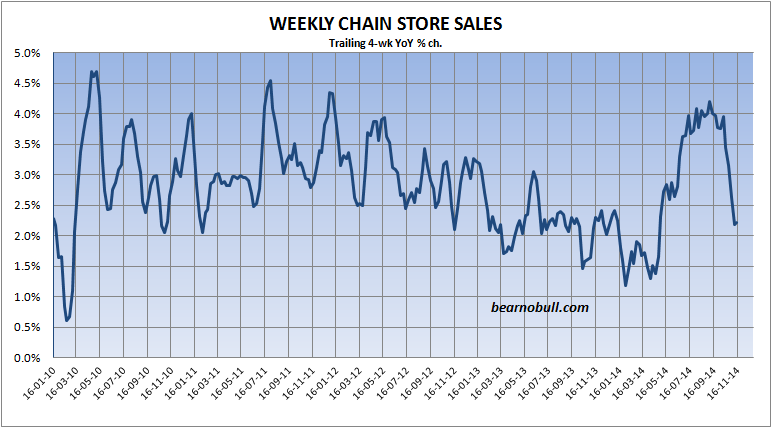
Weekly chain store sales up “only” 0.2% last week, “only” 2.2% YoY.
No momentum towards Thanksgiving so far.
EU Car Sales Gain Pace
New car registrations, a mirror of car sales, rose 6.5% to 1.07 million vehicles in October, the strongest monthly increase since March, when sales rose 10.6% and the strongest October since 2009, according to the European Automobile Manufacturers’ Association, known by its French initials ACEA. Car sales rose 6.1% to 10.6 million vehicles in the 10 months to October.
October marked the 14th month of consecutive growth in car sales, with all major markets posting gains except France, where new registrations slipped 3.8% in October from a year earlier.
China house prices fall for second month
Chinese home prices fell for a second straight month in October, registering the steepest annual drop since the current data series began in 2011.
Nationwide residential property prices fell an average of 2.5 per cent from a year earlier in October, according to Financial Times calculations based on the official data.
But prices fell only 0.8 per cent on a monthly basis, the smallest such decline since June. That follows data last week showing sales volume fell only 1.3 per cent in floor area terms in October, much slower than the 10.3 per cent decline in September.
“prices fell only 0.8% MoM”! Good grief…
Meanwhile, China electricity consumption rose 3.1% YoY in October after +2.7% in September. YTD consumption is up 3.8%, vs +7.3% in 2013, +5.5% in 2012 and +12.0% in 2011.
That deserves an “only 3.1%” for an economy supposed to grow 7.5%.
Shale Drillers Keep Output High Despite Oil Price Decline
(…) New wells are being drilled faster and are pumping more oil. The same thing happened before the 2012 natural gas bust, when prices fell to the lowest in a decade. The improvements make the rig count a less reliable measure of future growth. InNorth Dakota’s Bakken, for example, 191 rigs will add 104,000 barrels a day in December, double the gains made three years ago, according to the EIA. (…)
Falling Commodity Prices Hit Malaysia
(…) Unlike other Asian economies, which are commodity importers and are set to benefit from the decline in global commodity prices through lower inflation, Malaysia relies on exports of oil, palm oil and rubber.
Investors pulled $2.5 billion out of Malaysian stocks and bonds in the last month, making it the only emerging Asian country to see outflows. The Malaysian ringgit is one of the worst performing currencies in the region, falling to a four-year low Monday against the U.S. dollar.
Malaysia’s economy has been among the stronger performers in Asia, helped by exports and robust local demand.
But the sliding oil price has changed the picture somewhat. Poor data Friday confirmed investors’ worries about the economy and currency. Malaysia’s current account surplus, a measure of trade in goods, investments and services, fell 53% in the third quarter from the previous quarter, driven by weak exports. Economic growth was 5.6% in the period, still solid but down from 6.5% in the previous quarter. (…)
Globally, Malaysia ranks among the largest producers of rubber and palm oil, which is used in products from lipsticks and biscuits to transport fuel. Prices of these commodities also have tanked recently, hitting five-year lows in September.
Natural rubber prices are down almost 25% this year, while palm oil prices are down close to 16%.(…)
Given Malaysia’s high reliance on petroleum for revenue, Credit Suisse estimate falling oil prices could shave off up to 0.8% from gross domestic product in 2015. Goldman Sachs says the net oil exporter could see its trade balance decline by about 1% of GDP.
Malaysia’s government derives close to 30% of its revenues from the oil and gas sector and Malaysia’s state-run oil and gas company, Petroliam Nasional Bhd or Petronas, is a major contributor to the government budget.
There are benefits to lower oil costs. The government subsidizes fuel costs, a drag on the budget, and is trying to reduce these programs by raising gas prices. Cheaper oil reduces this drag and makes it easier to cut back on subsidies without sparking inflation. (…)
Pressure on Malaysian assets could increase if the U.S. starts to raise interest rates, which is expected sometime in 2015. Malaysia is particularly sensitive to capital outflows as foreign investors hold close to 40% of its outstanding public debt, one of the highest ratios in the region. (…)
Deal Boom Feeds on Surging Stocks The most active mergers-and-acquisitions market in years sped into an even higher gear Monday, as companies took advantage of rising stock prices to announce more than $100 billion in takeover deals.
