Today: Housing Starts misfire. Household finances improving. Fed up, Fed down. Banks.
Jobless Claims at Second-Lowest Level in 14 Years The number of new applications for unemployment benefits dropped last week to near postrecession lows, the latest indication layoffs are trending sharply lower amid generally improving economic conditions.
U.S. Housing Starts Fall, but Broader Trends Look Solid August Tumble Masks Upward Trajectory Over Past Year
Housing starts during August slumped 14.4% to 956,000 AR (+8.0% y/y) following a 22.9% July jump to 1,117,000, revised from 1,093,000. The latest level missed expectations for 1,035,000 starts in the Action Economics Forecast Survey. Last month’s decline reflected a 31.7% slump (+16.8% y/y) in starts of multi-family homes following a sharp recovery in July. Starts of single-family homes fell 2.4% (+4.2% y/y) following an 11.1% July jump.
Starts in the West retreated 24.7% (+3.6% y/y) to 204,000 while starts in the Northeast were off 12.9% (+24.7% y/y) to 121,000. Starts in the South declined 10.9% (+7.5% y/y) to 474,000 while starts in the Midwest fell 10.3% (+4.7% y/y) to 157,000.
Building permits retreated 5.6% (+5.3% y/y) following an 8.6% rise. The decline was led by a 12.7% drop (+17.4% y/y) in multi-family permits. Permits to build single-family homes slipped 0.8% (-0.8% y/y), about the same as they did in July.

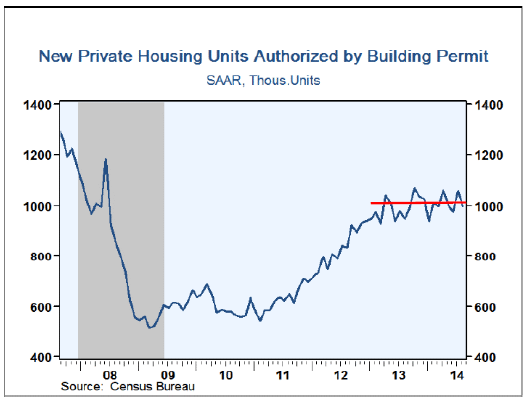
Do you see an “upward trajectory” in these charts? Only in builders confidence but why?
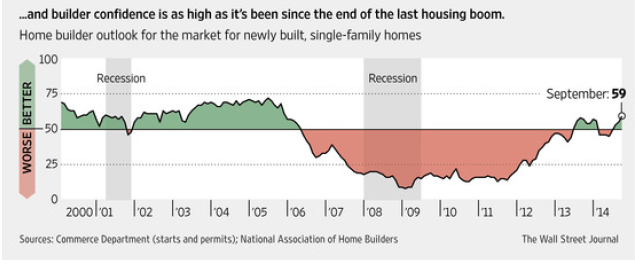
This CalculatedRisk chart may explain why? Better than last year. But last year was hurt by the sudden rise in mortgage rates. The fact remains that starts are showing no real uptrend.
Or it may be this chart from BloombergBriefs, giving some hope that the overall housing market is perking up:
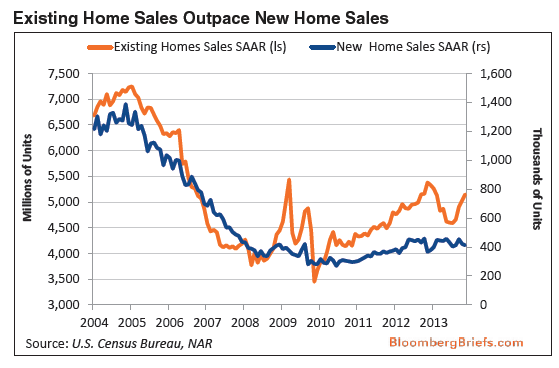
The long grind illustrated by CR:
Household Wealth Hits Record Consumer Borrowing Climbs at Fastest Pace Since the First Quarter of 2008
The net worth of U.S. households and nonprofit organizations—the value of homes, stocks and other assets minus debts and other liabilities—rose about $1.4 trillion between April and June to $81.5 trillion, the highest level on record, according to a report by the Federal Reserve released Thursday. The figures aren’t adjusted for inflation or population growth.
The value of stocks and mutual funds owned by households rose $1 trillion last quarter, Fed data show; the value of residential real estate grew a paltry $230 billion by comparison.
Overall household borrowing rose at an annualized 3.6% pace in the second quarter, the fastest rate since the first quarter of 2008. Much of that was driven by a sharp increase in consumer credit, including student loans, which grew 8.1%, stronger than the previous quarter’s 6.5% pace. Even mortgage debt grew 0.4%, following two straight quarters of shrinking.
Outstanding credit-card debt rose 3% last quarter, to $839 billion, after falling the previous quarter. Auto-loan debt grew about 3%, to $919 billion.
Total U.S. household debt was about 107% of disposable income in the second quarter, down from 108% the previous quarter and well over 130% before the recession.


Wheat Falls to 4-Year Low as Demand Wanes Amid More Crops
Hollande rules out further spending cuts

 Bond markets clash with Fed on rates Focus moves from timing of first rate rise, to how fast they will rise
(…) Investors are being told via the statement that current near zero rate policy will remain in place for a ”considerable time” after quantitative easing concludes next month. The projections, however, indicate rate hikes will assume a faster pace once the central bank starts tightening. (…)
The FOMC’s median rate for the fed funds rate by the end of 2015 was raised to 1.375 per cent from 1.125 per cent, with the key overnight borrowing rate seen reaching 2.875 per cent, rather than 2.50 per cent by the end of 2016.
In contrast, the bond market expects a funds rate of 0.76 per cent by the end of 2015 and 1.82 per cent a year later. This stand-off between the FOMC and bond market for now acts as some restraint on the dollar’s bull trend, while also keeping equities in a comfort zone that rate hikes may not derail highflying stock prices. (…)

 Big Banks Poised to Ride Rising Rate Tide Banks may soon be able to exit the killing yields, leading to a long-awaited rise in net-interest margins.
Economic projections released after this week’s Federal Reserve meeting indicate policy setters now expect short-term interest rates to rise more rapidly than previously thought once the central bank finally begins to increase rates. Although this isn’t anticipated until sometime next year, that should improve the ability of the largest banks to earn greater profits on the difference between their cost of funding and lending rates, or their net interest margin. (…)
If rates finally rise, as expected, the process should be set to work in reverse. In a rising rate environment, income produced by floating-rate loans climbs. Short-duration securities held in portfolios also flip into higher rates. The biggest question is how quickly interest-bearing deposits will reprice and how rapidly balances shift from noninterest-bearing to interest-bearing accounts. That will determine how much space banks have to grow interest margins. (…)
A recent report from Goldman Sachs GS +1.66% adjusted disclosed exposures to make apples-to-apples comparisons. Assuming no changes to the asset-and-deposit mix, Goldman analysts see a 1% rise in rates across the curve would lead to a 0.19 percentage-point improvement in the net interest margin at J.P. Morgan, 0.17 at Wells Fargo, 0.11 at Bank of America and 0.10 at Citigroup.
Given the size of the banks’ balance sheets, such seemingly small shifts can have a big impact. In its latest securities filing, BofA, for example, said a one-percentage-point increase in rates across the yield curve would boost net interest income by $3.55 billion. (…)
Keep in mind, too, that a move from interest rates that have been this low for this long is unprecedented. At a conference in June, J.P. Morgan finance chief Marianne Lake argued deposits are likely to be more sensitive to rates paid than in the last interest rate cycle. That would constrain margin growth of net interest margins to lower levels than Goldman’s analysis indicates. (…)