Today: U.S. housing, China housing. Japan Watch.
U.S. Housing Starts Down 2.8%, but Single-Family Market Shows Strength
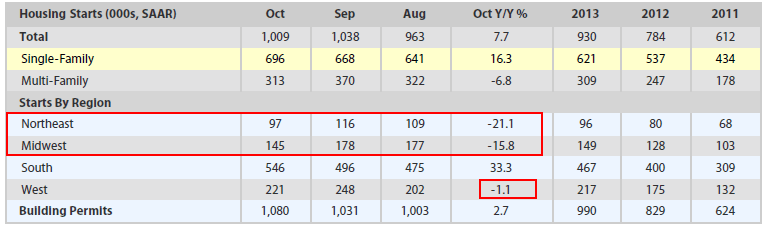
New construction on single-family units, roughly two-thirds of the market, rose 4.2% in October to reach its best pace since November 2013. Through the first 10 months of 2014, the number of single-family homes that builders started is up 5.3%, compared with the same period in 2013.

Building permits, a bellwether of future construction, increased 4.8% last month to a 1.08 million rate, the best pace since June 2008. The recent growth in permitting, however, has been driven by multifamily properties.
 That said, don’t think there is national recovery. It’s all happening in the South a this Haver Analytics chart reveals:
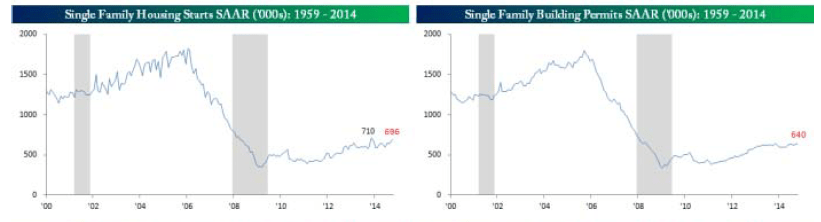
These longer-term charts from Bespoke Investment illustrate the very slow grind.
Could Decline in Median New-Home Size Herald Return of Entry-Level Buyers? Newly built, single-family homes in the U.S. finally are getting smaller, a sign that a long-awaited shift of builders to slightly smaller, more affordable homes likely has started.
Commerce Department data released Wednesday shows the median size of a single-family home built in the third quarter was 2,414 square feet, down 2.3% from the second quarter measure of 2,472.
The third-quarter figure is the lowest since 2012’s fourth quarter, and it is the second consecutive quarterly decline following a 0.2% drop in this year’s second quarter.

U.S. Mortgage Loan Applications Improve
The Mortgage Bankers Association reported that their total Mortgage Market Volume Index increased 4.9% last week (-13.3% y/y) to the highest level since the middle of last month. Applications to purchase a home jumped 11.7% (-6.7% y/y) to the highest level since July of last year. Refinancing applications gained 0.9% (-17.3% y/y).

CHINA HOUSING TURNING?
The decline in residential housing sales in October slowed from -10.3% last month to -1.6% Y/Y, with the absolute sales figure improving significantly. Boosted by the new mortgage policies issued on September 30 and the new housing provident fund policy which lowers home-buyers’ financing costs, the property market is returning to a market-driven system reflecting demand and supply dynamics.
Based on feedback from our survey respondents, we note that some banks are already offering a 5% discount to benchmark interest rates. Moreover, we expect availability of mortgage rates, which is closely correlated to consumers’ buying motivation, to continue to improve in the future. Since mortgage availability is improving and administrative rules are easing, the current round of sales recovery is set to be sustainable in Q4. (…)
Since inventory levels are high, developers are cautious toward making new investments even though sales have shown incipient signs of recovery. However, as sales pick up and developers’ willingness to purchase land rekindles, new starts volume will gradually increase in the future. (CEBM Research)
JAPAN WATCH
Nevermind Japan’s Recession Talk. Abenomics Is Working. If ever there were a contrarian indicator, it’s the fatalism ingrained in nearly all analysis of the Japanese economy. The fact is, there are reasons to believe Prime Minister Shinzo Abe’s stimulus and reform efforts are working.
(…) Surveys show household inflation expectations are rising, a sign that the BOJ’s monetary easing and the weak yen are breaking the back of deflation and ending the disincentive to save. There’s even hope for solutions to Japan’s aging society problem: Mr. Abe’s “womenomics” measures, for one, are creating incentives for women to join the work force, widening the productive base and offsetting the drag from retirees who leave it.
Meanwhile, Japanese companies are dispelling the myth of an inability to innovate and compete with low-cost producers in South Korea and China. Japan is leading the world in robotics, medical imaging, fuel cells and solar energy, for example.
What’s more, the recent slide in oil prices provides a de facto tax cut for an economy that’s highly dependent on imported fuel – a useful offset to April’s actual sales tax hike. (…)
Japan’s Exports Rise Most in 8 Months in Recovery Sign Japan’s exports rose the most in eight months in October, supporting an economy that fell into recession last quarter.
Overseas shipments rose 9.6 percent from a year earlier to the highest level since October 2008, the finance ministry said, compared with the median estimate for a 4.5 percent increase in a Bloomberg News survey. Imports grew 2.7 percent, leaving a trade deficit of 710 billion yen ($6 billion).
Export volumes climbed 3.8 percent from September to the highest since March last year, and the volume of imports was little changed. Exports of cars, ships and steel were some of the biggest contributors to the rise, with the value of motor vehicle shipments gaining 6.2 percent on increasing sales to the EU and Asia.
As Yen Slides, Investors Shun Other Asian Currencies Investors are shedding their holdings of Korean won, Singapore dollars and other Asian currencies, in a bet that the yen’s fall against the dollar will reverberate through the region’s foreign-exchange markets.
The yen has dropped 4.8% against the dollar since the Bank of Japan surprised markets by introducing new monetary-stimulus measures on Oct. 31.
Investors are wagering that central banks from South Korea to Thailand will allow their currencies to weaken to stay competitive.
Companies and government officials across Asia fear a weak yen will allow Japanese exporters to grab market share. The yen’s decline could also push Japanese companies to invest at home instead of overseas, where their money won’t go as far. (…)
“We will make efforts to stabilize the markets in case there are one-sided movements in the markets,” Bank of Korea Gov. Lee Ju-yeol said at a seminar in Seoul on Tuesday, commenting on the negative impact of the Japanese yen. (…)
Goldman’s Crystal Ball Shows ‘New Oil Order,’ No Fed Hikes Until September Goldman Sachs economists Wednesday set out the top macro themes they believe will dominate markets in 2015. On their radar: powerful disinflationary forces, a “new oil order” and no rate hikes by the Federal Reserve until September.
Expect the recovery to broaden beyond the U.S. (…) it also sees Japan and Europe, as well as emerging markets outside of China, improving, helped by lower oil prices, easing financial conditions and some relaxation in lending. Its forecasts for global growth are therefore “somewhat higher” than for 2014. (…)
The price of oil will continue to fall. Welcome to what Goldman calls the “new oil order.” The “material expansion in oil service capacity in recent years is likely to lead to 5%-15% cost deflation across oil developments,” the bank notes. (…)
Beware “lowflation.” (…) “Declining oil prices are likely to reinforce the downward pressure on headline and—to a lesser extent—core inflation until well into 2015,” the bank notes. Goldman adds that the response to deflationary risks is likely to be a powerful force in the markets in the new year.
The dollar will keep rallying. Goldman says dollar strength remains its “strongest asset market view looking through 2015.” It expects continued declines in the euro versus the dollar will be the single most important element in the dollar strengthening story, though it also anticipates further weakness in the yen. More good news for dollar bulls? Goldman says that “we are in a multi-year phase of USD recovery.”
Don’t expect a Fed rate hike until September. (…)
It’ll be a bumpy road ahead for China. (…)Though the bank predicts what it calls “relatively solid GDP growth of between 6% and 7% over the next couple of years,” it acknowledges that this suggests the upside in China-linked assets is somewhat capped in the coming year.(…)
Look for ‘improving imbalances’ in the emerging markets. (…) But emerging markets enter 2015 in better health, with India, Thailand and Chile among the standouts, Goldman says. The bank notes “2015 will also see more polarization between countries that have addressed their macroeconomic imbalances and are on the right side of the oil import/export divide and those that have not.” India, Goldman notes, is the clearest example of the former.
Absolute returns are going to be low. Goldman says the market outlook overall is “quite benign.” It says despite many asset prices being priced to offer low absolute rates of return over the coming years, the earnings yield on equities still makes them more attractive than sovereign bonds on a relative basis. Because markets will be “flatter,” the bank notes that entry points will matter more.