This comes to you from Osaka, Japan. One more week…
Jobless claims lowest since 2000
(…) new jobless claims slumping from 287,000 to 264,000 in the week ended 11 October, the lowest seen since April 2000. The four-week average also fell, down to its lowest since June 2000.
Production leaps higher
Production rose 1.0% in September after a 0.2% decline in August, its biggest gain for almost two years, according to official data compiled by the Federal Reserve. Manufacturing output was up 0.5% after August’s 0.5% drop.
The rise leaves industrial production 0.8% higher in the third quarter compared to the second quarter, adding to signs that the US economy continues to grow at a solid pace.
The upturn in production also pushed capacity utilisation up to 79.3%, its highest since June 2008. The Fed is keeping a close eye on how fast spare capacity is being used up, as this is a key gauge of future inflation trends.
U.S. HOUSING
U.S. Housing Starts Up 6.3% in September U.S. home building rebounded in September on the strength of apartment construction, a category that provides less of an economic boost than single-family homes.
Housing starts rose 6.3% in September from a month earlier to a seasonally adjusted annual rate of 1.017 million units, the Commerce Department said Friday. Building permits, a bellwether of future construction, increased 1.5% last month to a 1.018 million rate. Economists surveyed by The Wall Street Journal had forecast housing starts to rise 4.6% last month and building permits to increase 2.3%.(…)
After a sharp fall early in the year, starts did rebound to match a postrecession high of a 1.1 million annual rate in July before slipping in August. Starts in August fell 12.8% from July, a slightly smaller decline than initially estimated.
Single-family starts remain down 9% from the postrecession peak established in November 2013. Starts of properties with five or more units, mainly apartment buildings, have increased 22.7% so far this year, compared with the first nine months of 2013.
Newly started single-family units, roughly two-thirds of the market, rose just 1.1% in September. Permits for the category declined 0.5%. It has largely been a disappointing year for single-family construction, with starts up just 3.8% through the first nine months of the year, compared with the same period in 2013. (…)
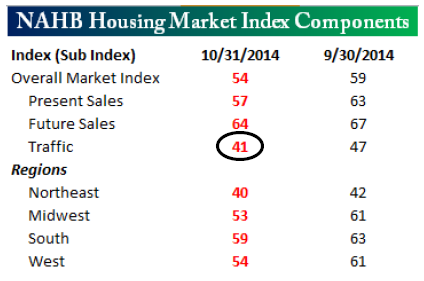

In reality, stable single family starts since mid 2013 is not all that bad considering the sharp price increases builders have implemented and the rise in mortgage rates since May 2013 (see Facts & Trends: U.S. Housing A House Of Cards?)

Housing turnaround around the corner?
Fannie Mae , Freddie Mac and mortgage lenders are nearing an agreement that could lower barriers and restrictions on borrowers with weak credit, a move that would expand access to home loans amid the sluggish housing recovery.
The move by the mortgage-finance giants and their regulator, the Federal Housing Finance Agency, would help lenders protect themselves from claims of making bad loans, according to people familiar with the matter.
Fannie and Freddie are also considering programs that would make it easier for lenders to offer mortgages with down payments of as little as 3% for some borrowers, the people said. That would be a reversal for the loan giants. The moves could be announced as soon as this coming week. (…)
Separately, Fannie Mae, Freddie Mac and the FHFA are considering new programs that would allow the companies to guarantee some mortgages with down payments of as little as 3%. The program might be limited to certain kinds of loans, such as mortgages to first-time home buyers.
Fannie Mae stopped accepting loans with 3% down payments last year, except in certain circumstances, while Freddie stopped guaranteeing such mortgages years ago.
The companies already guarantee loans with down payments of as little as 5%, though loans with down payments of less than 20% typically require mortgage insurance. (…)
This next image is just to give you an idea of the frugality efforts displayed by FNMA:
U.S. government bond yields, which influence mortgage rates, plunged on Wednesday as traders reassessed growth outlooks in Europe and fled to the safety of the U.S. The benchmark 10-year Treasury dipped as low as 1.873% on Wednesday before reclaiming some ground.
Freddie said that in the week ended Thursday, the average 30-year fixed-rate mortgage had a rate of 3.97%, down from 4.12% the week before. This week’s level was the lowest level tracked by Freddie since the week ended June 20, 2013, when rates averaged 3.93%. (Chart from ISI)
-
Gluskin Sheff estimates that the recent collapse in bond and mortgage rates makes refinancing available for 70% of current mortgages outstanding.
-
And this important change:

Natural-Gas Prices Fall Even With Chill Nearing When cold weather looms across the U.S., natural-gas prices usually rise. This year they are falling, after a record production boom nearly replenished stockpiles left at their lowest since 2003 by last winter’s freeze.
Prices for the fuel used to heat half of American homes fell to their lowest point of 2014 on Friday in intraday trading and are down 9.3% since Sept. 29 on speculation that further supply additions could lead to a glut.
On Friday, the November contract settled down 3 cents, or 0.8%, to $3.766 a million British thermal units on the New York Mercantile Exchange. It was the lowest close since July 28. (…)
For consumers, prices will be about 6.8% higher than last winter, as gas utilities sell more expensive fuel they bought in the spring and summer, according to the U.S. Energy Information Administration. But it could have been a lot worse. The EIA’s latest forecast for six months of residential prices dropped from what it had predicted in June. (…)
Even with higher prices, the EIA expects consumers to spend less because they will use less. The National Oceanic and Atmospheric Administration is predicting that heating degree days, a measure of weather-related heating demand, will be 12% lower than a year ago. That should reduce natural-gas consumption by 4% to 13% in different regions around the country, according to the EIA, with Midwestern states seeing the biggest savings on their heating bills. (…)
THE BASKET CASE:
ECB Officials Call for Bold Measures on Growth
European Central Bank officials fanned across Europe Friday to deliver a common message to governments that bold measures are needed to reform their economies, raise productivity and improve the eurozone’s anemic growth outlook.
The remarks from several members of the ECB’s 24-member governing council underscored the bank’s recent campaign to accelerate the debate in Europe on how to get the struggling eurozone economy on the right track without relying on the ECB’s easy-money policies.
 “Accelerate the debate in Europe”! LOL!!!
“The biggest bottleneck for growth in the euro area is not monetary policy, nor is it the lack of fiscal stimulus: it is the structural barriers that impede competition, innovation and productivity,” Bundesbank President Jens Weidmann said at a conference in Riga, Latvia, one of several ECB officials to speak Friday.
His comments were echoed by ECB executive board member Benoît Coeuré, who warned at the same conference that “talking vaguely about structural reforms, but not doing them, is the worst of all worlds.”
“While in ’normal’ times it might be acceptable to reform one sector at a time, in crisis times it is not. Fairness must be a priority. And the best way to align vested interests is to reform them all at once,” Mr. Coeuré said. (…)
The ECB responded in June and September with rate cuts, cheap bank loans and planned purchases of asset backed securities and covered bonds. The aim of the measures is to raise Europe’s money supply and spur new lending and spending. Mr. Coeuré said Friday that the ECB would begin these purchases “within the next days.”
But while these purchases have yet to even begin, financial markets are clamoring for the ECB to do more, primarily by purchasing large amounts of government bonds to reduce interest rates and cheapen the euro.
But the comments Friday suggest some on the ECB’s governing council remain skeptical of this policy, which was used extensively in the U.S., U.K. and Japan.
Mr. Weidmann noted that much of the weakening in eurozone inflation has been due to falling energy prices and the effects of reform efforts in parts of the region, forces that are largely outside the realm of monetary policy.
 “much of the weakening in eurozone inflation has been due to falling energy prices”. Hmmm, maybe in the last month or so, not over the several years.
He reiterated his criticism of the ECB’s asset-backed securities program, saying it transfers risks from financial institutions to the central banks and, ultimately, taxpayers. (…)
The top central banker in neighboring Austria, Ewald Nowotny, signaled the situation in Europe isn’t dire enough to require a more beefed-up response by the ECB. “It is not as if the ECB needs to open up the emergency toolbox,” he told journalists on the sidelines of an investor trade show in Vienna. (…)
“the situation in Europe isn’t dire enough” … so far…and depending on how one defines Europe…
Equity markets rally on low rate hints BoE adds voice to concern over acting too quickly
(…) The ferocity of market moves appears to have alarmed policy makers, with Andy Haldane, the Bank of England’s chief economist, saying on Friday that he favoured delayed interest rate rises. He said evidence of a weaker global economy, lower inflation pressures and low wage growth had forced him to reassess the UK economic outlook.
His comments followed those by James Bullard of the St Louis Fed on Thursday, who said the US Federal Reserve should carry on with its asset purchases in October, instead of halting them as scheduled. (…)
Bundesbank hits back at calls for stimulus
Germany’s top central banker has rejected calls for the eurozone’s largest economy to raid its fiscal coffers to fund an investment spree that critics say would stave off the risk of economic stagnation in the currency area. (…)
Jens Weidmann, president of the Bundesbank, on Friday acknowledged the recent economic data had been “disappointing”. But he hit back at the calls for Germany to shift its policy stance, saying maintaining its budget balanced made “perfect sense” for a country with debts of more than €2trn set to face a “huge” burden from its aging society in the coming decades.
Why would anyone invest in any meaningful way in Europe-centric companies just keeps escaping me.
China to Inject More Funds Into Banks The central bank plans to inject as much as 200 billion yuan ($32.6 billion) into about 20 large national and regional banks to push the economy back to stronger growth rates amid deepening worries about a global slowdown.
(…) The latest effort by the People’s Bank of China, which will offer funds to about 20 large national and regional banks, follows last month’s move to pump 500 billion yuan into the country’s five major state-owned banks. It comes as concerns mount in Beijing that the nation will miss its growth target—set at 7.5% this year—for the first time since the 1998 Asian financial crisis. (…)

The economic slowdown has led Chinese leaders including Premier Li Keqiang to call on the central bank and other financial regulators to help make credit more accessible to businesses and consumers. The latest action by the central bank comes just as senior officials of the Communist Party prepare to gather for an important policy meeting in Beijing, which opens on Monday. At the top of their agenda is the rule of law, but the leadership is also likely to discuss ways to make local officials more accountable for their failure to galvanize economic activity, according to Chinese officials.
(…) Banks are reluctant to lend to small businesses as the slowdown in growth has raised the prospect of soured loans.
Another challenge is the lack of strong demand among larger firms for loans. Many Chinese companies appear less eager to spend. In a survey of more than 2,000 industrial firms in July and August, economist Gan Jie found that most said they didn’t need bank loans. Nearly half the firms (44%) reported overcapacity in their industries, with supply exceeding demand in China and abroad. (…)
U.S. Stocks: Tenacious or Teetering? Stocks ended a tumultuous week with a burst of strength, but some money managers are warning that the underlying problems that drove prices down in the first place still loom large.
Nothing really worth quoting from this article except this, which reveals that much of the recent problem lies with energy stocks:
Of the 118 energy stocks in the Russell 2000 small-stock index, three-quarters have fallen 30% or more, Mr. Sluymer said. Of the 81 large and midsize energy stocks in the Russell 1000 index, 40% have fallen that much.
EARNINGS WATCH
I read a lot of stuff, even while on vacations on the other side of the planet. I am always surprised at how little emphasis is placed on earnings by the media and most popular strategists or market pundits. The fact is that the current turmoil is happening right in the middle of Q3’s earnings season and earnings are coming in pretty solid.
Of the 80 companies that reported so far, 57 (71.3%) beat estimates and earnings are beating by 5%. EPS were expected to rise 4-6% YoY in Q3 but, so far, they are showing +11.2%!
Trailing 12-m EPS are now seen near $115, up 12.5% YoY. On that basis, the Rule of 20 P/E is 18.1x, providing an 11% upside to the “20” fair value. If downside is 1700 (Rule of 20 P/E of 16.5 as in last correction), upside = +11% vs downside of 10%. Even odds but:
- Interest rates have declined a lot;
- Inflation is not rising;
- Earnings are rising and beating again (look at the chart showing how equities are falling while the Rule of 20 Fair Index Value (yellow line) is rising strongly);
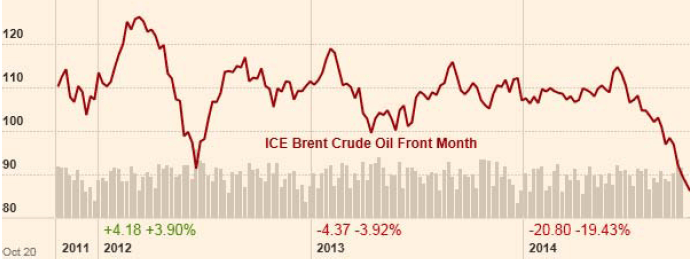
- Oil is declining;
- Mortgage rates are breaking below 4%;
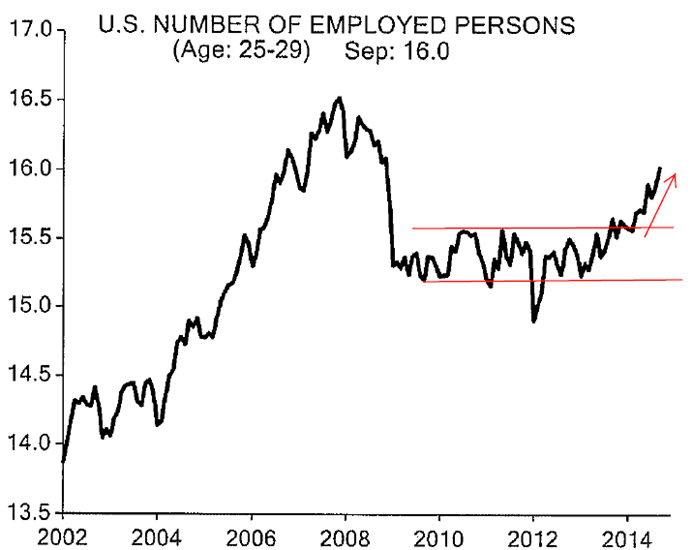
- Employment is strong, especially among potential first-time home buyers;
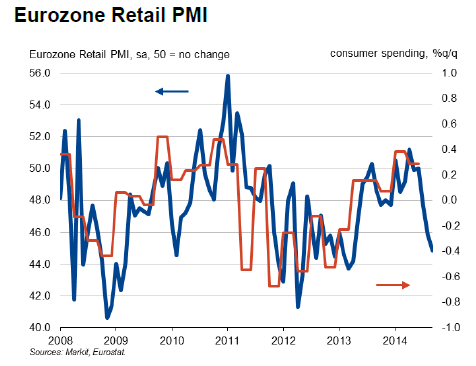
- Europe remains a basket case and more and more investors are coming back to this sad reality;
- China is a big unknown;
- The U.S. dollar is strong;
So, what else is there to buy other than U.S. equities and some Canadian non-resource stocks? I would rather wait to see markets settle down but buying the dips is now pretty tempting.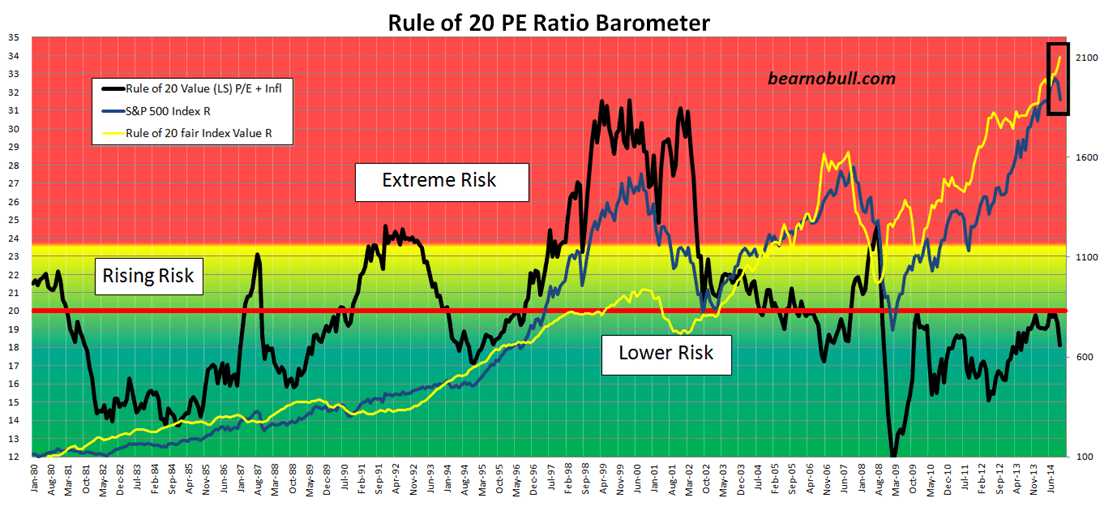
 Loans to buy US shares at record levels Previous peaks have come ahead of stock market downturns
(…) Recent wild swings in asset prices have been blamed already in part on brokers cutting margins for those investors whose investments were approaching losses. Forced sales by those investors helped fuel the market rout.
Obviously, this might be a problem for a while…