Today: Wage warning. Americans forgo marriage. Dollar warning. Death cross warning. Tech warning. Travel warning.
IS US WAGE GROWTH ABOUT TO GATHER STEAM?
US wage growth remains well contained, which probably explains why most FOMC voting members are content to wait a ‘considerable’ period of time between the end of QE and the first policy rate hike. However, a survey of employers suggests that wage growth may pick up by a percentage point or more through the remainder of this year.

(…) Average hourly earnings for all private non-farm employees rose by 2.1% in the twelve months to August. This measure of pay growth has remained at or below 2.5% for more than five years. However, a survey from the National Federation of Independent Business suggests that this may be about to change. The percentage of firms planning to raise worker compensation – usually a good leading indicator of the official data – is close to a six-year high. As such, given the continued strength of the US recovery, our own projections for US interest rates remain much closer to the Fed’s ‘dot’ estimates than the market’s expectation of a relatively more gradual tightening path.

Here’s an industry with tight labor and rising wages:
ATA Trucking Index increased 1.6% in August
American Trucking Associations’ advanced seasonally adjusted For-Hire Truck Tonnage Index increased 1.6% in August, following a gain of 1.5% the previous month.
Compared with August 2013, the SA index increased 4.5%, up from July’s 3.7% year-over-year gain. The latest year-over-year increase was the largest this year. Year-to-date, compared with the same period last year, tonnage is up 3.1%.

Treasury-Bill Yield Tips Into Negative Territory A scramble for safe, short-term debt left some investors on Tuesday paying for the privilege of lending to the U.S. government.
These 2 charts from Ed Yardeni explain:


More Americans Forgo Marriage as Economic Difficulties Hit Home For today’s women, a good man–an employed, educated one–is harder to find.
One in five U.S. adults aged 25 or older had never been married in 2012, a record high, according to a new report by the Pew Research Center that analyzed Census data. In 1960, the number was one in ten.
According to an accompanying survey Pew conducted this May and June, only 53% of all never-married adults said they would like to marry eventually, down from 61% in 2010. Around 32% said they were not sure, up from 27% in 2010. (…)
Among men and women who had never married but wanted to, nearly a third said they were not financially prepared for marriage. (…)For men 25 to 34, median hourly wages have declined 20% since 1980 in real terms. (…)
Among never-married adults aged 25 to 34, the number of employed, available men per 100 women has dropped to 91 in 2012, from 139 in 1960. That means if all of 2012’s never-married young women wanted to find a young, employed man who also hadn’t been married, about 9% of them would automatically fail—due to a man shortage. (Of course, these women could find and marry divorced men, or older men.) (…)
Nearly 25% of young adults 25 to 34 who have never been married were cohabiting last year, up from under 22% in 2007, Pew says. Roughly 7% of adults 30 to 44 were cohabiting in 2010, too, according to a different analysis, up from 3% in 1995.
New Tax Rules to Slow, Not Halt, Inversion Deals The Obama administration’s actions to tighten rules against corporate inversions should discourage such deals—at least temporarily—experts said. But many questioned how long any chilling effect would last.
(…) The administration still has at least one more regulatory card to play—it could limit still more of the benefits of inverting. The biggest benefit left untouched by Monday’s action allows inverted firms to “strip” domestic profits out of the U.S. in the form of untaxed interest payments to their new overseas parent. Administration officials say they are still studying that one. (…)
(…) The regulations are ostensibly to prevent so-called corporate inversions, in which U.S. companies acquire foreign firms and then relocate their legal headquarters offshore for tax purposes. But the practical impact will be to make it harder to make money overseas and then bring it back here. (…)
Inversions are for businesses that want to make money overseas and then bring it back here. But if the changes work as intended, they will make it more difficult and expensive for companies to reinvest foreign earnings in the U.S. Tell us again how this helps American workers.
(…) outside of Washington we notice that no one is complaining about recent merger announcements involving foreign firms buying U.S. companies. These foreign firms don’t suffer the same IRS penalty as U.S. businesses that want to take money earned elsewhere and invest it in the U.S. We’re all for foreign investment, but should Washington be punishing U.S. companies that wish to do the same?
(…) At 35 per cent, US corporation tax is among the highest in the developed world. Big companies with global operations are good at engineering far lower rates. Smaller ones – and budding entrepreneurs – often have to pay the full whack. This is the opposite of what a good tax system should do.
The template is the same one set by Ronald Reagan, the last US president to attempt tax reform: broaden the base, lower rates and simplify the system. An updated tax code would move the US towards a territorial system in line with much of the rest of the world, reducing the disincentive for companies to reinvest their worldwide income in the US.
The problem as ever is politics. Democrats are reluctant to lower the headline rate of corporation tax. Republicans are wedded to particular tax breaks that would have to go. With just weeks to run before the Congressional midterm elections, neither side is eager to compromise on a bargain that would enable reform to happen.
The White House may argue that it is not worth wasting capital on a long shot. But the administration has expended plenty of this valuable commodity using executive measures to close only partially the loophole. Mr Reagan showed that second term feats are possible even in a poisoned climate. Mr Obama has set his sights too low.
DEATH CROSSING
Yesterday I posted about the Russel 2000 death cross. Scotia Capital’s take on this:
The recent deterioration in Russell 2000 technicals has alarmed many investors who see this as a bad omen for the S&P 500. The Russell 2000 index broke below its 200-d MA last week for a third time this year and the small cap benchmark has triggered a death cross signal, which occurs when the 50-d MA drops below the 200-d MA.
Let’s set the record straight: a small cap death cross is not as bad as its name suggests. The Russell 2000 generated 26 death cross signals since 1979 and in most instances (65%), the benchmark managed to deliver positive performance in the following 90-day period. (…)
Positive leading indicators have historically offset bad technicals. 70% of death crosses occurred with the LEI in positive territory and were in turn relatively short-lived and of modest consequences. Currently, the LEI is running at an 8% pace on a six-month annualized basis. Bad small cap technicals matter more when the U.S. LEI is negative. (…) when the U.S. LEI (6-M annualized) is contracting before a death cross occurs, it tends to be a bad omen. The LEI signal failed in two
instances: the Asian crisis in 1998 (external shock) and the Fed tightening of 1983 (10-year yields increased 250 bp over a 12-month period).The S&P 500 triggered only 16 death cross signals since 1979 compared to 26 for small caps. In addition, the large cap death cross occurred before the small cap death cross in six occasions. That’s suggesting small cap death crosses have limited ability to deliver a reliable technical signal for large caps.
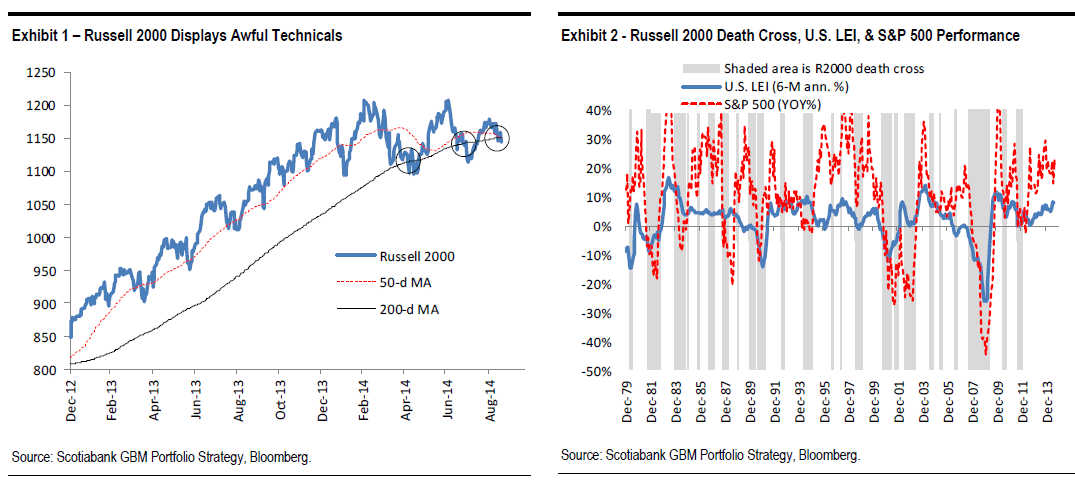
 Watch the 200-d m.a.. So far, it is still rising…
Best Quarter For the Dollar in Four Years

Hmmm. We will soon find out what that did to foreign earnings of U.S. global companies.
Tech bubble or no tech bubble?
Last Thursday the below snapshot of techies panhandling for funding on the side of the street hit Valley Wag:

 TRAVELLING
Sorry to sound like John Mauldin here. Suzanne and I are leaving today to visit one of our sons living in Manilla, Philippines. Another son, married to a Filipina but living in Miami will meet us in about a week with our new grand-daughter. That will be a great, long overdue, (partial) family reunion. We will also travel to Japan so I will be away for several weeks. I will post as much as physically possible, Asia time.
Where will the market be in a month? That “20” level is proving to be a tough barrier.