From Cebu Island, Philippines.
Job Openings Hit 13-Year High in August The number of job openings across the U.S. economy continued to climb in August, a sign this year’s strong job growth could stretch into the fall.
Employers had 4.84 million job openings in August, up from 4.61 million in July and the most since early 2001, the Labor Department said Tuesday.
At the same time, sturdy job creation has depleted the number of job seekers, a sign the labor market is tightening and raising the prospect of stronger wage growth. In August, there were just under two unemployed workers per job opening, the lowest level since the recession. In 2009, that figure almost hit seven.
A tighter labor market could eventually lead to higher wages for American workers. Wages have been growing at a tepid pace in recent years. In September, average hourly earnings for private-sector workers grew 2% from a year earlier, barely faster than consumer-price inflation, Friday’s employment report showed. But as companies seek to fill more job openings and the pool of job seekers shrinks, they may have to offer higher wages to fill them.
(…) The last time the proportion of job openings to overall employment was at August’s level, wages were growing at a 4% rate (…).
Still, other figures suggest the labor market is growing below its potential. Despite the pickup in job openings in August, the number of hires actually fell to 4.6 million from 4.9 million in July. That could be a sign that while employers are ready to expand, they’re having trouble finding the right workers or they may lack urgency to hire right away.
And the number of workers quitting their jobs has remained flat in recent months. That shows that despite stronger job growth, many workers are still not confident enough to quit their jobs for better opportunities.


Beth, a reader, writes
What about employment being the king of lagging economic indicators? I understand why politicians celebrate it, but has something changed such that it is not identified as a lagging indicator in Bearnobull, or other newsletters I read? What gives?
thanks, love Bearnobull
Partly right Beth. The king of lagging indicators is actually wages which Mrs. Yellen has made her principal stat to watch and dictate the Fed’s moves (!). I focus on employment because of the importance of consumer spending to sustain the U.S. and the world economy.
Consumer Credit Grows At Slowest Pace Since Late 2013
Total outstanding consumer credit, excluding loans secured by real estate, rose in August at a 5% seasonally adjusted annual rate to $3.247 trillion, the Federal Reserve said Tuesday. That was its slowest rate of increase since last November.
Credit-card use, an important indicator of consumer confidence and financial health, declined for the first time since February. Total outstanding revolving credit, mostly credit-card debt, fell at a 0.3% rate in August from the prior month to $880.32 billion. Still, the August level of revolving credit was 3.2% higher than a year ago. (…)
August growth of nonrevolving credit—primarily auto loans and student loans—slowed to its lowest rate since February. It rose 7% to $2.367 trillion.
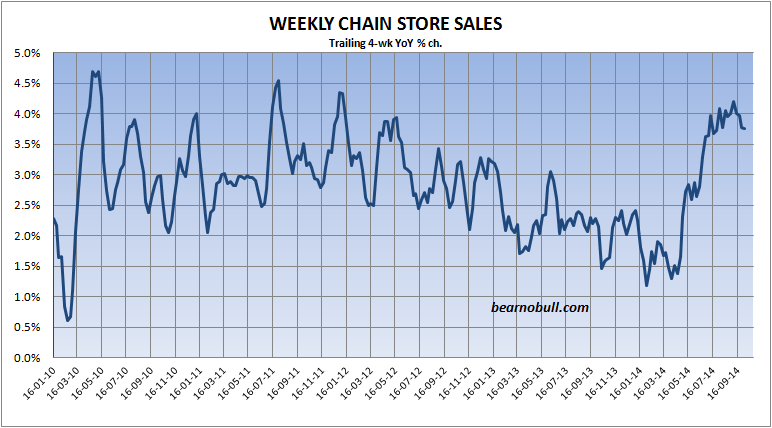
Meanwhile, retail sales are sputtering, showing no upward trend in recent weeks. Chain store sales are up 3.8% YoY but mainly because last year’s sales were weak through the fall.
German Factory Output Drops
German factory output fell 4% on the month—the sharpest decline since 2009, data from the country’s economy ministry showed Tuesday. (…) Tuesday’s figures were weak across the board, with manufacturing output down 4.8% and construction output off by 2.0%. Energy output eked out a gain of 0.3%.
The figures came a day after a surprise decline of 5.7% in manufacturing orders for August, also the sharpest since January 2009, when the world was mired in financial crisis.
German Economy Takes an Awkward Holiday August’s 4% drop in German industrial production is awful, but not a signal of economic collapse.
August’s number is the worst German performance since early 2009, when the world economy was still reeling after the collapse of Lehman Brothers. But it is largely down to a massive 25.4% drop in auto output caused by an unusual holiday pattern that led to simultaneous shutdowns at German car plants. That alone contributed 2.9 percentage points to the overall decline in production, UniCredit notes. Data for September from the German auto manufacturers’ association already shows a big rebound, almost to July’s level, J.P. Morgan Chase notes. That means any concerns that Germany’s economy has gone rapidly into reverse are overdone.
But worries about more pervasive weakness in the German economy persist. (…) Surveys of economic sentiment have been declining: Markit’s manufacturing purchasing managers index for September entered contraction territory, at 49.9. Weaker global demand and concerns about the tensions between Russia and Ukraine are to blame. If this unpleasant mix persists, then growth seems unlikely to pick up.
The saving grace for Germany may be consumer spending, somewhat ironically given its historic lack of dynamism. The labor market is strong, inflation is low and wages are rising. But German consumers aren’t the force that their spending-happy peers in the U.K. and U.S. are; consumer sentiment has been softening too. (…)
But Markit suggests not to hold our breadth on the German consumer:
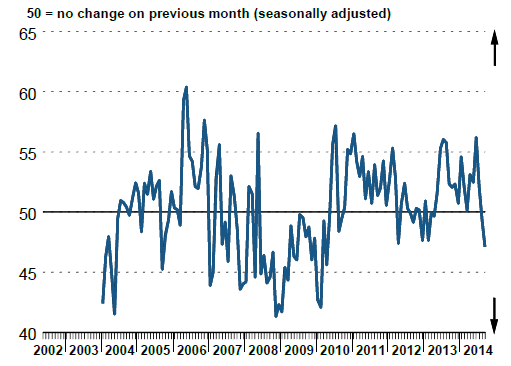
The seasonally adjusted Germany Retail PMI fell from 49.4 in August to a 53-month low of 47.1 in September, signalling an accelerated contraction in German retail sales. Retail sales also fell at a faster pace on an annual basis in September. The decline was the strongest since February 2013, with exactly 39% of the
survey panel reporting a drop in year-on-year sales
Just in case you’re wondering:
-
Bundesbank Knocks ECB Plan German Bundesbank President Jens Weidmann criticized the European Central Bank’s decision to buy private-sector bonds and signaled his opposition to purchasing government bonds.
-
Berlin holds firm on fiscal rigour Government determined to cut deficit to zero next year
“Doubts about our fiscal policy would harm us much more than any short-term growth stimulus programme,” Wolfgang Schäuble, finance minister, said on Monday.
So, while the IMF and the ECB are pushing for fiscal stimulation, Germany is saying “Nein”. Equity markets never like it when monetary policies are not well aligned when they need to be. Uncertainty is rarely positive. Policy fights are always terrifying.
 Remember Oct. 1987? Most of you probably don’t, but I do. James Baker, then U.S. Treasury Secretary, also certainly remembers telling the Germans on Saturday, Oct. 17 to “either inflate your mark, or we’ll devalue the dollar.” On Sunday, the Germans flatly told him to take a walk. The equity rout started Sunday in Asia and the rest is history.
Note that back then equities were very overvalued at 23.1x on the Rule of 20 P/E. They are now at 19x. Also, and importantly, inflation was sharply accelerating from 1.0% in December 1986 to 4.5% in October 1987. The crash brought equities to a Rule of 20 P/E of 17.4x, a level which applied to today’s much lower and stable 1.7% inflation environment would mean a P/E on trailing EPS of 15.7x (17.4 minus 1.7). On current trailing EPS of $111.94, that would bring the S&P 500 Index to 1757, down nearly 10% from current levels. If Q3 estimates are met, trailing EPS will rise to $115.09 over the next 5 weeks, or 1806 on the S&P 500 Index at 15.7x EPS, 6.6% below current levels.
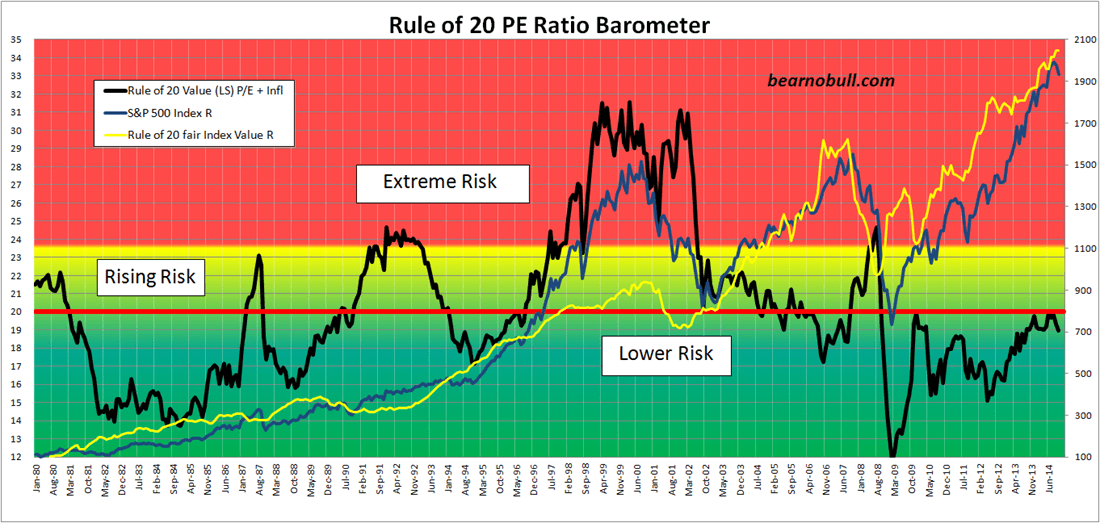
Technically, the 200 day m.a. is at 1900 and still rising nicely.
Eurozone Faces a 1-in-3 Chance of Reentering Recession Soon, IMF Says The eurozone’s chances of re-entering a recession have roughly doubled to nearly 38% since April, the International Monetary Fund said in its latest global economic outlook on Tuesday, as the threat of deflation smothers growth prospects in the region.
(…) Regional powerhouse Germany is only expected to grow at 1.5% next year, down 0.2 percentage point from the fund’s July outlook. And Italy is expected to enter its third consecutive year of recession as the government fails restructure the Italian economy to boost competitiveness. (…)

Cheap natural gas lifts US manufacturing Lower prices favour energy intensive industries
US gas sells for $4 per million British thermal units, compared with $10 in Europe and close to $18 in Asia.
The price gap has led to a 6 per cent average increase in US manufactured product exports, the IMF wrote in its twice-yearly World Economic Outlook. (…)
Lower prices for natural gas favour energy- and gas-intensive industries, such as steelmaking, oil refining, and nitrogen fertiliser production. The International Energy Agency has previously warned that Europe will lose a third of its share of global energy-intensive exports over the next two decades because its energy prices will remain stubbornly higher than those in the US.
According to the IMF, a 10 per cent fall in the relative price of US gas leads to an improvement in US industrial production relative to Europe of roughly 0.7 per cent after 1½ years.