U.S. Consumer Spending Rises After Inflation, While Prices Drop in March Americans’ spending grew steadily in March after accounting for inflation, positioning the economy to rebound from another winter slowdown, yet a drop in consumer prices signaled underlying economic sluggishness.
Personal consumption, a measure of what households spent on everything from groceries to dental care, rose 0.3% after inflation, the Commerce Department said Monday. That followed two months of declines.
Without accounting for inflation, spending was flat. (…)
Personal income—measuring wages, salaries, investment returns and government assistance—rose 0.2% in March from a month earlier. Real disposable income—or the money left over after inflation and taxes—grew 0.5%, the strongest gain since late 2015. (…)
The Fed’s preferred inflation gauge, the price index for personal-consumption expenditures, fell 0.2% in March from a month earlier. Core prices, which exclude volatile food and energy components, declined 0.1%, falling for the first time since 2001.
The overall price index briefly hit the Fed’s annual 2% target in February but slipped below it again in March. Compared with a year earlier, overall prices rose 1.8% in March, while core prices climbed 1.6%. (…)
Following up on my April 3 post, THE U.S. CONSUMER: FRAGILE STRENGTH:
- growth in personal income is slowing from +0.4% MoM in January and +0.3% in February to +0.2% in March.
- wages and salaries rose only 0.1% in March, down from +0.9% in Jan-Feb. combined.
- after tax disposable income was up 4.3% YoY in March but the sequential advance slowed to +0.2% in March, bringing Q1 to a +3.2% annualized gain, down from +3.7% in Q4’16, +4.4% in Q3’16 and +5.7% in Q2’16.
- But deflating prices helped real DPI gain 0.5% in March (+2.4% YoY) enabling a 0.3% rise in real spending following –0.4% in Jan-Feb. combined.
In all, the income side has turned sluggish but real expenditures are holding up thanks to negative headline and core inflation in March. The apparent YoY acceleration in disposable income will end soon given the slow down in sequential income growth and the continued deceleration in employment growth. Unless the economy pricks up in Q2, only declining prices will sustain real spending. Friday’s employment report for April will be very interesting.

(…) Over the past eight years, the economy has grown at an average rate of 1% in the first quarter, while growing at a 2.3% rate over the remaining three quarters. Much of the blame for this quirk has been placed difficulties the Commerce Department has faced adjusting the GDP figures for seasonal swings in an evolving economy. So it is natural to think growth will pick up, and that is what forecasters are banking on. Economists at J.P. Morgan for example, estimate the GDP will expand at a 3% rate in the current quarter.
But the worrisome thing about the GDP report is where the weakness was. Consumer spending grew at just a 0.3% annual rate—its slowest showing since the fourth quarter of 2009. The number is more worrisome because consumer spending accounts for about two-thirds of the economy and because it isn’t the part of the GDP report where seasonality problems have shown up. As confirmed by soft monthly retail sales and the drop off in car sales, the first-quarter spending slowdown was real.
With incomes rising, consumers will probably spend more, though rising inflation is eroding their gains. Unusual weather and a delay in tax refunds may have weighed on spending over the winter, for example, so there ought to be some catch-up.
Still, there are reasons to worry the rebound will be unimpressive. Jobs growth has been slowing as the U.S. has crept closer to full employment, so there are fewer new paychecks getting added to the income pile. Lenders have become a little more leery of extending credit for auto purchases and other consumer items, while the number of consumers falling behind on payments has started to rise. (…)
(…) Average prices for ground-floor space in nine of the 11 major retail districts in Manhattan fell in the first three months of 2017, according to real-estate services firm Cushman & Wakefield. SoHo recorded the largest percentage drop in average asking rent from the previous year, falling 12% to $488 a square foot.
The availability rates along most of those corridors also increased, with the stretch of lower Fifth Avenue between 42nd and 49th streets reporting the highest rate at almost 33%. (…)
While some owners of New York retail properties are reluctant to offer drastic rent cuts, they have become much more generous with other enticements such as free rental periods and contributions toward the costs of building out a store, incentives that were rare a few years ago, brokers said. (…)
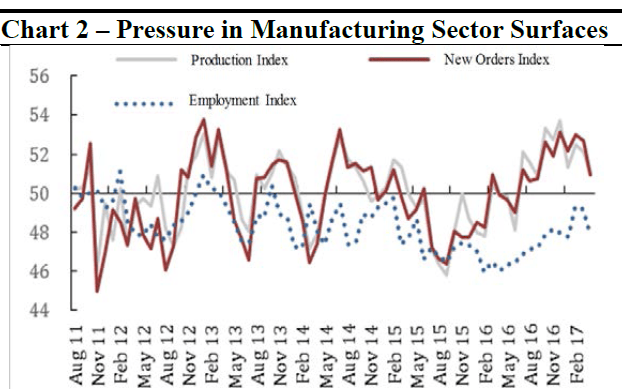
The seasonally adjusted Markit final US Manufacturing Purchasing Managers’ Index™ (PMI™) registered 52.8 in April, down from 53.3 in March, to signal the slowest improvement in overall business conditions since September 2016. A fall in the headline PMI largely reflected weaker contributions from output and new business growth in April, which more than offset a slight rebound in job creation.
Manufacturing production increased for the eleventh successive month in April. The latest survey signalled that the rate of expansion nonetheless eased to its weakest for seven months. New order growth also moderated to its slowest since September 2016, which survey respondents mainly linked to more cautious spending among domestic clients. Meanwhile, export sales gained momentum in April, with the latest rise in new work from abroad the fastest since August 2016. (…)
The signs of slowing growth are most evident in the domestic consumer sector, but investment goods manufacturers continue to fare well, enjoying stronger capital equipment spending from the energy sector in particular. (…)

Manufacturers also sought to reduce their inventory holdings, with stocks of purchases falling slightly for the first time in seven months. In contrast, postproduction inventories increased at a modest pace in April. (…)
Meanwhile, the latest survey highlighted strong cost pressures across the manufacturing sector. The rate of input price inflation accelerated to its fastest since September 2014. A number of panel members cited higher prices for metals, especially steel. Efforts to pass on higher costs to clients led to the most marked rise in factory gate charges for nearly two-and-a-half years.
The Institute for Supply Management on Monday said its closely watched index of U.S. manufacturing activity fell to 54.8 in April from 57.2 in March. (…) Sub indexes that fell most sharply— the new orders index fell 7 percentage points to 57.5, and employment sank 6.9 points to 52—remain in positive territory. (…)
The ISM index for exports last month rose to its highest level since November of 2013. (…)

U.S. gasoline demand falls for second straight month: EIA U.S. gasoline demand fell 2.4 percent in February from a year earlier, the second straight monthly decline, according to data released on Friday by the U.S. Energy Information Administration that suggested the market may have trouble repeating last year’s record volumes.
January demand for gasoline fell 1.9 percent from last year, EIA data showed. (…)

Source: @boes_
(…) Underneath a weak reading of first-quarter gross domestic product on Friday, non-residential investment in structures, equipment and intellectual property grew at a 9.4 percent annualized pace, the fastest since the fourth quarter of 2013. While the Bureau of Economic Analysis attributed the increase to a significant jump in “mining exploration, shafts, and wells” — which reflects a surge in oil-and-gas drilling — almost all categories of investment showed gains. (…)

A sustained pickup in business investment is a big question mark. There are many reasons to question a forecast of a sudden burst of productivity fueled by a capital-spending boom, said Michael Gapen, chief U.S. economist at Barclays Plc. The biggest determinants of business spending, he said, are current and past economic activity. In other words, it takes a lot to shake expectations in executive suites that tomorrow’s economy will be faster than the 2 percent growth they’ve seen in recent years. (…)
Businesses have been so tight with spending, however, that something may eventually have to change. The age of private fixed assets in the U.S. is 22.4 years, the oldest since 1955. Also, corporate balance sheets are in good shape and can support more investment, Deutsche Bank’s Slok said in a recent report.
On top of that, business surveys are showing more confidence and economic data are indicating more signs of a pickup.
Orders for non-military goods excluding aircraft, a proxy for business investment in equipment, rose an annualized 6 percent in the first three months of the year, Commerce Department data showed Thursday. That was the best quarterly performance for bookings since the third quarter of 2014. The new orders index in the Chicago purchasing managers’ index released Friday rose to 65.9 in April from 60.4 in March, according to an email to clients from RDQ Economics in New York. (…)
Hmmm…Actually, new orders for non-def cap goods ex-air rose 0.5% in total between December and March; that is a 2.0% annualized rate the last time I did the calculation. Improving nonetheless but not booming.


Trump Gambles on Big Health Victory The White House is pursuing a twisting path in Congress this week, yielding to Democratic demands on a major spending bill while aggressively pushing a partisan health-care measure, gambling on a big win on health but risking setbacks on both fronts
House GOP leaders hope to corral enough votes on health care by Thursday, since Congress departs for recess next week and Republicans want to begin tackling taxes, another complex issue, when they return.
Leaders were tight-lipped Monday night on precisely how many votes short they remain, according to lawmakers leaving a regular meeting of the whip team. Although some lawmakers are still pushing for changes to the bill, others said time had run out. At least 19 House Republicans are currently opposed to the bill, with at least 17 undecided, according to a Wall Street Journal survey of the lawmakers. The GOP can only afford to lose about 22 votes, depending on absences.
Meanwhile, frustrating some conservatives, President Donald Trump has backed off his longtime demands for immediate funding for a wall on the Mexican border in the spending bill. The White House also has declined to insist on its plans to cut Environmental Protection Agency funding and to deny funding to “sanctuary” cities. (…)
The risk for Mr. Trump is that it is far from clear that Republicans can round up the 216 votes they need on health care, especially from GOP centrists, after making changes in their initial proposal to win over conservatives. The centrists are especially spooked by a provision allowing insurers in some states to charge higher premiums to patients with pre-existing medical conditions who have let their coverage lapse. (…)
The White House is pushing aggressively for a vote on health care this week, eager for a victory on the politically potent subject. House leaders, including Speaker Paul Ryan (R., Wis.), embarrassed by having to pull an earlier version of the bill at the last moment, have not committed to a timeline. (…)
At 56.7 in April, up from 56.2 in March, the final Markit Eurozone Manufacturing PMI® rose to a six-year high. The PMI was only a tick below the earlier flash estimate of 56.8. Seven out of the eight nations covered recorded an improvement in operating conditions. Growth was led by Germany, which saw its rate of expansion remain close to March’s 71-month high. (… ) France, Italy and Austria saw growth accelerate to rates last achieved around six years ago. Rates of expansion also recovered from recent lows in Spain and Ireland. (…)
The latest survey readings indicate that manufacturing is growing at an annual rate of approximately 4-5%, which should make a significant contribution to overall economic growth. (…)

April saw manufacturing production and new orders both expand to the greatest extents since April 2011. Companies reported that demand improved from both domestic and export clients.
New export business also rose at the quickest pace for six years, led by strong (albeit slower) gains in Germany and faster rates of expansion in France, Italy, Spain, Austria and Ireland. The Netherlands also saw a strong increase in new export work, in contrast to a further sharp decrease in Greece. (…)
The rate of increase in staffing levels accelerated to its fastest in six years and was among the best registered since early-2000. Solid jobs growth was seen in almost all of the nations covered. (…)
Price pressures remained elevated during the latest survey month. Input costs increased at a rate close to February’s 69-month high. As a consequence, selling prices continued to rise, with the pace of inflation close to March’s near six-year record. Some firms linked higher costs to supply chain factors. This was further highlighted by vendor lead times lengthening to the sharpest degree since May 2011, signalling a growing trend towards a sellers’ market for many items.
China’s Credit Slowdown Poses a Threat to Global Growth China is making yet another attempt to rein in its overleveraged financial system, threatening to hamper the economy at a time when credit growth is already decelerating. Investors outside the country don’t seem to care, but they should.
(…) China this year has tightened monetary policy and launched a regulatory assault on off-balance sheet and interbank lending, squeezing financing for speculative vehicles. In the past China’s crackdowns on shadow banking have proved temporary, but the new head of the China Banking Regulatory Commission, Guo Shuqing, has more credibility than his predecessors. The CBRC has this year issued a flurry of orders including detailed work aimed at “regulatory arbitrage,” or rule-dodging.
“Basically every commercial bank in China is involved in at least some of the long list of activities now targeted by regulators,” said Chen Long at Gavekal Dragonomics in a note to clients.
Yields on Chinese bonds have risen and share prices in Shanghai and Shenzhen fallen as Chinese investors came to realize that Mr. Guo was serious in his attack on shadow banking. (…)
But China watchers are reassured that the authorities won’t do anything to risk upsetting the economy before Xi Jinping’s expected second term as president is signed off by the Communist Party Congress in the fall. Economic stability is assured, the argument goes, because anything else would be unthinkable. (…)
The reason to be concerned about China now is that a slowdown in credit hurts growth and could spread to the rest of the world, piling pressure on commodity producers. (…)
EARNINGS WATCH
Facstet’s summary as of last Friday:
Overall, 58% of the companies in the S&P 500 have reported earnings to date for the first quarter. Of these companies, 77% have reported actual EPS above the mean EPS estimate, 8% have reported actual EPS equal to the mean EPS estimate, and 14% have reported actual EPS below the mean EPS estimate. The percentage of companies reporting EPS above the mean EPS estimate is above the 1-year (70%) average and above the 5-year (68%) average.
In aggregate, companies are reporting earnings that are 6.7% above expectations. This surprise percentage is above the 1-year (+4.3%) average and above the 5-year (+4.1%) average.
The Energy (+24.5%) and Consumer Discretionary (+12.5%) sectors are reporting the largest upside aggregate differences between actual earnings and estimated earnings, while the Telecom Services (-0.5%) and Consumer Staples (-0.1%) sectors are reporting the largest downside aggregate differences between actual earnings and estimated earnings.
In terms of revenues, 68% of companies have reported actual sales above estimated sales and 32% have reported actual sales below estimated sales. The percentage of companies reporting sales above estimates is above the 1- year average (53%) and above the 5-year average (53%).
In aggregate, companies are reporting sales that are 1.0% above expectations. This surprise percentage is above the 1-year (0.0%) average and above the 5-year (+0.1%) average.
The Materials (+4.2%) and Consumer Discretionary (+2.8%) sectors are reporting the largest upside aggregate differences between actual sales and estimated sales, while the Telecom Services (-2.5%) and Consumer Staples (-1.1%) sectors are reporting the largest downside aggregate differences between actual earnings and estimated earnings.
The blended earnings growth rate for the first quarter is 12.5% this week, which is higher than the earnings growth rate of 9.9% last week. (…) If [the Energy] sector is excluded, the blended earnings growth rate for the remaining ten sectors would fall to 8.3% from 12.5%.
If the Energy sector is excluded, the blended revenue growth rate for the index would fall to 5.6% from 7.5%.
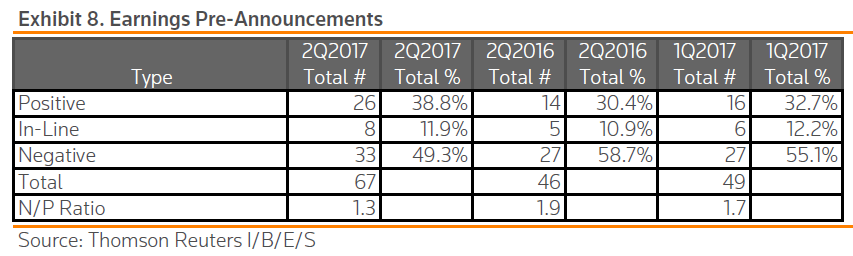
At this point in time, 62 companies in the index have issued EPS guidance for Q2 2017. Of these 62 companies, 38 have issued negative EPS guidance and 24 have issued positive EPS guidance. The percentage of companies issuing negative EPS guidance is 61% (38 out of 62), which is well below the 5-year average of 74%.
In the Information Technology sector, more companies have issued positive EPS guidance (10) than negative EPS guidance (7).

As of yesterday night:
- 302 companies (65.6% of the S&P 500’s market cap) have reported. Earnings are beating by 6.4%, with 78% of companies surpassing bottom-line estimates. Revenues are surprising by 0.7%.
- Expectations are for revenue, earnings, and EPS growth of 6.9%, 12.2%, and 14.1%, respectively. EPS is on pace for 15.7%, assuming a typical beat rate for the remainder of the season. (RBC)
SENTIMENT WATCH
Hmmm…

After 100 Days of Trump Presidency, Advisers Say Client Worry Has Eased After Donald Trump’s surprise election victory, many wealth managers were inundated with calls from clients both concerned and looking for ways to capitalize on his presidency. Now, as the president hits the 100-day mark, financial advisers say those calls have subsided and clients’ outlook has moderated.
The First Day of the Rest of the Presidency (Karl Rove) As the media obsesses over a fake milestone, Trump should take a minute to recalibrate.
(…) Much of this plan has yet to be passed into law or even introduced, but Mr. Trump has nonetheless compiled some respectable achievements. He recruited an impressive cabinet, especially in the foreign-policy and national-security areas. His spectacular Supreme Court nominee was confirmed, and Mr. Trump greenlighted the Keystone XL and Dakota Access pipelines. He took action against Syria, adopted a surprisingly tough line on Russia, and held positive meetings with world leaders.
Mr. Trump froze hiring of many federal workers, required rescinding two regulations of equal cost for every new rule created, and signed laws repealing last-minute Obama regulations that cost the economy billions. The stock market is up around 14% since Election Day and consumers are more confident than they’ve been in years.
Mr. Trump also points to nixing the Trans-Pacific Partnership, issuing dozens of executive orders, browbeating Ford and Carrier to keep jobs in America, and slowing illegal immigration. Not all the executive orders needed to be executive orders, but that’s unimportant to voters, who want to see action, strength, and promises being kept.
On the down side, the president’s poorly drafted travel ban blew up and his sanctuary-city executive order could too. Worse, House Freedom Caucus members stymied ObamaCare’s repeal and replacement, slowing the administration’s overall momentum. Tax reform will take until the fall—it always would—and remains a heavy lift. The administration seems more ragged, unfocused, understaffed and disorganized than any other in modern times, prone to overpromising and under-delivering.
This all leaves Mr. Trump with only 42% of Americans approving his performance, according to the RealClearPolitics average. With a 53% disapproval, the president easily earns the worst numbers ever recorded at this point. The Gallup average for modern presidents around this time is 61% approval. Mr. Trump had no honeymoon as president.
Yet 96% of his 2016 supporters would vote for him again, according to an April 17-20 ABC/Washington Post survey. (…)
Another troubling sign: While Mr. Trump is seen as “a strong leader” by 53% in the ABC/Washington Post survey, a majority thinks he “lacks the judgment and the temperament it takes to serve effectively.” Meantime, about 6 voters in 10 doubt his honesty and think he is out of touch.
This should provide openings for Democrats, but they have little to gloat about. While 47% said in an April 17-20 NBC News/Wall Street Journal poll they favored a Democratic Congress in the midterms, 43% favored keeping Republicans in charge. Democrats led on this measure by 9 points in April 2009 before being soundly beaten in the next midterm elections.
Because they control the White House and Congress, Republicans have the advantage of being masters of their own fate. They can shape the 2018 narrative by getting things done, especially on the economy. Democrats must hope the GOP screws up at both ends of Pennsylvania Avenue. That’s a distinct possibility, but if Republicans don’t, there’s no good foothold for Democrats.
The first 100 days of the Trump presidency shouldn’t bring comfort to either party: The Trump legacy will be decided by what happens after this arbitrary milestone. The president would be wise to recalibrate, reset and make changes in how he operates before today’s lowly ratings lock in place.
“This is more work than in my previous life. I thought it would be easier.”
 Too Many Investors Believe the Unlikely, Avoid Reality Investors would spare themselves embarrassment and loss by confronting information instead of hiding from it. Most do the opposite, writes Jason Zweig.
(…) There’s another reason so many investors believe in magic: We can’t handle the truth.
The efficient market hypothesis holds that stock prices fully reflect all the relevant information that is available. What if, instead, investors are so efficient at avoiding some information that it might as well not even exist?
Psychologists call this behavior “information avoidance.” You could also call it intentional ignorance.
“It’s a motivated decision to say ‘no’ to learning available but unwanted information,” says Jennifer Howell, a psychologist at Ohio University in Athens, Ohio, who studies the phenomenon. “People avoid information if it’s going to make them feel or behave or think in a way they don’t want to” — especially any evidence that could jeopardize their belief in their competence and autonomy or could require taking difficult or prolonged action. (…)
Researchers have documented for decades that people are much less willing to sell investments that have gone down in price. To “realize” a loss means not only to make it actual, but also to become aware of it. If you don’t lock in a loss by selling it, you don’t have to think about it or admit you made a mistake. (…)
However, you can’t tell whether your ideas are valid unless you let them be challenged. Just as the most partisan voters — of all stripes — shouldn’t remain deaf and blind to evidence that their favorite politicians might be wrong, investors would spare themselves embarrassment and loss by confronting information instead of hiding from it. (…)
Finally ask: What conditions or circumstances would it take for me to be proven wrong? If your answer is “none” or “that’s impossible,” you have a severe case of information avoidance. The only cure for that might be the shock of losses that come at you like a bolt from the blue.
Almost 600,000 Americans moved from the Midwest and Northeast to the Sun Belt states last year, the most since 2005, according to Brookings Institution demographer William Frey. Migration is boosting growth along Southeast and Western coasts as well as Nevada and Arizona, reflecting a healthier national economy that has made it easier to re-locate. (…)
Florida added 207,155 people in 2016, or almost 600 people a day. By contrast, New York, Illinois and California each lost more than 100,000 people. (…)

And this was before the coming tax reform:
The tax policy outline Mr. Trump unveiled Wednesday proposes repealing the deduction for state and local taxes, which lets individuals subtract their home-state levies from their federal taxable income. That move was a major shift for Mr. Trump, who previously had called for capping deductions but not killing the break.
What makes the latest proposal politically divisive—and could lead to a split inside the Republican Party—is that it would shift the tax burden from low-tax states such as Texas and Florida to high-tax states such as New York and New Jersey. Blue-state Democrats criticized the proposal, as expected, but Republicans from those states don’t like it either. (…)
Removing the deduction could raise more than $1 trillion over a decade, according to independent estimates, which would help offset the cost of GOP rate cuts.
The deduction, one of the largest breaks for individuals, saves taxpayers about $103 billion this year, according to the congressional Joint Committee on Taxation.

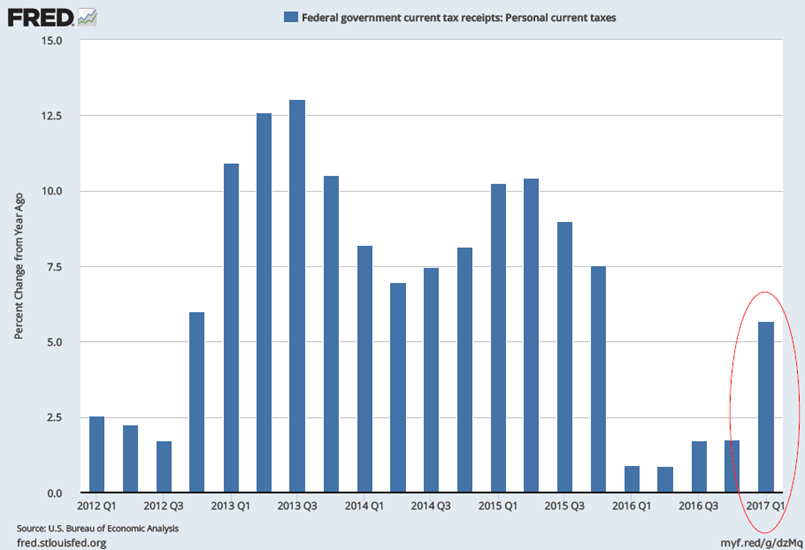
Donald Trump’s tax plan, if adopted, has been seen as an unmitigated windfall for corporate America. Cutting the corporate tax rate to 15 percent from its current effective rate of around 28 percent could generate nearly $2 trillion in additional income for the companies in the S&P 500 index alone over a decade.
But a surprising number of companies could be hurt at first. In all, because of an accounting quirk, the Trump corporate tax cut could erase as much as $210 billion from the bottom lines of companies in the S&P 500 in the first year. (…)
The reason for the potential big losses has to do with tax-loss carry-forwards and the accounting for them. When a company loses money, it can use some of those losses to offset taxes it will have to pay in the future. Accountants see those tax credits as an asset, and companies have to note them on their balance sheets. They are typically called deferred tax assets, or DTAs, and they sit on balance sheets along with more real world assets, like cash or inventory or plants and equipment, contributing to the book value or net worth of a company.
(…) A lower future tax bill means those tax credits, only a portion of which can be used each year, are worth less. And companies are forced to capitalize those deferred tax assets at the statutory rate, which is now 35 percent.
Here’s the problem: A big drop in the corporate tax to 15 percent would diminish the value of those DTAs as well, by as much as 57 percent. Worse, while the benefit of the asset accrues over time, accounting rules force companies to realize any drop in the value of those assets immediately. The result is a big one time write-off. And when companies write down any asset, they are forced to take a charge to earnings as well.
A surprising number of companies have DTAs on their balance sheets. Of the S&P 500, 263 companies list deferred taxes as part of their assets. For most of them, the value of the tax asset is relatively small, less than $500 million for two-thirds of the group. But 60 companies have more than $1 billion in DTAs, and some companies much more than that.
Many of the big holders of DTAs are the financial firms that narrowly survived the financial crisis. Citigroup, for instance, has nearly $47 billion in DTAs, the most of any company in the S&P 500. Bank of America and AIG have $28 billion and $14 billion, respectively. Other large holders include General Motors at $35 billion, Ford at $10 billion and both Lockheed Martin and Johnson & Johnson at more than $6 billion. (…)





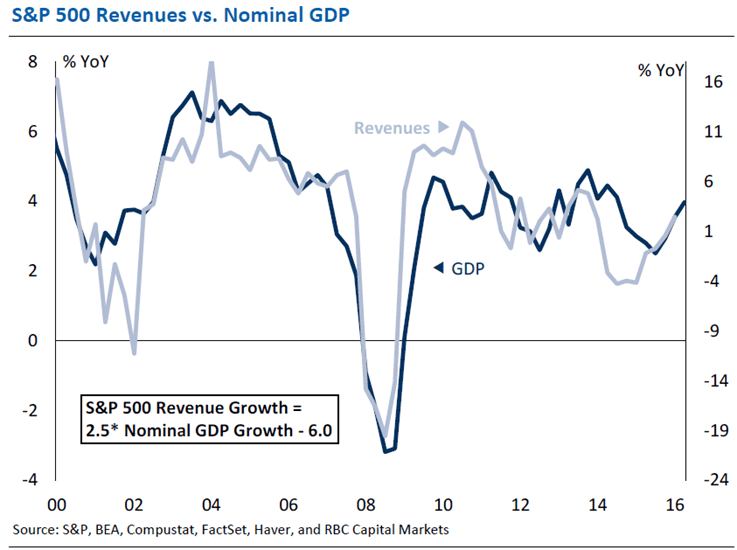
 The surprise is with EPS which are now seen up 14.4% YoY in Q1 (RBC Capital) with an unusually large 5.9% surprise. The real surprise is that the biggest surprises are coming from cyclical companies during a quarter when real GDP rose a very weak 1.9% YoY. Non-Financial cyclical companies are surprising by 8.3% so far with a 79% beat rate. While Energy companies are beating by 24.3%, Consumer Discretionary are beating by 11.1%, Industrials by 8.2% and IT by 5.5%. By comparison, Financials are beating by 5.8% and Non-Cyclicals by 2.8%.