The enemy of knowledge is not ignorance, it’s the illusion of knowledge (Stephen Hawking)

It ain’t what you don’t know that gets you into trouble. It’s what you know for sure that just ain’t so (Mark Twain)

Invest with smart knowledge and objective odds

YOUR DAILY EDGE: 15 April 2025

CONSUMER WATCH

Americans believe inflation will surge in the months ahead as tariffs take effect. The good news: Consumers see those rapid price increases as fleeting — not a permanent shock to the economy.

A line chart that displays median consumer inflation expectation over one-year and three-year horizons from June 2013 to March 2025. One-year inflation expectations peaked at 6.78% in June 2022, while the three-year rate reached a high of 4.21% in October 2021. Both rates show a downward trend since early 2023, with a recent spike in the one-year horizon in March 2025. A line chart that displays the five-year forward inflation expectation rate from April 11, 2024, to April 11, 2025. The rate starts at 2.32% and fluctuates, reaching a low of 2.02% on April 4, 2025, before closing at 2.07% on April 11, 2025.

Data: Federal Reserve Bank of St. Louis; Chart: Axios Visuals

Note that “the widely followed proxy for inflation in the 10-year TIPS market remains highly correlated with the price of a barrel of Brent crude oil, and both have been falling lately. Go figure. We are thinking that inflation might not rise as much as feared in coming months.” (Ed Yardeni)
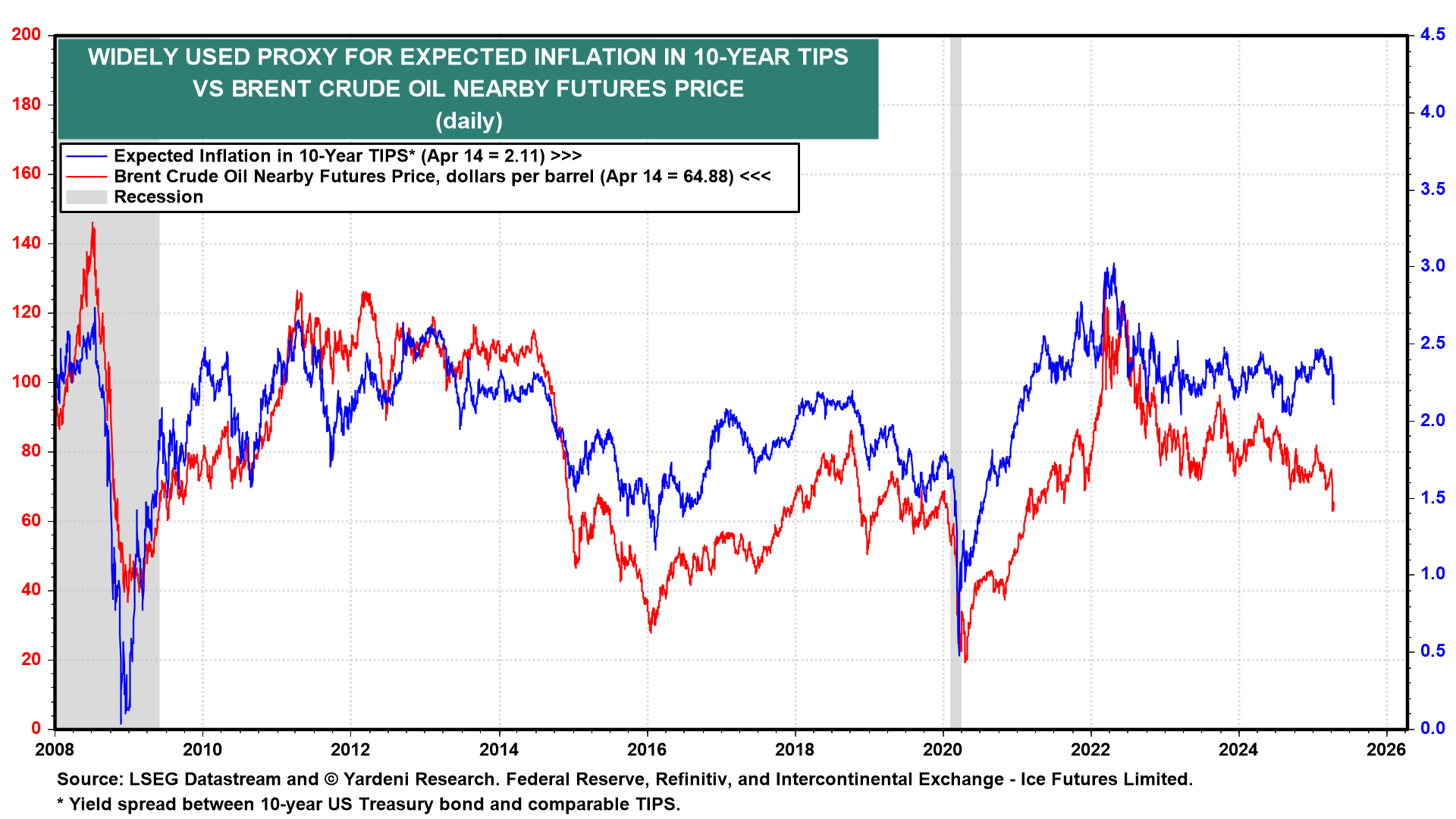
Yes, inflation might not rise as much as feared in coming months with the big drop in oil prices and slowing wages keeping services inflation low enough to offset rising goods prices.

Hassett ‘100% Not’ Expecting a US Recession This Year

White House National Economic Council Director Kevin Hassett dismissed the idea of a recession looming this year, countering some Wall Street forecasts of an economic downturn resulting from the steep tariff hikes being imposed by President Donald Trump.

Asked on Fox Business Monday whether he’s expecting a recession this year, Hassett responded, “100% not — 100% not.” He pointed to “very strong jobs numbers,” after data earlier this month showed an acceleration in payroll gains.

“Everything’s through the roof, anecdotally, with the CEOs I’ve been talking to,” Hassett said. “When I talk anecdotally to the CEOs, I say things like, ‘Well geez is the uncertainty over tariffs looking like it’s going to be a big drag?’ — and they’re saying things like, ‘No, in terms of production, we’re getting as much onshore as we can.’” (…)

Some people Mr. Hassett does not seem to talk to:

  • “Most CEOs I talk to say we are probably in a recession right now. A couple of airline CEOs told me, and one CEO specifically said, ‘The airline industry is like a proverbial burden, a canary in a coal mine.’ I was told that the canary is sick already… I do believe we’re probably starting, if not already in, a recession.” – BlackRock ($BLK ) CEO Larry Fink
  • “I think with a 90-day pause on tariffs and then probably a fairly long tail on full emergence of a clear picture… I think as every day goes by, let’s call it, this trade has negative carry to be able to hold.” – Bank of New York Mellon ($BK ) Vice Chair Robin Vince
  • “A couple of importers just yesterday, and they’ve chosen to suspend imports for a while… I know this won’t work for everyone, but it might be good just to hit the pause button if you can do it.” – Expeditors International of Washington ($EXPD ) Senior Advisor Customs Ted Henderson
  • “There’s a couple of large POs we’d like to place because of lead times, but we’re just kind of maybe holding off… So, I think a lot of people are just kind of a wait and see for a while in terms of placing any large orders.” – Richardson Electronics ($RELL ) General Manager Greg Peloquin
  • The tariff increases should pose costs of 90% to 95% for Five Below, said Oppenheimer analyst Brian Nagel.
  • Amazon Inc. is among a number of retailers — big and small — that have begun canceling orders from China and other parts of Asia. Global container bookings made between April 1 and 8 dropped 49% from the seven-day period immediately before, according to estimates from Vizion Inc., a tech company that gathers supply chain data.

Boom-bust underway:

During the period of the semiconductor shortages in 2021 and 2022, global vehicle production plunged, and as a consequence in the US, 6-10 million fewer new-vehicles were sold over the two-year period than might have been sold otherwise, and these 6-10 million missing vehicles are now not flowing into the used vehicle market.

In addition, leasing activity in 2021 and 2022 plunged, which has led to a sharp decline in the number of leases that are now maturing, and so supply of off-lease vehicles has plunged. And amid very solid demand and relatively tight inventory, retail prices started to rise again last September. (Wolfstreet.com)


Trump Floats Temporary Reprieve for Autos as Parts Tariffs Loom

President Donald Trump said he is exploring possible temporary exemptions to his tariffs on imported vehicles and parts to give auto companies more time to set up US manufacturing.

“I’m looking at something to help car companies with it,” Trump told reporters Monday in the Oval Office. “They’re switching to parts that were made in Canada, Mexico and other places, and they need a little bit of time, because they’re going to make them here.” (…)

Company representatives have told the administration that broad parts duties would drive up costs and trigger profit warnings and layoffs that would counter Trump’s goal of rebuilding US auto manufacturing. Carmakers are expected to shoulder much of the tariff burden, at least initially, with margins at many parts manufacturers already running thin.

Tariffs could add as much as $20,000 to the cost of some imported luxury vehicles, according to a report this month from research firm Anderson Economic Group. Even at the low end of the market, small sedans and crossovers with high US content could incur $2,500 to $4,500 in additional costs.

The group’s report estimated US consumer impact at $30 billion for the first full year. That would have a substantial impact on affordability, with buyers already facing average new-car prices approaching $50,000. (…)

“Look, I’m a very flexible person, I don’t change my mind, but I’m flexible, and you have to be. You just can’t have a wall, and you’ll only go, you know, sometimes you have to go around it under it or above it.” Trump told reporters.

“I helped Tim Cook recently and that whole business,” the president continued, referring to the Apple chief executive officer. “I don’t want to hurt anybody. But the end result is we’re going to get to the position of greatness for our country.” (…)

Made-in-China Toy Billionaire Says Tariffs Will Double US Prices

Toy billionaire Nick Mowbray said President Donald Trump’s tariffs have “paralyzed” his company and left it with little choice but to pump up retail prices in the US. (…)

“At the tariff levels right now, in toys at least, those retail prices need to nearly double,” Mowbray said in a telephone interview from Los Angeles. “We are in the same bucket as most of our competitors, given 80% of toys are made in China. Trump is probably going to steal Christmas from families and kids across the US.” (…)

Zuru is negotiating with retailers, many of whom have paused orders, Mowbray said.

“We’re reviewing our retail prices every day. They have to go up significantly,” he said. “We have to review how much of the tariff we are willing to absorb ourselves.” (…)

Mowbray said moving the company’s manufacturing to the US is not an option.

When it comes to toy-making, China has “a deep, deep ecosystem and the supply chain is very tight,” he said. “It’s very difficult even to go to places like Vietnam or India because the supply chain just doesn’t exist in the same way as it does in China.” (…)

“We’ve spent 22 years building this, and one or two people can upset it so much,” Mowbray said. “It’s a little bit hard to comprehend.”

CHINA

Goldman Sachs in China:

Our [Chinese] speakers concurred on the increasing importance of maintaining strong relationships with other trading partners, particularly the EU, given the anticipated significant decline in exports to the US. However, the Chinese government’s ability to strengthen these relationships remains uncertain. Substantive efforts would be required to encourage the EU to enhance trade ties with China.

These efforts could involve reducing tariff and non-tariff barriers, increasing Chinese imports from the EU, and promoting investment and technology transfer to the EU. Furthermore, the Chinese government would need to ensure that the surplus supply resulting from decreased exports to the US is not significantly redirected into the EU market.

Short-term measures should target middle-class households, whose consumption growth has decelerated the most in recent years, with stabilization of the stock and property markets as a key solution. Long-term measures should focus on low-income households, with a strengthening of the social safety net as the primary remedy.

Given the abrupt increase in US tariffs and a weakening economy, our speakers anticipate that policymakers may prioritize short-term consumption-boosting measures. Furthermore, our speakers believe that there is less potential for growth in goods consumption in China compared to services consumption. Considering the ongoing government-subsidized consumer goods trade-in program targeting goods consumption, new policies may target services consumption.

More targeted programs, such as childbirth subsidies, are probable.

Higher tariffs and declining exports could lead to renewed downward pressure on the property market in the coming months.

At China’s Wholesale Hub, U.S. Orders Have Suddenly Halted. One Example: Socks. Chinese sellers remain confident despite higher tariffs, saying it no longer makes sense to sell everyday goods to Americans

At the world’s biggest wholesale market in this eastern Chinese exporting hub, American clients have disappeared.

The Americans, or their representatives, used to show up to buy everything from Paw Patrol plushy dolls to Panama hats to toy sniper rifles. The famous Yiwu market here has 75,000 vendors across an area bigger than 1,000 American football fields; no other place sells so much stuff, so cheaply, and for decades, much of it went to the voracious U.S. consumer. (…)

Yet during a visit by a Wall Street Journal reporter, vendors said they were confident they would survive, sustained by sales to other buyers, and a bit perplexed. Where would the Americans get all their sparkly keychains, baseball caps and coffee thermoses now?

For some everyday items, such as socks, they said it might not be easy.

“They could get things from other countries, but I don’t know if the other countries can produce them as well as China,” said Zhou Li of socks maker Shen Li, referring to the U.S. “China’s ability to make stuff is just seriously incredible.” (…)

One subdistrict of Zhuji produces some 25 billion pairs of socks a year, or about a third of global socks production, state media Xinhua said.

In 2023, China accounted for 56% of American imports of socks and stockings, data from the International Trade Center’s Trade Map showed.

Socks are a low-margin item, however. Lowering their prices to offset the 145% American tariffs—which are paid by the importers—wouldn’t be feasible for sock makers, the manufacturers said. That means importers will need to cut into their profits, ask Americans to pay a lot more, or figure out some other country from which to buy low-cost socks to keep their feet warm and comfortable. (…)

Other countries, especially Pakistan, Honduras and El Salvador, also make lots of socks, and can likely pick up some of the slack if orders no longer come from China in large volumes.

But China’s prices and speed, backed by an army of skilled workers, are hard to beat. American consumers might have to pay more to buy from other countries, and could face capacity constraints if they suddenly shift orders for millions of socks to other places. (…)

That’s sharply weaker than the 0.88% loss registered during the previous week, when Trump first announced his plan for reciprocal tariffs.

Container throughput dropped 6.1%, reversing a 1.9% rise a week earlier, according to data from the transport ministry Tuesday.

The numbers mark a stark reversal from the steady increase in weekly port volumes since the end of the week-long Lunar New Year holidays starting late January. (…)

For the week ended April 11, the Ningbo Container Freight Index reported an 18.0% week-over-week slide in freight rates to the U.S. west coast and a 10.8% decline in the cost of shipping to the east coast, according to data provider Wind.

In contrast, the cost of freight to Europe increased 1.8% over the same period, with rates to western and eastern Mediterranean rising 15.3% and 13.0%, respectively. Freight costs via South American east routes soared 52.5%. (…)

Trump’s Trade War Deepens Threat to U.S. Brands in China Tariff fight arrives as Chinese consumers are turning to domestic goods

(…) From smartphones to fast food, major American brands are rapidly losing market share in China to domestic rivals. (…)

Many of America’s most popular brands around the world—Nike, Starbucks, Tom Cruise—have run into competition in China from newer companies trying to beat them at their own game, eroding years of American dominance and soft power.

In March, Nike said its quarterly sales in China had dropped 17% from the previous year. That month, domestic Tesla sales were down 12%. BMW, Porsche, Apple, Starbucks and L’Oréal have all warned investors that the China growth that was once a quarterly refrain had turned into slumping sales. (…)

Hollywood movies are part of the service trade between the U.S. and China, a new front in the trade war. Unlike goods, the U.S. sells more services to China than the other way around. Movies are a much smaller part of that trade than other sectors, such as the billions of dollars that Chinese families spend on a U.S. college education, but few sectors match their symbolic heft.

Trump, who has frequently turned major studios such as Disney into political targets, had little sympathy for the studios eyeing an uncertain future. Asked Thursday about the restrictions on cultural imports such as American movies, Trump responded, “I’ve heard of worse things.” (…)

A window into Beijing’s calculus will come soon. Brad Pitt’s new movie, the big-budget racing drama “F1,” is scheduled to be submitted to Communist Party authorities for review this week. (…)

China Orders Boeing Jet Delivery Halt as Trade War Expands Beijing has also asked that Chinese carriers halt any purchases of aircraft-related equipment and parts from US companies

Ed Yardeni:

When Trump was asked whether he would use military force against a blockade of Taiwan, he responded, “I wouldn’t have to, because he [Chinese President Xi Jinping] respects me and he knows I’m f— crazy.” Trump also said, “I would say: If you go into Taiwan, I’m sorry to do this, I’m going to tax you”—meaning impose tariffs—”at 150% to 200%.” Trump suggested that he might even shut down trade between the US and China altogether.

Trump has already played his card by imposing a 145% tariff on China. The Chinese retaliated with a 125% tariff and now export controls on rare earths to the US.

The Chinese economy is much more vulnerable than is the US economy to a trade war between the two superpowers. President Xi might conclude that now is a good time to invade Taiwan since Trump has played his tariff card and Xi needs a diversion from the calamity about to befall his economy. Geopolitical risks are rising.

I disagree with Ed on the respective vulnerabilities. Today’s FT explains:

China had a trade surplus of almost $300bn with the US last year, with about 15 per cent of its total exports heading into the US. Trump’s tariffs of 145 per cent would inflict significant pain on Beijing.

But international economists said this overlooks one crucial fact: China can replace its imports from the US more easily than the other way around. US goods exports to China are heavily focused on agriculture — such as soyabeans, cotton, beef and poultry — and so are low value-added. Many US imports from China — electronics, machinery and some processed minerals — are the opposite.

German Economic Sentiment Collapses on Trump’s Tariff Chaos The ZEW Indicator of Economic Sentiment has posted its steepest decline since Russia’s full-scale invasion of Ukraine in 2022

The ZEW Indicator of Economic Sentiment, a gauge that tracks the expectations of analysts at 168 banks, insurance companies and other businesses, dived 65.6 points on month to minus 14.0 in April. (…)

“The erratic changes in the U.S. trade policy are weighing heavily on expectations in Germany,” ZEW President Achim Wambach said.

“It is not only the consequences the announced reciprocal tariffs may have on global trade, but also the dynamics of their changes, that have massively increased global uncertainty,” he added.

Goldman’s revised, revised, revised outlook:

Following President Trump’s April 9 announcement that the supplementary portion of the April 2 “reciprocal” tariffs will be paused for 90 days, we reversed the US recession call we had published less than two hours earlier. Implementation of this tariff would have pushed the 2025 effective tariff rate increase to a likely recessionary 20pp+.

Delaying (and perhaps ultimately rescinding) the supplementary tariff should limit the increase to a number closer to the 15pp we had expected before April 2, even considering the prospect of additional tariffs on pharmaceuticals, semiconductors, and other “critical goods.” We estimate that a 15pp increase in the tariff rate will cause US GDP growth to fall from 2.5% in 2024 to 0.5% in 2025, both on a Q4/Q4 basis, but will not quite trigger a recession.

image

However, the outlook remains fluid, particularly with respect to the China tariffs. Will the exemptions (or rate reductions) for telecoms and semiconductor equipment remain in place? Will Chinese firms be able to reroute their exports to the US via other Asian countries such as Vietnam?

And is there any hope for an agreement that brings broad tariff rates back to levels which allow for at least a moderate amount of mutually beneficial trade outside of favored products and sectors? In part because of these uncertainties and in part because it is unclear how the US economy will cope with the dramatic increase in uncertainty, we still peg the probability of a full-blown recession over the next 12 months at 45% and view the bar for returning to a recession baseline as low.

One key economic question is the resilience of the US labor market. So far, there are few signs of deterioration. The March employment report was solid, initial jobless claims remain low, and few private-sector firms have reported large-scale layoffs. A bigger uncertainty is gross hiring, which is harder to observe in real time but typically accounts for more of the ups and downs of net job growth.

In an environment marked by extreme business uncertainty, hiring is likely to decline further from its already depressed pre-tariff level—the only real question is how much. Our forecast assumes a moderate decline that pushes the unemployment rate from 4.2% now to 4.7% at yearend, but the risks are tilted to a sharper drop in hiring and a bigger increase in joblessness.

In the Euro area, we now expect real GDP in 2025 to grow just 0.3% on a Q4/Q4 basis. While the revision is smaller than in the US, the interest rate implications are more clearly dovish because tariffs are unlikely to affect European inflation much—in fact, we cut our core HICP forecast further to 1.8% in late 2026 because of the weaker growth picture and likely trade diversion from China. We now expect the ECB to keep cutting sequentially until the deposit rate reaches 1.5% (vs. 1.75% before).

We have also cut our growth and inflation forecasts in the UK and now see Bank Rate falling to 2.75% in 2026 (vs. 3% before), though our best guess is that the pace of cuts will remain quarterly.

We estimate that the direct and indirect effects of the latest tariff escalation will shave 1.7pp from China’s growth pace. However, we expect a sharp turn to easier macro policies—including an increase in the augmented fiscal deficit to a whopping 14.5% of GDP—to offset 1.2pp of this hit and have therefore downgraded our annual average growth forecasts by “only” 0.5pp, to 4% in 2025 and 3½% in 2026. The aggressive easing moves show that the Chinese leadership is preparing for a protracted economic confrontation in which it wants to be less dependent on US demand.

Our FX strategists have turned very negative on the US dollar, especially versus the yen, euro, and Swiss franc. One reason is simply valuation. Even after the depreciation of the past two months, the Fed’s real broad trade-weighted dollar index remains 20% (or two standard deviations) stronger than its long-term average. Perhaps more

importantly, the turn toward protectionism has weakened the case for US growth outperformance not only in the short term but also in the longer term. Our FX strategists note that such a creeping deterioration in relative US economic performance may have a larger negative impact than a full-blown recession, which can set off a flight to safety and boost dollar valuations along the lines of the well-known “dollar smile.”

While equity markets appear to be discounting an economic scenario similar to our baseline forecast and the still-high level of implied volatility could set the stage for further near-term price gains, our equity and cross-asset strategists remain cautious because current pricing does not offer much risk premium relative to our 45% recession probability.

  • If it might seem as though we’re spending too much time on prognosticating where the tariff conflict will go, there’s a reason. Earnings for the rest of this year, and the multiples to place on them, are critically affected by how far the tariff walls are set. Until that’s resolved, nobody much pretends to have a clue as to the stock market’s direction. There’s not much to do beyond try to work it out. (John Authers)
Investors Haven’t Been This Bearish in 30 Years, BofA Poll Shows

Investor sentiment regarding economic prospects is the most negative in three decades, yet fund managers’ pessimism isn’t fully reflected in their asset allocation which could mean more losses for US stocks, a Bank of America Corp. survey shows.

Fund managers are extremely gloomy, with 82% of respondents to BofA’s monthly survey expecting the global economy to weaken. Consequently, a record number intend to reduce exposure to US equities, according to the poll.

Fund mangers are “max bearish on macro, not quite max bearish on the market,” strategists led by Michael Hartnett wrote in a note. “Peak fear” is not yet reflected in cash allocations, which currently stands at 4.8% of assets and would typically need to rise to 6%, they added. (…)

Respondents are a net 36% underweight US stocks in April, down from 17% overweight in February, the biggest ever two-month drop. (…)

image

Source: Bank of AmericaSource: Bank of America


Source: Baker, Bloom & Davis and Wells Fargo Economics

Top Federal Reserve official says US could require rate cuts if big tariffs return Governor Christopher Waller warns that should Trump resume steep duties growth will ‘slow to a crawl’

The Federal Reserve may need to cut interest rates sharply to prop up the US economy if Donald Trump follows through on his threat to resume big “reciprocal” tariffs, a top official at the central bank has warned.  Christopher Waller, a Federal Reserve governor, said on Monday that if the US president reimposes the levies unveiled on April 2, then the US central bank would be forced to quickly make a series of “bad news” rate cuts. (…)

Waller said that if Trump applies big reciprocal tariffs after the pause, US economic growth would “slow to a crawl”, while the unemployment rate would rise “significantly” from 4.2 per cent to 5 per cent next year. (…)

“While I expect the inflationary effects of higher tariffs to be temporary, their effects on output and employment could be longer-lasting and an important factor in determining the appropriate stance of monetary policy,” said Waller on Monday. “If the slowdown is significant and even threatens a recession, then I would expect to favour cutting the . . . policy rate sooner, and to a greater extent than I had previously thought.” (…)

Other FOMC members have stuck by a “wait and see” approach to lowering borrowing costs, saying that they would need to see evidence in the hard data of a slowdown before responding. (…)

(…) The Atlanta Fed chief anticipates economic growth upwards of 1% this year, but he said there’s a lot of uncertainty around that outlook. He described the economy as being in a “big pause position.” Bostic pointed to businesses holding off on investments and consumers delaying big purchases.

“There’s enough uncertainty moving forward about the stability and the robustness of growth that most business leaders are not eager to just sort of get out ahead of things and hire,” Bostic said. “Whether that will persist is, I think, one of the big questions that we’re all going to have to be watching for and tracking moving forward.”

Time to hear from Scott Bessent:

Pointing up Treasury Secretary Scott Bessent on Tariffs, Bonds and the Next Fed Chair

Proposed Republican tax change would lead to spike in costs for Canadians who invest in U.S. securities

Canadian investors holding U.S.-listed securities could see a sudden spike in the amount of tax they owe under a recent U.S. bill that has been tabled as a retaliatory measure against what it calls “discriminatory taxes” of foreign countries, including Canada’s digital services tax.

If passed, the proposed legislation would add 5 percentage points to the withholding tax rate each year for four years on certain types of U.S. income for anyone living in a country that imposes a tax that the U.S. considers discriminatory or extraterritorial for U.S. citizens or corporations. The additional 20-per-cent withholding tax would remain in place as long as the other country’s disputed tax is in effect.

The proposed bill appears to be targeting jurisdictions that have implemented a digital services tax on large U.S. technology companies or have an undertaxed payments rule (UTPR). Canada’s DST was enacted in 2024.

The proposal means that Canadians who own U.S. securities that pay dividends or interest, or have realized gains, could see a large tax increase, said Kris Rossignoli, a cross-border tax and financial planner with Cardinal Point Wealth in New York. (…)

Typically, non-U.S. residents are subject to a 30-per-cent withholding tax on U.S. dividends. Currently, under the Canada-U.S. tax treaty, Canadians receive a reduced tax rate of 15 per cent. (…)

But under the proposed draft legislation – known as H.R. 591 – Canadian investors could be now be denied the reduction and required to pay the higher 30-per-cent rate. Investors would also be subject to the additional 20-percentage-point rate hike, bringing their withholding tax rate to 50 per cent.

In addition, the Canada-U.S. tax treaty currently provides an exemption from withholding tax earned within certain registered retirement accounts, such as a registered retirement savings plan. However, the proposed bill could override the current tax treaty, and expose retirement accounts to an immediate 35-per-cent withholding tax, including the first annual 5-percentage-point hike.

Karl Dennis, KPMG’s national leader for the U.S. corporate tax team in Canada, said it is still early days in the legislative process for the proposed tax bill, and Canadian investors should not make any drastic changes to their investment portfolio as a result.

In the U.S., there are dozens of legislative proposals put forward by members of Congress, he said, and few of them make it into tax law.

However, a number of Republicans have voiced support for the revised tax changes – a “step towards becoming more real,” he added.

President Donald Trump has been targeting taxes in more than 120 countries that he argues discriminate against American companies. One of his biggest complaints is the digital services tax that Canada enacted last year, which requires tech giants such as Amazon, Google, and Facebook to pay a 3-per-cent levy on revenue they generate from Canadian users. (A number of other countries such as Britain, Spain, Italy and France have imposed a DST for years without any retaliation from the U.S.) (…)

KMPG’s Mr. Dennis said it is unclear how the current draft bill would be passed as it is currently “not very articulately worded” and has some “internal inconsistencies” in it.

“It will need more work before it can be put up to vote,” he said.

Confused smile Trump again blames Ukraine for starting war with Russia

(…)  “Listen, when you start a war, you gotta know you can win a war,” Trump said. “You don’t start a war against somebody that’s 20 times your size and then hope that people give you some missiles.” (…)

While Ukraine has agreed to Trump’s offer, Putin has taken a hard line and shown no signs of stepping back from his maximalist demands for ending his three-year invasion of the country. The Russian admission of the missile strike on Sumy also appeared to contradict Trump’s claims on Sunday evening that Russia had “made a mistake” in the attack. (…)

YOUR DAILY EDGE: 14 April 2025

Trump’s Exceptional Tariff Weekend His Customs office announced tariff-rate exceptions on electronics on Friday that he renounced on Sunday.

The WSJ Editorial Board:

President Trump is taking exception to the idea that his Administration is offering exceptions to his punishing tariffs. That’s the story after a confusing weekend that offers more lessons in the arbitrary nature of Trump trade policy.

Late Friday his own Customs and Border Protection (CBP) department issued a notice listing products that will be exempt from Mr. Trump’s so-called reciprocal tariffs that can run as high as 145% on goods from China. The exclusions apply to smartphones, laptop computers, hard drives, computer processors, servers, memory chips, semiconductor manufacturing equipment, and other electronics.

The CBP notice takes the tariff rate on these products down considerably. Barron’s calculates that the exceptions cover $385 billion in 2024 imports. That includes $100 billion from China, or 23% of U.S. imports from that country. The tariff rate falls to 20% on the newly exempted Chinese exports.

The press spent Saturday reporting this without cavil from the White House. We weighed in with a WSJ.com editorial on Saturday afternoon, noting that this meant a big reprieve for powerful tech companies, though not for small manufacturers.

But on Sunday morning Commerce Secretary Howard Lutnick said tariffs on electronic goods would go up again in the future, though he offered no details. Mr. Lutnick hasn’t been the most reliable voice on the Administration’s plans, so that was taken with some caution.

Finally Mr. Trump jumped in late Sunday afternoon. “NOBODY is getting ‘off the hook’ for the unfair Trade Balances, and Non Monetary Tariff Barriers, that other Countries have used against us, especially not China which, by far, treats us the worst!” he wrote. “There was no Tariff ‘exception’ announced on Friday. These products are subject to the existing 20% Fentanyl Tariffs, and they are just moving to a different Tariff ‘bucket.’”

Mr. Trump blamed the press for reporting the exceptions that his own CBP had announced, albeit in stealth fashion at 10:36 p.m. Friday. And he announced that his Administration is taking a “look at Semiconductors and the WHOLE ELECTRONICS SUPPLY CHAIN” for potential tariffs.

So what happened and what’s the real policy? Who knows? Perhaps Mr. Trump didn’t like the reporting that tech giants like Apple and its shrewd and capable CEO Tim Cook were getting exceptions. Other winners in the CBP notice would be Dell Technologies’ Michael Dell, Jensen Huang of Nvidia, and the executives and shareholders of Hewlett-Packard and TSMC.

This is no rap on them, since their job is to look out for the best interests of shareholders and that means getting tariff carve-outs if they can. Some of the companies may not have sought exemptions, though the opacity of the process for getting one is the Beltway Swamp’s dream.

These CBP exemptions would be good news for consumers who were otherwise facing much higher prices for smartphones that are a staple of modern life. How would you like a $2,400 iPhone? But after Mr. Trump’s broadside, tech companies and electronics firms are left wondering who will get reprieves.

Perhaps Mr. Trump doesn’t like that exceptions are a tacit admission that tariffs will make American companies less globally competitive, especially in the artificial intelligence race. That explains the exemptions for ASML’s chip-making equipment and Nvidia’s graphic processing units. Mr. Trump first makes U.S. companies less competitive, then he and his Administration pick exceptions worthy of help to remain competitive. Politicians, not success in the marketplace, pick business winners and losers.

Exemptions would also undermine the Administration’s legal justification that his tariffs are needed to meet a national “emergency.” Imports of glassware and umbrellas from China are an emergency but imports of electronics aren’t?

All of this exposes the political nature of tariffs. Some industries benefit but others don’t. Too bad if you make shoes, or clothing, or thousands of other consumer products that must pay the tariffs but lack the political or market clout to win exemptions. Too bad, too, if you’re a small manufacturer that relies on a component from China but can’t afford a K Street lobbyist.

Welcome to the new tariff economy, where you still pay onerous taxes, endure punishing regulation, and now must also navigate the political minefield of arbitrary tariffs.

Bloomberg:

Trump told reporters aboard Air Force One his decisions will come soon, indicating that details on a tariff rate for semiconductors would be announced in the coming week.

Yet Trump also signaled an openness to talks with companies over the scope of his sectoral tariff on semiconductors and products like iPhones and tablets that rely on them. “We’ll be discussing it, but we’ll also talk to companies,” he said. “You have to show a certain flexibility. Nobody should be so rigid.”

Sunday night’s “Nobody” seems different than Sunday afternoon’s “NOBODY”. In this Trump game, one is much better being “somebody” than “nobody”.

Still, the maneuver means weeks, maybe months, without extra tariffs on the array of phones and computers before the specific sectoral tariff on electronics kicks in — one virtually certain to be lower than the 125% rate on China, another level of reprieve. It also opens a window for companies and lobbyists to push for different parameters and exclusions.

Trump, aboard Air Force One late Sunday, said the tariffs would be in place “in the not too distant future.”

The semiconductor tariffs are “coming in probably a month or two,” Lutnick said. He said a notice will be published in the federal registry this week related to semiconductors, but he didn’t elaborate. The administration will likely need to launch a so-called Section 232 investigation as a next step, which would require a report within 270 days and then open the door to tariffs. (…)

In some ways, Trump’s Friday exclusions were an announcement of the products that will ultimately be under the “semiconductor” sectoral tariff.

It’s not clear what tariff rate the administration would apply to semiconductors and products it covers under that tax, but they’ve been 25% so far on other industries. Those Section 232 tariffs may prove more permanent than Trump’s country rates, which are based on a more vulnerable legal authority and which he’s said he will negotiate.

The tariff reprieve does not extend to a separate Trump levy on China — a 20% duty applied to pressure Beijing to crack down on fentanyl, including the shipment of precursor materials. Other previously existing levies, including those that predate Trump’s current term, also appear unaffected.

Trump, in his social media post Sunday, reiterated that the 20% rate still applies.

On China, “everyone pays at least the 20% and these particular components are being put through a separate process controlled by the Department of Commerce which is the 232,” Lutnick told ABC.

There you go!

Apple Was on Brink of Crisis Before Trump Tariff Concession

(…) On Friday night, the US president handed Apple a major victory, exempting many popular consumer electronics. That includes iPhones, iPads, Macs, Apple Watches and AirTags.

Another win: The 10% tariff on goods imported from other countries has been dropped for those products. (…)

“This is a major relief for Apple,” Evercore ISI analyst Amit Daryanani said in a note on Saturday. “The tariffs would have driven material cost inflation.” (…)

If Apple moves even more production from China at a rapid pace, how would the country retaliate? Apple generates about 17% of its revenue from the country and operates dozens of stores, making it an outlier among US-based companies. (…)

The iPhone is Apple’s biggest moneymaker, and about 87% of them are produced in China, according to estimates from Morgan Stanley. About four in five iPads also are made in the country, along with 60% of Macs. (…)

The company generates about 38% of its iPad sales in the US, as well as about half its Mac, Apple Watch and AirPods revenue, Morgan Stanley estimates. (…)

Though Trump has pushed Apple to make iPhones in the US, the lack of domestic engineering and manufacturing talent will make that nearly impossible in the short run.

The size and scale of the facilities in China makes it unmatched in speed and efficiency. The China production also is crucial for Apple’s sales in the world beyond the US. The Cupertino, California-based company gets nearly 60% of its revenue outside of the Americas. (…)

The potential impact was even more stark after Trump paused higher tariffs on other countries. That meant Apple rival Samsung Electronics Co., which makes its phones outside China, would have had an edge. (…)

Darn! This is so complex …

BTW: Research from the US Department of Commerce found that at least 48% of all manufactured goods purchased in America were reliant on direct or indirect imports.

John Authers:

  • Why is the US complaining of being victimized for 70 years when in reality, it’s ruled the world and enjoyed great prosperity?

This might be the greatest mystery of all. In absolute terms, nothing bad has happened to the US economy over the last few decades. Its gross domestic product per capita is much greater than that of the European Union or China, and continues to grow healthily. If the US is being taken advantage of, it doesn’t show up in the aggregate figures (…):

  • Why is the dollar falling, even though Treasury yields are rising?

(…) Put all these together, and the only explanation is a loss of confidence in the US as a destination for funds. Last week’s combination of rising yields and a falling currency is reminiscent of any number of emerging markets crises, and of the one for gilts and sterling that followed Prime Minister Liz Truss’s unfunded UK tax cuts in 2022. It’s amazing that such a fate can befall the US. Truss capitulated and sterling rebounded; that’s generally the pattern that emerging crises follow. Amazingly, that is now the template for the US.

  • How is anyone supposed to make sense of this?

(…) The bottom line for markets: The US is in a weak place and making concessions. That’s good news compared to the last couple of weeks, so an equity rally at Monday’s open seems likely. That said, the sheer ad hoc nature of policymaking over a sector as important as iPhones and laptops shows ever more conclusively that the children are in charge. This is amateur hour, and terrifying. Ultimately, nobody can give a confident answer to the question. Risks and volatility are likely to continue.

FYI:

In new research, Hanson and Enrico Moretti find that in 1980 manufacturing accounted for 39% of the U.S. jobs where workers earned high wages (after adjusting for factors such as education). By 2021 that had dropped to 20%. Over the same period, the share of high-paying jobs in the finance, professional and legal industries jumped from 8% to 26%. (WSJ)

image

CONSUMER WATCH

Buying ahead, easing or doing fine?

Credit and debit card spending per household increased 1.1% year-over-year (YoY) in March after a decline of 2.3% YoY in February, according to Bank of America aggregated card data. Seasonally adjusted (SA) spending per household rose 0.2% month-over-month (MoM), following the 0.3% MoM rise in February and –0.4% in January. (…)

Looking at spending by income, we see a consistent trend: higher-income households show no clear sign yet of easing their spending. The top third of households by income (which accounts for over half of overall US consumer spending according to Bureau of Economic Analysis data) have largely had higher card spending growth than middle- or lower-income peers for more than a year. (…)

However, the pace of growth for higher-income households broke a four-month acceleration streak in March 2025, with after-tax wage and salary growth for this cohort up 2.6% YoY in March versus 3.6% in February. And, notably, after-tax wage growth for lower-income households was just 1.4% YoY, the lowest rate of wage growth since April 2017, according to Bank of America deposit data.

As we move further into the tax season, returns continued to help buoy consumers, though somewhat more so for lower- and middle-income households. Over the 2025 tax filing season, average federal and state tax refund payments into Bank of America deposit accounts for households at the lower-end of the income distribution were up around 1.5% YoY as of April 4, with increases of about 1.8% YoY for those earning middle-incomes and 0.4% YoY for higher-income households. However, particularly for the highest earners, the impact of recent declines in global equity markets may prove more consequential to their spending. (…)

Looking at large household durables (washing machines, refrigerators etc.), the University of Michigan March 2025 Survey of Consumers continues to suggest that some consumers do think it is a “good time to buy large household goods (or vehicles) as prices are going higher.” This survey response remains close to its highest point in 10 years. (…)

image image

Within total card spending, retail spending (ex-gas and restaurants) increased 0.5% MoM in March, while overall spending on services increased by 0.1%

Services spending is comprised of both “nice-to-have” discretionary choices – such as dining out, going to the movies or traveling – and “must-have” nondiscretionary expenses such as rent, utilities, and insurance. Looking at Bank of America card data, it appears that consumers are easing up on “nice to have” spending by pulling back across restaurant, travel/tourism and leisure spending in February and March. By contrast, these categories had strong growth in the fourth quarter of 2024.

image image

Additionally, our proxy for durables spending using Bank of America credit and debit card spending data, which includes auto parts, furniture, electronics, and building materials, increased 1.5% MoM in March after two months of declines

One category where buying ahead is clear appears to be vehicles. Car and truck sales surged in March. And using Bank of America internal data on consumer vehicle loan (CVL) applications, we see that there was a surge in loan applications at the end of March following the March 26 announcement that tariffs on vehicle and vehicle parts will go into effect April 2. In fact, vehicle loan applications were up 23% YoY for the period between March 27-April 1.

Some of the weakness in discretionary services spending likely reflects weather-related disruptions at the start of this year. But the sharp drop in consumer sentiment along with rising cost of living pressures may also be a factor. Reflecting these cost pressures, nondiscretionary services spending growth continues to rise (Exhibit 17). Importantly, much of this spending is partly a function of rising prices – insurance, rents and utilities are all seeing price growth above the overall US CPI inflation rate. So, while the nondiscretionary part of services spending may well persist, this itself might chip further away at discretionary spending.

‘From Anxious to Petrified’: Consumer Sentiment Plunges Further The University of Michigan’s closely watched index hit its second-lowest reading on record, dragged down by fears of higher prices and unemployment

(…) Sentiment is now at its second-lowest level in history, according to the survey. It was slightly lower in June 2022, when inflation was soaring thanks to snarled supply chains and pandemic buying. Back in 2022, the index touched 50, which was the lowest reading on record going back to 1952.

Sentiment declined for Democrats, Republicans and independents alike.

Sentiment for independents reached the lowest level on record. Sentiment for Republicans was the lowest it has been for almost any time during a Trump administration. (…)

Respondents also said they were bracing for prices to surge 6.7% in the year ahead—a level of pessimism about costs last seen in the inflation-wracked early 1980s. That suggests Americans expect tariffs will push up prices fast (…).

image

Longer-run expectations, for inflation over a five-year horizon, increased to 4.4%. A year ago, they stood at 3%.

The share of consumers expecting unemployment to rise in the year ahead rose for the fifth consecutive month to the highest since 2009. (…)

Consumers appear to be blaming Trump for his handling of the economy, said James Knightley, chief international economist at ING. He noted that 67% of respondents in the Michigan survey said the government is doing a poor job fighting inflation and unemployment, up from 44% in January.

“So you’ve got income, prices and wealth all moving against the consumer, and that is not a pretty picture,” he said.

European travellers cancel US visits as Trump’s policies threaten tourism International visitors stay away as political and economic tension and fears of a hostile border rise

Visitors from western Europe who stayed at least one night in the US fell by 17 per cent in March from a year ago, according to the International Trade Administration. (…)

The total number of overseas visitors travelling to the US dropped by 12 per cent year-on-year in March, the steepest decline since March 2021 when the travel sector was reeling from pandemic restrictions, according to the ITA data.

The trend poses a threat to the US tourism industry, which accounts for 2.5 per cent of the country’s GDP. (…)

“In just two months [Trump] has destroyed the reputation of the US, shown one way by diminished travel from the EU to the US,” said Paul English, co-founder of travel website Kayak. “This is not only one more terrible blow to the US economy, it also represents reputation damage that could take generations to repair.”

(…) other data, including from US airports and land crossings from Canada, all showed “it’s very clear something is happening . . . and it is a reaction to Trump”. (…)

Naren Shaam, CEO of travel booking site Omio, said cancellation rates for bookings to the US were 16 per cent higher in the first quarter than a year earlier — with travellers from the UK, Germany and France showing an even higher cancellation rate of 40 per cent. (…)

Accor last week said bookings for Europeans visitors to the US this summer were down 25 per cent.

Last year, international visitors spent more than $253bn on US travel and tourism-related goods and services, according to the ITA, or more than 19 per cent of $1.3tn in US travel spending in 2024. (…)

Places in the US such as Las Vegas, for example, welcomed 1.4mn Canadians in 2023 — or a quarter of all international visitors. (…)

image

(…) At least a third of the 1,000 US consumers who were surveyed by travel research and marketing firm MMGY earlier this month say they plan to travel closer to home this year. (…)

Travel agents we spoke to this week say their clients are rethinking established plans to go abroad. (…)

Clients, she says, are asking questions such as “ ‘Are we not popular abroad? or ‘Are things getting too expensive?’ ” while also worrying that their investment portfolios and 401(k)s have just gone “down by a whole lot.” The net effect, Vazquez says, is that they’re focusing “a little bit more on domestic travel rather than going abroad.” (…)

But making Americans refocus their travels domestically won’t exactly make the US travel industry great again. The economic turmoil around the “reciprocal tariffs” we read about all week is not only making it harder for Americans to commit to trips abroad, it’s also making it harder for foreigners to access the country.

Canadian flight bookings to the US through September are down 70% year-over-year, according to a report by OAG Aviation Worldwide, causing United Airlines to pull back on routes that cross the northern border. In another report, 50% of Brits said they also plan to travel locally this year. Delta Air Lines has cut down on capacity increases this year, and demand has been low enough on Air France that the carrier is reducing international economy fares. (…)

European bookings to the US this summer have fallen by 25%, according to Sébastien Bazin, chief executive officer of French hotel group Accor SA, which is estimated to result in a $9 billion loss in visitor spending.

Hotels up and down the West Coast (and in Florida) are feeling iced out by Canadians, who normally come thaw from their chilly winters in places such as Palm Springs, California, whose downtown is now plastered with signs saying “Palm Springs loves Canada.” We’ve even heard that some hotels in California are considering offering discounts to our northern neighbors to try to curb the damage. (…)

(…) Many Canadians are giving up their U.S. vacation homes, selling properties they have owned for decades in popular snowbird spots like Florida and Arizona, according to local real-estate agents.

One factor is economics: The Canadian dollar in recent months had weakened against the U.S. dollar—earlier this year hitting its lowest level in 22 years—making it more expensive for Canadians to pay HOA fees, insurance and property taxes in the U.S. On the flip side, selling their homes in U.S. dollars was more of a boon, especially since property values in popular winter escapes have risen significantly. 

While the broader economic arguments for selling have been compelling for months, what’s pushing many over the edge now is politics, real-estate agents say.  (…)

Brokers say their clients talk about feeling increasingly unwelcome and worry that the government may increase taxes on properties owned by Canadians. Other measures, such as the new rule requiring foreign nationals who stay in America for more than 30 days to register with the government, have made them nervous about future travel restrictions, agents say. 

“The key word is ‘uncertainty,’” says Catherine Spino with Lyonsgate Realty in Boca Raton, Fla., where she has been a real-estate agent for nine years. Since January, she has seen twice as many Canadian clients list their homes compared with the usual amount this time of year—and a sharp decline in Canadians looking to buy homes in the area.  (…)

The firm typically got calls from about two Canadian clients a week who had either sold or were selling in the U.S. For the past couple months, that has surged to 20 to 30 a week, he says. (…)

In the greater Phoenix area, there has been a dramatic increase in Canadians selling their property, says Miles Zimbaluk, a real-state agent with HomeSmart in Scottsdale, Ariz. Such listings climbed to around 700 in January through March, up from around 100 at the same time last year, according to Zimbaluk’s review of tax records. He says he has also seen a 40% decline in the number of Canadians buying property in Arizona during that period. (…)

In Arizona, Canadians own almost 20,000 residential properties, accounting for more than 90% of the properties owned by foreigners in the state, according to an analysis of tax data by Zimbaluk, the agent with HomeSmart. Canadians made up 17% of the number of residential purchases by foreigners in Florida in 2024, the most of any foreign buyers, according to Florida Realtors, a trade association. (…)

Also:

Source:  @LizAnnSonders

CHINA
Tariffs to Impact Millions of Chinese Workers in Blow to Economy

(…) Trump’s 145% tariffs on China’s goods are threatening to obliterate its access to the world’s biggest economy, with Goldman Sachs Group Inc. estimating that up to 20 million people — or about 3% of the labor force — may be exposed to US-bound exports. A full economic divorce would roil a workforce already drained by widespread salary cuts and layoffs.

(…) a measure of job openings compiled by Paris-based QuantCube Technology plunged nearly 30% from a year ago over the past two months, based on a data set that tracked online postings from over 2,000 companies.

image

An index of future hiring plans fell in March to a six-month low, according to results of a poll of mostly private companies surveyed by the Cheung Kong Graduate School of Business, or CKGSB. The employment sub-gauge of China’s non-manufacturing purchasing managers’ index is also in decline. (…)

But Quantcube’s analysis also reveals that

Recent observations highlight notable disparities across economic sectors, with Technology, Financials, Consumer Discretionary, and Real Estate experiencing pronounced slowdowns as shown. The slowdown in the real estate sector is particularly noteworthy, given its substantial impact on consumer spending, with approximately 70% of Chinese household wealth tied to real estate.

image

On the other hand, sectors closely tied to industry, such as Industrials and Materials, have shown positive trends recently

image

This improvement can be attributed to recent monetary stimuli that are boosting factory activity as indicated by the recent rebound in the QuantCube Manufacturing Nowcast. Exhibit 5 showcases the trend evolution of the components of the QuantCube manufacturing Nowcast. Over the last few weeks, we have been observing an improvement in China’s manufacturing activity in terms of output, new orders and exports.

image

Businesses reported rising confidence in sales and financing in the first three months, according to indexes built by CKGSB on the basis of its poll, which found the highest optimism in almost two years.

image

S&P Global’s March PMI showed the Chinese economy chugging along:

Central to the rise in activity was greater inflows of new business, including new export business. Backlogs also accumulated for a second straight month. Employment levels declined, however, linked mainly to job shedding in the service sector. Overall business sentiment remained optimistic, with the level of confidence still above the 2024 average, despite easing since February.

image

Exports rose 12.4 per cent in dollar terms in March on a year earlier, figures from China’s customs administration showed on Monday, well above expectations and the biggest rise since October. Imports fell 4.3 per cent. (…) Exports to the US rose 4.5 per cent in March. But they rose more sharply to south-east Asia, increasing 17 per cent to Vietnam and 18 per cent to Thailand. (…)

image

Last week:

“China also wants to make a deal, badly, but they don’t know how to get it started. We are waiting for their call. It will happen!” Trump posted this week on social media.

White House officials have said the steep tariff rates will eventually push Xi to pick up the phone. Trump’s top economic adviser Kevin Hassett suggested it’s only a matter of time “because the pressure on China right now is extreme.”

“China will by no means be coerced into coming to the negotiation table,” said Shen Jianguang, who met with Premier Li Qiang this week along with other experts consulted for their views on the economy. China needs positive signal from Trump that he’s sincere about a “mutually beneficial deal” for talks to happen, said the Hong Kong-based chief economist of JD.com Inc.

“Both sides are unwilling to talk at the moment and are unlikely to start talks until there’s enough pain at home,” said Duncan Wrigley, chief China economist at Pantheon Macroeconomics. “On the US side, that means the market and especially popularity among Trump space. And on the Chinese side it means the economic impact for exports and jobs.”

Some prominent Chinese scholars are framing US-China relations as a competition of who suffers less, a “negative sum game” where both sides lose.

“As long as my rival suffers a greater loss than me, that is an acceptable outcome,” Zhang Yuyan, director of the Institute of World Economics and Politics at Chinese Academy of Social Sciences, said in January, referring to the mindset driving some of the US policy decisions on China.

One option — according to Wu Xinbo, director at Fudan University’s Center for American Studies in Shanghai — would be for Trump to open talks on fentanyl and reward any progress by removing the 20% tariffs tied to the US complaint.

The president could then pause the broader tariffs and allow face-to-face dialogue at a ministerial level, paving the way for leadership talks, Wu added. (WSJ)

(…) Scott Bessent, the US Treasury secretary, argued that China is “playing with a pair of twos . . . We export one-fifth to them of what they export to us, so that is a losing hand for them.” (…)

The American market represents only about 14 per cent of Chinese exports. Joerg Wuttke, the former head of the European Chamber of Commerce in Beijing, argues that American tariffs are “inconvenient, but it’s not going to be a threat to the economy . . . It’s a $14tn-$15tn economy and the exports to the US are $550bn.” (…)

An authoritarian system — tightly controlled by the Chinese Communist party — is also probably better prepared to absorb a period of political and economic pain than the US, where economic turmoil swiftly translates into political pressure. (…)

Trump has dealt himself a losing hand. Sooner or later he is going to have to fold. Textbook Art of the Deal!

Goods that the U.S. imports can hardly be sourced elsewhere, at least for a while, and/or at similar costs. Most of what China imports from the U.S. (agriculture, energy-related,chemicals) can easily be sourced elsewhere. (cahrt from the FT)

image

Here and there:

  • For now, Bessent’s status in the administration is on the rise. One senior official described him as an “adult in the room,” saying he has gained favor with the president. Trump is now giving Bessent a leading role in negotiating with countries, a senior administration official said.  Bessent gave a speech to the American Bankers Association telegraphing the Trump team’s new strategy. “We can probably reach a deal with our allies,” Bessent said. “And then we can approach China as a group.”
  • She said she had refused US customers’ requests to slash prices after the tariff war broke out, even though cancelled orders have forced her to lay off more than 10 per cent of her workers. “Chinese people think differently from foreigners. We save money, and we can survive on our savings for one, two, even three years. (FT)
  • Mike Harlan is chief executive officer of the tool and die and machining shop Whitworth Tool Inc., which has about 125 employees in Hardinsburg, Kentucky. He said a major challenge has been quoting prices for customers: The price quotes he gets for the steel he buys are only good for 24 hours, and prices have risen as much as 20% from one week to the next.
  • Multiple surveys of capital-spending intentions — by business groups including the National Association of Manufacturers as well as regional Federal Reserve banks — already show a decline in capital-spending intentions in recent months after initial gains following Trump’s election. “It is the lack of ability to plan,” she says. “You step away from the news for 5 seconds and you discover there is yet another change,” she said.
  • While many Chinese businesses are reeling from the trade war, Qi, the Maga merchandise maker, brushed off any suggestion his might suffer. Trump supporters, he said, were willing to pay any price for items bearing the image of their beloved president — and US suppliers were making such a huge profit on them that they could afford to partially absorb the tariff impact. A Trump baseball cap, for instance, cost only Rmb7.50 ($1) to produce. Tariffs might raise that cost to Rmb20, but the caps were being sold for $50 in the US. “American sellers could even use the tariffs as an excuse to raise the price to $60 — yet the extra cost will still be borne by the US consumers,” said Qi.
OIL

(…) Moscow’s budget — about a third of which comes from oil and gas — may be as much as 2.5 per cent lower than expected in 2025 if crude prices stay at current levels. (…) Urals was trading at about $50 a barrel as of Thursday, according to price reporting agency Argus. Russia planned its budget for 2025 based on Urals at $69.70 a barrel. (…)

One category where buying ahead is clear appears to be vehicles. Car and truck sales surged in March (Exhibit 13). And using Bank of America internal data on consumer vehicle loan (CVL) applications, we see that there was a surge in loan applications at the end of March following the March 26 announcement that tariffs on vehicle and vehicle parts will go into effect April 2. In fact, vehicle loan applications were up 23% YoY for the period between March 27-April 1

image

EARNINGS WATCH

A Clearing Event or More Uncertainty?

This is from LSEG:

Using the April 4th publication of the S&P 500 Earnings Scorecard, Q1 earnings growth is forecasted at 7.8%– the slowest pace in five quarters. Health Care and Information Technology are driving the bulk of earnings growth–excluding these sectors, growth would fall to just 0.1%. 

Q1 is expected to be the weakest quarter in 2025, with growth expected to reaccelerate to 10-12% in the remaining quarters of the year. (…)

The distribution of Q1 earnings growth is skewed to the upside. Roughly 30% of index constituents are projected to grow earnings by more than 10%, while just 21% are expected to contract by more than 10%.

While still early in the Q1 reporting cycle, only 57.9% of the 19 companies that have reported so far have exceeded analyst expectations—well below the four-quarter average of 77%. If this trend holds through earnings season, it will mark the weakest beat rate since 2008.

Heading into earnings season, Q1 growth expectations were revised down by 4.3 percentage points—above the long-term average of -3.3 points. This marks the largest downward revision since Q4 2023 and the third straight quarter of estimate cuts leading into the reporting season.

At the sector level, revisions were broad-based. All sectors except Utilities saw estimates decline, with the most significant reductions in Materials, Consumer Discretionary, and Industrials. At a constituent level, the primary drivers of the Q1 downgrade include Ford, Apple, and Tesla, along with insurers such as Travelers Companies, Chubb, and Allstate. The insurance group was impacted by losses related to the Los Angeles wildfires.

Q1 2025 Revisions by Sector

A key driver of estimate downgrades heading into the quarter appears to be weaker-than-usual forward guidance.  In Q1, there were 120 total pre-announcements, with 78 negative and 32 positive—resulting in a negative-to-positive (N/P) ratio of 2.4x. This exceeds the prior four-quarter average of 2.1x and suggests a more cautious tone from management teams. 

Importantly, many companies noted during Q4 earnings calls that Q1 guidance does not yet reflect the impact of proposed tariffs. This omission adds a layer of uncertainty for analysts and investors, complicating efforts to accurately model earnings trajectories–a trend that is likely to continue in Q1.  We may find companies withdraw guidance altogether or widen the range of guidance provided to account for heightened uncertainty.  Another question will be whether companies use this quarter to recalibrate expectations (i.e. a clearing event) for the rest of the year.

The Magnificent-7 are still expected to play a large role in Q1, but the trend is pointing towards a relative rotation into the S&P 493.  Five of the seven companies are in the top 10 list of companies expected to drive earnings growth in Q1–Nvidia, Amazon, Microsoft, Apple, and Meta Platforms.  As a group, they are expected to contribute 45% of the net earnings growth in Q1.  Notably, Mag-7 earnings (+18.3%) are expected to outpace S&P 500 earnings by smallest margin since 2023 Q1. The forward four-quarter P/E for the group is currently 23.8x–the lowest in three years.

Magnificent-7 Earnings Growth Rate

Net profit margins reached an all-time high last quarter (12.2%) and are expected to decline to 11.6% in Q1, marking a reversal after five quarters of improvement. Most sectors have seen downward revisions to margin forecasts—excluding Health Care and Technology—with Materials, Real Estate, and Industrials experiencing the most significant cuts.

This will be a critical data point as tariff policy evolves. Rising input costs force a strategic decision: either absorb the inflation and compress margins or pass pricing through to end consumers. In a more adverse macro scenario, margin compression could be exacerbated. Slowing economic growth would dampen top-line revenue while operating leverage and tariff pressures weigh simultaneously on profitability.

  • Bears and Recessions: The big open question from here is whether you get a recession, as that will determine whether markets can just shrug it off and head higher vs getting mired into a deeper and more drawn-out draw-down.

Image

Source:  @dailychartbook via @SpecialSitsNews

  • Drawdowns:  On the daily closing prices the drawdown from peak to trough so far has been just shy of -20% — which is a relatively common area to visit (30-40%+ down are less common, but happen about once per decade on average). (Callum Thomas)

Source: Topdown Charts

Iran Says Any Future US Sanctions Relief Must Be Guaranteed

Iran said that it’s “extremely important” that any sanctions relief agreed with the US as part of a potential future nuclear deal is “guaranteed” to last.

The country’s Foreign Ministry Spokesman, Esmail Baghaei, told reporters in a televised press conference on Monday that Iran expects the Trump administration to provide assurances that any sanctions it agrees to lift can’t be easily reimposed by future US governments. (…)