MANUFACTURING PMIs
Eurozone factory output rises for first time in two years
The HCOB Eurozone Manufacturing PMI rose for the third consecutive month in March to 48.6 (February: 47.6). While this still pointed to a deterioration in the health of the goods-producing sector, the PMI signalled a decline that was only modest overall and the softest since January 2023.
Just two of the euro area nations covered by the PMI surveys posted expansionary Manufacturing PMI readings in March – Greece and Ireland. Greece’s upturn was strong overall and the fastest in almost a year, whereas Irish growth lost momentum. Industrial business conditions remained challenging elsewhere, although there were some tentative signs of recovery, particularly in the currency union’s big-two economies of Germany and France as Manufacturing PMI figures here were the highest for 31 and 26 months, respectively.A renewed increase in factory output across the euro area was the highlight of the latest HCOB PMI survey data. Although only marginal overall, the expansion was the first in two years and the most marked since May 2022. Notably, production growth was accomplished despite a further monthly fall in volumes of incoming new business. New factory orders fell in March, as they have done continuously for almost three years, but the rate of decline was the weakest over this period. Export markets remained a drag on sales performances, with demand from foreign clients decreasing further. That said, the pace of contraction was the softest since April 2022.
The level of backlogged work shrank across the eurozone manufacturing sector in March as a rise in output came in tandem with lower new business intakes. However, the extent to which outstanding orders declined was the least pronounced since July 2022.
Eurozone factories made further cuts to their workforce numbers at the end of the first quarter amid signs of excess capacity. That said, the rate of job shedding cooled from February’s four-and-a-half-year record and was the softest in seven months.
Eurozone manufacturers reduced their quantities of purchases at the end of the first quarter, albeit to an extent that was the least marked in just over two-and-a-half years. Nevertheless, pre-production inventories shrank at a slightly faster pace than in February. Stocks of finished goods were also reduced, as they have done in every month for almost two years.
Meanwhile, surveyed factories in the euro area reported speedier supplier delivery times. In fact, the degree to which vendor performance improved was the greatest since June last year.
Input prices for eurozone manufacturers continued to rise in March, extending the inflationary trend seen in the year-to-date.
The pace of increase also accelerated to a seven-month high but remained muted in comparison to the survey trend. Prices charged for goods produced in the euro area rose marginally amid an intensification of cost pressures, marking the first monthly rise since August last year.
Looking ahead to the coming year, euro area manufacturers foresee greater production volumes, with growth expectations slightly above the series average. However, the level of optimism dipped to a three-month low.

China: Manufacturing sector conditions improve at fastest pace in four months
The headline seasonally adjusted Purchasing Managers’ Index™ (PMI®) improved to a four-month high of 51.2 in March, up from 50.8 in February. This marked the sixth successive month in which the index has posted above the neutral 50.0 mark, signalling an improvement in manufacturing sector conditions.
Manufacturing production growth accelerated for a third straight month in March and contributed to the latest uplift of the headline index. Chinese manufacturers indicated that they raised production in response to higher new orders. Better demand conditions, alongside successful business development efforts and the launch of new products, underpinned the latest uptick in new business inflows. External demand improved as well, with firms signalling the fastest rise in new export orders in just under a year.
Growth in new orders contributed to a further accumulation of backlogged work. This was the sixth successive month in which the level of unfinished business has increased across the Chinese manufacturing sector. To cope with rising workloads, Chinese manufacturers hired additional staff. This resulted in the first increase in staffing levels since August 2023, albeit only marginal.
Meanwhile, purchasing activity expanded at an accelerated rate to meet production requirements. The sustained expansion of buying activity contributed to a renewed rise in stocks of purchases. Firms also mentioned that they had raised their pre-production inventory holdings as lead times for inputs deteriorated. Shipping delays were often mentioned as the reason for the first lengthening of suppliers’ delivery times since last October.
On the other hand, post-production inventories declined for a second straight month in March as finished goods were shipped out for order fulfilment.
Turning to prices, supplier discounts and reductions in certain raw material costs contributed to the first fall in average input prices in six months. The reduction in cost burdens enabled Chinese manufacturers to reduce their factory gate prices in March. Export charges also fell slightly. Anecdotal evidence suggested that greater market competition weighed on selling prices at the end of the first quarter of 2025.
Finally, business sentiment across China’s manufacturing sector remained positive in March as firms were hopeful that the introduction of new products and promotional efforts would boost sales and output in the next 12 months. That said, the level of optimism slipped further below the series average as some goods producers noted rising uncertainties with additional trade barriers around the world.


Japan: Manufacturing downturn deepens in March
The headline au Jibun Bank Japan Manufacturing Purchasing Managers’ Index™ (PMI®) fell from 49.0 in February to 48.4 in March, to signal a decline in the health of the sector for the ninth successive month. Though modest, the rate of deterioration was the quickest seen for a year.
Data broken down by sector indicated that operating conditions deteriorated at a faster pace across the intermediate and investment goods segments. Consumer goods makers meanwhile signalled the first decline in the health of its sector for eight months.
Manufacturing production in Japan fell for the seventh month running in March, and at the quickest pace in a year. The drop was commonly linked to weaker customer demand, with total new work falling at a similarly solid pace. New export business also declined again, albeit only marginally, with panellists citing muted demand conditions across key markets such as Mainland China and the US.
Lower sales and production requirements led factories to cut back on input buying again in March. Notably, the rate of decline was the quickest seen in just over a year and solid. Inventories of both pre- and post-production items were meanwhile trimmed as firms readjusted stock levels to reflect current demand conditions.
Supplier performance was broadly stable in March, helped in part by reduced demand for inputs.
Although market conditions were relatively subdued, manufacturing firms in Japan added to their workforce numbers in March. Though modest, the rate of job creation was the quickest seen in 2025 so far. The upturn was linked to the filling of vacancies and in anticipation of higher workloads in the months ahead. Greater staff numbers and fewer orders meanwhile contributed to a further reduction in outstanding business, which fell solidly.
Cost pressures remained acute at the end of the first quarter, with firms signalling a further sharp rise in average input prices. Anecdotal evidence indicated that higher costs for labour, materials, energy and transport contributed to greater expenses, alongside an unfavourable exchange rate.
Firms partly passed on their higher cost burdens to customers in the form of higher selling prices. The rate of charge inflation softened to a five-month low, but remained solid overall.
When assessing the one-year outlook, Japanese goods producers were generally confident that output would rise from current levels over the next year. That said, the level of positive sentiment picked up only slightly from February and was the second-lowest since April 2022. Optimism was often linked to forecasts of firmer global demand and an associated boost to sales. However, a number of firms expressed concerns over inflation and increased uncertainty over the international trade environment.

 China Says It Is Aiming to Coordinate Tariff Response With Japan, South Korea
China is seeking to coordinate its response to U.S. tariffs with Japan and South Korea, Chinese state media said Monday, as the world’s second-largest economy looks to bolster regional economic collaboration.
Japanese and Korean officials said there was no decision to coordinate action with Beijing, but said the countries have recently discussed trade issues amid three-way talks over the weekend, the first such dialogue in five years.
A social-media account run by China’s state broadcaster said in a Weibo post on Monday that the three countries will strengthen dialogue on supply-chain cooperation and export controls, and plan to conduct speedy negotiations toward a trilateral free-trade agreement.
According to the post, Japan and South Korea are hoping to import some semiconductor raw materials from China, while China is also interested in importing chip products from Japan and South Korea.
A South Korean trade ministry spokeswoman told The Wall Street Journal that there were “some exaggerated aspects” in the Chinese social-media post.
“The three countries exchanged views on the global trade environment, and as you can see in the joint statement, you can understand that they shared an understanding of the need for continued economic and trade cooperation,” she said, referring to a statement published by the three countries on Sunday.
Japan’s trade minister Yoji Muto said at a news conference on Tuesday that the three countries exchanged opinions on the trade environment but added that they didn’t reach any agreement to take joint action against U.S. tariffs.
The comments come after senior trade officials from the three Asian export hubs held their first economic dialogue in five years on Sunday as they gear up for more tariffs from the U.S. this week. (…)
All three are major trading partners of the U.S. running historically high trade surpluses. Japan and South Korea are among the top auto exporters and steel suppliers to the U.S. (…)
In response to the auto tariffs set to take effect on April 3, South Korea said it planned emergency support for the auto industry, with trade minister Ahn Duk-geun saying the industry faced “considerable damage.”
Tokyo has said it will keep asking Trump for a tariff exemption, with Prime Minister Shigeru Ishiba saying Japan will “thoroughly examine the impact on domestic industries and employment and take all necessary measures.”
Relations among Beijing, Seoul and Tokyo have been strained over the years by issues including territorial disputes. Some analysts say that Trump policies could shift relations between the three Asian countries, particularly as Japan and South Korea stand to be among the hardest hit by U.S. tariffs.
“We reaffirmed our conviction that trilateral efforts in the economic and trade sectors are essential for fostering the prosperity and stability of the regional and global economy,” according to a joint statement released by the three Asian countries after the Sunday meeting.
The countries also said Sunday that they will speed up negotiations for a trilateral free-trade agreement, which have been in process since 2012 but have yet to produce tangible results.
(…) “We are willing to work with the Indian side to strengthen practical cooperation in trade and other areas, and to import more Indian products that are well-suited to the Chinese market,” the ambassador to India was quoted as saying by China’s state-run Global Times, in a story posted Monday.
Bilateral trade between the neighbors stood at $101.7 billion in 2023-24, according to India’s trade ministry, with India running a significant deficit. India’s main exports include petroleum oil, iron ore, marine products and vegetable oil, amounting to $16.6 billion, according to the government figures. (…)
It is the right choice for the two nations to be partners, Xi said in a message to the president of India, adding that he is willing to deepen coordination in major international matters and jointly safeguard peace in the border areas. (…)
IN THE REAL WORLD
Tariffs on Screws Are Already Hitting Manufacturers Levies on steel and aluminum are reaching deeper in supply chains and spawning a hunt for domestic producers
(…) Unlike a similar Trump levy in 2018, the latest ones cover a wider range of imports, including the screws, nails and bolts that serve as the connective tissue in manufacturing.
That has set off a hunt to find domestic supplies of some of manufacturing’s smallest components. Tariffs on imported steel and aluminum are already driving up the costs of foreign and domestic metal used to make those components. Manufacturing executives said the U.S. doesn’t have the plants to churn out the amount of steel wire or screws and other fasteners needed to displace imports.
“The production capacity we need doesn’t exist here in the U.S.,” said Gene Simpson, president of Illinois-based fastener maker Semblex. “It’s a select group of suppliers.”
And companies that use screws and other metal parts covered by tariffs say their customers won’t tolerate price increases. Some construction contractors may delay projects until they get a handle on how to blunt the effects of import duties. (…)
Broadening the tariff to more products means steel screws imported from China carry an additional 25% tax that is layered on top of a 45% duty in effect. The enlarged tariff pushes up the cost of a 10-cent screw to 17 cents for an importer, companies said. (…)
At AlphaUSA, about half the of the materials that the Michigan-based auto-parts manufacturer purchases are fasteners. Many of them are made outside the U.S., particularly in Canada, which is now subject to the 25% duty after being exempted for years.
President Chuck Dardas said he expects it will take as long as six months to find U.S. suppliers to replace foreign producers of fasteners. He said the company’s customers often request specialized parts for assembly lines. (…)
Jim Derry, chief executive of Illinois-based Field Fastener, said his company has been receiving letters from customers who are warning that they won’t accept price increases.
“There’s just no way we’re going to sell the products without increasing the costs,” he said. “People are just going to have to pay more for the product.”
Simpson’s firm Semblex produces fasteners for automobiles, industrial lighting, farm equipment and heavy-duty commercial trucks. To make those fasteners, the company uses specialty steel wire. It imports more than half of the wire it uses, mostly from Canada.
As tariffs make imports more expensive, American steel wire producers are raising their prices at the same time. Simpson said cost increases for steel are difficult to quickly pass along to customers, especially in the automotive industry where prices are often locked in monthslong contracts.
Annie Mecias-Murphy, president of commercial construction company JA&M Developing in Florida, said costs for steel building materials, including steel cable and concrete reinforcing bars, have increased by 5% to 8% on average in recent months. She said the cost of nails has climbed by 4%. (…)
Costs for American companies are rising faster than most everywhere in the world…
- President Trump’s plans to impose 25% tariffs on imported vehicles will hike the average price of cars by as little as $5,000 and as much as $10,000 to $15,000, Wedbush analysts say in a research note. The analysts say the tariffs will wreak havoc on auto supply chains, since even automakers that make cars in the U.S. source around half of their parts from abroad. That means it will take around three years to move 10% of the auto supply chain to the U.S., costing hundreds of billions that will be passed directly to the consumer and push down demand, the analysts say. (WSJ)
- Businesses are racing to adapt and trying to game out what’s to come, which for many means hitting the pause button on even small decisions. At DataDocks, which helps companies like PepsiCo Inc. and and Stitch Fix Inc. coordinate traffic at factory and warehouse loading docks, bookings for the month of April are down 35% from the year before. More worryingly to Nick Rakovsky, DataDocks’s founder, companies that would normally plan deliveries well into the summer months aren’t booking any beyond the first half of April. (Bloomberg)
- “This is the most dramatic shift in confidence that I can recall, except for when Covid hit,” Neel Kashkari, the Minneapolis Fed president since 2016, said last week. “It’s conceivable that the hit to confidence could have a bigger effect than the tariffs themselves.” (BB)
- Tesla executives wrote in a recent letter to US trade officials that new tariffs risked hurting not just the automaker, but overall American competitiveness, by raising the cost of manufacturing in the US. (BB)
- Trump’s victory in November made Picarazzi realize she needed to quit China entirely. During her hastily arranged trip in December, she set in motion plans to move all production to Vietnam, a country that has had a spike in interest in recent years from companies big and small searching for safe havens amid the US-China trade war. The couple, whose home is collateral for a loan to the business, are now waiting in dread to learn which nations the Trump administration will target with reciprocal tariffs in April, a list that could include a large number of countries or a smaller group of a dozen or so with which the US has the largest bilateral trade deficits. “If reciprocal tariffs happen, my whole Vietnam plan is shot,” Picarazzi says. (BB)
- Vietnam’s exports to the US jumped 18% in 2024, and the country logged the third-largest trade surplus with the US. In the two months since Trump took office, Citibin’s tariffs on its China-sourced goods soared beyond all expectations—from 7.5% to 52.5%—while duties on its Vietnam shipments have jumped from zero to 25%, because of levies on aluminum and steel that took effect on March 12. (Unlike those imposed during Trump’s first presidency, the new metal tariffs also apply to downstream products, including nuts and bolts and auto parts.) So far the company is looking at a tariff bill on five of its shipping containers arriving in New York this spring that will be $130,000 higher than it would’ve been before Trump took office. (BB)
- She and her husband have tried to game out the impact on their business from Trump’s various tariff proposals. “We have this spreadsheet we created where every column is a scenario, and I am asking, ‘How many f—ing columns? Why is another being added?’” she says. (BB)
- Picarazzi says she’s explored the possibility of bringing production back to the US but can’t make the math work. She recently sent 20 requests to factories and got back only two quotes, both of which were double her costs in Asia, she says. “I am a patriotic American,” Picarazzi says. “I would be so proud to be able to manufacture here, but no bank is going to give me a loan to start a factory.” (BB)
- Virgin Atlantic said it saw signs of a slowdown in U.S. demand for transatlantic travel. (WSJ)
- European Tourists Start Avoiding the US as ‘Unknown Territory’
French hotel group Accor SA haswarned that forward bookings from Europe to the US are down 25% this summer as travelers that feel put off by US President Donald Trump’s crackdown on immigration divert to other locations.
The company is seeing a “pretty strong deceleration” across the Atlantic, Chief Executive Officer Sébastien Bazin said on Tuesday in a Bloomberg TV interview. The drop is an acceleration from an 18-20% decline in the first 90 days of the year, he said. Travelers are deciding to visit places such as Canada, South America of Egypt instead of the US, Bazin said. (…)
On Monday, Air Canada said bookings for transborder flights between Canadian and US cities were down 10% for the April-to-September period, as Canadians respond to a brewing trade war by avoiding trips south. (…)
Canada could see some 160,000 people lose their job in the second quarter, pushing unemployment up to 7.3 per cent, while the economy could shrink at an annualized rate of 5.4 per cent in the quarter, the research group said in a five-year outlook.
The economic hit would come as tariffs lead to real exports falling by a third including over 50 per cent for automotive exports.
The U.S. however will also feel the effects of its trade hostility and see its economy shrink in the second quarter, and the Conference Board is forecasting tariffs could be lifted by July 1 to start a recovery in the third quarter.
“The silver lining is that we anticipate a swift recovery, provided the tariffs remain in place for only three months,” it said. (…)
The Era of Cheap Stuff Was Already Ending. Now Comes the Tariff Threat. Goods prices are rising after decades of deflation, and Trump’s tariffs will give an added push
President Trump’s tariffs threaten to amplify a big inflation challenge: Even before the new levies landed, a long run of everyday stuff getting cheaper was coming to a close.
Most prices gradually go up most of the time. But over the 20 years before the pandemic, the basket of physical products that typical shoppers buy didn’t get even a cent more expensive.
Prices of core goods in the consumer-price index—that is, excluding food and fuel—fell 1.7% between December 2011 and December 2019. Over the same period, prices of core services like housing, healthcare and education rose 2.7% a year. The combined effect of rising service and falling goods prices was a core inflation rate of 2% a year overall.
Goods prices shot up during the pandemic, peaking in summer 2023 then declining over the following 12 months. But in September, core goods prices started rising again, by an average of 0.1% a month, including 0.2% in February. (…)
China’s entry into the World Trade Organization in 2001 kick-started a flood of exports to the U.S.; they grew more than 500% between 1998 and 2014. As a result, inflation for all imported goods was 0.6 percentage points lower a year than otherwise, a study by Monarch and Colin Hottman of the Federal Reserve found.
It will be harder to find those kinds of gains in the future. “There’s no second China waiting to be unleashed on the global economy,” Monarch said.
Energy markets brought yet more luck. Global oil prices were cheaper in 2019 than at the start of the 2010s, aided by America’s fracking boom. That helped reduce manufacturing and shipping costs for domestic and imported goods alike.
Not only are import prices no longer falling, Trump’s tariffs could make them more expensive. (…)
A month into new levies against Canada and Mexico, the cost of moving goods across North American borders is ballooning, said Breanna Leininger, vice president of U.S. operations at Canada’s PCB Global Trade Management.
“I don’t think we’ve ever seen a trade action elicit the kind of response we have now in terms of anxiety, confusion, and changing business patterns,” Leininger said.
A survey of 400 chief financial officers, released this past week by the Richmond Fed, the Atlanta Fed and Duke University, found that companies that don’t import from Canada, Mexico and China expect to raise prices 2.9% this year. But companies that rely heavily on these tariffed countries plan to raise prices 5.1%. (…)
In theory, a one-time increase in tariffs will generate a one-time increase in prices. The inflation rate rises temporarily then falls back once the tariff has been in place for a year or so.
But tariffs can add to inflation pressure in other ways. By reducing competition, trade barriers allow domestic producers to raise prices more. The gap between U.S. and world steel prices has risen sharply since January because of tariffs, for instance. With less foreign competition, domestic producers feel less pressure to adopt the latest technology or boost worker productivity, adding to cost pressures over the long term. (…)

MAKING HISTORY?
Trump’s Tariffs Set to Make History

Senator Reed Smoot and Representative Willis Hawley at the Capitol in 1929.Source: Granger Historical Picture Archive/Alamy
(…) “This is going to be much bigger than Smoot-Hawley,” says Douglas Irwin, an economic historian at Dartmouth College, who points to both the expected leap in tariff rates and the amount of trade covered as likely to eclipse what happened in 1930. “Imports are a much greater share of GDP now than they were back in the early 1930s by a long shot.” Imports of goods and services are 14% of US gross domestic product — about triple the share they accounted for in 1930.
An analysis by Bloomberg Economics found that a maximalist approach could add up to 28 percentage points to the average US tariff rate — resulting in a hit of 4% to US GDP and lifting prices by close to 2.5% over a two- to three-year period. This would be equivalent to lopping more than $1 trillion off US output, or roughly the GDP of Pennsylvania. For comparison, this would be nearly as bad as the impact of the global financial crisis — which left the economy roughly 6% smaller after 3 years than its pre-crisis trend.
Trump’s vocal concerns about value-added tax in Europe and non-tariff barriers in China mean they could face a major tariff shock, and potentially lose much of their exports to the US, Bloomberg Economics found. But because a limited share of GDP is exposed, the economic hit would likely be manageable. Canada and countries in Southeast Asia would likely feel a bigger disruption.
The Bloomberg Economics forecast assumes retaliation by other countries in the form of tariffs on US imports. It doesn’t capture indirect economic costs of the policies, such as how uncertainty about the future might lead companies to shelve investment plans and consumers to put off purchases. (…)

Ed Yardeni: Our New S&P 500 Earnings & Price Targets Under Trump’s Reign Of Tariffs
Yesterday, we reduced the odds of our Roaring 2020s base-case scenario from 65% to 55% and raised the odds of a stagflationary scenario from 35% to 45%. The latter includes the possibility of a shallow recession later this year, following a buy-in-advance shopping spree during April and May. (…)
We still expect that the Roaring 2020s scenario will prevail over the remainder of the decade, as it has so far, but after six to 12 months of heightened stagflationary risks for now. So we are lowering our outlook for S&P 500 earnings per share and our S&P 500 stock price targets for 2025 and 2026. We are still targeting 10,000 for the S&P 500 by the end of the decade. (…)
In our base-case scenario, S&P 500 revenues continue to grow solidly. The risk, of course, is that they won’t do so if Trump’s Reign of Tariffs results in stagflation.
While we aren’t lowering our outlook for revenues (yet), we are lowering our estimates for S&P earnings per share from $275 to $260 this year and from $320 to $300 next year. We are doing so to reflect the rising risks of stagflation, which would entail a growth recession and squeezed profit margins. (…)
Our earnings estimates lead us to forecast that S&P 500 forward earnings per share will be $300 at the end of this year and $350 at the end of 2026.
We are projecting a forward P/E range of 17-20 for this year and next year. The top of the range reflects our base-case scenario remaining intact even this year, while the bottom of the range is more consistent with the risks that could thwart that. If a recession occurs, the forward P/E would be lower than 17.
Our S&P 500 stock price targets are simply equal to our estimates of forward earnings times forward P/Es. So we are currently targeting S&P 500 ranges of 5100-6000 this year and 5950-7000 next year. In our base-case, the S&P 500 would end the year at 6000, a small gain on a year-over-year basis and 7000 at the end of next year.
But Ed, in a recession EPS decline 10-15%, don’t they? So your 17 recession P/E could not apply to $300 EPS.
Don’t Look to the Fed for the Answer to Stagflation
(…) Until recently, the Fed’s sought-after soft landing — inflation gradually returning to its 2% target without higher unemployment — still looked plausible, even though inflation had proved stickier than anticipated and cuts in the policy rate were thus likely to be somewhat delayed.
Suddenly, though, the outlook is much worse — not because monetary policy is now too loose and aggregate demand too high, but because the administration’s threatened trade war could cause prices to spike by disrupting supply. The new threat is stagflation, and the Fed isn’t equipped to handle it.
The remedy for too much demand is tighter monetary policy. That’s the calculation that preoccupies the central bank. But there’s no monetary-policy remedy for inflation induced by a supply-side shock.
If the administration persists with its actual and threatened tariffs, it will deliver exactly that, raising the cost of producers’ inputs, directly adding to consumer prices, and leading workers and investors to expect higher inflation to come. When a central bank responds to supply-side inflation by raising rates, the result is lower output and less-than-full employment.
In short, using monetary policy to fight stagflation is enormously costly. And in such circumstances, the Fed’s dual mandate — stable prices and maximum employment — is simply unachievable. (…)
But Mr. Powell said 2 weeks ago that given a difficult choice, he would favor the economy over inflation.
The Bank of Canada said exactly the opposite.

 Consumers also see costs rising 5% over the next 12 months, the highest since 2022. But even more foreboding is what Americans see for the country’s jobs market. For years, the US has left the rest of the post-pandemic world behind with low employment levels not seen since the 1960s, when Richard Nixon was president. “Notably,” said Joanne Hsu, director of the Michigan survey, “two-thirds of consumers expect unemployment to rise in the year ahead, the highest reading since 2009.” (…)
 Americans don’t seem “ok with that little disturbance”, are they?


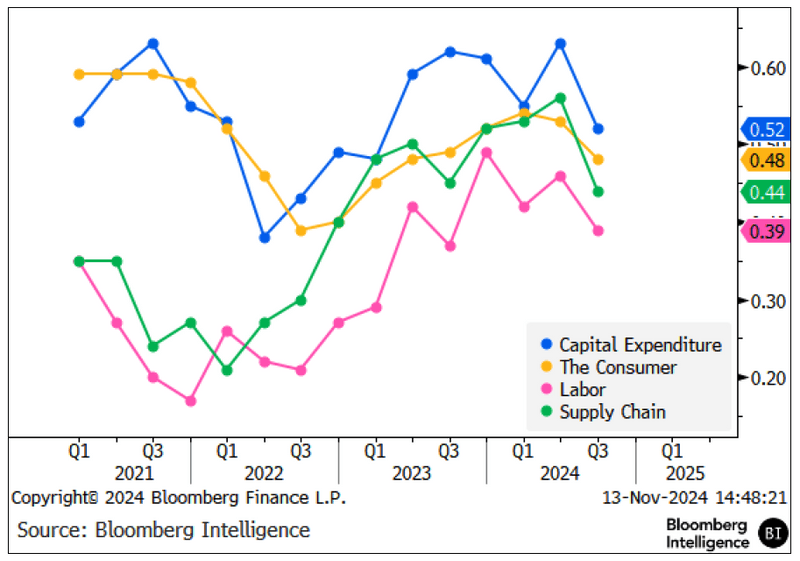
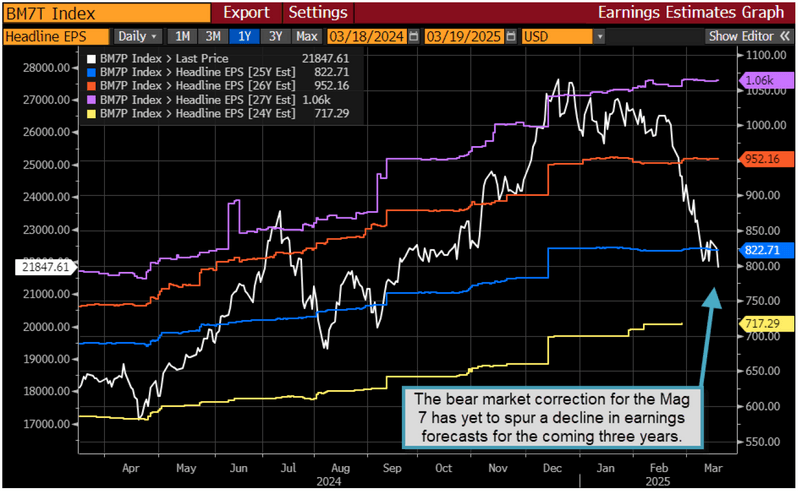
 Last night, Goldman’s David Kostin got more cautious:


